Share This Article
No items found.


Workplace friction is any force that slows, blocks, or degrades work, from unclear processes and misaligned tools to poor communication and scheduling conflicts. It costs U.S. businesses an estimated $1.8 trillion annually in lost productivity. Left unaddressed, friction drives disengagement, inflates real estate and operational costs, and accelerates turnover. The good news: most friction is diagnosable, measurable, and fixable with the right framework and tools.
Workplace friction is any structural, interpersonal, or operational force that increases the time, effort, or cost required to complete work, far broader than interpersonal conflict alone.
The category includes redundant approval chains, disconnected software tools, unclear ownership of decisions, and inconsistent office experiences. According to Stanford Graduate School of Business research on workplace friction, Stanford professor Robert Sutton defines friction as "putting obstacles in front of people that slow them down, that make their jobs more difficult" [2], a definition that spans process design, technology, and management behavior alike.
"The goal isn't a frictionless organization. It's an organization where friction is used wisely — where you make the right things easier and the wrong things harder." — Robert Sutton, Professor, Stanford Graduate School of Business
The business cost is measurable and large. Gallup's research links active disengagement, a direct output of unresolved workplace friction, to $8.8 trillion in lost global productivity annually. That figure reflects absenteeism, reduced output, and turnover costs that accumulate when employees repeatedly hit walls in their daily work.
Friction also compounds. A single broken process, say, a desk-booking system that fails to show real-time availability, doesn't just waste five minutes. It suppresses office attendance, reduces team co-presence, and distorts the utilization data that corporate real estate leaders rely on to make portfolio decisions. One friction point creates downstream effects across attendance, collaboration, and space cost simultaneously.
Hybrid and distributed work amplifies this dynamic. Coordination overhead, time zone gaps, and inconsistent in-office experiences multiply the baseline friction that exists in any organization. When employees can't reliably predict whether the office will be worth the commute, friction becomes a structural deterrent to showing up at all.
Not all friction should be eliminated. Sutton and his Stanford colleague Huggy Rao draw a clear distinction in their research [2]: constructive debate, rigorous peer review, and deliberate decision gates add friction that improves outcomes. This is healthy tension, it slows the right things down.
Destructive friction is different. Redundant approvals that don't add oversight, tool sprawl that forces employees to re-enter the same data in three systems, and unclear ownership that stalls decisions, these slow the wrong things down [3]. The goal isn't a frictionless workplace; it's a workplace where friction is applied intentionally, not accidentally.
"Friction is not inherently bad. The problem is when organizations accumulate friction accidentally rather than deploying it deliberately." — Huggy Rao, Professor of Organizational Behavior, Stanford Graduate School of Business
The five highest-frequency sources of workplace friction are tool sprawl, unclear decision rights, meeting overload, poor space coordination, and inconsistent management practices.
Qatalog research found that the average knowledge worker switches between apps 1,200 times per day, each context switch adds cognitive load and delays output. Unclear decision rights compound the problem: when employees don't know who can approve what, work stalls at every handoff.
Meeting overload is the most visible friction source. Calendars packed with status updates and alignment calls leave little time for focused work, and the meetings themselves often exist because communication channels are broken. According to Forbes reporting on workplace friction, distinguishing productive tension from destructive drag is the critical first step leaders must take before any intervention.
Hybrid and remote setups introduce three friction types that office-only environments largely avoid: scheduling inequity, proximity bias, and the coordination tax of asynchronous work.
Scheduling inequity occurs when in-office employees get spontaneous access to decision-makers while remote colleagues wait hours for an async reply. That gap compounds into proximity bias, managers rate in-office employees higher on performance reviews, not because they produce more, but because they're visible.
The coordination tax is the hidden cost of asynchronous work: more documentation, more follow-up, more time spent confirming that distributed team members are aligned. When teams also can't predict who will be in the office on a given day, attendance drops and real estate spend goes to waste on empty desks. Upflex's UnifyAI engine addresses exactly this gap, forecasting office attendance with 97% accuracy so teams can coordinate in-person days without the guesswork.
Micromanagement and unclear communication are the two management behaviors that generate the most organizational friction [2].
Micromanagement creates approval bottlenecks: every decision routes through one person, slowing execution and signaling to employees that their judgment isn't trusted. Unclear communication forces rework, when instructions are ambiguous, teams complete tasks and then redo them after the actual requirement surfaces.
Friction sources rarely appear in isolation [3]. Tool sprawl, proximity bias, and approval bottlenecks typically coexist, feeding each other. Treating one without diagnosing the full system produces temporary relief at best, which is why structured diagnosis matters before any intervention.
"When managers hoard decisions and create unnecessary approval layers, they don't just slow things down — they signal to employees that their judgment isn't trusted, which is one of the most corrosive forms of workplace friction there is." — Adam Grant, Organizational Psychologist and Professor, Wharton School of the University of Pennsylvania

Diagnosing workplace friction requires three inputs: workflow maps, utilization data, and direct employee feedback, each one exposing what the others miss.
Start by mapping workflows end-to-end. Trace every handoff in a core process, a budget approval, a project kickoff, a new hire onboarding, and mark where work sits idle between steps. Handoff delays longer than 24 hours are a reliable signal of structural friction [2].
Second, run a friction audit. Combine pulse survey data (ask employees to rate how often bureaucratic obstacles slow their work) with time-tracking data that shows hours spent on rework or re-approval cycles. The gap between time invested and output produced is where friction lives.
Third, cross-reference space utilization data against stated capacity. Badge swipe records, desk booking logs, and meeting room occupancy sensors give you a fast proxy: if booked desks sit empty more than 30% of the time, coordination friction is the likely culprit, not employee disengagement. Upflex's UnifyAI engine surfaces exactly this pattern, flagging attendance forecasting gaps that explain why reserved space goes unused.
Add a qualitative layer with structured "friction interviews", 30-minute conversations with team leads built around one question: "What slows your team down most before noon on a Monday?" Quantitative data tells you where friction accumulates; these interviews tell you why [3].
Leadership responds to four numbers: cost-per-seat versus actual utilization rate, average meeting-to-output ratio, eNPS trend over rolling quarters, and hours lost to rework or re-approval cycles per project.
The measurement trap most organizations fall into is tracking inputs, hours worked, meetings held, emails sent, rather than outputs like decisions made or projects shipped. Input metrics mask friction; output metrics expose it [2].
Reducing workplace friction follows a five-step sequence: prioritize by impact, eliminate redundant handoffs, standardize communication, redesign space processes, then measure at 60 and 90 days.
Consider a 500-person hybrid company whose employees reported that desk booking was their single biggest daily obstacle. The company ran three separate approval steps to reserve a workspace, had no visibility into who else would be in on a given day, and saw voluntary office attendance plateau at under 40%.
After consolidating booking into one platform, with AI-driven attendance forecasting replacing manual coordination, voluntary attendance rose 22% within one quarter. Real estate spend fell 15% as utilization data revealed two underused floors that could be consolidated. The compounding effect: when employees could predict who would be in and reliably book the right desk, attendance became self-reinforcing rather than a daily gamble.
Upflex's UnifyAI engine produces exactly this kind of visibility, forecasting office attendance with 97% accuracy so teams coordinate around real patterns rather than guesswork.
Not every friction point is worth fixing. Start by calculating the effort-to-impact ratio, prioritize friction that touches the most people most often, because those fixes compound fastest [2].
The change management layer matters here. Removing familiar processes, even inefficient ones, triggers resistance. Run a pilot with one team first, measure the outcome, then scale. That sequence reduces pushback because the data does the persuading.
The right tool category depends entirely on the friction type, no single platform fixes process bottlenecks, coordination gaps, and communication overload at once.
Four tool categories map to four distinct friction problems:
Point solutions, standalone room booking apps, for example, solve one problem cleanly but create a new friction layer when they don't connect to HR systems, calendar tools, or badge-access infrastructure. Integration depth is a non-negotiable evaluation criterion, not a nice-to-have.
Integrated platforms close that gap by connecting attendance forecasting, desk booking, and real estate analytics in a single system. Upflex, for instance, pairs its UnifyAI engine, which predicts office attendance with 97% accuracy, with desk booking and a global on-demand workspace network, giving corporate real estate leaders one consolidated view instead of three disconnected tools.
AI-powered attendance forecasting specifically targets the coordination friction that drives low office utilization and wasted real estate spend. When a platform can tell your team which days colleagues will be in before anyone has to ask, the friction disappears at the source rather than being managed after the fact. The Filene Research Institute's Friction Manifesto reinforces this point, arguing that organizations must design systems that actively reduce unnecessary friction rather than leaving employees to navigate it on their own.
Organization size is the clearest decision variable. Teams under 200 employees can often resolve most workplace friction through async communication improvements alone, better documentation, fewer standing meetings, and structured response norms cost little and move quickly.
Organizations with 200 or more employees running hybrid schedules need a dedicated workplace management platform. At that scale, coordination complexity exceeds what async tools or manual scheduling can handle, the number of daily attendance permutations grows faster than any team can track without software built for it.
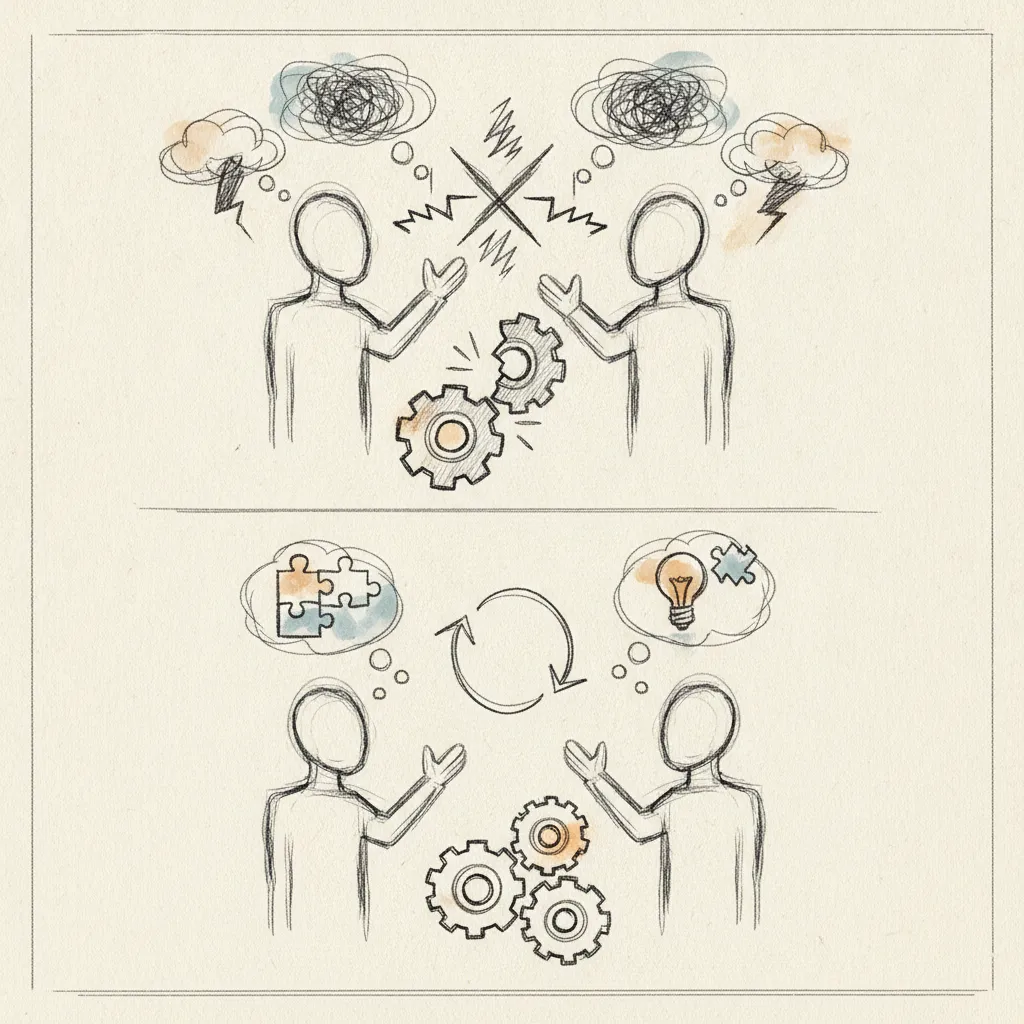
Workplace friction refers to structural obstacles, broken processes, unclear workflows, redundant approvals, that slow work down, while conflict is an interpersonal disagreement between individuals or teams. Friction is systemic; conflict is relational. A poorly designed expense approval process is friction. Two managers disputing budget ownership is conflict. Both reduce productivity, but they require different fixes: friction demands process redesign, while conflict typically calls for mediation or clearer role boundaries.
Estimates vary, but research consistently places the cost of unnecessary process friction in the thousands of dollars per employee per year in lost productive time. A 2023 report from Asana found that knowledge workers spend roughly 58% of their time on "work about work", status updates, redundant meetings, and tool-switching, rather than skilled output. For a 1,000-person organization, even a conservative estimate of two hours of friction-related waste per employee per week adds up to millions in annual salary cost.
Yes, deliberate friction that slows down high-risk or irreversible decisions is often worth keeping [2]. Stanford professor Robert Sutton calls this "good friction": a mandatory peer review before a major contract is signed, or a cooling-off step before a layoff decision is finalized [1]. The goal is not zero friction but the right friction, removing obstacles that block routine work while preserving checks that prevent costly mistakes.
Quick wins, such as eliminating a redundant approval step or consolidating three booking tools into one, can show measurable time savings within four to eight weeks. Deeper structural changes, like redesigning a cross-departmental workflow or deploying an AI-powered attendance forecasting platform, typically take one to two quarters before utilization data reflects the improvement. Setting a baseline metric before any intervention is the most reliable way to measure progress accurately.
Start by quantifying the cost of friction in terms leadership already tracks: salary hours lost to rework, real estate spend on underused space, or eNPS decline tied to process frustration. Pilot the fix with one team, measure the outcome, and let the data make the case for broader rollout. Employees are more likely to support changes when they see peers benefit first, and executives are more likely to fund initiatives backed by measurable ROI rather than qualitative complaints alone.
this approach is not a soft problem, it carries a hard cost in wasted hours, underused real estate, and teams that can't coordinate effectively. Three things are worth acting on now: audit your highest-friction processes by asking employees where they lose the most time each week; distinguish structural friction (fixable with better tools or process design) from interpersonal conflict (which needs a different response entirely); and treat physical workspace coordination as a friction source in its own right, not an afterthought.
A practical first step: pull your office utilization data for the past 90 days. If attendance is unpredictable and desks sit empty while employees struggle to find space on peak days, that gap is measurable friction with a direct fix. Request an Upflex demo to see how AI-powered attendance forecasting closes that gap with 97% accuracy.
Explore more from our content library: