Share This Article
No items found.

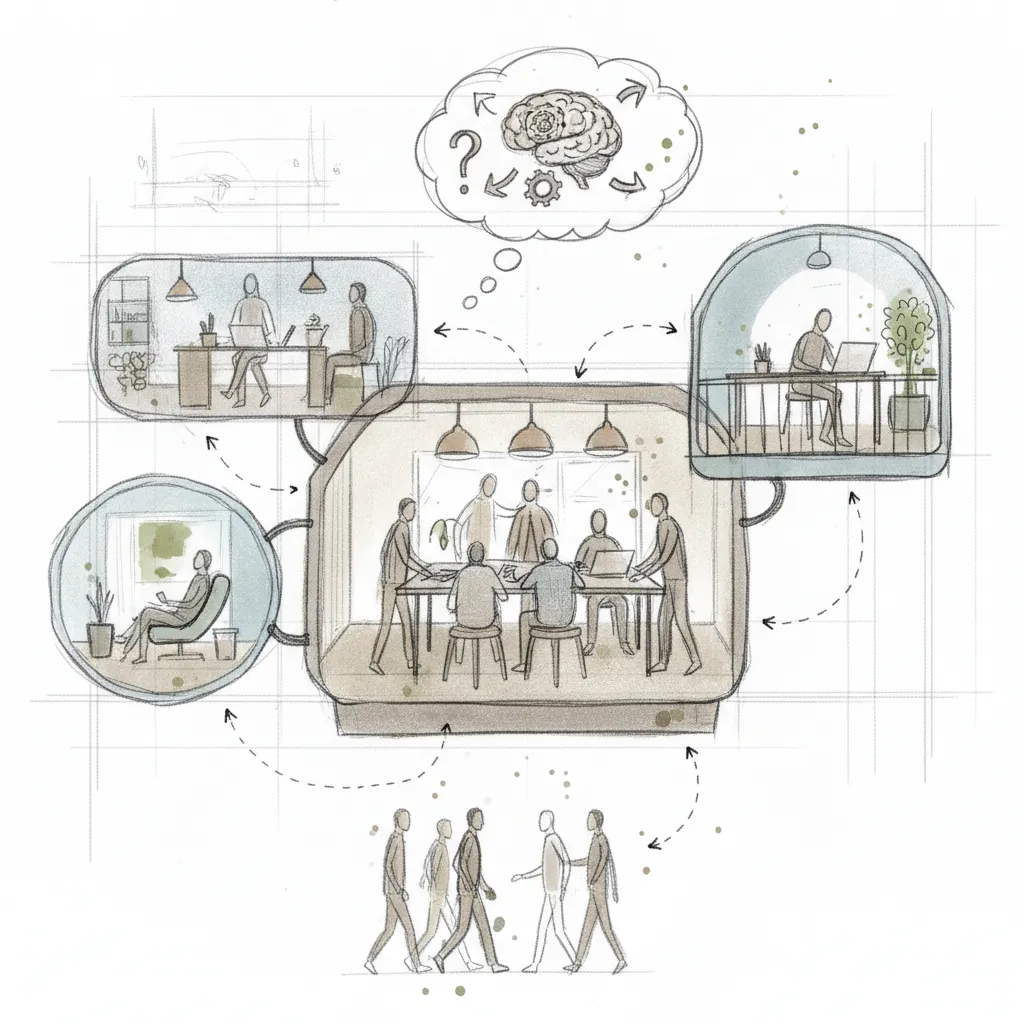
Understanding what is activity based working is essential for modern workplace strategy. Activity-based working (ABW) is a workplace model where employees choose from a range of purpose-designed spaces, focus rooms, collaboration zones, lounge areas, based on the task at hand, rather than sitting at a permanently assigned desk. No one owns a seat; the office is organized around work activities, not job titles. Companies that implement ABW well typically reduce real estate footprint by 30–40% while improving collaboration and employee autonomy.
Activity-based working is a model where employees choose from purpose-designed workspace types, focus rooms, collaboration zones, phone booths, social areas, matched to the specific task they're performing, with no permanently assigned desk. According to Wikipedia's overview of activity-based working, the concept centers on providing workers with a variety of settings that support different work activities throughout the day.
The term was coined by Dutch consultant Erik Veldhoen in the 1990s, who argued that knowledge workers perform a range of distinct activities each day and need different physical environments to support them. The model gained limited traction for two decades, then accelerated sharply after 2020 as hybrid work normalized average office occupancy of 40–60% of desks on any given day, making the economics of one-desk-per-person untenable for most large organizations.
What sets activity-based working apart is intentional design. The office is not a single open floor of identical desks. It is a portfolio of zones, each engineered for a specific work mode, supported by technology that lets employees find and book the right space before they arrive.
"Activity-based working is not about removing desks — it's about giving people the right environment for every type of work they do throughout the day." — Erik Veldhoen, Founder of Activity-Based Working and Author of The Demise of the Office
Assigned seating ties one employee to one fixed desk, regardless of whether that person spends the day on video calls, in meetings, or writing in silence. Hot-desking removes the assignment but keeps the format: employees take any available desk on a first-come basis, with little or no differentiation between spaces.
ABW goes further on both counts. It eliminates fixed assignment and replaces undifferentiated desks with distinct zones matched to distinct work modes. A deep-focus task routes an employee to a quiet room; a brainstorming session routes a team to a collaboration zone. The space type changes with the activity, that is the core principle behind what is activity-based working in practice.
Removing desks without building this zone structure is not ABW. It is simply desk reduction, and it tends to produce the employee frustration and productivity loss that critics wrongly attribute to ABW itself.
"Office peacocking" describes the trend of companies designing visually striking, amenity-rich offices, think living walls, barista bars, and branded collaboration studios, to draw hybrid employees back in voluntarily rather than through mandates.
ABW is the operational structure behind those environments. The visual appeal attracts employees; the zone design determines whether they can actually work productively once they arrive. A company that invests in striking office aesthetics without a deliberate ratio of space types, quiet zones, collaboration areas, social spaces, matched to real work patterns will see attendance spike briefly and then fall back as employees find the space doesn't support what they need to do.
Platforms like Upflex use attendance forecasting and utilization data to help organizations calibrate that ratio over time, ensuring the space mix reflects how teams actually work rather than how designers imagined they would.
Activity-based working cuts real estate costs, improves focus, and boosts employee experience, but it fails without the right physical design, technology, and cultural groundwork.
"The evidence is clear: when employees have genuine choice over where and how they work within an office, both their experience and their output improve measurably." — Tim Oldman, CEO and Founder at Leesman, global workplace experience research firm
The headline benefit is straightforward: organizations typically find 40–60% of desks sit empty on any given day. ABW lets you right-size desk inventory to actual occupancy, which translates directly into a 30–40% reduction in real estate spend. For a global enterprise carrying office space as a top-three cost line, that's a material portfolio decision, not a workplace design preference.
Productivity data supports the model too. Microsoft's 2023 Work Trend Index found employees in flexible, activity-matched environments reported higher focus scores than those in traditional assigned-desk layouts. According to Advanced Workplace Associates (AWA), a leading workplace strategy consultancy, ABW offices consistently score 10–15 points higher on employee experience indices compared to conventional offices [2]. Employees who can choose a quiet focus booth for deep work and a collaborative lounge for team sessions report doing both better.
The challenges are just as real. Removing personal territory triggers genuine psychological discomfort, people lose their anchor point and their sense of belonging. Without lockers for personal storage, good acoustic zoning, and reliable desk booking technology, activity-based working degrades into chaotic hot-desking where employees race for the same three desks every morning. That outcome is the opposite of what ABW is designed to achieve.
ABW is a poor fit for roles tied to specialized fixed equipment, labs, trading floors, and manufacturing lines cannot rotate through shared zones. Teams with high confidentiality requirements, such as legal or HR functions handling sensitive casework, also struggle in open, shared environments.
Organization size matters too. Companies with fewer than roughly 30 employees often find the overhead of managing distinct activity zones outweighs the space savings. The model is built for scale; below a certain headcount, a well-designed open office achieves the same flexibility with far less complexity.
The most common objection to ABW is loss of belonging, employees worry they'll lose their team and their place. The most effective counter is the team neighborhood design pattern: each team gets a defined home zone within the broader ABW framework, even without fixed desks. Team members know where to find colleagues, managers can hold stand-ups in a consistent area, and the sense of group identity stays intact.
Platforms like Upflex support this directly, its AI-powered attendance forecasting predicts which days teams plan to come in, so neighborhood zones can be pre-configured and desks pre-booked before employees arrive. That removes the morning scramble that turns ABW skeptics into ABW opponents.
Organizations that implement activity-based working correctly report 30–40% reductions in real estate costs and measurable gains in cross-team collaboration within 18 months. To fully understand what is activity based working at scale, it helps to examine how leading organizations have deployed the model and what their data shows.
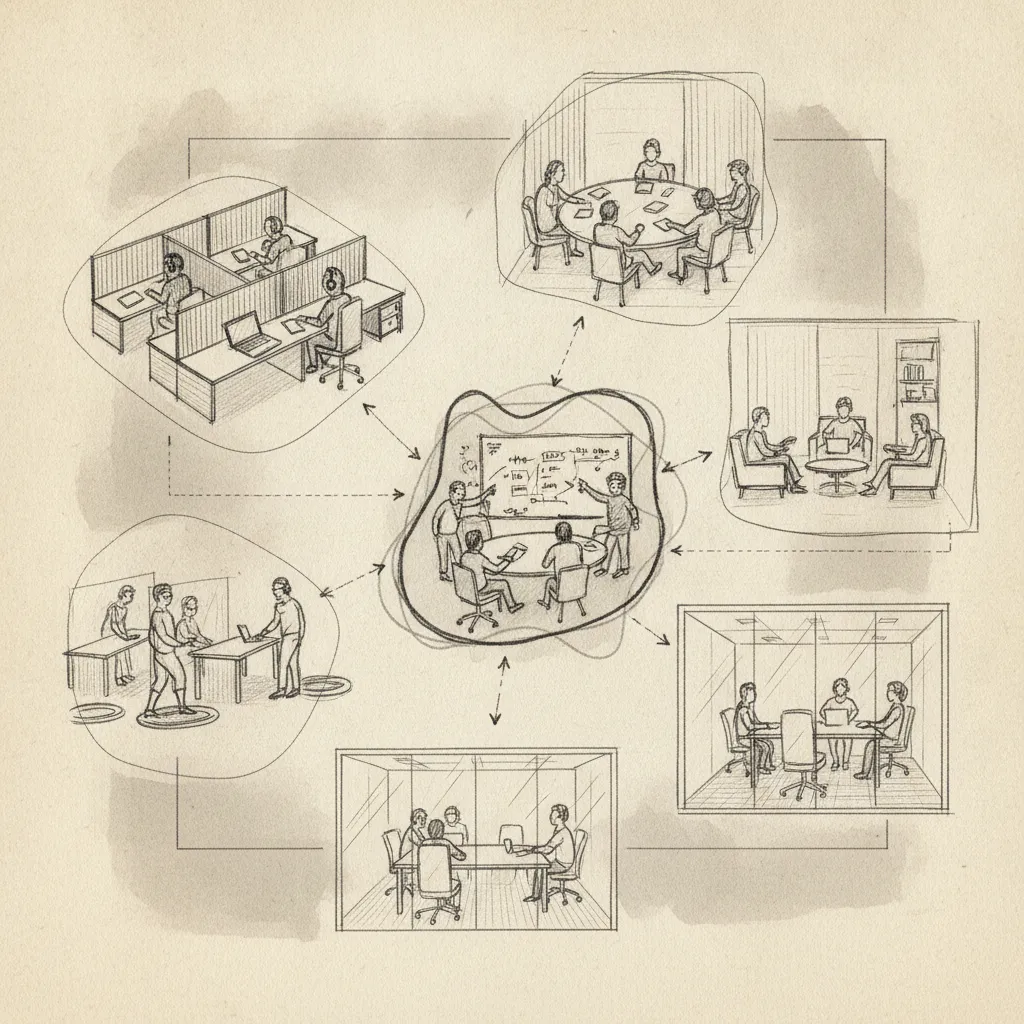
ABW is built around four distinct work modes, each requiring a different physical environment. Understanding what is activity-based working at an operational level means mapping your floor plan to these four modes, not just removing assigned desks.
Space ratios should mirror this time split. An office that allocates 60% of its floor plan to open collaboration zones but only 15% to quiet focus areas will fail the 40% of work that demands concentration, a design error with measurable consequences.
Microsoft Netherlands was among the earliest large-scale adopters, reporting a 30% reduction in real estate costs and a measurable increase in cross-team collaboration within 18 months of rollout [2]. Deloitte's Amsterdam headquarters, The Edge, is the most cited ABW benchmark: sensor data matches employees to available spaces in real time, and Deloitte reported 40% fewer square meters per employee compared to their previous office [2].
The cost case is equally direct. Traditional assigned offices in major markets run $10,000–$18,000 per desk per year. An ABW model with a 0.7 desk-to-employee ratio cuts that cost proportionally, while adding the amenity variety employees actually need to do different kinds of work.
Poor implementation produces the opposite result. A 2022 Leesman study found that employees in ABW environments without adequate quiet zones reported lower focus satisfaction than those in traditional offices [2]. Design quality, not the ABW label, determines whether outcomes improve or decline.
Platforms like Upflex support this kind of data-driven design by tracking actual space utilization across an office portfolio, giving corporate real estate teams the occupancy data they need to calibrate zone ratios before committing to a floor plan change.
Activity-based working requires a specific technology stack, booking software, occupancy sensors, and analytics dashboards, to function as an operational system rather than a design concept. As noted in the Wikipedia entry on activity-based working, technology infrastructure is a foundational enabler of the model, not an optional add-on.
Desk and room booking software is the foundation. Employees choosing spaces on the fly need to reserve desks, phone booths, or collaboration rooms in advance, or find available zones in real time. Without this infrastructure, activity-based working collapses into a daily scramble for seats. Platforms like Upflex handle this through desk booking workflows that integrate with attendance forecasting, so space availability aligns with actual team presence rather than guesswork.
Occupancy sensors, PIR motion detectors, badge readers, and Wi-Fi triangulation, feed real utilization data back to facilities teams. This is how organizations validate that their space ratios are correct and identify underused zones worth reconfiguring or consolidating.
Workplace analytics dashboards translate that raw sensor data into metrics that drive decisions: peak occupancy by zone, average desk utilization rate, and collaboration space demand versus supply. These numbers tell you whether your ABW layout is actually working.
For hybrid teams, the technology layer must extend beyond the building. Co-attendance coordination tools, showing which teammates plan to come in on a given day, are critical to making ABW feel worthwhile rather than isolating. Upflex's UnifyAI engine forecasts attendance with 97% accuracy, giving teams a concrete reason to coordinate their in-office days.
Mobile-first access ties it together. QR-code check-in, wayfinding maps, and instant availability views reduce the daily friction that kills ABW adoption before it starts.
A successful ABW transition follows four sequential steps: utilization audit, space design, pilot, and phased rollout, skipping any one step raises the failure rate significantly. Organizations that want to understand what is activity based working in implementation terms should treat this sequence as non-negotiable.
Badge data and occupancy sensors typically reveal that 40–60% of desks sit empty even on peak days. That baseline number is your business case, and it sets your target desk ratio, which most organizations land between 0.6 and 0.8 desks per employee once they make the switch.
Without this data, any space redesign is guesswork. With it, you can defend every square footage decision to your CFO. Upflex's utilization reporting gives corporate real estate teams exactly this kind of attendance baseline, drawn from real booking and forecasting data rather than assumptions.
Survey employees on how they split a typical week across focus work, collaboration, social interaction, and learning. Then translate those percentages directly into square footage allocation, if 45% of time is spent on focused individual work, roughly 45% of your floor plate should support it.
This is where understanding what activity based working actually means in practice pays off: the space must reflect real behavior, not an idealized version of it. According to AWA's workplace strategy research, organizations that skip the behavioral audit phase and design based on assumptions consistently underperform on both utilization and employee satisfaction metrics.
Choose a willing team, give them the new environment for 90 days, and measure booking behavior, space preferences, and friction points. The pilot generates real data, and real advocates who can speak credibly to skeptical colleagues during the full rollout.
Change management is the most common failure point in ABW implementations [2]. Employees who feel the change is being done to them, rather than for them, will resist it loudly and persistently.
Communicate the employee benefit first: more variety in where and how they work, better tools, and fewer days commuting only to sit on a video call in an open-plan office. Cost savings are a leadership metric, not a motivation for the people being asked to give up their assigned desk.
"The organizations that succeed with activity-based working invest as much in the human transition as they do in the physical redesign. Culture change and space change must happen in parallel." — Dr. Peggie Rothe, Chief Insights Officer at Leesman, workplace experience research organization
Set four metrics upfront: desk utilization rate, employee experience score (the Leesman index is the industry standard), real estate cost per head, and collaboration space booking rates. Review all four at 30, 90, and 180 days post-launch, and adjust space ratios based on what the data shows, not what the original plan assumed.
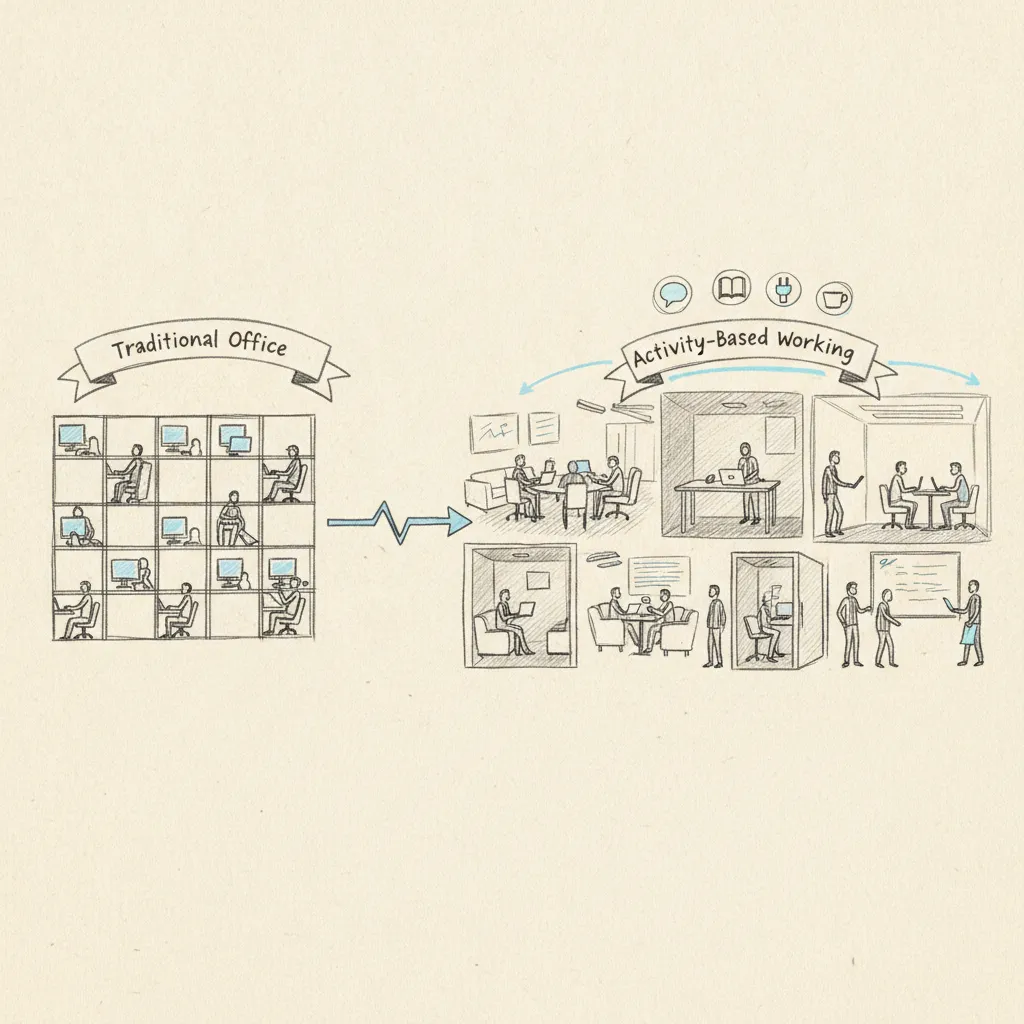
Activity-based working is not the same as remote or hybrid work, it is a specific office design and management strategy, not a location policy. Hybrid work determines where employees work (home, office, or a third space). Activity-based working determines how the office itself is organized once employees arrive, giving them a range of settings, focus rooms, collaboration zones, social areas, matched to the task at hand rather than assigning them a fixed desk.
Most organizations implementing activity-based working target a desk-to-employee ratio between 0.6:1 and 0.8:1, meaning roughly 6 to 8 desks per 10 employees. The right ratio depends on your actual attendance patterns. Organizations with reliable attendance data, through tools like Upflex's UnifyAI, which forecasts office attendance with 97% accuracy, can size their desk inventory precisely rather than defaulting to conservative estimates that leave space underused and costs high.
A common starting ratio is 60% focus-oriented spaces to 40% collaboration zones, though this varies significantly by industry and team type. Knowledge-intensive teams, legal, finance, engineering, often need more quiet focus space, while creative or sales teams may flip that ratio. The most effective approach is to audit how your teams actually spend their time before committing to a layout, then adjust the ratio after 90 days of occupancy data.
A full activity-based working rollout typically takes 12 to 24 months from strategy to settled adoption. Physical redesign, technology deployment, and change management each add time. Pilot programs in a single floor or business unit, the approach most consultants recommend, can compress early learning cycles to 3 to 6 months and reduce the risk of a costly organization-wide misstep before the model is validated.
What is activity based working most compatible with? Organizations that already embrace autonomy, trust, and output-based performance management tend to see the strongest results. ABW requires employees to self-direct their environment choices throughout the day, which works best in cultures where managers evaluate results rather than presence. Companies with highly hierarchical or surveillance-oriented cultures often struggle with ABW adoption because the model fundamentally redistributes control over how and where work happens.
Activity-based working is a deliberate bet: trade assigned desks for a portfolio of purpose-built spaces, and both productivity and real estate efficiency improve, but only if attendance data, space design, and change management move together. The organizations that fail treat it as a furniture project. The ones that succeed treat it as an operational model that requires ongoing measurement.
Three concrete actions follow from that: audit how your teams actually spend time before redesigning a single square foot; set a target desk-to-employee ratio grounded in real attendance data rather than assumption; and build a feedback loop that adjusts space allocation every quarter as work patterns shift.
If attendance forecasting is the gap holding your real estate decisions back, request a data walkthrough from Upflex, bring your current utilization numbers and see what a 97% accurate forecast would change about your next lease decision.
Explore more from our content library: