Share This Article
No items found.

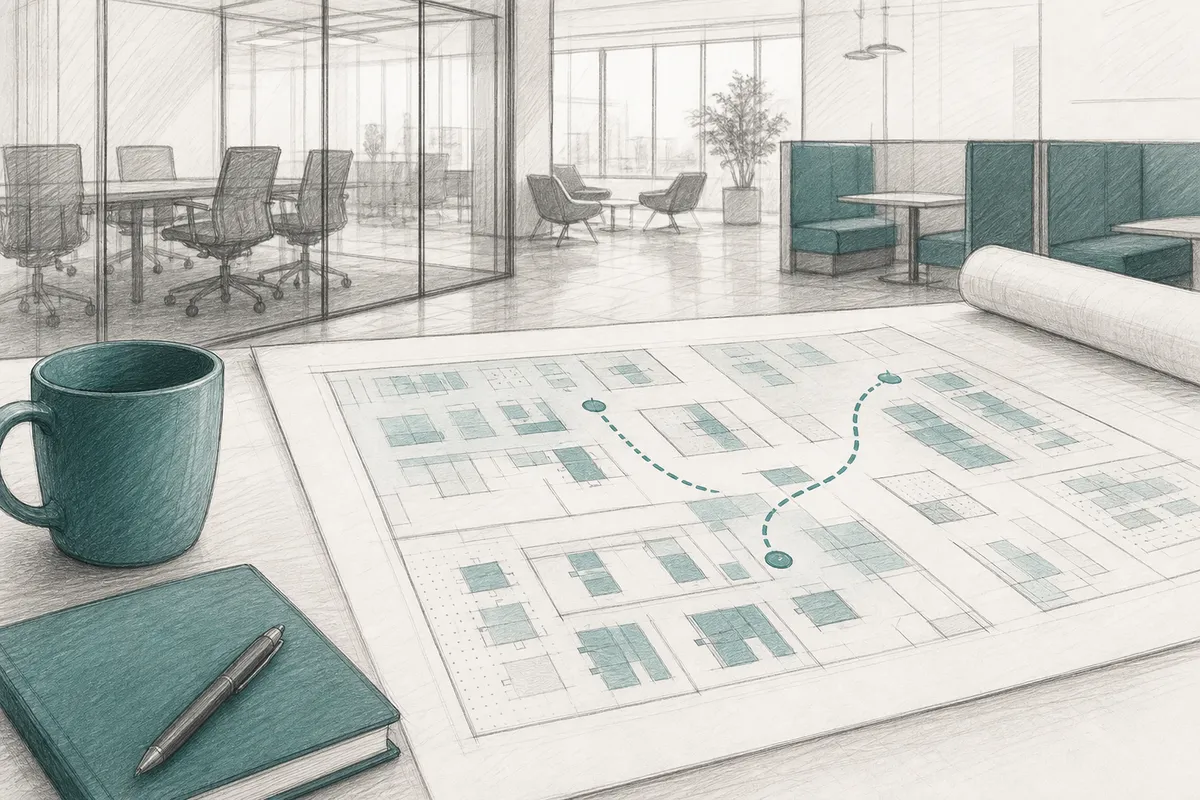
Understanding predictive capacity planning is essential. Predictive workplace capacity planning uses AI to forecast office space utilization and occupancy patterns before they happen, so real estate teams can right-size their portfolio instead of guessing. Machine learning models analyze badge swipes, calendar data, Wi-Fi connections, and booking history to predict how many people will show up, when, and where, days or weeks in advance. Instead of reacting to a lease renewal deadline with incomplete data, teams get a continuous, forward-looking view of demand. That view turns into decisions: consolidate underused floors, renegotiate leases with confidence, or reallocate square footage to the teams that actually need it, maximizing space ROI rather than paying for empty desks. For a broader overview of the discipline this builds on, IBM's introduction to capacity planning lays out the foundational concepts.
AI models pull structured signal from five workplace data streams, then learn the recurring patterns hidden inside them to project future occupancy instead of just reporting past attendance. This is particularly relevant for predictive capacity planning.
This approach starts with raw operational exhaust most companies already generate but rarely unify. The main signal sources include:
None of these signals alone is reliable. Badge data misses no-shows on booked desks; calendar data misses walk-ins. A forecasting engine like Upflex's UnifyAI blends all five so the prediction reflects what people actually do, not just what one system claims. This time-series approach to blending multiple signals is explored further in Algomox's overview of forecasting techniques.
Instead of averaging last quarter's attendance, machine learning models detect structure: which days a sales team clusters in-office, how a finance department's attendance dips during close week, or how an engineering org's hybrid rhythm shifts after a policy change. That pattern recognition is what separates forecasting from reporting.
The practical payoff is timing. A lease renewal deadline used to force a binary call, renew or exit, based on incomplete, backward-looking data. This method instead gives teams a rolling 30-to-90-day demand view, so square footage decisions get made before costs lock in, not after.
Accuracy compounds as more signal sources and more historical cycles feed the model. But that forecast isn't a one-time report, hybrid schedules shift constantly, so the model needs continuous refreshing to stay useful.
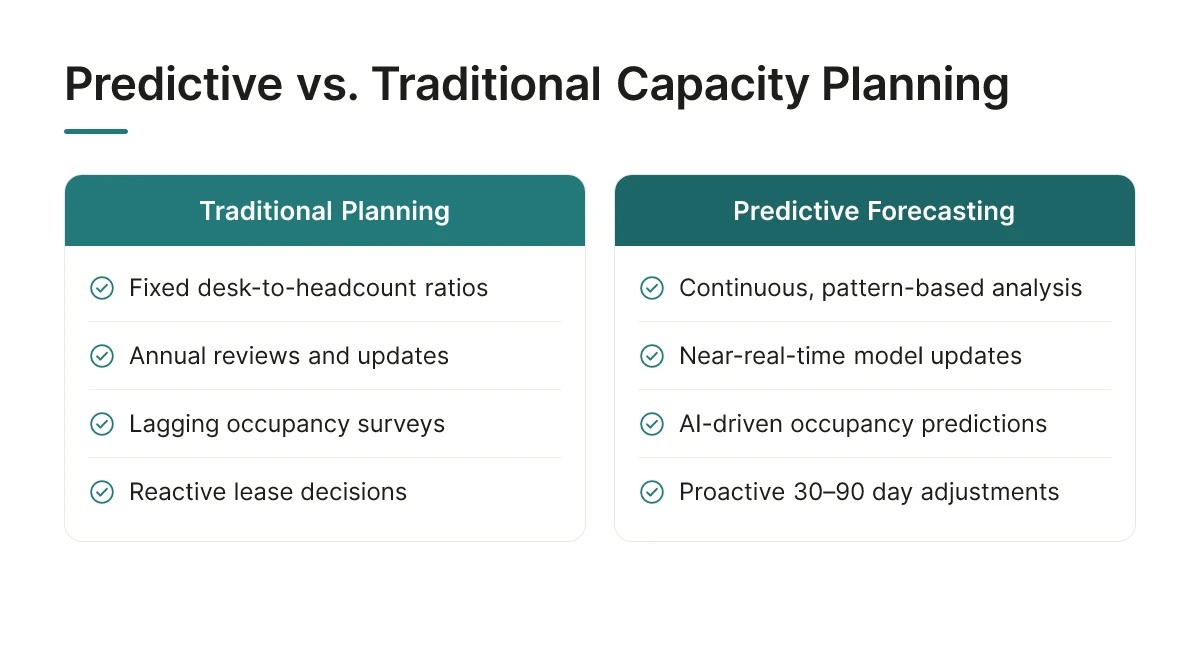
Traditional capacity planning fixes a desk-to-headcount ratio once a year; predictive capacity planning recalculates occupancy patterns continuously as attendance data changes.
The old model was built for a world where employees showed up five days a week, every week. Real estate teams counted headcount, applied a ratio, often 1:1 or 1:1.2 desks per employee, and locked that number into a lease term or floor plan for years. Occupancy surveys, when they happened, measured what already occurred rather than what was coming. That's a lagging indicator dressed up as planning.
Ratio-based math assumes a stable constant, and hybrid work removed that constant entirely. When attendance swings from 30% on a Monday to 80% on a Wednesday, a fixed desk-per-employee formula has no way to represent either day accurately. The result is chronic over-provisioning on quiet days and desk shortages on peak days, often in the same building, the same week. Static annual reviews can't catch a shift that happens month to month as teams change their in-office norms. When considering predictive capacity planning, this point stands out.
Predictive models fail in specific, recognizable ways, including:
Implementing this approach works best as a phased rollout, audit your data, pilot on one building, then expand once the forecast proves itself against real attendance.
A practical rollout typically follows three stages:
A forecast only earns trust once you build a feedback loop around it, every gap between predicted and actual attendance gets fed back into the model so accuracy improves over time. Upflex's UnifyAI engine is built around this loop, forecasting attendance at 97% accuracy by continuously reconciling predictions against booking and check-in data.
The next stage is closed-loop operation: alerts that trigger automatically when forecasted demand shifts, prompting space reallocation or a booking policy change without waiting for a facilities manager to spot the pattern manually. That's the difference between a static report and a system that acts on what it sees.
None of this works without alignment first. Facilities, HR, and finance need a shared definition of "right-sizing", square footage cut, cost per seat, or co-attendance targets, before anyone acts on a forecast. And execution should be staged: consolidate a floor before terminating a lease, so early forecasting misses don't turn into a real estate commitment you can't undo.
Five metrics prove this approach works: forecast accuracy, space utilization rate, cost per occupied seat, lease decisions avoided, and vacancy trend. For those exploring predictive capacity planning, this matters.
Forecast accuracy compares predicted attendance against what actually happened, and it's the metric that validates all the others. If your model consistently misses attendance by a wide margin, every downstream decision, consolidation, lease renegotiation, desk ratios, rests on shaky ground. This is why Upflex reports UnifyAI's forecast accuracy openly at 97%: a real estate leader can't justify cutting square footage on a forecast nobody has stress-tested.
Space utilization rate and vacancy trend work together to build the case for consolidation. A floor that sits underused for months, not just on a slow Friday, signals that its lease and operating costs, not just its lighting and cleaning bills, are candidates for removal. That distinction matters: usage-based savings are marginal, but eliminating an entire floor or building from the portfolio removes fixed costs entirely.
Expect savings to scale with rollout scope, a single-building pilot proves the model, while an enterprise-wide deployment compounds savings across a full portfolio.
A budget-friendly pilot in one region validates forecast accuracy and utilization patterns before you commit to lease decisions. An enterprise-wide rollout applies those same mechanics across every office, which is where cost-per-occupied-seat improvements and co-attendance gains, Upflex customers track toward an 88% co-attendance benchmark, turn into portfolio-level real estate reductions.
A SaaS company with flexible hybrid schedules needs shorter, rolling forecast windows than a manufacturer running fixed shift patterns. Tech firms see attendance swing week to week around meetings and team days, so weekly forecasting catches real signal. Manufacturing and e-commerce operations with fixed on-site shifts already know headcount in advance; their capacity planning focus shifts toward shift-based space allocation and seasonal peak handling rather than day-to-day attendance prediction.
The right platform connects three things: data breadth, forecast frequency, and the ability to act on what it predicts, not just display it.
Start with data integrations. A forecasting engine is only as good as what feeds it, badge swipe data, calendar invites, desk booking history, and HR system records all carry signal about who's actually coming in and when. A vendor that only ingests one or two of these will miss patterns that a broader pipeline catches, especially in organizations where teams book desks inconsistently or skip badging in. This directly impacts predictive capacity planning outcomes.
Refresh frequency matters just as much. A model that recalculates weekly can't catch a shift caused by a new hybrid policy rolled out mid-quarter. Ask vendors how often forecasts update and what triggers a recalculation.
Finally, ask whether the tool recommends action or just reports numbers. A utilization percentage on a dashboard tells you what happened. A recommendation to consolidate a floor, rebook a team, or release surplus square footage tells you what to do next.
A pure analytics or BI tool stops at the report, someone still has to interpret the chart, build a business case, and manually trigger a change. A workplace optimization platform closes that loop: forecast, alert, act, re-measure, on a continuous cycle rather than a quarterly review.
That distinction compounds over time. A static dashboard requires the same manual analysis every cycle. A closed-loop system gets sharper as it accumulates data on what actions actually shifted attendance and utilization.
Vendor fit depends on company size, how complex your hybrid policy is, and what data infrastructure already exists, not on a generic feature checklist. A 2,000-person company with one hybrid policy needs less than a global enterprise running different attendance rules across 40 offices.
Upflex fits this closed-loop model directly: its UnifyAI engine forecasts attendance at 97% accuracy, then coordinates desk booking and on-demand workspace access so real estate teams act on the forecast, right-sizing owned space while giving employees flexible workspace elsewhere, instead of just reading about it.
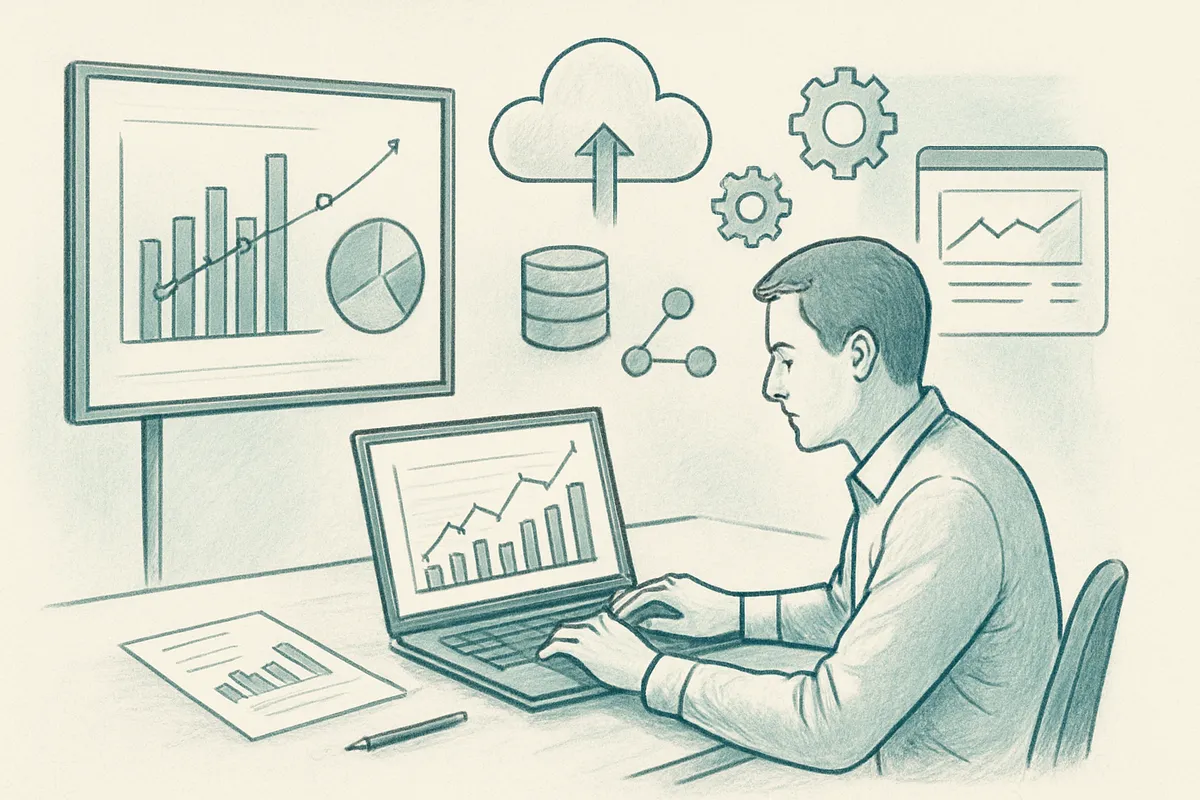
Most platforms forecast reliably 1 to 4 weeks out, with directional trends visible several months ahead. Upflex's UnifyAI engine forecasts attendance at 97% accuracy by combining booking patterns, calendar signals, and historical trends, which gives real estate and workplace teams enough lead time to adjust staffing, cleaning schedules, and floor plans before a low- or high-attendance week hits. This is particularly relevant for predictive capacity planning.
A useful forecast can start with a few months of badge, booking, or calendar data, you don't need years of history. Accuracy improves as the model observes more cycles, including holidays and seasonal dips, but early forecasts are still far more reliable than manual estimates or gut-feel scheduling decisions.
It works for a single office as well as a global portfolio spanning dozens of sites. A single-office deployment forecasts attendance and desk demand for that location alone, while multi-site enterprises use the same underlying data to compare utilization across offices and prioritize which leases to renew, shrink, or exit.
Forecasts should refresh continuously, ideally daily, as new booking and calendar data arrives. Weekly or monthly refreshes miss short-term shifts like a canceled offsite or a new hybrid policy, so real-time updating keeps space planning and co-attendance tracking accurate.
Facilities, HR, and finance each bring a different lens: facilities focuses on floor plans and lease terms, HR tracks headcount and policy changes, and finance evaluates cost per seat. Involving all three early prevents a forecast from being acted on in isolation, which is often where consolidation plans stall or get reversed later.
Predictive capacity planning turns office decisions from guesswork into a data-backed process. The organizations getting the most out of it share three habits: they forecast attendance before cutting space, they track co-attendance so consolidation doesn't wreck team collaboration, and they pair owned offices with on-demand workspace for overflow rather than over-leasing for peak days.
Upflex customers use this approach to cut real estate spend by 40%+ while hitting 88% co-attendance achievement. If you're facing a lease renewal in the next two quarters, start by pulling six months of badge or booking data and running it against your current footprint before you sign anything new.
Explore more from our content library: