Share This Article
No items found.

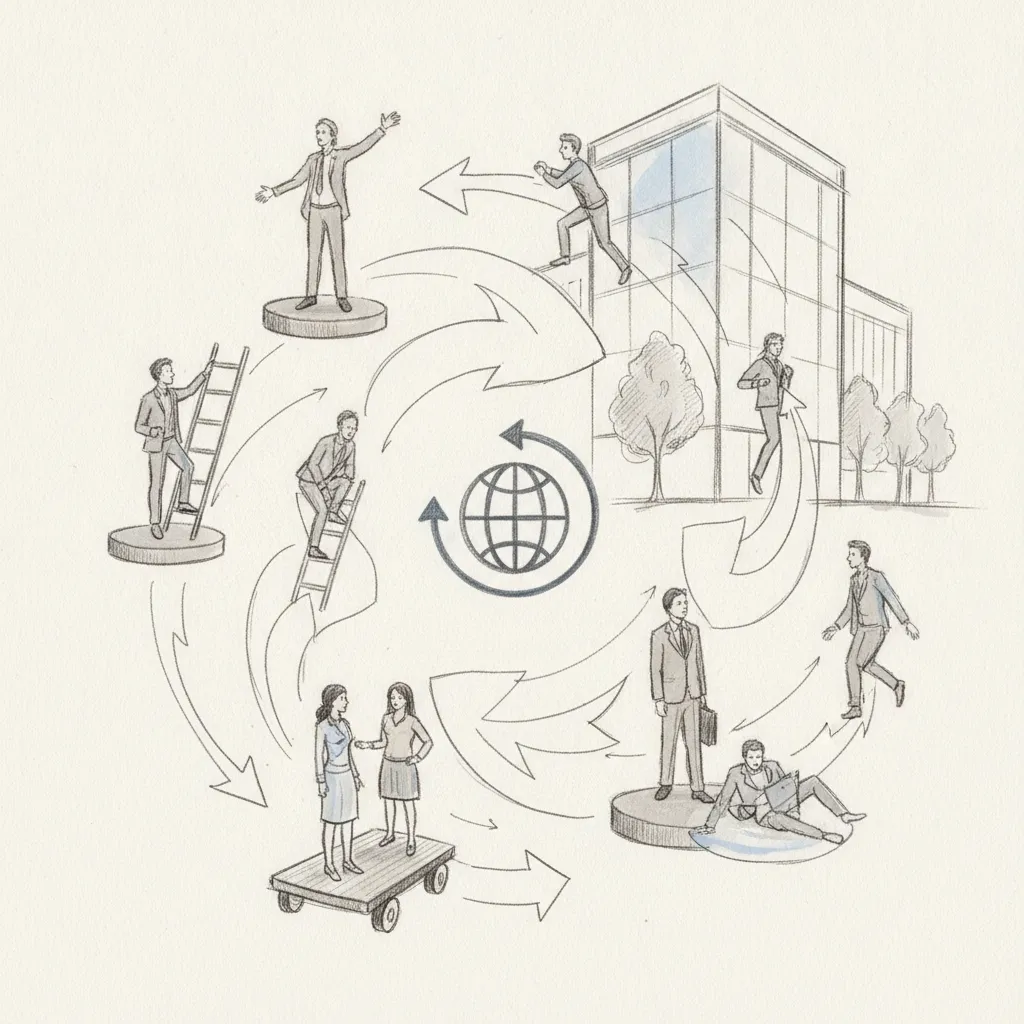
Employee mobility management is the structured practice of moving talent across roles, teams, locations, or work arrangements within an organization, rather than defaulting to external hiring. Companies with mature internal mobility programs fill open roles 2x faster, reduce regrettable attrition by up to 30%, and cut cost-per-hire by 40–60% compared to external recruitment. The discipline spans policy design, manager enablement, compliance, and the technology platforms that connect employees to opportunities before those employees start looking elsewhere.
Employee mobility management is the deliberate, policy-driven process of deploying existing talent across roles, geographies, or work arrangements, before reaching for an external hire.
That distinction carries real financial weight. External hires cost 1.7x more than internal moves, according to SHRM (Society for Human Resource Management), and take two to three times longer to reach full productivity. Every open role filled from outside the organization is a compounding cost: recruiter fees, onboarding time, and a longer ramp before the person contributes at full capacity.
Retention is the other side of the equation. LinkedIn's 2023 Workplace Learning Report found employees stay twice as long at companies with strong internal mobility cultures. When people see a path forward inside the organization, they stop looking outside it.
Traditional recruitment treats every open role as a market problem, source, screen, hire, onboard. Employee mobility management treats it as a talent allocation problem first, with external hiring as the fallback, not the default.
The scope of mobility management is broader than most HR teams initially assume. It covers lateral moves, promotions, project-based assignments, geographic relocations, and hybrid or remote work transitions. A senior analyst shifting to a cross-functional product team counts. So does a regional manager taking a six-month assignment in a new market.
The business case sharpened after 2022. Hiring slowdowns and budget pressure pushed finance and HR leaders to extract more value from existing headcount rather than grow it. Internal mobility shifted from an HR aspiration to a cost-control lever, one that reduces cost-per-hire, preserves institutional knowledge, and keeps high performers engaged without adding headcount.
For organizations managing distributed or hybrid teams, that lever is harder to pull without visibility into where talent sits and when people are actually present and available. That's where the operational side of mobility management, scheduling, space, and workforce data, starts to intersect with the strategic side.
Employee mobility management spans five distinct movement types, each requiring different policy rules, compliance checks, and manager obligations to work in practice.
The five categories are: vertical (promotion to a higher-level role), lateral (same-level role change in a different function), geographic (domestic relocation or international assignment), project-based (temporary cross-functional deployment), and flexible/hybrid (a shift in work arrangement, such as moving from office-based to fully remote). Treating these as a single category in policy design is where most programs break down.
Policy requirements differ sharply by type. A lateral move may require only manager notification and an updated job description. A geographic move triggers tax nexus obligations, immigration compliance, and benefits re-enrollment, obligations that a lateral transfer never touches. Project-based deployments need defined end dates and home-team return rights to prevent employees from falling into organizational limbo.
Every mobility policy, regardless of type, must address four non-negotiable elements: eligibility criteria (a common benchmark is a minimum of 12 months in the current role), a formal application process, manager notification rules with defined response windows, and transition timelines that protect both the sending and receiving teams.
The notification rules matter more than most HR teams expect. A policy that lets employees apply internally but allows managers to block moves indefinitely creates a talent hoarding dynamic [1], where high performers stay trapped in teams because their managers refuse to release them. That single design flaw can invalidate an otherwise well-constructed program.
Mobility rights and constraints differ materially across employee groups. Exempt employees typically have more flexibility to shift roles without triggering wage-and-hour recalculations; non-exempt employees moving to different locations or schedules may face overtime reclassification. Contractors generally fall outside internal mobility programs entirely, though some organizations create conversion pathways for long-tenure contractors moving into FTE roles.
Remote-first workers present a distinct challenge: a geographic move that looks invisible on paper, an employee relocating from Texas to New York while keeping the same remote role, can still create payroll tax and benefits compliance obligations the policy must address explicitly. According to the U.S. Department of Labor, employers must ensure wage-and-hour compliance is re-evaluated any time an employee's work location changes across state lines.
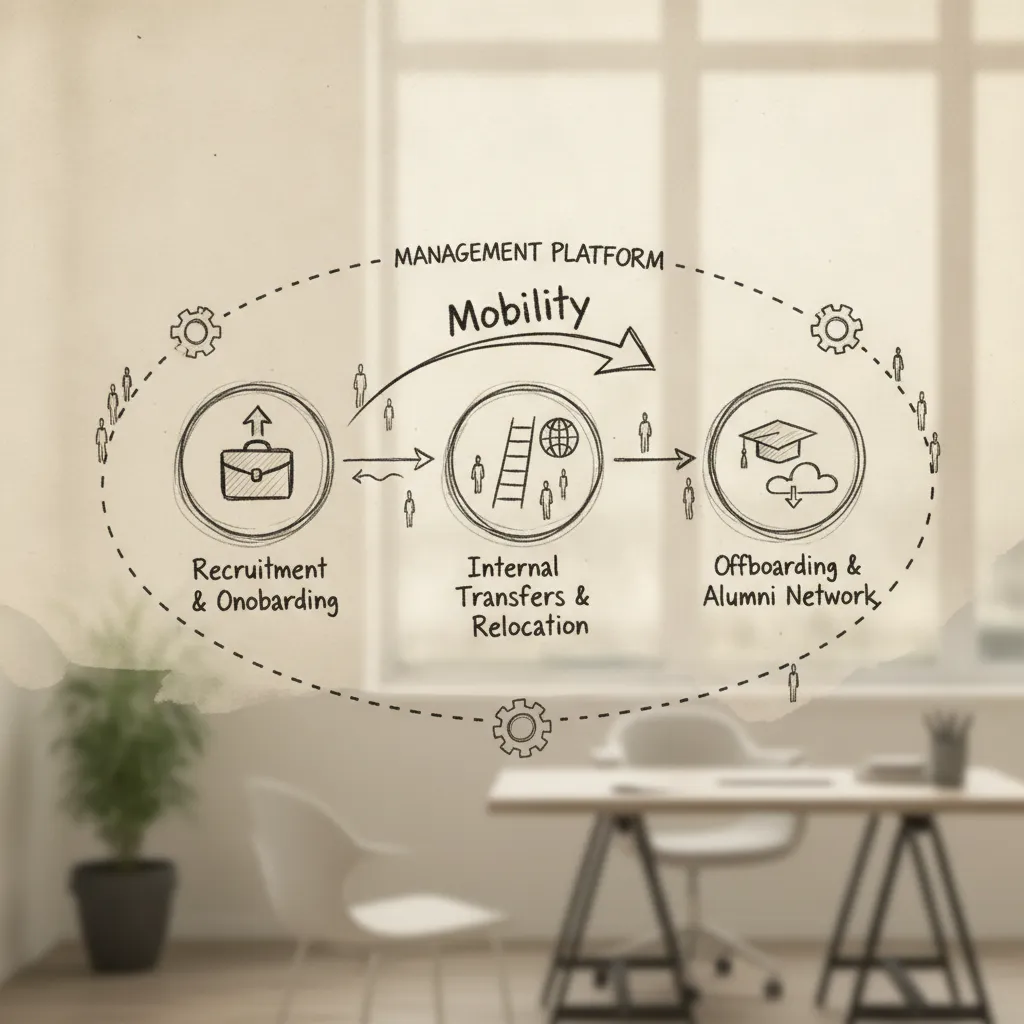
An effective internal mobility program launches in five steps, solves the manager resistance problem structurally, and routes cross-border moves through HR and legal before employees transfer. For more information, see Blog.
On communication: employees should receive a written mobility opportunity summary within five business days of applying. Hiring managers must provide structured feedback within 10 days of a final decision, no exceptions, and no vague rejections.
HR professionals cite managers as the main obstacle to internal mobility in 70% of companies [1], and the reason is straightforward: when a high performer moves internally, the manager absorbs the productivity loss while another team captures the gain.
The fix is not persuasion. It is incentive redesign. Tie manager performance reviews explicitly to their team members' internal mobility success rates. A manager who develops three people who advance internally in a year should score higher on their annual review than one who retains the same team by blocking transfers.
According to research on internal mobility and manager involvement, the most effective organizations remove managerial veto power by configuring talent marketplaces so employees submit applications directly to the hiring team, with the current manager receiving only an automated notification after submission.
Pair that with a clear transition period policy: a standard 30–60 day handover window gives managers enough runway to backfill without holding the moving employee hostage to an open requisition.
"The single biggest lever organizations have for retaining top talent is making internal career paths as visible and accessible as external job markets. When employees can see opportunity inside the company, they stop looking outside it." — Josh Bersin, Global HR Industry Analyst and Founder, The Josh Bersin Company
Every cross-location move should trigger a compliance review before the transfer is confirmed, not after the employee has already relocated.
In the United States, a cross-state move creates payroll tax nexus in the new state and may change workers' compensation obligations. HR and payroll teams must update withholding before the employee's first day in the new location.
EU cross-border assignments activate the Posted Workers Directive, which sets minimum employment conditions in the host country, and require social security coordination to determine which country's scheme applies, typically governed by EU Regulation 883/2004. The European Commission's guidance on posted workers provides the authoritative framework for HR teams managing cross-border assignments within the EU.
For non-citizen employees, any role change that alters job title, duties, or work location may affect visa status or work authorization conditions. Route these cases to immigration counsel before the offer letter is issued.
Six KPIs tell you whether your employee mobility management program is working, and most can be tracked with data you already own.
Start with these six core metrics:
Companies with formalized internal mobility programs report 25–30% lower regrettable attrition than those without one (Gartner, 2023). That single figure often closes the business case before you reach the other five metrics.
Unilever's internal talent marketplace is the most-cited benchmark: within 18 months of launch, the company filled 40% of roles internally and cut external hiring costs by 30%, a result driven by structured tracking and executive sponsorship, not a large program budget.
You don't need enterprise software to start measuring. A minimum viable dashboard pulls three data sources: HRIS role-change records, ATS source-of-hire fields, and exit interview codes tagged to "lack of growth opportunity." Export those monthly into a shared spreadsheet and you have enough to report meaningful trends to leadership.
The ROI formula is straightforward:
(Cost of external hire avoided × number of internal fills) − program operating cost = net mobility ROI
Worked example: if your average external hire costs $25,000 in recruiting fees and lost productivity, and you fill 20 roles internally in a year, you avoid $500,000 in costs. Subtract a $60,000 program operating cost (one part-time coordinator, a learning budget, and an HRIS configuration project) and net ROI is $440,000. Substitute your own numbers, the structure holds.
Four platform categories cover most employee mobility management needs, from AI-driven skills matching to physical workspace access for relocating employees.
The platform market breaks into four distinct tiers. Enterprise talent marketplaces, Eightfold AI, Gloat, and Fuel50, use AI to match employees to internal roles, projects, and mentors based on inferred skills. HRIS-native mobility modules from Workday Talent and SAP SuccessFactors embed internal mobility directly into the system HR teams already operate. Standalone internal job boards such as Greenhouse and Lever offer internal posting features that work well for organizations that don't need a full marketplace. The fourth category, workspace and hybrid mobility tools like Upflex, manages the physical dimension: giving relocating or remote employees on-demand access to a global office network so geographic mobility becomes a logistics problem the platform solves, not one HR has to handle manually.
Any platform you evaluate should clear five capability tests: a skills inference engine that reads employee profiles without manual tagging; a manager notification workflow so line managers aren't blindsided by a direct report's application; compliance flag triggers that surface tax, visa, or labor-law issues on cross-jurisdiction moves; an employee-facing opportunity feed that surfaces relevant roles proactively; and a mobility analytics dashboard that tracks fill rates, time-to-move, and retention lift.
Company size should drive your shortlist. Under 500 employees, an HRIS-native module or a lightweight internal board is sufficient. Between 500 and 5,000, a standalone talent marketplace adds the matching depth you need. Above 5,000 employees, an enterprise platform with AI skills matching, and the integration architecture to support it, is the minimum viable choice.
On integration, no mobility platform operates in isolation. It must connect to your HRIS (the authoritative source for org structure and headcount), your LMS (to pull skills gap data and recommend development paths), and your ATS (to prevent a role already in the internal pipeline from generating a duplicate external posting that wastes recruiter time and signals poor planning to candidates). For a broader perspective on how mobility management technology fits into fleet and workforce operations, Chevin's guide to mobility management success outlines the operational principles that apply across both HR and asset-based mobility programs.

Internal mobility refers specifically to moving employees between roles, teams, or locations within a company. Employee mobility management is broader, it covers the full operational infrastructure that supports where and how employees work, including physical workspace access, hybrid scheduling, travel coordination, and the technology that ties those functions together. Internal mobility is one component of a complete employee mobility management strategy.
Most organizations see measurable results within 6 to 12 months of launching a structured internal mobility program. Early wins typically appear in reduced external hiring costs and faster role-fill times. Longer-term outcomes, improved retention rates and stronger succession pipelines, generally take 12 to 24 months to show up clearly in workforce data.
Programs most often fail because managers block talent movement to protect their own teams, a pattern 70% of HR professionals identify as the primary obstacle to internal mobility [1]. Other common causes include a lack of visible internal job postings, no dedicated budget for skills development, and HR systems that don't surface employee skills data to hiring managers. Without manager buy-in and the right data infrastructure, even well-designed programs stall.
Yes, companies with as few as 100 employees benefit from a documented policy, even a lightweight one. Without clear guidelines on role transfers, workspace access, and hybrid scheduling, decisions default to individual managers and become inconsistent. A formal policy reduces that inconsistency, sets employee expectations, and creates a foundation you can scale as headcount grows.
A well-structured employee mobility management program reduces reliance on external hiring networks that often reflect existing demographic imbalances. By surfacing internal candidates based on skills and potential rather than manager relationships, mobility programs can expand access to advancement for underrepresented groups. According to the U.S. Equal Employment Opportunity Commission, transparent internal promotion processes are among the most effective structural tools for reducing bias in career advancement decisions.
Employee mobility management works when three things align: clear policy, usable data, and physical workspace that matches how your teams actually show up. The organizations cutting real estate costs by 40% or more aren't doing it by guessing, they're forecasting attendance, tracking utilization, and acting on what the numbers show.
Two concrete steps worth taking now: audit your current office utilization data to identify which locations are chronically underused, and map where your employees actually work each week versus where your leases assume they work.
If your attendance data is unreliable or nonexistent, that's the starting point. Upflex's UnifyAI engine forecasts office attendance with 97% accuracy, request a demo to see what your utilization picture actually looks like before your next lease decision.
Explore more from our content library: