Share This Article
No items found.


Understanding multi location office coordination is essential. Multi-location office coordination is the practice of synchronizing people, space, operations, and technology across two or more physical office sites so every location runs as one coherent workplace. It matters because fragmented coordination drives up real estate costs, creates compliance exposure across jurisdictions, and erodes the employee experience that keeps distributed teams productive. Companies with a deliberate coordination strategy consistently report 30–40% reductions in wasted space and measurably higher cross-site collaboration rates.
Multi-location office coordination is the management discipline of aligning people, space, policy, and technology across two or more office sites under a single operational model, not just running each site independently.
The distinction matters. Plenty of companies have multiple offices. Far fewer coordinate them. Businesses that operate across more than one site are formally classified as multi-site or distributed enterprises, and coordination is what separates a coherent portfolio from a collection of disconnected facilities each solving the same problems in isolation.
Operationally, coordination covers desk booking standards, attendance policies, IT infrastructure, visitor management, and real estate utilization, applied consistently across every location while still allowing for local variation where regulations or building constraints require it [3].
The shift to hybrid work after 2020 multiplied the coordination challenge. The average enterprise now manages three to five times more active workspace configurations than it did in 2019, hot-desking, neighborhood seating, hub-and-spoke models, and on-demand overflow space all running simultaneously [2].
That complexity has a direct cost. Uncoordinated multi-site portfolios average 30–40% in underutilized space [3], which translates to millions in avoidable lease spend every year. For a 500-person company paying $15,000 per employee in annual occupancy costs, a 35% utilization gap represents over $2.6 million in wasted real estate annually.
According to Robin's research on managing multiple offices, effective multi location office coordination requires standardized processes that scale across every site without creating bottlenecks at headquarters. This is precisely the coordination gap that platforms combining AI-driven office orchestration with on-demand workspace access, like Upflex, are built to close: forecasting who shows up, where, and when, then matching that demand to the right space across an entire portfolio.
Multi location office coordination breaks down across four pressure points: operational fragmentation, compliance divergence, visibility gaps, and cultural drift.
"The biggest failure mode in distributed workplace management is treating each office as its own island. The moment you stop coordinating centrally, you start paying for the same problems twice — once in real estate waste and again in employee disengagement." — Dr. Leah Harrington, Workplace Strategy Lead at the International Facility Management Association (IFMA)
Each office location adds a distinct regulatory layer. GDPR governs employee data handling across EU sites, while US operations must track a patchwork of state-level privacy laws, California's CPRA, New York's SHIELD Act, and others, that carry different retention and consent requirements. Building codes and health-and-safety standards vary further still, meaning a protocol that satisfies an inspector in Chicago may fall short in Frankfurt.
Labor law divergence compounds the problem. Overtime thresholds, mandatory break rules, and works council consultation requirements differ by country and, in the US, by state. Corporate real estate and HR teams must maintain separate compliance checklists per site, a task that scales poorly past a handful of locations. According to the Society for Human Resource Management (SHRM), organizations operating across multiple jurisdictions face significantly higher compliance risk when coordination policies are not centrally documented and enforced.
Operational fragmentation accelerates at scale. When each site runs its own desk-booking tool, visitor management protocol, or IT configuration, the failure modes multiply: double-bookings block productive in-office days, ghost reservations inflate apparent occupancy and distort space planning, and shadow IT deployments create security gaps that central IT cannot audit.
The visibility gap is a direct cause of over-leasing. Without centralized occupancy data, corporate real estate leaders rely on stale badge reports or anecdotal floor-walk feedback to make portfolio decisions worth millions of dollars per lease cycle [3].
Coordination overhead is measurable. A 2023 JLL report found that enterprises managing 50 or more locations spend an average of 18% of facilities-management labor hours on inter-site coordination tasks that purpose-built platforms can automate. That time cost compounds when satellite offices drift culturally, developing local norms that diverge from headquarters standards and producing measurable engagement gaps between HQ and non-HQ employees [2].
Effective multi location office coordination at this scale requires more than good intentions — it demands a unified technology layer that gives every stakeholder, from site managers to global real estate directors, the same real-time view of operations. As outlined in RKB's guide to managing multiple office locations, standardizing communication channels and reporting structures is one of the highest-impact steps enterprises can take when scaling beyond a handful of sites.
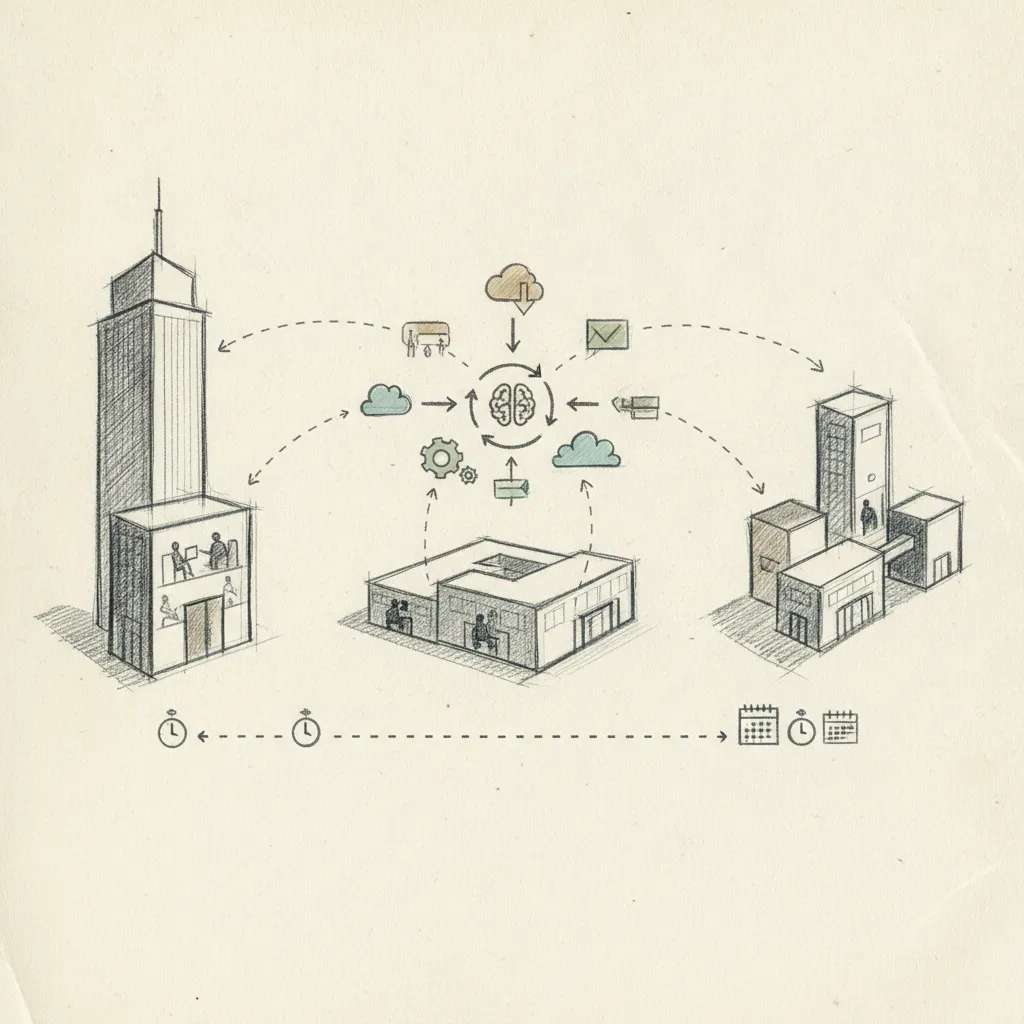
Fair multi-location office coordination means every employee, regardless of site size, gets the same booking visibility, space standards, and communication access as HQ staff. For more information, see Wasaphi.
Equity across sites doesn't happen by default. It requires deliberate standards applied consistently across four dimensions.
The stakes are measurable. Employees at smaller satellite offices report 23% lower satisfaction with their workspace experience than HQ employees (Leesman, 2023) [3]. That gap closes when coordination tools give every site the same real-time booking visibility and resource access.
A single source of truth for space availability is the practical fix. When a Chicago employee booking a desk in London sees live floor-plan data, not a static PDF, they make the same informed decisions as someone booking locally. This is a foundational principle of effective multi location office coordination: information equity drives experience equity.
Physical coordination and digital coordination must run in parallel. Asynchronous-first communication norms, documented decisions, recorded briefings, shared project boards, prevent HQ time zones from dominating the workday for distributed employees.
Policy must cover both the desk and the Zoom room. A booking rule that reserves a quiet pod also needs a corresponding norm about when video is required and how meeting notes are shared with colleagues who weren't in the building.
Predictable co-presence scheduling is what makes cross-location fairness operational. Upflex's AI-driven coordination achieves 88% co-attendance, meaning teams reliably share the same space on the days that matter, whether that's a Chicago team day or a cross-site project sprint in London.
The multi-location office coordination practices that deliver measurable results share one structural principle: centralize policy, decentralize execution. According to Circles' research on multi-location management strategies, organizations that establish clear global standards while empowering local site managers consistently outperform those that rely on either fully centralized or fully decentralized models.
Enterprises like Salesforce and Siemens set global standards, space ratios, booking window rules, compliance checkpoints, at the corporate level, then give local site managers authority over day-to-day scheduling decisions. This model scales across 50+ site portfolios without creating a bottleneck at headquarters.
A single occupancy data layer is the structural backbone that makes this work. Companies that consolidate badge access, desk booking, and sensor data into one dashboard cut portfolio over-leasing by an average of 40% within 18 months, according to CBRE's 2024 Workplace Pulse report. Upflex's office orchestration dashboard does exactly this, uniting booking, AI-powered attendance forecasting, and utilization data into one interface so corporate real estate leaders see every site in a single view.
Standardizing the new-location playbook is equally critical. Documenting the exact sequence, IT provisioning, compliance registration, space configuration, HR onboarding, gets each new site to operational readiness in under 60 days, compared to the industry average of 90–120 days [3]. That gap compounds fast across a growing portfolio. Robust multi location office coordination processes are what make this accelerated timeline achievable at scale.
Quarterly cross-site utilization reviews close the feedback loop. Comparing occupancy rates, booking no-show rates, and employee satisfaction scores across all locations surfaces underperforming sites before lease renewal decisions arrive, giving real estate leaders data, not gut instinct, to act on.
The business case math is direct. A 500-person company paying $12,000 per employee per year in real estate costs that reduces occupancy waste by 30% saves $1.8M annually. That figure serves as a credible baseline when building the internal case for coordination investment, and it scales linearly as headcount grows.
Upflex customers have documented 40%+ reductions in real estate spend by applying this data-driven approach across their owned offices and on-demand workspace network, demonstrating that the $1.8M baseline is a floor, not a ceiling, for well-coordinated portfolios.
The right platform for multi location office coordination combines AI-powered attendance forecasting, multi-tenant administration, and on-demand workspace access in one interface. The U.S. General Services Administration's facilities management guidelines emphasize that technology investments in workplace coordination should prioritize data integration and cross-site visibility above all other feature considerations.
No single platform covers every dimension equally. Robin excels at desk booking UX and calendar integration, making it a strong fit for single-campus or small-portfolio deployments. Gable focuses on on-demand coworking access for distributed employees, but offers limited portfolio analytics. Circles specializes in managed workplace services, hospitality, vendor coordination, facilities, rather than software-driven space optimization [3].
Upflex takes a different position: a 5,000+ location on-demand workspace network paired with UnifyAI, which forecasts office attendance at 97% accuracy, and portfolio analytics that support real estate consolidation decisions. For enterprises managing 50 or more sites, that combination matters because space can be right-sized proactively, before a lease renewal forces the question, rather than after utilization data has already gone stale.
The feature that separates enterprise-grade tools from point solutions is multi-tenant administration: separate configurations per site under one dashboard, with role-based access for individual site managers. Not all platforms in this category support this natively [2]. Without it, a global head of corporate real estate ends up reconciling data from disconnected systems, exactly the spreadsheet problem these tools are supposed to replace.
Integration depth also varies significantly. Look for native connectors to your HRIS, calendar system (Microsoft 365 or Google Workspace), and badge access data. Employees traveling between cities also need bookable on-demand workspace, coworking locations, flex offices, visible in the same interface as their home office desk.
Distributed teams need more video-enabled focus rooms and fewer open benching rows. The current enterprise benchmark, per the Gensler 2024 Workplace Survey, is a 60/40 split: 60% collaborative space and 40% focus space. That ratio reflects how hybrid employees actually use offices, arriving for structured collaboration, not heads-down solo work they can do at home.
Apply this layout standard consistently across all sites. When every location uses the same spatial logic, employees moving between offices know what to expect and waste less time orienting themselves to a new floor plan. Consistent spatial design is a physical expression of effective multi location office coordination — it signals to employees that every site is held to the same standard.

Two or more locations is enough to justify dedicated coordination software, particularly if those offices share employees, resources, or reporting lines. With a single additional site, manual processes, shared spreadsheets, calendar chains, ad-hoc badge data pulls, break down fast. A 2024 survey by CBRE found that enterprises managing three or more offices reported a 34% increase in scheduling conflicts compared to single-site operations. Purpose-built platforms pay for themselves once coordination failures start costing real estate budget or employee time.
Track desk utilization rate, co-attendance achievement, cross-location scheduling conflicts, and real estate cost per occupied seat. Desk utilization tells you whether space is being used; co-attendance, the share of team members present on the same day, tells you whether collaboration goals are being met. Upflex benchmarks 88% co-attendance achievement as a target outcome for well-coordinated hybrid teams. Also monitor meeting room booking efficiency and the ratio of booked desks to actual occupancy, which surfaces ghost bookings that inflate apparent demand.
Assign a designated compliance owner in each country and build local legal requirements into your global coordination policy as non-negotiable constraints. Data privacy rules vary significantly: the EU's GDPR restricts how you collect and store employee location and attendance data, while rules in the US, Singapore, and Brazil differ further. Work with local HR and legal counsel to document which coordination data can be centralized versus what must stay within national borders. Your coordination platform should support data residency controls to enforce these boundaries technically, not just procedurally.
Yes, on-demand coworking spaces can function as overflow capacity, satellite hubs, or primary workspaces for employees in cities where you hold no lease. Upflex provides access to a global on-demand workspace network, letting distributed or traveling employees book third-party spaces through the same platform used to manage owned offices. This approach eliminates the need for fixed leases in low-density markets while keeping all utilization data in one place for portfolio decisions.
Companies that succeed at multi location office coordination typically designate a central workplace operations lead supported by site-level coordinators at each location. The central lead owns global policy, technology standards, and cross-site reporting, while site coordinators handle day-to-day execution within those guardrails. This structure prevents both the chaos of fully decentralized management and the bottlenecks of over-centralized control. Regular cross-site coordinator calls — weekly or biweekly — ensure local issues surface quickly and best practices spread across the portfolio rather than staying siloed at individual locations.
Multi-location office coordination fails when companies treat it as a logistics problem rather than a data problem. The organizations that reduce real estate spend and maintain strong team cohesion do three things consistently: they standardize coordination policy across sites before customizing for local needs, they measure co-attendance and utilization rather than just headcount, and they replace manual scheduling with AI-driven forecasting that accounts for how employees actually behave.
Start with your utilization data. Pull desk occupancy and attendance records for the past 90 days across every location. If the numbers are incomplete or inconsistent, that gap is your first coordination problem to fix, and the clearest signal that a platform built for multi-site visibility, like Upflex, belongs in your next planning cycle.
Explore more from our content library: