Share This Article
No items found.


Understanding the financial impact of flexible work arrangements is essential for any organization considering a structural shift. Hybrid work saves companies 30–40% on real estate costs by reducing dedicated desk ratios and consolidating office footprints. Beyond rent, organizations cut utilities, facilities management, and commuter benefits proportionally. The bigger, often-overlooked gains come from retention: replacing one employee costs 50–200% of their annual salary, and hybrid flexibility measurably reduces voluntary turnover. Net savings depend on company size, industry, and how well space utilization data drives decisions.
Run the numbers before you restructure. Companies that anchor their hybrid work cost savings projections to utilization data consistently outperform those that estimate by intuition.
Real estate is the largest single lever. In major metro markets, desk vacancy rates above 40% create a direct path to reducing your footprint by 30–40%, which translates to $10,000–$15,000 in annual savings per employee. But that number only holds if the restructuring decision is grounded in actual occupancy evidence, not headcount assumptions.
"The data is unambiguous: companies that right-size their real estate portfolios based on actual attendance patterns — not assumptions — recover their hybrid transition costs in under 12 months." — Kate Lister, President at Global Workplace Analytics
Without occupancy sensor data or desk booking records, any savings estimate is guesswork. Badge swipe logs, calendar integrations, and booking platform data are the minimum inputs you need before projecting a square footage reduction.
The anchor metric for hybrid space planning is a desk-to-employee ratio of 0.6:1, meaning 60 desks for every 100 employees. Use your current ratio as the baseline, then calculate how many square feet you could exit if you hit that target. Platforms like Upflex generate this utilization data automatically through their desk booking and attendance forecasting engine, giving you the evidence base a CFO will accept. According to Global Workplace Analytics, organizations that leverage real occupancy data consistently achieve faster and larger reductions in their real estate footprint.
Lease costs are only the first line. A complete cost inventory covers three categories: real estate (rent, fit-out amortization, property taxes), operations (utilities, facilities headcount, office supplies, cleaning contracts), and talent-related spend (commuter subsidies, parking reimbursements, and turnover costs).
Commuter and parking subsidies alone can run $2,000–$5,000 per employee annually in dense urban offices, a figure most finance teams omit from their hybrid modeling. Include it.
On the talent side, factor in productivity-adjusted output. Research by Stanford economist Nick Bloom shows hybrid workers are 3–4% more productive than fully in-office peers. On a $100,000 salary, that gap is worth $3,000–$4,000 per employee in output value, a real number that belongs in your business case alongside the rent savings.
Gross savings from hybrid arrangements routinely run 20–40%, but implementation overhead, security exposure, and coordination drag can cut that figure significantly if you don't account for them upfront.
IT infrastructure upgrades, video conferencing hardware, expanded VPN capacity, endpoint security tools, and collaboration software licenses, typically cost $1,500–$3,000 per employee in year one alone. That's a line item most initial business cases omit or underestimate.
The security exposure compounds the problem. Cybersecurity incidents increase by 30% in the first year of hybrid transitions without proper endpoint management. The tail-risk cost of a single breach, regulatory fines, incident response, reputational damage, can dwarf an entire year's stipend budget. Build endpoint security into the baseline cost model, not the contingency column.
Home-office stipends and equipment allowances add another $500–$2,000 per employee annually. In competitive talent markets, these are effectively non-negotiable, so treat them as fixed costs rather than optional perks when projecting net savings.
Poorly structured hybrid policies increase meeting time by an average of 24%, according to Microsoft's Work Trend Index data. That overhead translates directly into lost productivity hours, a cost that doesn't appear on any invoice but shows up clearly in output and morale.
Training managers on asynchronous communication and hybrid facilitation averages $500–$1,200 per manager. This cost is frequently left out of ROI projections entirely, which is why so many first-year hybrid budgets come in over target.
Platforms like Upflex address part of this coordination drag by automating attendance forecasting and desk booking workflows, reducing the manual scheduling burden that inflates management overhead, but training and policy design remain costs your finance team needs to model explicitly before finalizing any net ROI estimate. For more information, see Seo Agency Alternatives Smart Cost Effective Options For.
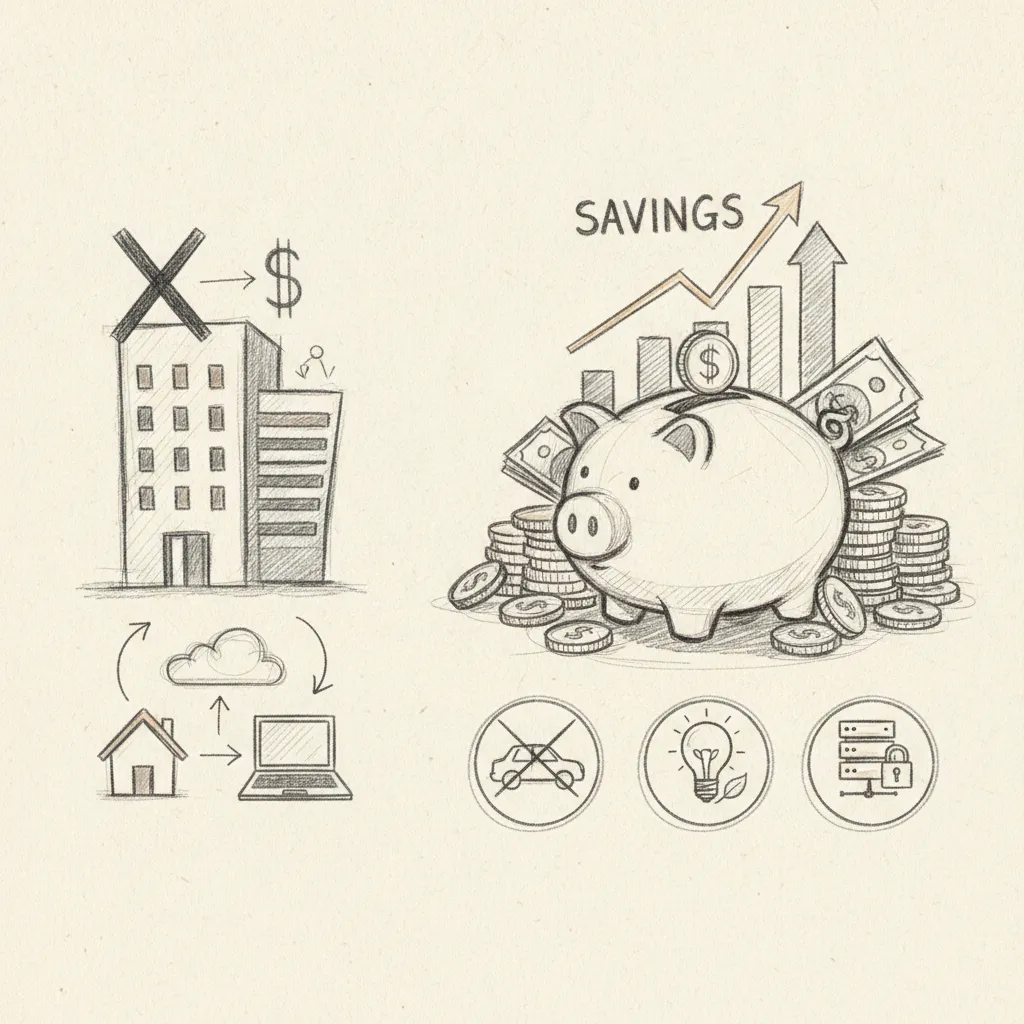
The financial benefits of hybrid work vary sharply by company size and sector. Large enterprises typically save millions on real estate, while smaller firms gain most from talent access and lower turnover. According to Hybo's analysis of hybrid work cost-effectiveness, the return on investment depends heavily on how deliberately organizations approach space consolidation and policy design.
Tech and professional services firms reach positive ROI fastest, typically within 6 to 12 months. High average salaries mean that retaining even a handful of employees who would otherwise leave covers the full cost of a hybrid program, and existing digital infrastructure keeps IT uplift costs low.
Financial services is a more complicated picture. Compliance frameworks including MiFID II and SEC record-keeping rules add an estimated $800 to $2,000 per hybrid employee annually in monitoring, audit tooling, and supervisory overhead. Those costs don't eliminate the savings case, but they do extend the payback period and require a line-item in any honest cost model.
Manufacturing, healthcare, and retail see the most limited gains. Frontline roles, assembly workers, clinical staff, store associates, cannot work remotely, so hybrid savings concentrate entirely in back-office and knowledge-worker populations. That group typically represents only 20 to 40% of total headcount, which caps the organization-wide impact significantly. The U.S. Bureau of Labor Statistics American Time Use Survey provides sector-level data on remote work prevalence that can help benchmark your industry's realistic ceiling for flexible work adoption.
Large enterprises capture the biggest absolute numbers. JLL data shows Fortune 500 companies reducing real estate portfolio costs by $1 million or more annually through office consolidation, but that scale comes with real coordination and IT complexity costs that smaller organizations avoid.
SMBs face a different constraint: most lack the lease flexibility to shed square footage quickly. A five-year lease signed in 2022 doesn't shrink because your team now comes in three days a week. For smaller firms, the strongest financial returns from hybrid arrangements come from hiring outside expensive metros, accessing talent pools where salaries run 15 to 25% lower, and from reduced turnover in a workforce that values schedule flexibility. Those gains are real, but they show up in payroll and HR budgets, not on a real estate line item.
For knowledge-worker-heavy organizations, the financial returns from reduced turnover often exceed what you'll recover from real estate consolidation alone. This is one of the most underappreciated dimensions of hybrid work cost savings.
Replacing a mid-level knowledge worker costs 50–200% of their annual salary once you account for recruiting fees, onboarding time, and productivity ramp. At a $100K salary, a single departure costs between $50K and $200K, a figure most finance teams undercount because the costs are spread across HR, hiring managers, and lost output rather than a single budget line.
Hybrid flexibility reduces voluntary turnover by 25–35% in organizations that implement it with clear policies, according to Gallup's 2023 State of the Global Workplace report. That reduction translates directly into avoided replacement costs. The Gallup State of the Global Workplace report provides detailed benchmarking data on how flexibility policies correlate with employee engagement and retention outcomes across industries.
Run the math on a concrete example: a 500-person company with 15% annual turnover sees 75 departures per year. Saving 30% of those departures avoids roughly 22 replacements. At an average replacement cost of $75K, that's $1.65M in annual savings, from retention alone, before touching a single lease.
One caveat worth noting: during economic downturns, voluntary turnover drops as employees hold their positions regardless of flexibility. In recession conditions, the retention ROI case weakens, and the financial argument shifts back toward real estate consolidation and headcount-driven space reduction.
Hybrid hiring expands your candidate pool beyond commuting distance, which cuts time-to-fill by an average of 18 days and reduces dependency on agency fees. Fewer agency placements at 15–20% of first-year salary compound quickly across dozens of annual hires.
Tracking these figures requires the same data discipline as real estate optimization. Platforms like Upflex that surface workforce attendance patterns and team coordination data give HR and finance a shared baseline, so retention outcomes can be tied to specific hybrid policy decisions rather than attributed to general market conditions.
Most financial gains from hybrid arrangements disappear before they're realized, not from bad strategy, but from five predictable implementation errors.
The single largest savings killer is keeping legacy office space "just in case." Companies that fail to right-size their portfolio within 18 months of going hybrid pay an average of $8,000 per unused desk annually. That buffer mentality feels cautious; the P&L treats it as waste.
Implementing hybrid without utilization data compounds the problem. Facilities teams without booking and occupancy data default to peak-day planning, designing for the busiest Tuesday of the quarter rather than the median week. That habit inflates space requirements by 30–50% above what teams actually need. Upflex's UnifyAI engine addresses this directly: it forecasts attendance with 97% accuracy, giving real estate leaders the data to right-size based on real demand, not worst-case assumptions.
A one-size-fits-all hybrid policy across departments destroys both savings and productivity. Engineering teams need focused, bookable heads-down space; sales teams need collaboration zones and client-ready rooms. Treating both the same wastes money and frustrates both groups.
Don't overlook the "ghost desk" problem either. Employees who badge in but settle in empty wings still trigger HVAC, lighting, and cleaning costs for those zones. Space consolidation must be physical, closing off floors or wings, not just a policy update.
Skipping manager training on hybrid coordination is the quietest cost. Without clear guidance, managers schedule redundant check-ins to compensate for lost visibility, creating meeting overload that erodes the productivity gains that make the hybrid model financially defensible in the first place.
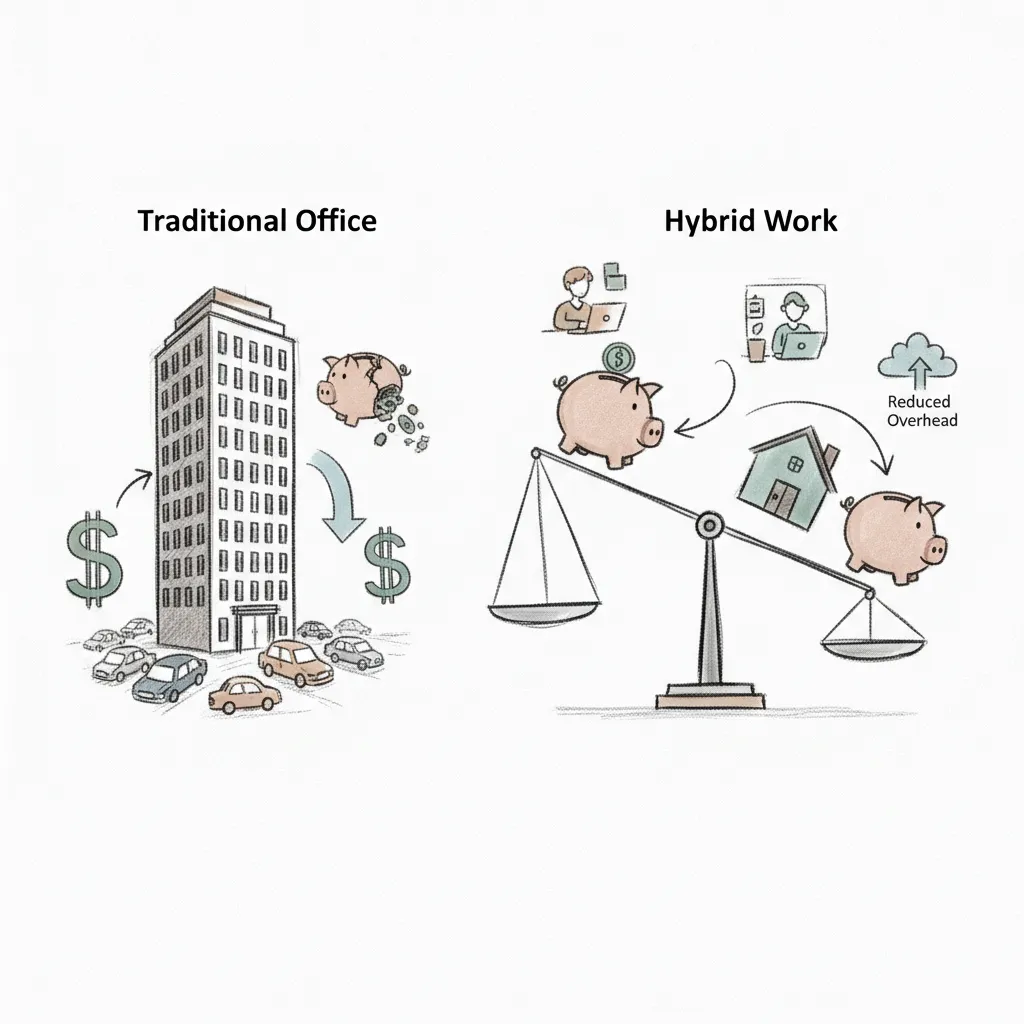
Hybrid work produces real, measurable savings, primarily through reduced real estate spend, lower overhead, and decreased employee turnover costs. According to Global Workplace Analytics' research on hybrid work costs and benefits, a typical employer saves around $11,000 per half-time remote worker per year [1]. The savings are largest for companies that actively right-size their office portfolios rather than simply letting employees work from home while keeping the same square footage. Without deliberate space consolidation, the financial gains stay on the table.
Most companies begin seeing measurable cost reductions within 12 to 18 months of implementing a structured hybrid program. Early wins come from reduced utilities and facilities costs; larger savings from lease consolidation typically materialize at the next renewal cycle, which can be two to five years out. Companies that use attendance data to build the business case for downsizing, rather than waiting for anecdotal evidence, compress that timeline significantly.
The financial case for hybrid arrangements becomes more defensible during a downturn, not less, because real estate and headcount are two of the largest controllable cost lines on a corporate balance sheet. Companies with flexible, data-driven office portfolios can reduce space faster and avoid being locked into underused leases [2]. The risk runs the other way: organizations that returned to full-time office mandates before renegotiating leases often carry fixed real estate costs they can no longer justify.
The 5 C's, Collaboration, Communication, Coordination, Culture, and Connection, are the operational pillars that determine whether a hybrid model delivers its promised savings. When coordination breaks down, attendance becomes unpredictable, office space is either over-provisioned or too crowded on peak days, and the cost-reduction case weakens. Companies that score well on co-attendance and team coordination, Upflex clients average 88% co-attendance achievement, tend to consolidate space with greater confidence.
IT infrastructure costs for a hybrid transition typically run between $1,000 and $3,000 per employee in the first year, covering endpoint devices, collaboration software licenses, and network security upgrades. This figure varies widely by industry and existing infrastructure maturity. The key budget discipline is avoiding duplication: paying for both a legacy on-premise system and a cloud-based workplace management platform simultaneously is a common and avoidable cost that erodes the savings hybrid work is meant to generate.
The companies capturing the largest hybrid work cost savings share three habits: they measure actual attendance rather than assuming it, they tie space decisions to utilization data rather than gut feel, and they act on lease events rather than waiting for the perfect moment. Real estate spend reductions of 30–40%+ are achievable, but only when forecasting and space management work together, not in separate spreadsheets.
Your most concrete next step: pull your current office utilization rate for the past 90 days and compare it against your cost-per-seat. If that number isn't available in under an hour, that data gap is your first problem to fix, and the starting point for any credible cost-reduction conversation with your CFO. See how Upflex's UnifyAI engine surfaces that data automatically.
Explore more from our content library: