Share This Article
No items found.


Understanding why office occupancy is declining is essential. Office occupancy keeps declining because the gap between hybrid work policy and employee behavior keeps widening, companies set return-to-office targets, but flexible work options, long commutes, and uneven enforcement mean actual attendance rarely matches the mandate. The result is portfolios sized for a workforce that no longer shows up five days a week, leaving real estate leaders paying for space that sits empty most of the time. Fixing this isn't about forcing attendance back up, it's about measuring true utilization and matching your footprint to how people actually work now, using flexible space and data-driven forecasting instead of guesswork.
Announced return-to-office policy and measured attendance have become two separate data sets, and the distance between them is the real reason why office occupancy is declining. Leadership sets a target, three days a week, five days a week, and badge data or desk-booking records show something consistently lower, often with no sign of closing over time.
The gap doesn't shrink because the conditions that created it haven't changed. Companies wrote hybrid policy assuming attendance would trend back toward pre-2020 norms once the mandate existed. Instead, each quarter of mismatched data becomes the new baseline, and real estate teams keep paying for space sized against the policy document rather than the sign-in sheet.
Remote work capability removed the old default that physical presence equaled productivity, and once that assumption broke, it didn't come back. Collaboration tools, cloud file access, and video conferencing now handle work that once required a shared desk. Many roles, especially knowledge work suited to asynchronous schedules, function fine without daily co-location, and managers who spent several years running distributed teams built comfort with output-based evaluation instead of hours-at-desk evaluation. That comfort is sticky; it doesn't reverse just because a mandate says "be here Tuesday through Thursday."
Preference splits by career stage and by sector, and a single blanket policy rarely fits either. Early-career employees often want in-person time for mentorship, visibility, and learning the informal rules of a job, the office still has clear upside for them. Tenured employees with established networks and proven track records see much less personal benefit from a commute, since they've already built the relationships and reputation that in-person time is supposed to create [1].
Industry matters just as much. Roles tied to physical equipment, client-facing retail, or regulated trading floors have far less flexibility to go remote than software, marketing, or professional services teams, a variation the later industry comparison in this article examines directly.
Enforcement without flexibility tends to backfire rather than fix attendance. Mandates that ignore long commutes or team-specific schedules push people toward attrition or quiet non-compliance, showing up to badge in and leaving within the hour, instead of genuine, sustained presence [2].
Measuring utilization means combining badge data, sensor readings, and booking records to see peak-day crowding and desk-level usage, not just a single occupancy percentage. For more information, see Service As Software Back Office.
Most real estate teams start with lease-based occupancy: square footage divided by headcount, or badge swipes counted as "presence." Both are misleading. A badge swipe tells you someone entered the building, not whether they found a desk, used a meeting room, or stayed past lunch. Understanding why office occupancy is declining requires metrics that reflect actual behavior, not building access logs.
Three numbers matter more than a generic occupancy rate: peak-day attendance, desk-level usage, and meeting-room turnover. Peak-day attendance shows the single busiest day your office handles, usually Tuesday through Thursday, rather than a weekly average that flattens the picture [1]. Desk-level usage shows which seats go untouched for weeks at a time, often revealing that entire floors are carrying 20–30% utilization while a handful of neighborhoods run over capacity.
Averaging attendance across five days hides the real problem. A floor that shows 45% average utilization might actually run at 85% on Tuesday and 15% on Friday [3]. Footprint decisions based on the average lead to a space that's simultaneously too big most days and too small on the days that matter. Space planning has to start with peak demand, not the mean.
Sensor data, badge data, and booking-system data each capture part of the picture and miss the rest. Badge data confirms building entry but not seat usage. Sensors detect desk occupancy but rarely connect to who booked what or why a meeting room sat empty despite a reservation [1]. Booking-system data shows intent, not actual turnout, a desk marked "reserved" that nobody used still reads as occupied unless it's cross-checked against sensor or badge confirmation.
Compare cost-per-used-seat, not cost-per-leased-seat, divide real estate spend by seats actually occupied on peak days, not by total seats under lease. A floor with 500 leased desks but only 220 used at peak is paying full freight for capacity nobody needs [2]. That calculation becomes the defensible number a CFO can act on when deciding whether to renew, consolidate, or exit a location.
Most utilization tracking is backward-looking: it tells you what happened last quarter, not what's coming next month. That's the gap predictive forecasting closes. Upflex's UnifyAI engine processes scheduling and utilization data to forecast attendance with 97% accuracy, giving real estate and workplace leaders a forward view instead of a rearview mirror, so space decisions get made ahead of a lease renewal, not in reaction to it.

Occupancy decline is not uniform, it tracks closely with how a sector works, how old the company is, and where its offices sit on the map. Any answer to why office occupancy is declining has to account for this variation, because a single national or even company-wide target will misread what's actually driving attendance in each business unit.
Client-facing finance and legal firms tend to hold onto higher occupancy, while tech and many professional services firms have seen steeper, more durable declines. The mechanism is structural, not cultural: legal and finance work runs on apprenticeship-style training, regulatory record-keeping, and in-person client meetings that are hard to replicate remotely.
A junior associate learning deal structuring or courtroom strategy benefits from sitting near partners; a compliance officer may need to work from a monitored, badge-access environment for audit reasons. Client expectations reinforce this, a wealth manager or litigator meeting a client in person signals seriousness that a video call doesn't.
Tech and software companies operate on a different logic entirely. Much of the work is output-based and asynchronous: a developer shipping code, a product manager reviewing specs, a designer iterating on mockups can all do this work effectively from anywhere, and teams have built tooling specifically to coordinate without co-location. Hybrid work exposes this gap directly, when the output doesn't depend on physical presence, the office becomes optional rather than functional [2].
Mid-tier and smaller cities generally see steadier office attendance than major metros, largely because commute times are shorter and the daily cost of showing up is lower. A 15-minute drive carries far less friction than an hour on a train, so the marginal decision to come in tips toward "yes" more often outside the largest urban cores.
Some major metro markets, Phoenix is one example, show vacancy figures that look like recovery on the surface but mask sharp unevenness between newer, amenity-rich buildings and older stock that nobody wants [4]. Talent competition plays a role too: in smaller markets with fewer employers competing for the same workforce, companies have more use to ask for in-office days without losing candidates to a more flexible competitor.
Company age and portfolio structure add another layer. Younger, distributed-native companies were built around remote-first hiring and rarely signed long leases, so they have little sunk cost pulling them back to a desk-for-everyone model. Legacy firms sitting on owned buildings or decade-long leases face a different calculus, the real estate is already a fixed cost, so leadership often pushes attendance policy to justify square footage rather than redesigning the portfolio around actual use [3].
This is why portfolio strategy has to be sector- and location-aware rather than a flat occupancy target applied everywhere. A platform like Upflex addresses this by combining UnifyAI attendance forecasting, accurate to 97%, with desk booking and access to an on-demand workspace network, so corporate real estate leaders can set different coordination models for a client-facing finance team in a major metro versus a distributed engineering group in a secondary market, instead of forcing one occupancy assumption across a portfolio that doesn't behave uniformly.
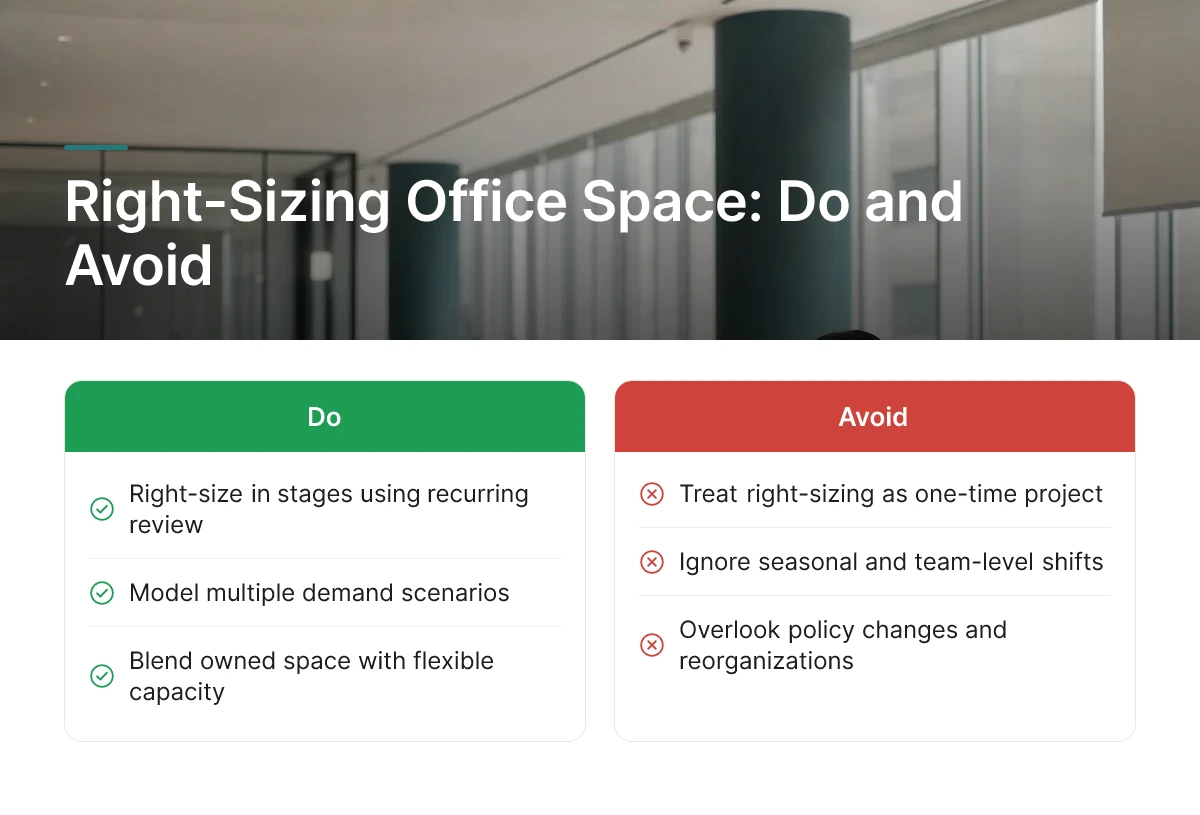
Right-size in stages using a recurring review cadence, not a single cut, model multiple demand scenarios, then blend owned space with flexible capacity to absorb the swings.
Most real estate teams treat right-sizing as a one-time project: analyze badge data, cut a floor, sign a smaller lease, done. That approach breaks down fast. Demand shifts by season, by team, and by policy change, a new return-to-office mandate, a reorg, or a push for more in-person onboarding can swing attendance within a single quarter. Understanding why office occupancy is declining in the first place, hybrid policies, employee preference, and structural shifts in how teams work [5], only gets you a snapshot. Treat footprint decisions as a recurring review, revisited quarterly or at each lease milestone, rather than a problem you solve once and file away.
Cut around how teams actually use the office, not by trimming every department's square footage by the same percentage. Office space management works best when it connects physical space to how people actually work, rather than applying planning assumptions uniformly across the portfolio [1]. In practice, that means identifying your core collaboration days, the two or three days a week when most teams are in, and consolidating desks, meeting rooms, and amenities around that pattern. A function that rarely needs in-person coordination can shrink more aggressively than a product team that depends on whiteboard sessions. Utilization data, not headcount alone, should decide where the cuts land, since behavioral patterns vary widely between teams even within the same building [3].
Match lease flexibility to demand uncertainty through renegotiation, subleasing, consolidation, or blending owned space with on-demand capacity. Leases are fixed; occupancy isn't, and that mismatch is the core structural problem behind most stalled right-sizing efforts. Renegotiating terms at renewal, subleasing unused floors, and consolidating multiple locations into fewer, better-utilized ones are the standard levers [2]. A fourth option is often overlooked: pairing a smaller core footprint with access to an on-demand workspace network for overflow, travel, or regional coverage. Upflex gives corporate real estate teams exactly this, a platform that forecasts attendance with 97% accuracy through its UnifyAI engine and pairs it with access to a global network of flexible workspaces, so a company can shrink its owned footprint without losing capacity when demand spikes.
The risk runs both directions. Cutting too aggressively based on a quiet summer or a slow quarter leaves no room when leadership pushes for more in-person collaboration or hiring picks back up. Scenario planning, modeling low, moderate, and high attendance cases before committing to a lease decision, de-risks the resize far more than acting on current occupancy alone.
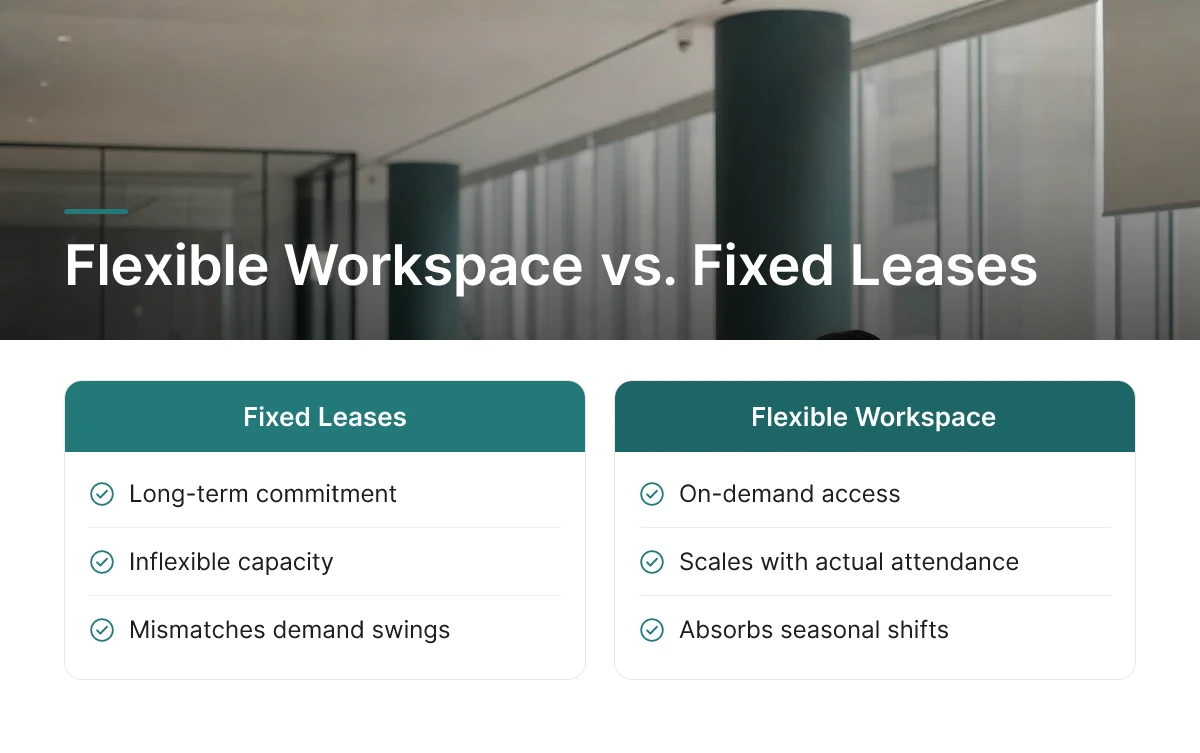
The fix combines two things: flexible workspace access that replaces fixed leases with on-demand capacity, and AI forecasting that predicts attendance before it happens. Together they let real estate teams match supply to demand instead of guessing, which is the structural answer to why office occupancy is declining faster than most portfolios have adjusted to it.
Flexible workspace networks convert part of a company's footprint from fixed, long-term leases into on-demand access that scales up or down with real attendance. Instead of paying for an entire floor that sits half-empty on Mondays and Fridays, a company can hold a smaller core footprint and tap outside workspace only when teams actually need it [2].
This matters most for distributed teams. Rather than concentrating everyone in one expensive headquarters, a company can give employees access to workspace near where they actually live, suburban hubs, satellite cities, secondary markets, without signing a lease in every location [1]. Upflex's on-demand workspace network applies this directly, giving employees access to external locations worldwide so the company's owned real estate doesn't have to absorb every possible attendance scenario.
AI-powered space orchestration forecasts who's coming in, when, and where, so real estate and workplace teams can plan room allocation and staffing ahead of time instead of reacting to day-of surprises. Utilization data turns scheduling from a guess into a plan, matching meeting rooms, desks, and amenities to the teams actually booked in that day [3].
Forecast accuracy is the mechanism that eliminates waste. Better predictions mean fewer floors held "just in case" attendance spikes, and fewer scramble days where employees show up to find no open desks. Upflex's UnifyAI engine forecasts attendance at 97% accuracy, which lets real estate teams commit to smaller footprints with confidence rather than padding capacity against uncertainty, the same uncertainty that's driving why office occupancy is declining in portfolios still sized for 2019 headcounts.
Approaches to flexible workspace span a range. A budget-friendly strategy might mean occasional day passes for a small distributed team. A mid-range approach adds structured desk booking across a few owned locations plus limited network access. An enterprise approach, the one most relevant for large, multi-location hybrid organizations, combines a consolidated core footprint, full network access for overflow and remote employees, and forecasting that ties the two together into one coordinated system rather than separate tools pulling in different directions.
Most evidence points to a structural shift rather than a temporary dip. Hybrid schedules, lifestyle preferences, and employer acceptance of remote arrangements have become embedded in how companies operate [5], and vacancy pressure in many markets continues even years after pandemic restrictions ended [4]. Real estate leaders should plan around sustained lower attendance, not wait for a full rebound.
Not if the reduction is paired with better coordination of when teams actually come in. Cutting square footage without managing co-attendance can leave remaining space chaotic on peak days and empty the rest of the week. Tools that forecast attendance and align team schedules help preserve in-person collaboration even as total footprint shrinks.
Review utilization data at least quarterly, with a deeper portfolio assessment tied to each lease renewal or expiration. Attendance patterns shift as hybrid policies, team structures, and headcount change, so a static annual review often misses meaningful drift in space needs.
For most large enterprises, no, a smaller anchor office still matters for culture, brand, and leadership presence. What changes is the balance: a right-sized headquarters combined with on-demand workspace access covers distributed and traveling employees without paying for permanent desks that sit empty most days.
Declining occupancy isn't a problem to wait out, it's a signal to rebuild how real estate decisions get made. Start by replacing guesswork with attendance data, size offices around actual usage rather than headcount, and give employees access to workspace near where they live and travel instead of forcing commutes to half-empty floors. Platforms like Upflex make this concrete: 97% accurate attendance forecasting, desk booking, and a global on-demand workspace network in one view, with customers documenting 40%+ real estate savings and 88% co-attendance achievement. The next step: pull your last quarter of badge or booking data and compare it against your current square footage before your next lease decision.
Explore more from our content library: