Share This Article
No items found.


Real estate is typically the second-largest operating cost for global enterprises, yet most organizations still manage their office portfolios the way they managed investments before algorithmic trading existed: manually, reactively, and with incomplete data. Workplace portfolio management is the strategic discipline of overseeing, optimizing, and right-sizing an organization's entire collection of physical work environments, including owned offices, leased spaces, and on-demand workspaces, to align real estate spend with actual employee usage and business objectives. Done well, it turns a cost center into a competitive advantage. This article covers what workplace portfolio management actually involves, how it works in 2026, the key benefits, common pitfalls, and the best practices that separate high-performing real estate teams from the ones still guessing.
Workplace portfolio management is the ongoing process of analyzing, planning, and optimizing an organization's full inventory of physical work environments to reduce costs, improve utilization, and support employee experience. It spans every location type, from headquarters floors to satellite offices, coworking memberships, and on-demand bookings.
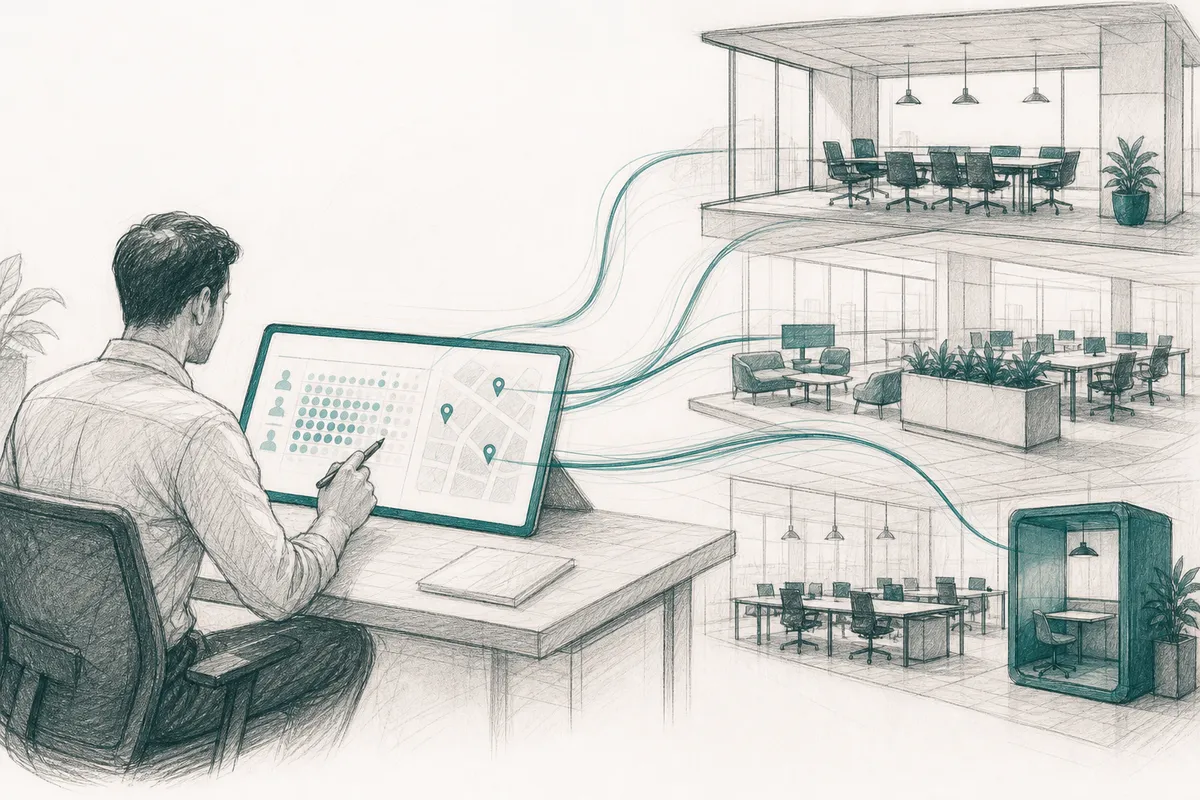
Traditional corporate real estate management focused almost entirely on long-term leases and owned buildings. Workplace portfolio management takes a broader view. It treats every workspace an employee might use, whether that's a dedicated desk in Chicago, a hot-desking arrangement in Singapore, or a booked coworking space in Berlin, as part of one integrated portfolio to be actively managed.
According to the Association for Project Management, portfolio management is fundamentally about "the selection, prioritization and control" of assets "in line with strategic objectives." [1] Applied to real estate, that means every square foot needs to justify its cost against measurable business outcomes.
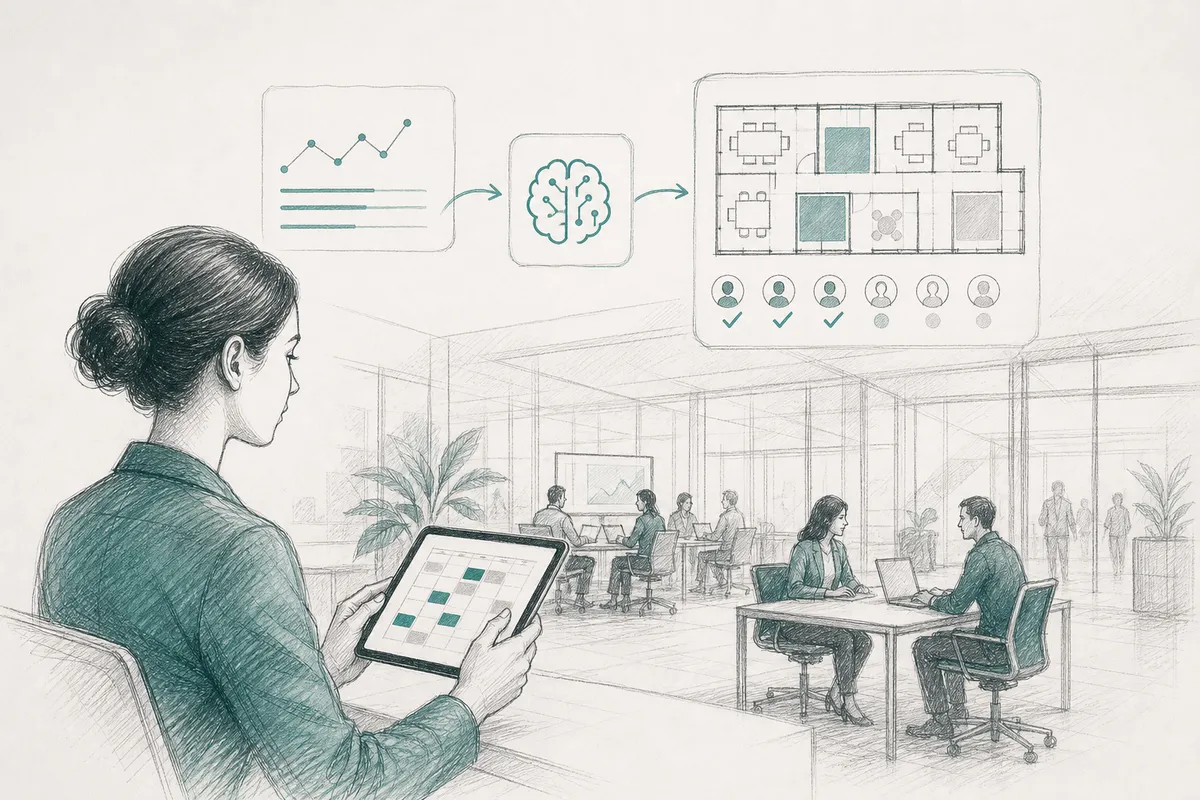
As of 2026, the discipline has expanded considerably. Hybrid work has fragmented where employees actually work, making utilization data harder to collect and portfolio decisions harder to justify. The organizations that are getting this right have moved beyond badge-swipe data and floor plans. They're using AI-powered forecasting to understand not just where people sat yesterday, but where they'll sit next Tuesday.
The financial stakes are significant. Research from McKinsey indicates that companies willing to actively manage their real estate portfolios, rather than simply renewing leases, can unlock substantial savings and strategic flexibility. [2] For a global enterprise spending $50 million annually on real estate, even a 20% reduction represents $10 million returned to the business.
Workplace portfolio management also directly affects talent. Employees who can't find a desk when they come in, or who commute only to sit on video calls in a noisy open plan, don't come back. Getting the portfolio right is both a finance problem and a people problem simultaneously.
Pro Tip: Start your portfolio management review by mapping every workspace your organization currently pays for, including underused coworking memberships and legacy satellite offices. You can't optimize what you haven't inventoried.
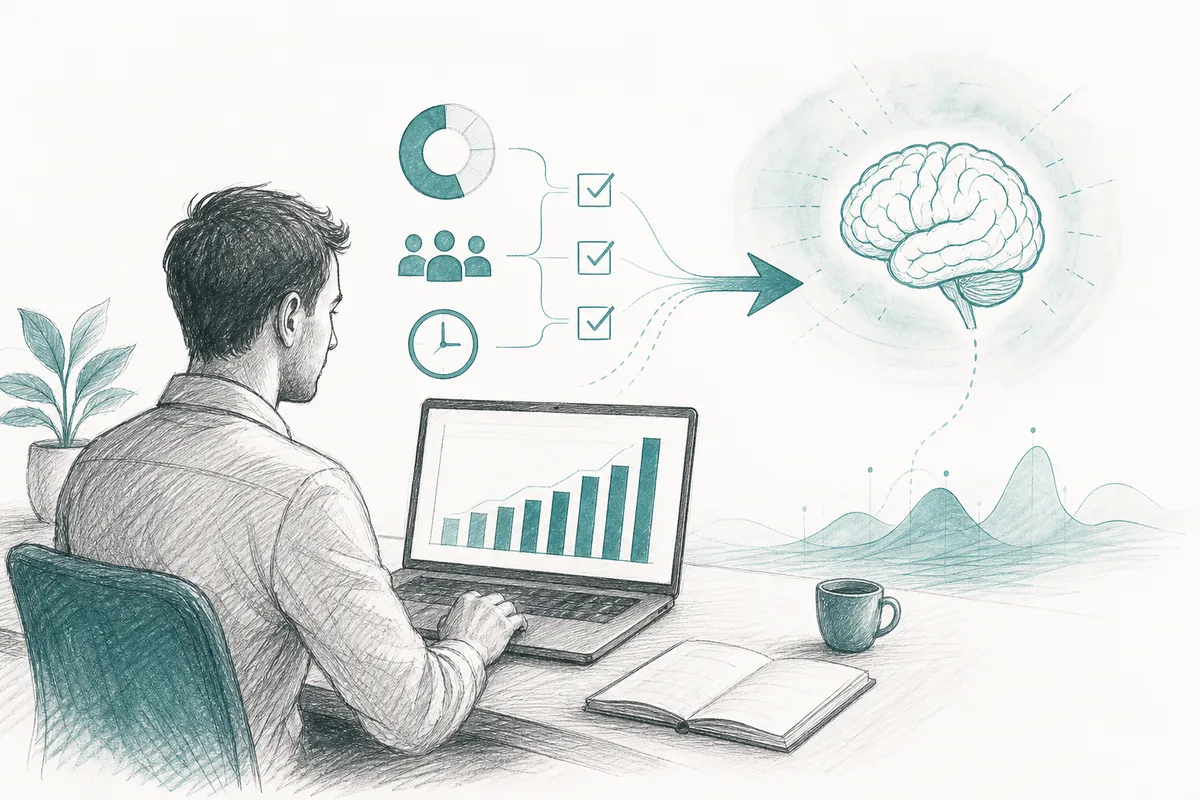
Effective workplace portfolio management follows a data-collection, analysis, and decision cycle that repeats continuously rather than once at lease renewal. The process combines utilization data, attendance forecasting, and financial modeling to drive real estate decisions.
In practice, the process breaks down into five repeating stages:
The PMI's framework for Lean Portfolio Management emphasizes that this kind of continuous planning cycle, rather than annual reviews, is what separates adaptive organizations from rigid ones. [3] The same principle applies directly to real estate portfolios.
Manual spreadsheet-based portfolio management was already strained before hybrid work. As of 2026, it's genuinely inadequate for organizations with more than a few hundred employees across multiple locations. The data volume is too high and the variables too dynamic.
Modern workplace portfolio management platforms consolidate desk booking, attendance forecasting, utilization reporting, and on-demand workspace access into a single interface. This gives corporate real estate leaders the consolidated view they need to make defensible, data-backed decisions rather than gut-feel lease renewals.
Industry analysts suggest that organizations using integrated workplace management systems (IWMS), a category of software that centralizes real estate, facilities, and space data, make portfolio decisions up to 30% faster than those relying on disconnected tools. [4]

Organizations that manage their workplace portfolio strategically, rather than reactively, consistently achieve lower real estate costs, better employee experiences, and stronger alignment between their physical footprint and their actual business needs.
The most direct benefit is cost reduction. When you know which spaces are underused, you can exit leases, consolidate floors, or substitute expensive long-term commitments with flexible on-demand workspace access. Upflex customers have achieved 40%+ reductions in real estate spend by combining AI-driven utilization insights with access to a global on-demand workspace network, replacing underperforming fixed leases with flexible alternatives.
The table below summarizes the key benefits across stakeholder groups:
| Stakeholder | Primary Benefit | Measurable Outcome |
|---|---|---|
| CFO / Finance | Reduced real estate operating costs | 40%+ reduction in real estate spend |
| Corporate Real Estate | Data-backed lease decisions | Faster portfolio right-sizing |
| HR / Workplace Experience | Better team co-attendance | 88% co-attendance achievement |
| Employees | Reliable workspace availability | Reduced friction on in-office days |
| Leadership | Strategic real estate alignment | Portfolio decisions tied to business goals |
A well-managed workplace portfolio doesn't just save money. It also ensures that when employees do come in, the experience is worth the commute. That means available desks, the right collaboration spaces, and team members present on the same days.
Research from Harvard Business Review indicates that hybrid work models succeed or fail largely on the quality of in-person coordination, not just the physical space itself. [5] Workplace portfolio management that incorporates attendance forecasting and co-attendance tracking directly supports this. Organizations that achieve high co-attendance rates report stronger team cohesion and reduced attrition among hybrid employees.
From experience working with global enterprises, one consistent finding stands out: companies that treat their real estate portfolio as a talent tool, not just a cost line, make better portfolio decisions. They're asking "does this space help our people do their best work?" alongside "what does this space cost per square foot?"
Pro Tip: Present portfolio optimization recommendations to your CFO and CHRO together. Framing real estate decisions as both a cost reduction and a culture investment gets faster organizational buy-in than leading with square footage alone.
Even experienced corporate real estate teams run into predictable obstacles when managing a hybrid workplace portfolio. Knowing these pitfalls in advance significantly reduces the risk of costly mistakes.
The most common challenge, in real-world practice, is fragmented data. Badge access systems, desk booking tools, HR headcount records, and lease management software rarely talk to each other. The result is a portfolio manager who has to manually reconcile four different spreadsheets to answer a basic question like "how many people actually used our Austin office last month?"
A SaaS company we've seen navigate this challenge had three separate desk booking tools across their North American offices, none of which integrated with their IWMS. Their utilization reports were six weeks stale by the time they reached decision-makers. By the time lease renewal conversations started, they were negotiating without current data.
The APM defines effective portfolio management as requiring both "selection and control" of assets. [1] Control is impossible without real-time, consolidated data. Fragmented tooling undermines both.
A common mistake is treating hybrid work as a temporary adjustment rather than a permanent structural change to how space gets used. Organizations that plan their portfolios based on pre-2020 occupancy assumptions consistently over-provision space on low-attendance days and under-provision it on peak days.
The Colliers return-to-office research highlights this directly: portfolio decisions made without accurate attendance data tend to result in either costly over-leasing or employee frustration from insufficient space on high-demand days. [6] Neither outcome is acceptable.
Other pitfalls to watch for include:
The organizations achieving the strongest results from their workplace portfolio management programs share a set of consistent practices: they use real-time data, they plan continuously, and they treat fixed and flexible workspace as complementary rather than competing options.
Effective portfolio management starts with measurement. You need utilization data that's current, granular, and connected to business context. That means integrating your desk booking system, badge data, and attendance forecasting into a single reporting layer.
At Upflex, we've found that organizations using AI-powered attendance forecasting, rather than historical badge data alone, make significantly more accurate space planning decisions. Forecasting who will be in the office next week, rather than reviewing who was there last month, changes the quality of every portfolio conversation downstream.
The PMI's Lean Portfolio Management framework recommends building "participatory budgeting" and "continuous planning" cycles into portfolio governance. [3] Applied to real estate, this means monthly portfolio reviews informed by live utilization data, not annual lease reviews informed by stale reports.
The most resilient workplace portfolios in 2026 combine three layers:
This three-layer model reduces the risk of over-committing to long-term leases while still providing employees with reliable, high-quality workspace wherever they need it. Colliers' research on return-to-office portfolio strategy supports this hybrid approach as the dominant model for enterprise real estate planning. [6]
The table below compares the three workspace layers by cost structure, flexibility, and best use case:
| Workspace Layer | Cost Structure | Flexibility | Best Use Case |
|---|---|---|---|
| Core leased / owned | Fixed, predictable | Low | Stable headcount, HQ functions |
| Managed / flex office | Semi-variable | Medium | Growing markets, project teams |
| On-demand workspace | Variable, pay-per-use | High | Remote employees, travelers, overflow |
Pro Tip: When sizing your core lease commitment, use your 70th-percentile attendance day as the baseline, not your average. Designing for average occupancy means you'll be overcrowded 30% of the time and paying for empty space the rest.
Portfolio management isn't just about square footage. It's about enabling the collaboration patterns your business depends on. The most effective corporate real estate leaders work directly with HR to understand which teams need to be co-located, on which days, and in what kind of space.
HBR's research on decentralized portfolio management notes that hybrid work and AI tools are forcing organizations to be "more flexible in delivering" on strategic goals. [5] For real estate, that flexibility means building portfolios that accommodate team-driven attendance patterns rather than imposing top-down schedule mandates.

The seven key elements of mature portfolio management are: strategic alignment (ensuring every asset serves a defined business objective), clear governance (defined decision rights and escalation paths), optimized resource allocation (matching budget and capacity to highest-value assets), data-driven insights (real-time utilization and performance metrics), agility (the ability to rebalance the portfolio as conditions change), continuous improvement (regular review cycles rather than annual snapshots), and effective communication (transparent reporting to all stakeholders). In the context of workplace portfolio management, these elements translate directly to lease decisions, space utilization targets, and hybrid work coordination frameworks. [7]
In financial investment contexts, the 60/20/20 rule refers to allocating 60% of a portfolio to equities for growth, 20% to bonds for stability, and 20% to alternative assets like gold for inflation protection. Applied to this approach, a similar diversification principle holds: roughly 60% of your workspace commitment in stable core leases, 20% in flexible managed office arrangements, and 20% in on-demand or pay-per-use workspace access. This ratio varies by organization size and hybrid work intensity, but the underlying logic of balancing commitment against flexibility is directly transferable from investment theory to real estate strategy.
A workplace portfolio is the complete collection of physical work environments an organization manages or pays for, including owned buildings, long-term leases, short-term flex office agreements, coworking memberships, and on-demand workspace bookings. Unlike a single-office view, the portfolio perspective treats all locations as interconnected assets to be actively balanced against headcount, utilization data, and business objectives. Effective this means continuously optimizing this mix to reduce cost, improve space efficiency, and support employee experience across every location type.
it typically involves corporate real estate leaders (responsible for lease strategy and cost), workplace experience or facilities managers (responsible for day-to-day space operations), HR and people leaders (responsible for employee experience and team coordination), and finance stakeholders (responsible for budget oversight). In larger organizations, a dedicated Portfolio Management Office (PMO) may coordinate across these functions. As of 2026, AI-powered platforms are increasingly automating the data collection and forecasting tasks that previously required significant analyst headcount. [8]
AI improves this method primarily through attendance forecasting, utilization analysis, and automated space coordination. Rather than relying on historical badge data, AI engines can predict who will be in the office on a given day with high accuracy, enabling real-time space planning decisions. Upflex's UnifyAI technology, for example, delivers 97% attendance forecast accuracy, which directly supports lease right-sizing decisions and co-attendance coordination. This level of precision isn't achievable with manual methods, particularly in large hybrid organizations with variable attendance patterns.
Facilities management focuses on the operational upkeep of physical spaces, including maintenance, cleaning, security, and day-to-day space logistics. this strategy operates at a higher strategic level, making decisions about which spaces to keep, exit, or add based on business need and utilization data. In practice, the two disciplines overlap significantly: good portfolio decisions depend on accurate facilities data, and facilities teams benefit from portfolio-level clarity about which spaces are long-term investments versus short-term commitments.
this approach has moved from a back-office real estate function to a front-line strategic priority. The organizations winning in 2026 aren't the ones with the most office space. They're the ones who know exactly how much space they need, where, and when, and who have the tools to act on that knowledge faster than their leases expire.
Getting this right requires three things working together: accurate utilization data, AI-powered attendance forecasting, and a portfolio model that combines fixed commitments with flexible on-demand workspace access. That's precisely the combination Upflex was built to deliver. From 40%+ reductions in real estate spend to 88% team co-attendance achievement, the outcomes are measurable and the path to get there is clear.
Your workplace portfolio is one of your largest cost lines and one of your most powerful talent tools. Managing it strategically, with real data and the right platform, is how you make it earn its keep.
Explore more from our content library: