Share This Article
No items found.


Understanding how to implement flexible work policy is essential. A flexible work policy sticks when it's built around measurable goals, a clear model, and the tools to operationalize it, not just a written document granting employees freedom to choose where they work. Companies that successfully implement flexible work policies start by defining what they want the policy to accomplish (lower real estate costs, better retention, higher utilization), choose a model that matches their team's actual work patterns, pilot it with real data before rolling it out company-wide, and track adoption and space usage afterward to keep refining it. Policies fail when they skip the measurement step and treat the launch as the finish line.
Every policy needs one measurable objective, cost reduction, talent retention, or productivity, written down before any rule gets drafted.
Most companies asking how to implement flexible work policy start by writing rules: three office days a week, core hours, booking windows. That's backward. The rules only make sense once leadership agrees on what the policy is supposed to fix. A policy built to cut real estate spend looks different from one built to widen the hiring radius or protect deep-work productivity, and most organizations actually need some balance of all three, with one as the priority that breaks ties when they conflict.
Cost reduction, talent outcomes, and productivity pull a policy in different directions, and skipping this distinction is why so many policies drift. A real estate-driven policy optimizes for consolidating offices and raising space utilization, it tolerates mandatory in-office days if they fill the building efficiently. A talent-driven policy optimizes for retention and recruiting beyond the local commute radius, it tolerates lower daily attendance if it keeps strong employees from leaving. A productivity-driven policy optimizes for output, which sometimes means more in-person collaboration and sometimes means less. Mercer's research found two out of three organizations were actively creating or updating flexible work policies [4], often without settling this question first. Without a stated objective, a policy has no anchor, and it tends to swing to an extreme, full remote because it's easiest to approve, or a rigid mandate because leadership loses patience with ambiguity, usually within a year of launch.
A 50-person startup renting one floor optimizes differently than a 5,000-person enterprise holding leases across a dozen cities. The startup's flexible work policy is mostly a hiring and retention tool, the real estate line item is too small to drive the decision. The multi-city enterprise is carrying real estate as a top-three cost line, so the policy has to answer a portfolio question: which offices get consolidated, which get renewed, and which get dropped. Industry matters too, a professional services firm with client-facing teams needs different coverage patterns than an engineering organization running asynchronous project work.
Before drafting any rules, write the objective as a single measurable sentence: "Reduce real estate spend by 30% while maintaining 80%+ co-attendance on core collaboration days." Upflex's UnifyAI engine forecasts attendance at 97% accuracy, which gives leaders the attendance and utilization data to set that number honestly instead of guessing.
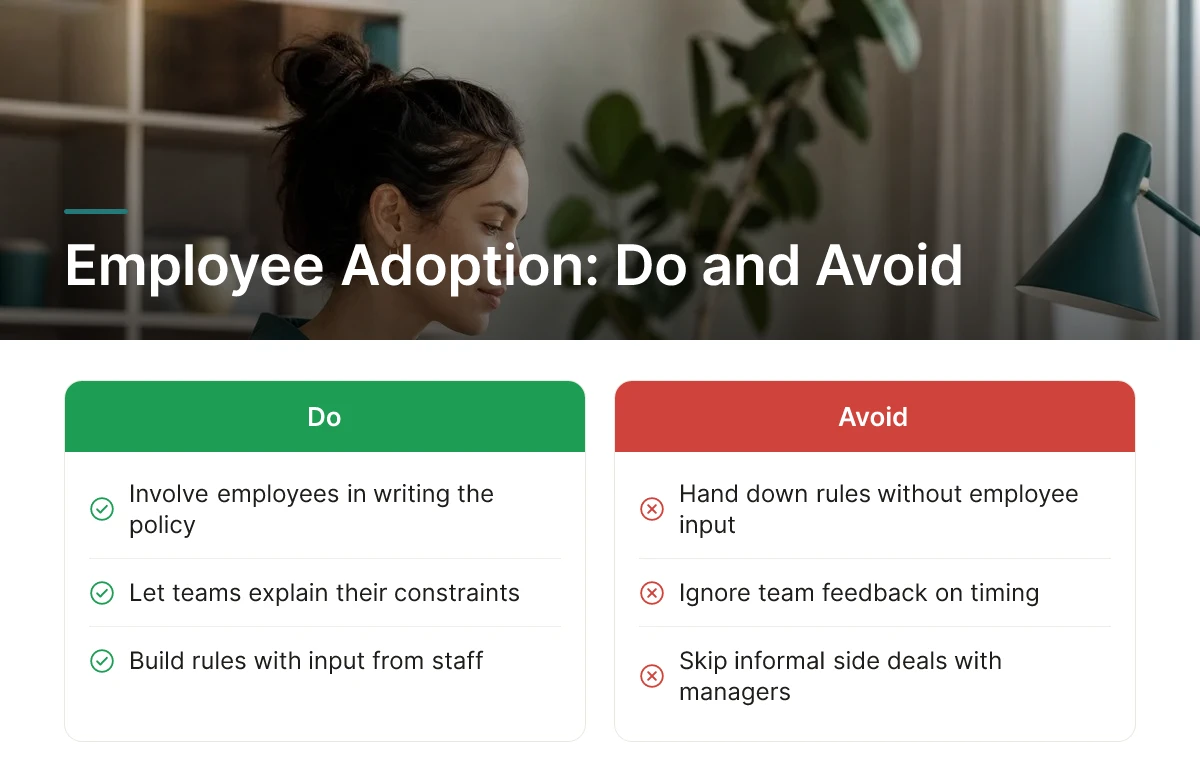
A flexible work policy succeeds only when employees had a hand in writing it, rules handed down without input get quietly ignored within months.
Most organizations already know this failure mode. Leadership announces three mandatory in-office days, no one asks the engineering team why Tuesdays are impossible for them, and by week six half the floor is empty on the designated day while people show up on Thursday instead. The policy still exists on paper. It just stops governing behavior. Instead, managers start cutting informal side deals, "come in when it works for you", and the organization ends up with as many arrangements as it has employees, which defeats the purpose of having a policy at all.
Employees want a policy that addresses the specific reasons they skip the office, not a survey that just ranks their preferred days.
A generic preference poll ("Which three days would you choose?") produces data that looks useful but explains nothing. A short, targeted survey or a handful of team conversations that ask "what makes a Tuesday in the office harder than a Tuesday at home?" surfaces the real blockers: a commute that doubles on specific days, a lack of meeting rooms when the whole team shows up at once, or a manager who never actually checks attendance so there's no reason to come in. This is the input that turns into policy language instead of a slide no one references again.
The policies that fail share three recurring problems, and each has a direct, operational fix.
Learning how to implement flexible work policy well comes down to converting employee input into specific, written rules, not phrases like "flexibility within reason," which every manager interprets differently. A platform like Upflex helps translate those rules into practice: its UnifyAI engine forecasts attendance with 97% accuracy, so leaders can set realistic core-day expectations instead of guessing, and employees can book desks or access on-demand workspace when the written policy allows for it.
The model you pick, async-first, fixed-hybrid, or remote-optional, determines how much office space you can give up and how tightly teams stay connected. Getting this choice wrong is the most common reason a flexible work policy fails to cut costs or keep teams aligned. Any serious plan for how to implement flexible work policy has to start here, because the model sets the constraints every later decision operates inside.
Each model trades team cohesion for space efficiency in a different place, and no option gives you both for free.
This is where the model choice directly determines the tooling you need. Upflex's UnifyAI engine forecasts attendance with 97% accuracy, which lets fixed-hybrid teams staff peak days correctly instead of over-leasing for a worst case. For remote-optional teams, Upflex's on-demand workspace network gives employees access to workspace near home or while traveling without the company carrying a fixed lease for seats that sit empty most of the year.
Where employees physically work changes what laws apply to them, and that reality should narrow your model choice before culture preferences do. Multi-state and multi-country employment rules mean a fully remote-optional policy can trigger different wage, overtime, and leave obligations depending on an employee's location [3]. Remote workers can also create state or national tax nexus for the employer, a risk finance and legal teams need to flag before a policy goes company-wide. Health and safety obligations for home workspaces are a further consideration: several frameworks discussed by workplace flexibility researchers treat ergonomic and accessibility support as part of the employer's duty of care, not an optional perk [3].
As a simple default: sales and customer-facing teams tend to fit fixed-hybrid models best, since client meetings and team coaching benefit from predictable in-person days. Engineering and product teams often run well async-first, given deep-focus work and strong documentation habits. Operations and finance teams, which depend on tight coordination with legal and compliance, usually need remote-optional with occasional mandated overlap rather than either extreme.
A policy survives contact with reality only after a time-boxed pilot proves it with data, not opinions, and the data gets fed back into the rules before full rollout. Anyone researching how to implement flexible work policy successfully will find the same failure pattern: companies write the rules, announce them, and skip the test phase. That's how policies end up revised twice a year by committee, instead of refined once by evidence.
Pick the metrics before the pilot starts, not after you see the results, otherwise you'll rationalize whatever happened. Five numbers matter most for a hybrid policy pilot:
Run the pilot with one business unit or floor for a fixed window, six to eight weeks is long enough to capture normal weekly variation without dragging on indefinitely [1]. Define the group, the duration, and the KPI list in writing before day one, and don't move the goalposts mid-pilot.
When the pilot ends, sort findings into three buckets: rules to keep as written, rules to loosen (maybe the mandatory three-in-office-days turns out to work better as two), and rules to tighten (maybe booking windows need to close earlier to stop no-shows). This is the step most companies skip, reviewing the policy only once a year instead of treating the pilot as a structured first draft [2].
Operationalizing the policy day to day requires three tooling layers working together: a booking and scheduling system for desks and rooms, utilization sensors or badge-swipe data to verify who actually showed up, and a coordination layer so hybrid teams can see who's in on which days before they commute in. Upflex combines these into a single dashboard, pairing desk booking with UnifyAI attendance forecasting and access to an on-demand workspace network, so the policy is enforced through daily workflow rather than a document nobody rereads.
Brief managers before announcing anything to employees; managers need to answer questions the day the policy goes live, not learn about it alongside their teams [4]. Publish one single source of truth for the rules, and keep a feedback channel open well past launch, adoption keeps shifting for months after rollout, and the policy should shift with it.
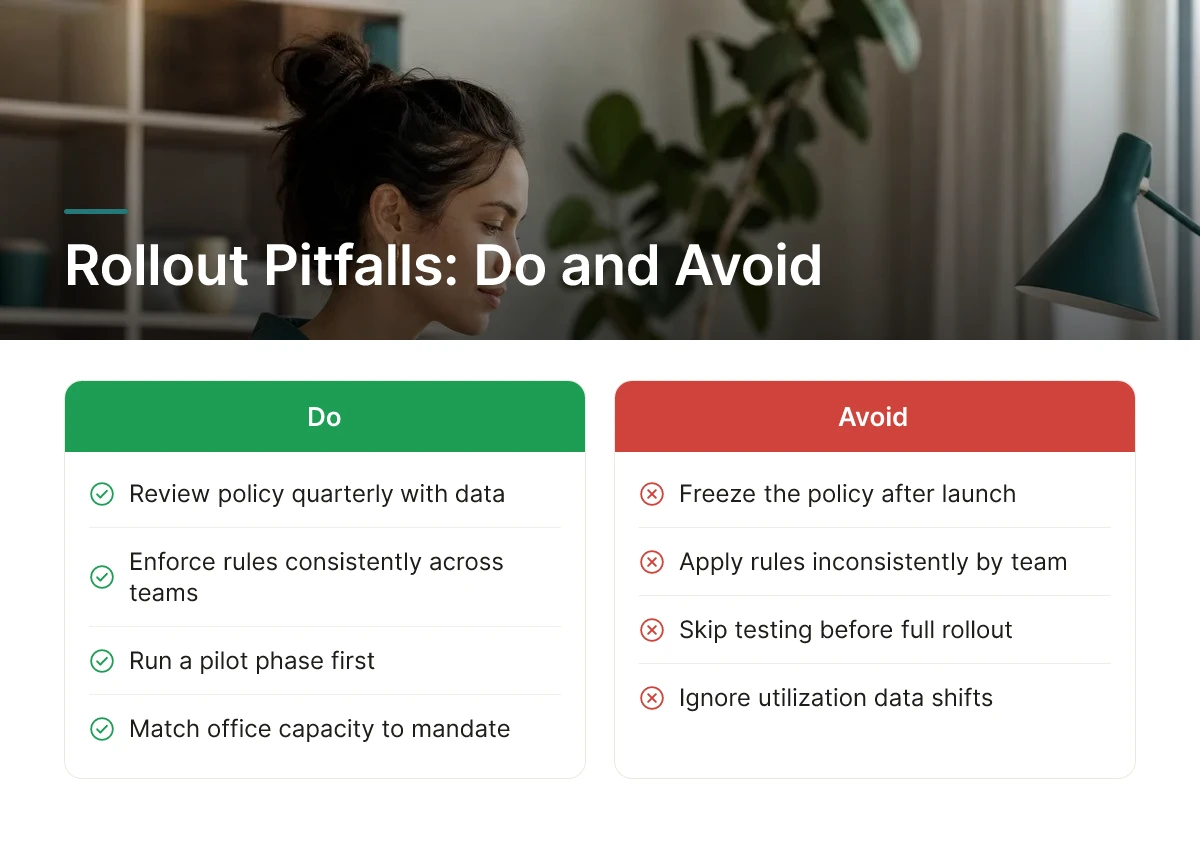
Most failed rollouts share four root causes: a frozen policy, inconsistent enforcement, no pilot phase, and office capacity that doesn't match the mandate. Knowing how to implement flexible work policy successfully means knowing what derails it first.
Companies write a flexible work policy once, publish it, and never revisit it. That's a mistake once utilization data starts coming in, attendance patterns shift by season, by team, and by project cycle, and a policy frozen at launch stops matching reality within a few months. Set a review cadence (quarterly works for most enterprises) and tie it to actual badge and booking data, not anecdote.
One manager holds the line at three in-office days; another lets the team work from home whenever. This inconsistency erodes trust faster than a stricter policy applied evenly across the company [1]. Employees notice the double standard immediately, and HR ends up fielding fairness complaints instead of coordination questions. A clearer, slightly stricter rule that applies to everyone beats a lenient one that applies to some.
Rolling out a new policy company-wide without testing it first means the first real signal you get is a real estate decision, a lease renewal, a downsizing call, built on untested assumptions. Running a pilot with a few teams for a defined trial period surfaces problems while the stakes are still low [1]. Mercer's research notes that most organizations are actively building or revising flexible work policies right now [4], which makes a rushed, untested rollout even riskier against competitors who tested first.
Mandating three anchor days without checking desk capacity or booking systems creates a worse in-office experience than fully remote work did. Employees who can't find a desk, a room, or a parking spot on the mandated day will disengage from the policy entirely. This is where forecasting tools matter: Upflex's UnifyAI engine predicts attendance with 97% accuracy, so real estate and workplace teams know exactly how many desks to hold and where before they set mandatory days, instead of guessing and apologizing afterward.
Run a pilot for 60 to 90 days before committing to a company-wide rollout. That window is long enough to cover at least two full billing or project cycles, surface seasonal attendance swings, and give managers enough data points to judge whether co-attendance targets are realistic rather than lucky. Shorter pilots tend to reward novelty, not habit.
No single function should own it alone, corporate real estate, HR, and team managers each hold a piece. Real estate owns the space and cost data, HR owns policy fairness and compliance, and managers own day-to-day enforcement and team coordination. Upflex's dashboard gives all three a shared view of utilization, so decisions get made on the same numbers instead of competing spreadsheets.
A remote work policy covers where employees work; a flexible work policy covers where, when, and how, including hours, schedules, and office attendance expectations. Remote work is one option within a broader flexible policy, not a substitute for one [5].
Review the policy quarterly for the first year, then move to a semi-annual cadence once attendance patterns stabilize. Tie each review to actual utilization and co-attendance data rather than anecdotes, so adjustments reflect what's happening on the floor, not what's loudest in the room.
A flexible work policy succeeds or fails on three things: clear scope, data-backed decisions, and a review cycle that actually changes the policy over time. Skip the pilot and you're guessing at adoption; skip the utilization data and you're negotiating leases on gut feel; skip the review cadence and last year's policy quietly stops matching how people actually work. Upflex gives corporate real estate and HR leaders the attendance forecasting and utilization data to make each of those calls with evidence instead of guesswork. Start by pulling your last 90 days of badge or booking data and comparing it against your current office capacity, that single comparison usually reveals whether your next step is a pilot, a policy rewrite, or a portfolio conversation with your CFO.
Explore more from our content library: