Share This Article
No items found.


The best real estate portfolio management tools combine space utilization data, lease and cost tracking, and workspace booking into one system so corporate real estate and finance leaders can right-size office footprints across multiple locations. These tools matter most in hybrid work settings, where attendance is unpredictable and fixed leases often sit underused. The strongest options pair AI-driven forecasting with on-demand workspace access, letting teams shrink committed square footage without losing capacity when demand spikes. Costs range from budget-friendly point solutions to enterprise platforms bundling analytics, booking, and finance integration.
These nine real estate portfolio management tools help corporate real estate and finance leaders cut hybrid workplace spend and manage multiple office locations, not track rental investment returns. Each entry below focuses on how companies right-size office footprint, not how individual investors monitor property cash flow.
Pricing varies too much by portfolio size, lease terms, and contract length to quote exact figures with any honesty. Instead, each tool is marked budget-friendly, mid-range, or premium/enterprise, reflecting where it typically lands relative to the others on this list.
Every tool gets evaluated on the same three criteria: depth of space utilization data, how well it integrates with existing HR and facilities systems, and how easily it scales as a company adds or exits locations. A tool that excels at single-office booking but breaks down across ten countries scores lower here than one built for multi-location complexity.
The final section turns this comparison into a decision framework, matching portfolio size and lease structure to the tool type most likely to pay for itself within a year.
Upflex is an office orchestration platform that forecasts attendance and connects corporate teams to on-demand workspace, cutting real estate spend by up to 40%+.
The mechanism behind this is UnifyAI, which forecasts office attendance with 97% accuracy. Instead of guessing which days teams will show up, real estate and workplace leaders get a forward-looking view of demand, then pair that forecast with a global on-demand workspace network for employees who need space outside the owned footprint.
The benefit shows up directly on the balance sheet: companies stop paying for fixed leases sized for peak attendance and instead reserve space, owned or flexible, only for days demand actually requires it. Upflex also tracks co-attendance against team goals, with a documented benchmark of 88% co-attendance achievement, so cost cuts don't come at the expense of in-person collaboration.
This fits corporate real estate and finance leaders managing several offices under hybrid policies, where lease renewal decisions depend on knowing real attendance patterns rather than badge counts from last quarter. The differentiator among real estate portfolio management tools here: Upflex pairs forecasting accuracy with a live marketplace of flexible spaces, rather than reporting utilization after the fact and leaving the leasing decision to someone else. Cost sits in the mid-range to enterprise tier, depending on portfolio size and how much network access a company needs.
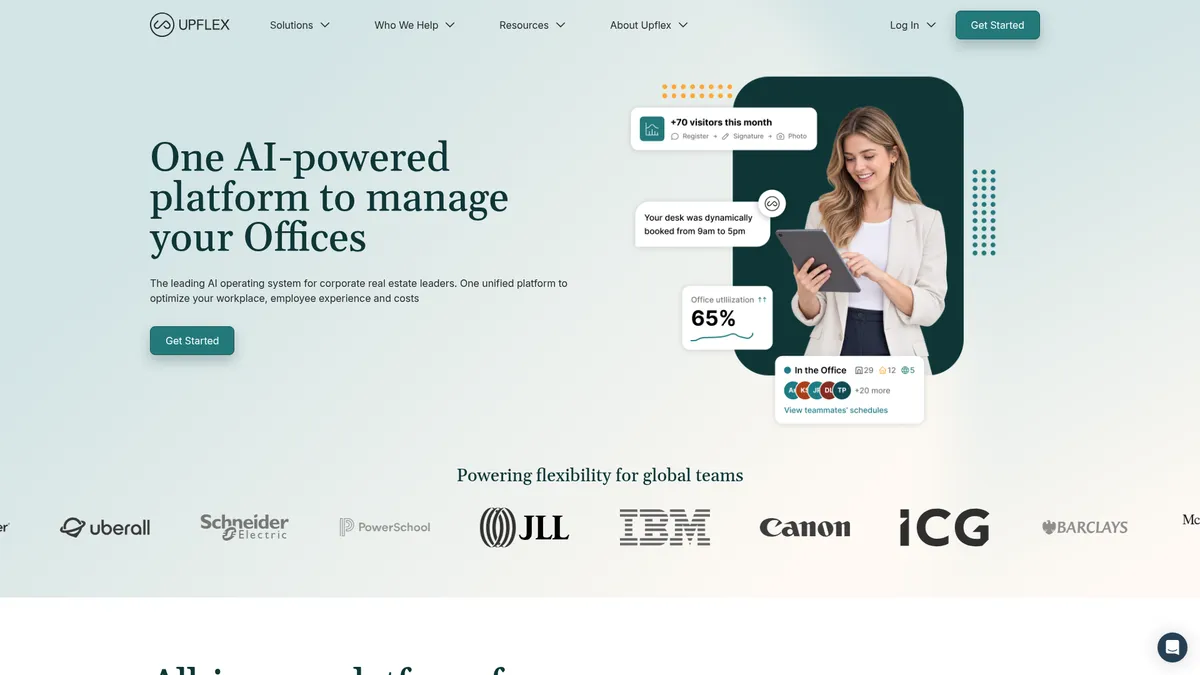
These platforms convert occupancy sensors and badge-swipe data into utilization rates per floor or location, showing exactly how much office space actually gets used.
The mechanism is straightforward: sensors under desks or in meeting rooms, combined with badge-in data, roll up into dashboards showing peak and average occupancy by day, floor, and building. Finance leaders use these numbers to argue for or against lease renewal with evidence instead of anecdote, a common gap when 63% of executives plan to reduce or reconfigure office space without hard usage data to back the decision [2].
This category fits portfolios with several owned or long-leased offices heading into renegotiation, where landlords and internal stakeholders both want proof before signing a smaller footprint. The stronger platforms in this space pair historical utilization with headcount forecasting trends, rather than offering only a snapshot of today's occupancy, a meaningful difference when the renewal decision is about next year's headcount, not last month's. Cost generally lands in the mid-range tier, often priced per square foot monitored or per sensor deployed, scaling with building size rather than seat count alone.
These platforms centralize lease documents, renewal dates, and payment schedules so finance teams never miss an option deadline or trigger a penalty clause.
The mechanism is document and date management at scale: every lease, amendment, and critical date gets logged in one system, with automated alerts ahead of renewal windows, escalation clauses, or termination options. For companies holding leases across multiple jurisdictions, this single record replaces a patchwork of spreadsheets and shared drives that are easy to lose track of during a leadership transition.
The benefit is compliance, not space optimization, these tools reduce audit risk tied to lease accounting standards and give finance teams a defensible paper trail when auditors ask how a liability was calculated. That makes this category best suited to finance teams managing large lease volumes across countries or business units, where a missed renewal notice can cost far more than the software itself.
The differentiator against other real estate portfolio management tools on this list: the focus stays on compliance workflows and audit trails, not day-to-day desk booking or space planning. Cost runs budget-friendly for smaller lease portfolios and climbs to premium for enterprise volumes spanning dozens of jurisdictions.
IWMS platforms bundle maintenance, space planning, and asset tracking into one record per location, built for companies that own as much real estate as they lease.
The mechanism consolidates facilities work orders, maintenance schedules, and space inventory into a single system of record, so a single building's data, square footage, HVAC service history, lease status, occupancy plan, lives in one place instead of three departments' separate tools. That consolidation matters most for companies managing a mix of owned buildings and leased offices, where facilities and finance teams historically work from different data sets entirely.
The core benefit is eliminating data silos: workplace experience teams, facilities managers, and finance leaders all pull from the same source instead of reconciling conflicting occupancy numbers before every board meeting. This fits companies with sizable owned real estate footprints alongside leased space, where maintenance and compliance obligations go well beyond what a booking app tracks.
The differentiator is depth, IWMS platforms handle facilities and maintenance workflows that lighter, booking-only tools skip entirely, from work order routing to asset lifecycle tracking. That depth comes at a cost: implementation scope typically pushes these into the premium/enterprise tier, with rollout timelines measured in months rather than weeks.
These tools predict office attendance by pattern-matching historical check-ins, calendar invites, and team schedules before anyone shows up. The underlying machine learning models look at who attended which days in the past, cross-reference upcoming meetings and team events, and output a projected headcount per location per day.
The benefit for corporate real estate leaders is concrete: commit to the space actually needed instead of guessing. Overbuild and you carry dead square footage; underbuild and employees show up to no open desks. Upflex's UnifyAI engine, for example, forecasts attendance with 97% accuracy, which gives real estate and finance teams a defensible number to plan around rather than a gut estimate.
This category fits companies with volatile hybrid attendance across several offices, locations where Tuesday looks nothing like Thursday and manual estimation breaks down fast. The differentiator is that forecasting here stands alone as a capability; it typically feeds into booking systems or lease-decision platforms rather than replacing them. Pricing sits in the mid-range tier, usually licensed per employee or per location, which makes it one of the more specialized entries among real estate portfolio management tools.
Desk and room booking systems let employees reserve space for the day, and once that data is aggregated across locations, it becomes a utilization dataset in its own right. Every reservation is a data point on which desks, floors, and offices actually get used, information most companies would otherwise have to collect through manual headcounts.
The immediate benefit is better day-to-day allocation. Teams avoid the scenario where everyone shows up Tuesday and half of them end up working from the kitchen counter because no desks were left. Booking systems smooth that out by capping reservations and giving visibility into which floors are filling up before employees commute in.
This category works best for companies that already have enough square footage but allocate it poorly, the problem is distribution, not total capacity. The differentiator against other tools on this list is scope: booking systems are operational and employee-facing, built for daily use rather than strategic decisions about which leases to renew or exit. Cost is generally budget-friendly, priced per seat, making it an accessible entry point before investing in broader portfolio tools.
These platforms connect real estate cost data directly to corporate finance systems through API or middleware integrations, pushing lease payments, occupancy costs, and utility spend straight into existing accounting software. Instead of someone exporting a spreadsheet from a facilities tool and re-entering it into the ERP, the numbers sync automatically.
That integration removes a recurring headache: manual reconciliation between what real estate is spending and what the company's budget says it should be spending. Finance teams dealing with lease escalations, multi-currency locations, or quarterly close cycles benefit most, since real estate costs flow into broader financial planning without duplicate data entry or version-control problems between departments.
This category is built for finance leaders first, CFOs and controllers who need real estate numbers inside the same system that tracks payroll, procurement, and revenue. The differentiator is architecture: these tools are designed around accounting system compatibility, with space utilization data treated as a secondary feature rather than the main product. Given the integration and implementation work required, pricing generally lands in the premium tier.
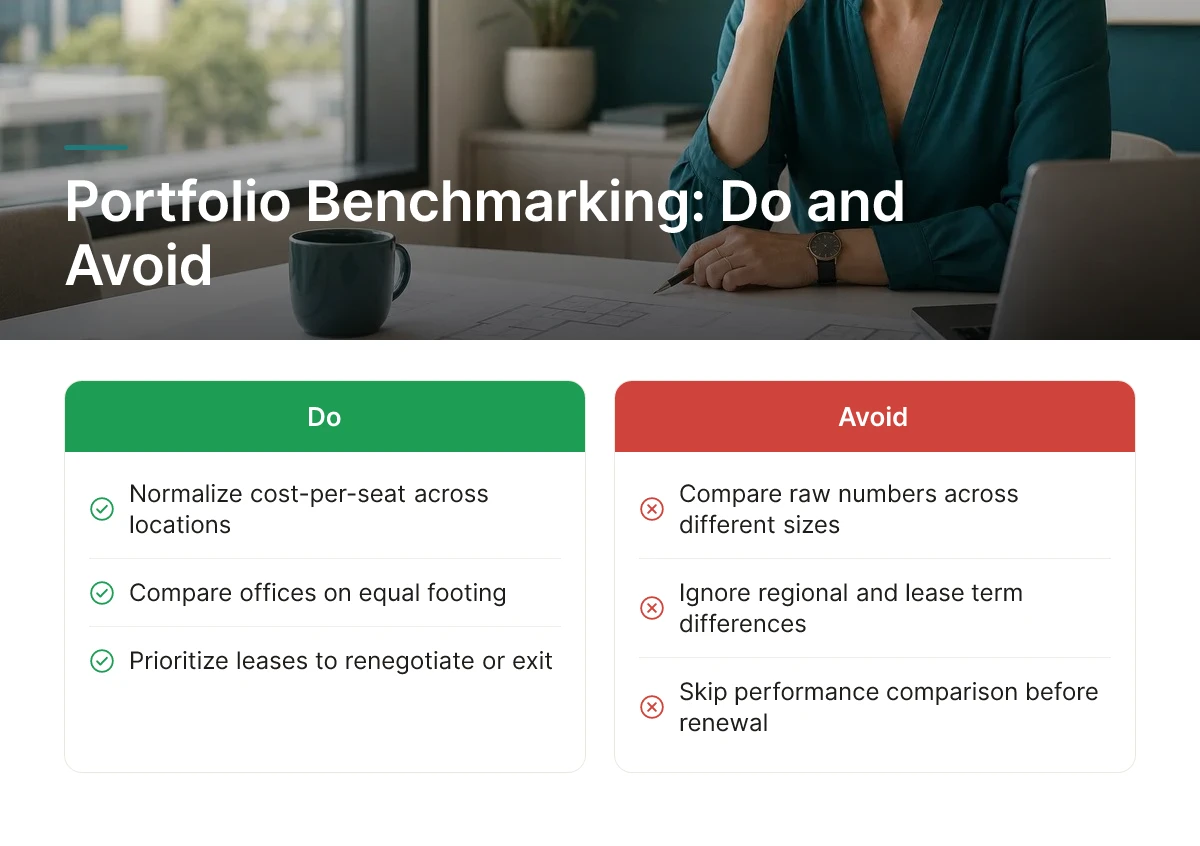
These dashboards normalize cost-per-seat and utilization rate across offices of different sizes, lease terms, and regions so leadership can compare them on equal footing. A 50,000-square-foot office in Chicago and a 10,000-square-foot satellite in Austin don't compare cleanly on raw numbers alone, normalization puts them on the same scale.
The payoff is a side-by-side view of location performance that tells leadership which leases to renegotiate or exit first. With 63% of executives planning to reduce or reconfigure office space within the year [2], this kind of prioritization has become a recurring board-level conversation rather than an annual exercise.
Multi-office companies needing a consolidated view for board or leadership reporting are the clearest fit. The differentiator here is purpose: these tools focus on reporting and visualization, not on operational booking or day-to-day forecasting, they're built to answer "where should we cut" rather than "who's coming in today." As a category within real estate portfolio management tools, pricing tends to sit in the mid-range tier, reflecting a reporting layer rather than a full operational platform.
Match tool complexity to portfolio size, hybrid policy maturity, and how deeply the platform needs to connect with existing finance systems.
A company with three or four offices may need nothing more than a booking system paired with basic utilization tracking. A company with dozens of locations across regions, carrying significant lease exposure and CFO scrutiny, justifies an integrated platform that combines forecasting, booking, and financial reporting in one view. Attendance variability is the deciding factor between fixed lease commitments and on-demand workspace access, stable, predictable attendance supports long-term leases, while volatile or seasonal patterns favor flexible access to external workspaces that can flex up or down without a multi-year commitment.
Check three things before signing a contract: compatibility with the existing accounting or ERP system, documented API availability for custom connections, and single sign-on support for security and IT approval. Missing any one of these turns a promising pilot into a manual data-entry project within six months.
Ask vendors directly about data residency (where occupancy and financial data is stored), access controls (who inside the company can see what), and audit logging for both financial and occupancy records. These questions matter more as real estate data increasingly overlaps with employee location and attendance information, which carries its own privacy considerations.
Timeline expectations should scale with portfolio size: smaller portfolios can pilot a new tool in a matter of weeks, while enterprise rollouts involving ERP integration and multi-region compliance reviews often take several months to go live.

Hybrid work shifts priorities from fixed square footage to flexible, attendance-driven capacity planning. With 63% of executives planning to reduce or reconfigure office space within the year [2], portfolio decisions now hinge on forecasting who shows up and when, not on locking in long-term leases based on headcount alone. Real estate leaders need utilization data before signing or renewing, not after.
Track utilization rate, cost per occupied desk, co-attendance against team targets, and lease expiration timelines across every location. Utilization alone is misleading without attendance forecasting layered on top, a desk that sits empty three days a week still carries full lease cost. Upflex tracks co-attendance against an 88% achievement benchmark alongside utilization, giving real estate and HR leaders a shared scorecard instead of competing numbers.
Compare real estate spend before and after consolidation against the cost of any new tools or flexible workspace access added to support the change. Start with baseline lease and operating costs, subtract post-consolidation costs plus platform and on-demand workspace fees, and factor in avoided costs like deferred expansions. Upflex customers use this framework alongside documented outcomes of 40%+ reduction in real estate spend to build the business case CFOs expect before approving a footprint cut.
Flexible access pays off when attendance is unpredictable, teams are distributed across cities, or a location doesn't justify a full lease. Traditional leases still make sense for stable, high-density anchor offices. The pattern playing out across the industry: JLL notes real estate is shifting from a fixed cost center toward a strategic, usage-based lever [3], which favors blending owned space with on-demand access rather than an all-or-nothing choice.
Most organizations see utilization and attendance data clear enough to act on within one to two quarters of deployment. Lease-level savings follow on a longer timeline tied to renewal dates, but the forecasting and booking data needed to justify consolidation decisions typically becomes reliable well before any lease event arrives.
Picking the right tool starts with the decision you're actually trying to make: track performance, forecast attendance, or justify a footprint cut to the CFO. Match the tool to that decision instead of buying for features you won't use. The strongest portfolios combine utilization data, attendance forecasting, and flexible workspace access so owned offices and on-demand space work as one system rather than two budgets. If a lease renewal or consolidation decision is on your calendar this year, start by pulling 90 days of utilization data, it's the baseline every other decision in this article depends on.
Explore more from our content library: