Share This Article
No items found.


Understanding why hybrid work needs better planning is essential. Hybrid work fails operationally when companies treat it as a policy memo instead of a planning problem spanning governance, real estate, and technology. Without structured rules for who's in when, and without real estate allocation tied to actual attendance patterns, organizations end up paying for underused space while employees face scheduling chaos. Better planning means building governance frameworks, forecasting attendance accurately, and matching workspace supply to measured demand, not guessing. Organizations that plan this way report meaningfully lower real estate overhead and fewer coordination breakdowns than those that roll out hybrid policies without a structured process.
Most rollouts stall at the same point: leadership sets a policy, like three days in office, but no one translates that into which teams sit where on which days. That gap between policy and operational planning is exactly why hybrid work needs better planning, not just a revised attendance mandate.
A policy memo answers "how often." It doesn't answer which desks get used on Tuesday, which teams need to overlap for collaboration, or how much square footage an office actually requires once attendance settles into a rhythm. Organizations that skip that second layer end up with policies that look decisive on paper and chaotic in practice.
Most hybrid rollouts miss their savings targets because real estate decisions get locked in before any attendance data exists, so space gets sized on guesswork rather than measured demand.
Lease renewals often come due well before a hybrid policy has run long enough to reveal real usage patterns. Facilities teams are forced to guess at occupancy, typically erring toward keeping more space than needed because downsizing against a hunch feels riskier than overpaying. Fentress's workplace planning framework for hybrid offices treats workforce analysis and attendance pattern evaluation as prerequisite steps precisely because skipping them undermines the rest of the plan [3]. Without that sequencing, companies pay for square footage based on what attendance might be, not what it is.
The office has shifted from a daily-capacity workspace sized for every employee to a coordination hub sized for scheduled overlap and team collaboration.
Eptura's research describes this shift as a long-term operating model that is changing how organizations plan, collaborate, and grow, with leaders redesigning spaces around changing attendance rhythms rather than fixed daily headcount [1]. A floor plan built for 2019-style full occupancy doesn't serve a model where the office's job is to bring specific teams together on specific days. Real estate strategy has to follow that functional shift, not preserve a footprint sized for a purpose the office no longer serves.
A structural reason these gaps persist: ownership is split. HR sets attendance policy, corporate real estate controls the lease and the floor plan, and IT runs the booking tool, three departments making decisions that affect the same square footage, often without a shared data source connecting them. Upflex addresses that fragmentation directly by combining attendance forecasting, desk booking, and real estate utilization data in one platform, so the three functions work from the same numbers instead of three separate spreadsheets.
Hybrid governance works best when it assigns clear decision rights: company-wide attendance targets set the floor, and teams decide which specific days they cluster within that floor. Top-down mandates ignore how real work actually clusters around projects and collaboration needs; pure team autonomy produces scattered attendance that makes real estate decisions impossible. The middle path is why hybrid work needs better planning that treats schedule-setting and space-planning as one decision, not two.
The mechanism connecting the two is straightforward. When teams anchor their in-office days to overlapping windows, say, every team picks two shared days instead of five scattered ones, the organization can shrink leased square footage without cutting anyone's access to a desk. Unpredictable attendance is what currently forces companies to hold onto space nobody's using most of the week [2].
A workable rollout follows five steps, each building on data rather than assumption.
Platforms built for this, including Upflex's UnifyAI forecasting engine, shorten this cycle by predicting attendance patterns before a pilot even starts, so the baseline and target-setting steps take weeks instead of a full quarter.
Survey preferred in-office days first, then negotiate the overlap, don't mandate fixed days and hope preferences fall in line. Most employees have a handful of days that work for commuting, caregiving, or focus time; the governance job is finding where those preferences intersect across a team, then setting that intersection as the anchor day. This reconciliation is also where structured hybrid models outperform informal ones: giving people a voice in scheduling while still enforcing a shared cadence reduces the friction that derails return-to-office pushes [2].
Governance isn't a one-time document. Build in a quarterly review that checks the policy against actual occupancy data, adjusting anchor days or targets as team composition and attendance patterns shift. A policy set once and left alone will drift out of sync with real usage within a few quarters, undercutting the real estate savings it was built to protect.

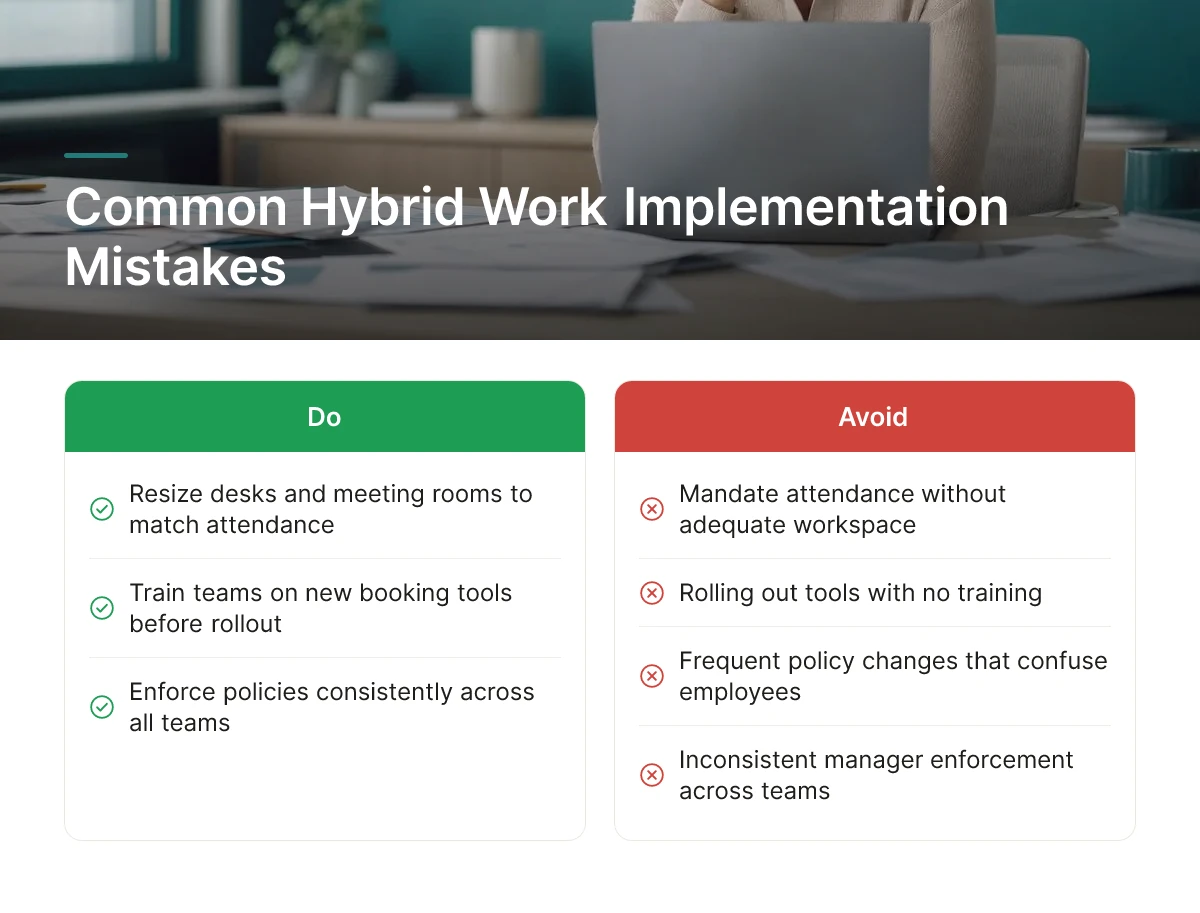
Most hybrid programs fail from four repeated errors: mismatched space and mandates, untrained rollouts, policy churn, and managers who enforce rules differently across teams.
The most damaging mistake is mandating attendance without the space to support it. A company tells employees to come in three days a week, but desks, meeting rooms, and parking haven't been resized to match, so the office feels more crowded and less useful than working from home. Close behind is rolling out a new booking tool with no training, which leaves adoption low and old habits (email chains, sticky notes on desks) intact within weeks.
Policy that changes faster than teams can adapt is another recurring problem. When guidelines shift quarter to quarter, employees stop trusting that the current rule will still apply next month, and planning efforts become pointless exercises. Research on hybrid plan failures points to poor communication as a central cause: about half of employees say they don't understand their organization's hybrid policy, which leaves room for managers and teams to interpret rules however suits them [5].
That gap is where manager-level inconsistency does the most damage. One manager enforces three-day attendance strictly; another lets the team coordinate informally. Employees compare notes, credibility in the policy collapses, and no amount of rewriting the document fixes it, the problem is enforcement, not wording.
Frame changes around team outcomes, better collaboration days, faster decisions, more focused heads-down time, rather than compliance language like "mandatory" or "tracked." Give managers a short set of talking points so every team hears the same reasoning, not five different improvised explanations. Run a feedback loop with a pilot group before full rollout; surfacing confusion early is cheaper than fixing a company-wide misunderstanding later.
Hybrid planning breaks down when informal exceptions accumulate, a manager here, a team there, until no one can predict who's actually showing up on a given day. This is precisely why hybrid work needs better planning: without a single process, occupancy forecasting becomes guesswork, and the cost-optimization case for a smaller footprint falls apart. The practical fix is one exception-approval process and a shared, visible calendar that shows planned attendance across teams. Upflex's UnifyAI engine, for instance, replaces that guesswork with attendance forecasting built on actual scheduling and utilization data, so leaders see real occupancy patterns instead of relying on managers' individual judgment calls.
Proving ROI requires tracking cost-per-seat, forecast accuracy, day-by-day utilization, and retention together, not occupancy badge swipes alone. This is where why hybrid work needs better planning becomes a measurement question, not just a policy one. Without a defined set of metrics, leaders are left arguing about anecdotes instead of trends.
Four numbers do most of the work. Real estate cost per occupied seat tells you whether square footage is actually earning its keep, not just whether a lease is signed. Attendance forecast accuracy versus actual turnout tells you whether your planning assumptions hold up week over week. Space utilization rate broken out by day, Tuesday through Thursday almost always outperforms Monday and Friday, exposes where consolidation is viable without creating a scramble for desks. Employee retention and satisfaction, segmented by how much schedule flexibility a team actually gets, connects the real estate decision back to the workforce outcome finance and HR both care about.
Occupancy alone is a vanity metric, a floor can look busy and still be losing money if cost-per-seat is bloated or if the people in the building aren't the people who needed to collaborate that day. Good measurement pairs utilization with cost-per-seat and a read on whether teams actually hit their in-person collaboration goals, not just whether anyone showed up.
The absence of this pairing shows up in two failure patterns. Poor forecasting either overbooks the office, eliminating the flexibility that made hybrid attractive in the first place, or leaves a leased floor underused, which erases the cost case for keeping it. Upflex's UnifyAI engine addresses this directly, forecasting attendance with 97% accuracy and reporting against an 88% co-attendance benchmark, so real estate and HR leaders see both sides of the equation in one dashboard rather than reconciling spreadsheets after the fact.
Building the internal business case doesn't require a research department. Baseline current cost per seat and utilization before making changes, track the same four metrics every quarter, and present the trend line rather than a single snapshot, a single good week proves nothing, but six consecutive quarters of declining cost-per-seat alongside stable or improving retention is a case finance will approve.
A coordination stack needs four functions working together: attendance forecasting, real-time desk and room booking, cross-location workspace access, and reporting tied back to the metrics governance already defined. Miss one, and the other three lose much of their value, this is the practical reason why hybrid work needs better planning rather than a single new tool bolted onto an old process.
AI-driven forecasting differs from manual spreadsheet planning because it updates predictions continuously, pulling from live booking activity and badge-swipe patterns instead of a static quarterly survey. A quarterly headcount survey tells a real estate leader what people said they'd do three months ago. A system that recalculates daily off actual booking and access-card data tells them what's happening this week, and adjusts as patterns shift.
Upflex's UnifyAI engine works this way, forecasting attendance with 97% accuracy and feeding that forecast directly into desk booking and space-management workflows. The practical difference shows up in co-attendance: when forecasting is accurate enough to coordinate which days teams actually overlap, organizations using this approach have reached 88% co-attendance achievement against their stated targets. That's a governance metric made achievable by the technology underneath it, not a separate initiative.
The stack needs to connect scheduling data to calendar systems and real estate records, because disconnected tools force employees and facilities teams into duplicate manual entry that erodes adoption within weeks. If a booking tool doesn't sync with Outlook or Google Calendar, people stop using it and fall back to Slack messages and guesswork, which is exactly the fragmentation better planning is meant to eliminate.
The second piece is access to space beyond the owned portfolio. A flexible, on-demand workspace network lets a company absorb variable attendance, a product team's three-day sprint, a sales group traveling through a city without a formal office, without signing a new lease to cover demand that might not recur. Upflex provides access to the world's largest on-demand workspace network alongside its own booking and forecasting tools, treating external space as one lever in a broader portfolio strategy rather than a replacement for it.
Evaluate any dedicated workspace orchestration platform against these four functions and the integration question before adopting it, a tool that handles booking well but can't forecast, report, or connect to existing calendar and real estate systems will solve one problem while recreating the others.
Most organizations settle somewhere between two and three in-office days, but the right number depends on team function and collaboration needs, not a company-wide average. A product team with daily dependencies may need three overlapping days, while a sales team spread across regions may need one. Fixed anchor days work better than a blanket rule applied to every department.
Organizations typically choose among role-based, team-based, schedule-based, flexible, or location-based hybrid models, each assigning in-office time differently [1]. Role-based schedules tie attendance to job function, team-based schedules sync whole departments on shared days, and schedule-based models set fixed weekly patterns. Flexible and location-based models give employees more say but require stronger forecasting to avoid empty offices or overcrowded days.
No, hybrid work has shifted from a temporary pandemic response into a durable operating model that most enterprises now plan around permanently [1]. Leaders are redesigning space, budgets, and systems around hybrid attendance patterns rather than treating it as transitional. The open question isn't whether hybrid continues, but whether it's planned well enough to control cost.
At minimum, you need attendance forecasting, desk booking, and a way to see real-time space utilization across your portfolio. Spreadsheets and badge data alone can't predict who's coming in on a given day. Platforms like Upflex combine AI-driven forecasting, accurate to 97%, with desk booking and on-demand workspace access, giving real estate and HR leaders one system instead of a patchwork of disconnected tools.
Hybrid work fails when it's treated as a policy memo instead of an operating system. The leaders getting results are the ones pairing clear attendance expectations with real forecasting data, then letting that data drive lease, consolidation, and space-design decisions, not guesswork. Poor communication and mismatched space are the two failure points worth fixing first [5].
Start by pulling your last 90 days of badge or booking data and comparing it against your current lease footprint. If the gap is wide, that's your business case for a forecasting-driven platform like Upflex before your next renewal date arrives.
Explore more from our content library: