Share This Article
No items found.


Understanding why is real estate a major cost is essential. Real estate ranks as the second-biggest operating cost after payroll because it combines a large fixed commitment (lease or mortgage obligations signed years in advance) with costs that keep accruing whether or not the space gets used, utilities, maintenance, insurance, and amenities. Most organizations also pay for far more square footage than employees actually occupy on any given day, since office attendance fluctuates but leases don't. That gap between paid-for space and used space is what turns real estate from a fixed line item into a controllable one, the core lever being how much space you hold versus how much you need at any moment.
Real estate behaves like a fixed obligation signed years in advance, while payroll can flex within a single quarter through hiring freezes or attrition, that structural gap is why is real estate a major cost on nearly every corporate balance sheet.
A lease typically locks in a company for five to ten years, sometimes longer when capital improvements are involved. Payroll, by contrast, adjusts in weeks: a hiring slowdown, a round of attrition, or a reorg can shrink the headcount line almost immediately. Real estate commitments don't move that way. A CFO can freeze hiring tomorrow, but breaking a lease early usually means penalties, subletting headaches, or buyout negotiations that take months to unwind.
Real estate sits right behind payroll as the second-largest line on the operating budget, and it holds that position because it can't be throttled the way a software subscription can [3]. A SaaS tool can be downgraded or canceled at the next renewal. A real estate footprint, once leased or built, stays on the books regardless of how many employees show up to use it.
That rigidity is exactly why real estate accumulates into a top-two expense over time even when usage patterns shift. Headcount can be managed in near real time; square footage cannot.
The base lease or mortgage payment is only the starting point. Total real estate expense also includes:
None of these costs scale down automatically when fewer employees come in. A half-empty floor still needs its lights on, its carpets cleaned, and its entrances staffed, the building doesn't know it's underused. Global utilization rates hover around 50% [3], meaning many organizations are paying the full weight of this cost stack for space that sits idle half the time.
That combination, a commitment that can't shrink quickly, layered with running costs that don't care about occupancy, is the structural reason real estate outpaces nearly every other line item except payroll itself.
The gap between leased square footage and actually-used square footage is the single biggest lever for cutting real estate spend, and it's a gap most companies never measure closely. A desk or floor costs the same whether 90% of seats are empty or full, rent, utilities, cleaning, and security run on a fixed clock, not an attendance sheet. This is a core reason why is real estate a major cost for companies that signed leases based on headcount projections rather than actual daily presence.
Desks sit empty for reasons that have nothing to do with capacity planning gone wrong: employees travel for client meetings, work from home on focus days, or spend the day off-site entirely. None of that reduces the bill. Global utilization rates hover around 50% according to one hybrid occupancy benchmarking report, meaning roughly half the square footage a company pays for goes unoccupied on any given day [3].
That gap compounds in a way spreadsheets often hide. Fixed costs, lease payments, HVAC, janitorial contracts, get divided across however many people actually show up, not the number of badges issued. When occupancy drops, the cost per person in the building climbs even though total spend hasn't changed. Stretched across a five- or ten-year lease term, a persistent utilization gap turns into years of paying premium rent for space nobody occupies [3].
Lowering the cost-per-used-desk means shrinking the denominator problem directly: consolidate underused floors, right-size allocations by team, and reassign zones that sit idle most weeks. Rightsizing has become a standard response to hybrid attendance patterns, with companies renegotiating leases around actual occupancy rather than historical headcount [1].
The right ratio of desks to employees isn't universal. A sales team that spends most of its week on the road or at client sites needs a fraction of the fixed space an engineering team requires, since engineers tend to cluster around collaborative work that benefits from dedicated desks and meeting rooms. Treating every department the same when allocating space guarantees waste somewhere. This is where attendance forecasting earns its keep: Upflex's UnifyAI engine predicts office attendance with 97% accuracy, giving corporate real estate leaders the data to allocate space by actual team behavior instead of guesswork, and to consolidate the floors that don't earn their cost.
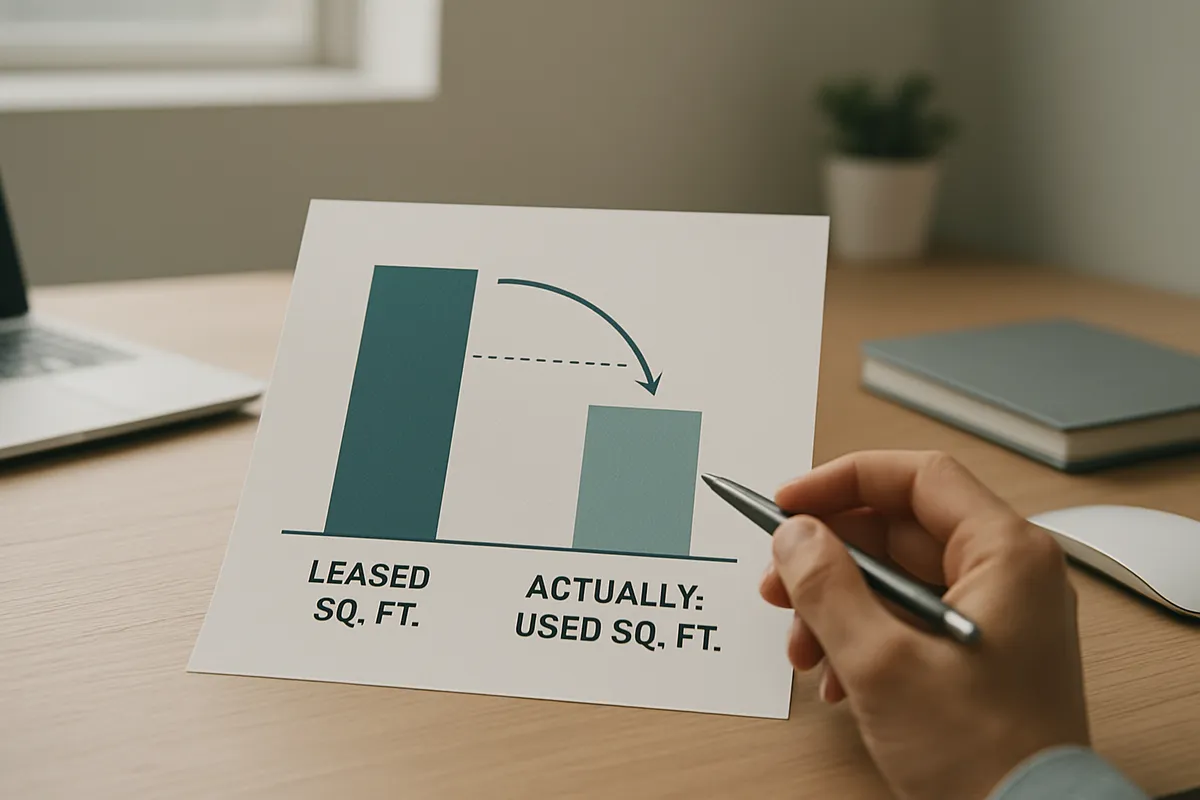
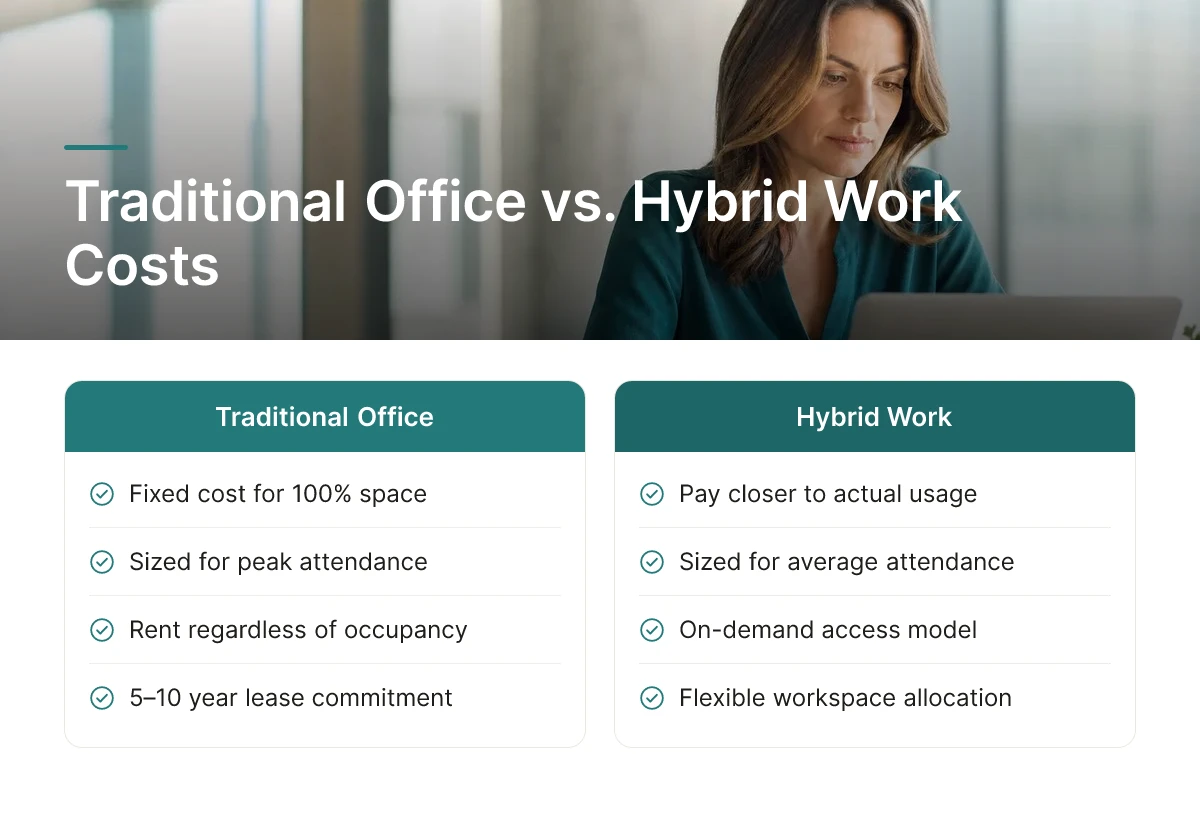
A fully leased office charges you for 100% of the space every day, whether 90% of desks sit empty or every seat is full, hybrid work with on-demand access lets you pay closer to what you actually use.
A traditional lease is a fixed cost. You sign for a set square footage, usually for five to ten years, and the rent, utilities, and maintenance bill arrive regardless of how many employees show up on a given Tuesday. That's a core reason why real estate is a major cost on most corporate balance sheets, it's sized for peak attendance, not average attendance, and global utilization still hovers around 50% [3]. A hybrid model breaks that rigidity apart. Instead of provisioning every seat for the busiest possible day, you shrink the owned footprint to match typical in-office demand and convert the overflow into variable, usage-based spend through on-demand workspace.
Savings come from closing the gap between peak-day capacity and average daily use, not from cutting the office entirely.
Under a dedicated-lease model, a company pays for the square footage needed to seat everyone on the one or two days a week attendance spikes, typically Tuesday through Thursday. Upflex addresses that gap with UnifyAI, which forecasts attendance with 97% accuracy so real estate teams can right-size the core office around actual demand, then route overflow employees to a global on-demand workspace network rather than holding spare desks year-round. Customers using this approach have documented real estate spend reductions of 40% or more while still hitting an 88% co-attendance achievement benchmark, proof that smaller, better-coordinated space can outperform a larger, half-empty one.
Transitions carry real costs that are easy to underestimate: lease exit penalties, overlapping rent, reconfiguration, and the time it takes employees to adjust.
Hybrid is not automatically cheaper. A poorly managed rollout leaves a company paying for an underused core office and an uncoordinated pile of ad hoc flexible bookings on top of it, the worst of both cost structures. The fix is coordination: pairing a budget-friendly core footprint with premium on-demand access only where and when forecasted demand actually requires it, rather than defaulting to both at full scale.
Benchmark against your own trend line first, then adjust for region and industry, raw comparisons to other companies' totals are rarely meaningful without that context.
Most teams trying to understand why is real estate a major cost start by hunting for an external number to measure themselves against. That instinct is reasonable but often misleading. Real estate portfolios differ too much in age, location, lease structure, and workforce composition for a single external figure to tell you much. A more reliable approach combines a small set of internal metrics, tracked consistently over time, with honest adjustments for where and how your company operates.
Four metrics give corporate real estate and finance leaders a working picture of whether space spend is under control. Cost per employee shows how much the portfolio costs relative to headcount, independent of square footage. Cost per square foot isolates the price of the real estate itself, separate from how many people occupy it. Occupancy rate versus capacity reveals the gap between what you're paying for and what's actually in use, often the most telling number in a hybrid environment. Space cost as a percentage of total operating budget puts real estate in context against payroll and other major expense lines, which is usually how the conversation surfaces with the CFO in the first place.
The value of these metrics comes from watching them move over quarters and years, not from matching them to an unverified industry average. If cost per employee climbed 15% over two years while occupancy stayed flat or dropped, that trend tells you something concrete about your own portfolio, regardless of what a peer company reports. Internal trend data is also harder to dispute internally, since it's drawn from your own lease documents, payroll records, and badge or booking systems rather than a third-party survey of unknown methodology.
What counts as "normal" space cost shifts sharply by geography and sector, which is part of why is real estate a major cost in ways that resist one-size-fits-all comparison. A professional services firm leasing floors in a dense urban core carries a different baseline cost structure than a logistics company operating warehouses in a secondary market. Office-heavy industries like finance and technology also tend to carry more square footage per employee than industries built around fieldwork or distributed operations. Comparing your cost per square foot directly against a company in a different metro or sector will produce a misleading conclusion even if the math is correct.
Pairing financial metrics with utilization data closes the remaining gap. Badge swipes, desk booking records, and occupancy sensors show how space is actually used, which turns a cost-per-square-foot figure from a lease-term abstraction into a measure of real value delivered. Upflex's UnifyAI engine forecasts attendance with 97% accuracy, giving real estate and workplace teams utilization data precise enough to validate whether a given cost per square foot reflects genuine demand or legacy lease terms nobody has revisited. When comparing across the organization or against outside reference points, always normalize to per-employee or per-square-foot ratios, comparing raw total real estate spend between a 2,000-person company and a 20,000-person company tells you nothing useful.
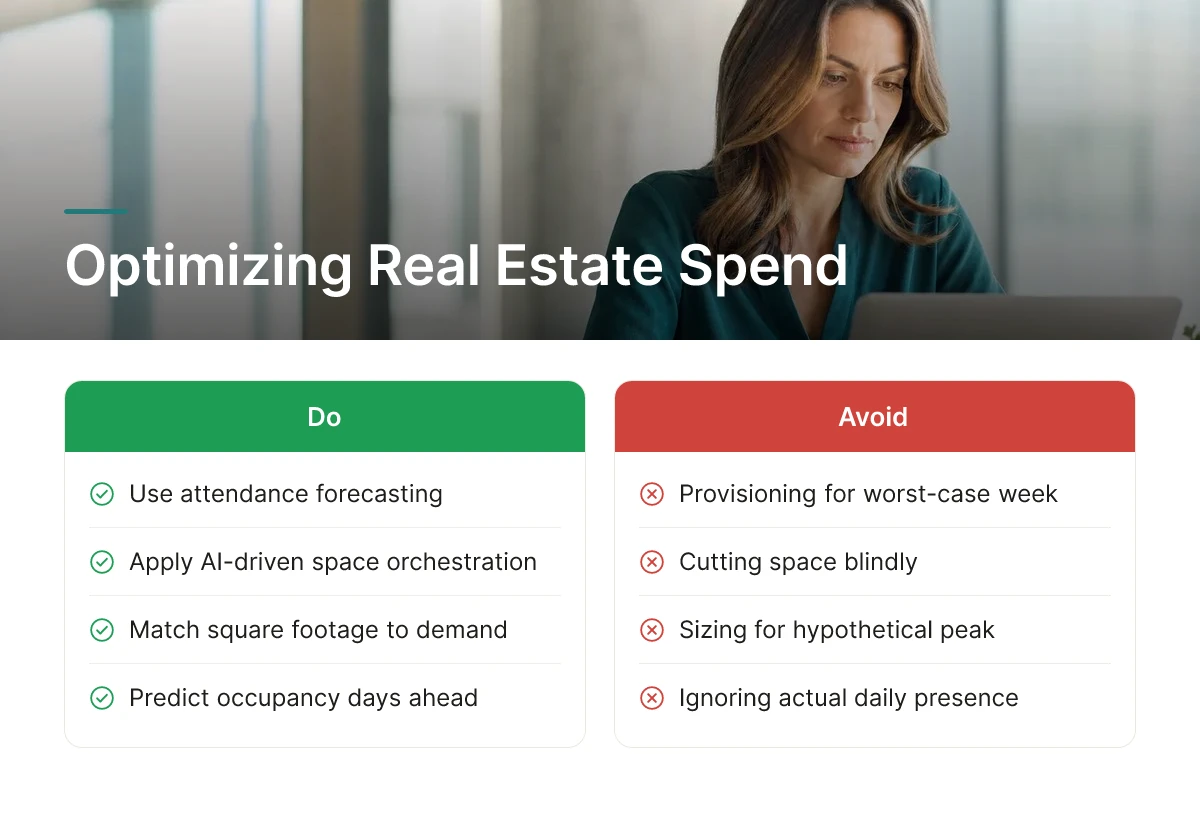
The fix combines attendance forecasting, AI-driven space orchestration, flexible workspace access, and sharing policies that match square footage to actual demand rather than cutting it blindly.
Understanding why is real estate a major cost only matters if it leads to action. Most portfolios are sized for the worst case, the one week a quarter when every team shows up at once, which means the other 47 weeks, a large share of the floor plan sits empty [3]. Forecasting breaks that pattern. Instead of provisioning for a hypothetical peak, a company can predict, days or weeks ahead, how many people will actually be in which building on which day, and size space decisions around that real number instead of a worst-case guess.
Orchestration software matches available desks and rooms to predicted attendance in real time, so a company stops holding excess square footage as a buffer against uncertainty.
Upflex's UnifyAI engine forecasts attendance at 97% accuracy and feeds that prediction directly into desk booking and space assignment, so facilities teams know which floors to open, which to consolidate for the day, and where to route overflow before anyone arrives. That's different from simply tracking badge swipes after the fact. The forecast lets a team act ahead of demand, closing a floor on a predicted low-attendance Friday, for instance, rather than reacting to an empty building after the lease is already paid for. Enterprises using this kind of coordination have reported real estate spend reductions above 40% alongside 88% co-attendance achievement, meaning teams still show up together on the days that matter for collaboration, not fewer days overall.
A flexible workspace network turns fixed lease cost into variable, pay-for-use cost by giving employees on-demand access to space in locations the company doesn't own.
A long-term lease is a fixed cost regardless of how many desks sit empty on a given day. On-demand access to third-party workspaces changes that math: a company pays only when an employee actually needs a desk in a given city, not for twelve months of capacity in case someone travels there. Upflex gives employees access to the largest on-demand workspace network available, so a distributed sales team or a traveling executive can book a desk near a client without the company holding a permanent office in every market its people pass through.
The goal is matching supply to demand, not cutting square footage across the board, careless cuts just relocate the productivity problem instead of solving the cost problem.
Not for every organization, but it holds true across most corporate office portfolios. Real estate is typically the second largest expense line behind salaries [3]. Exceptions exist for asset-heavy industries like manufacturing or logistics, where equipment, inventory, or transportation can outrank office space on the balance sheet.
Not automatically, it depends on lease structure, timing, and how the space is reconfigured. Cutting square footage without exiting or subleasing unused terms can leave fixed lease obligations in place. Real savings require matching the footprint reduction to actual utilization data, not just a headcount estimate.
Timelines usually run from several months to a few years, depending on lease terms and portfolio size. Companies with leases nearing renewal can move fastest, often consolidating within one budget cycle. Those locked into long-term leases typically wait for break clauses or renewal windows, using utilization data in the meantime to build the case for downsizing.
Cost per square foot measures space efficiency; cost per employee measures how real estate spend translates to headcount support. A low cost-per-square-foot figure can still produce high cost-per-employee numbers if utilization is poor. Corporate real estate leaders increasingly track both, since utilization rates hovering near 50% [3] distort square-footage metrics alone.
Real estate ranks as a top operating expense because fixed leases keep running regardless of how many desks sit empty, and most portfolios still operate near 50% utilization [3]. The fix isn't guessing at headcount, it's pairing accurate attendance forecasting with flexible access to space. Upflex combines UnifyAI's 97% accurate attendance forecasting with desk booking and a global on-demand workspace network, giving corporate real estate and finance leaders the utilization data needed to consolidate with confidence. Start by pulling your current utilization numbers against your next lease renewal date, that comparison usually reveals the first square footage worth cutting.
Explore more from our content library: