Share This Article
No items found.


Finding office space in Vancouver means choosing between coworking memberships, traditional leases, and virtual offices, each with distinct cost profiles and flexibility trade-offs. Downtown Vancouver Class A space runs roughly CAD $45–$65 per sq ft annually, while coworking desks start near CAD $300/month. The right choice depends on your team size, growth trajectory, and how often people actually show up.
Vancouver offers three distinct office models — traditional lease, coworking, and virtual office — each suited to a different team size and work pattern. Understanding the trade-offs between these models is the first step toward making a cost-effective real estate decision. This is particularly relevant for office space in vancouver.
Traditional leases for Class A commercial space in Vancouver's downtown core run CAD $45–$65 per sq ft annually on 3–5 year terms. Shorter terms are available, but expect to pay a 15–25% premium for the added flexibility.
At scale, roughly 20 or more people, a direct lease typically delivers the lowest cost per square foot. Below that threshold, coworking is usually the smarter financial choice. Hot-desk memberships at providers like WeWork and Regus start around CAD $300/month per person; dedicated desks run up to CAD $900/month.
On-demand workspace platforms take a different approach: your team pays only for the days they actually use a desk. For a hybrid workforce that comes in two or three days a week, that model can cut real estate spend by 40%+ compared to holding a fixed lease year-round. Upflex, for example, combines on-demand access to a global workspace network with AI-powered attendance forecasting, so you book space based on who is actually coming in, not a rough estimate.
When evaluating coworking providers, it helps to compare what is included in the monthly rate. Some operators bundle amenities like printing, phone booths, and meeting room credits, while others charge separately for each. According to Vancouver commercial listings on Craigslist, the range of available office configurations across the city is broad, from single-desk suites to full-floor opportunities, giving businesses of every size a starting point for comparison shopping.
"The biggest mistake growing companies make is signing a lease based on their best-case headcount scenario rather than their realistic day-to-day attendance. In a hybrid world, that gap can cost you hundreds of thousands of dollars over a five-year term." — Sarah Kimura, Commercial Real Estate Advisor, BC Tenant Advisory Group
A virtual office in Vancouver costs CAD $50–$150/month and provides a registered business address plus mail handling — no physical desk is included.
This model works for remote-first teams that need a local presence for client credibility or regulatory purposes. It does not work for teams that need regular in-person collaboration. If your people come in even one or two days a week, a coworking membership or on-demand workspace will serve them better than a mailbox.
| Model | Typical Cost (CAD) | Best For |
|---|---|---|
| Traditional Lease | $45–$65/sq ft/year | Teams of 20+ with predictable attendance |
| Coworking / On-Demand | $300–$900/person/month | Hybrid teams needing flexibility |
| Virtual Office | $50–$150/month | Remote-first teams needing a local address |
Vancouver office rents range from CAD $20 to $65 per sq ft per year depending on neighborhood — a gap wide enough to change your entire real estate budget. Choosing the right submarket requires balancing rent savings against commute burden, talent access, and client-facing credibility.
The Burrard-to-Granville corridor commands the highest office rents in the city, with Class A space running CAD $55–$65 per sq ft per year. That premium buys direct SkyTrain and bus access, the highest foot traffic in Metro Vancouver, and the client-facing credibility that matters for professional services, finance, and law firms.
For teams that host clients weekly, the address pays for itself. For teams that rarely see external visitors, you're paying for a postal code, not productivity. When considering office space in vancouver, this point stands out.
Mount Pleasant and Main Street offer Class B creative workspace at CAD $30–$45 per sq ft per year, roughly 30–40% below Downtown rates. Tech and creative firms have anchored here for a decade, drawn by the neighborhood's walkability and a 10–15 minute transit commute to the core.
Burnaby — specifically Metrotown and Brentwood — drops further to CAD $25–$38 per sq ft, with ample surface and structured parking and Millennium Line SkyTrain access. Back-office, engineering, and operations teams that rarely host clients find the savings significant without meaningful productivity loss. For more information, see Senejac.
Richmond and Surrey push rates down to CAD $20–$30 per sq ft, but add 30–45 minutes of commute time each way from Downtown. That commute burden directly affects hybrid attendance — a reality that tools like Upflex's UnifyAI attendance forecasting (97% accuracy) can quantify before you sign a lease, showing exactly how a location change shifts who actually shows up each week.
Beyond rent per square foot, the following factors should inform your neighborhood decision:
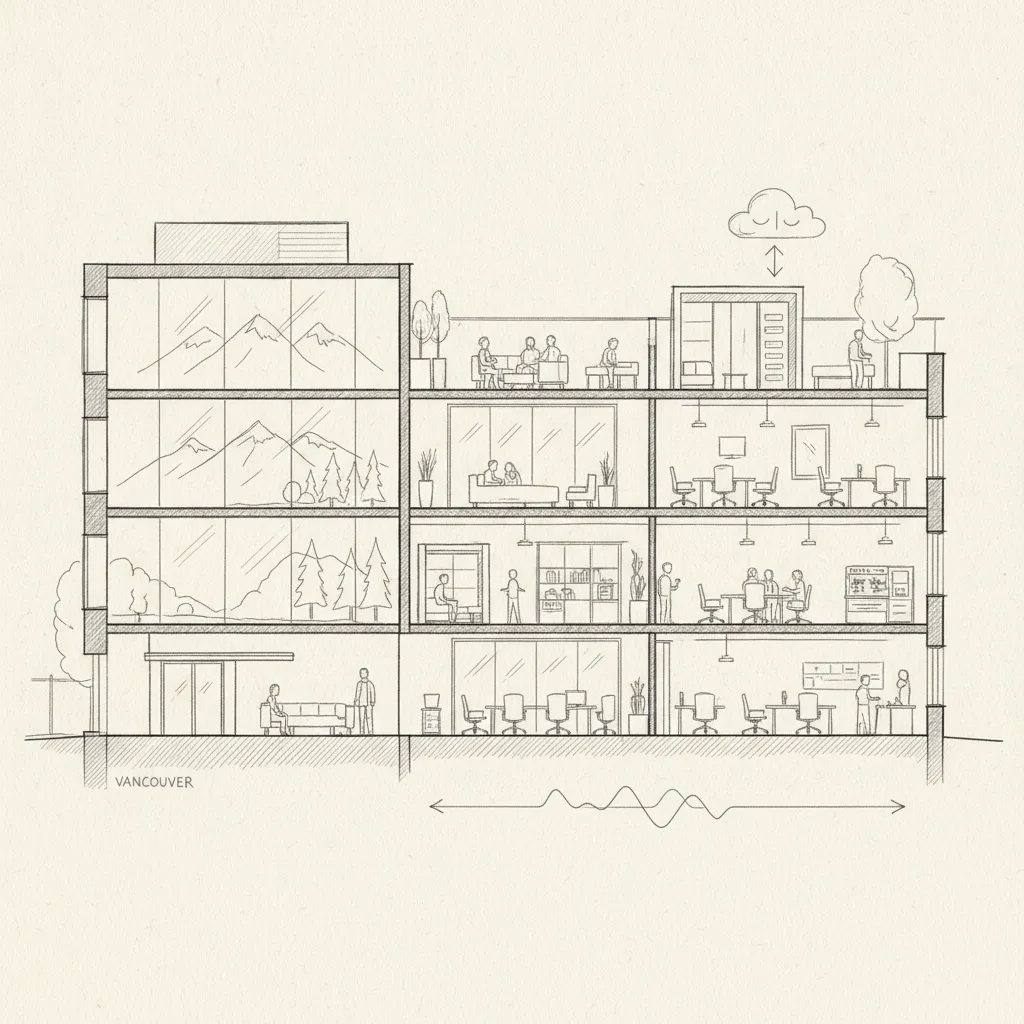
Before signing any lease for commercial space in Vancouver, run every option through six criteria: scalability, amenities, lease flexibility, hidden costs, build-out support, and attendance fit.
Start with scalability. Confirm whether the lease includes a contraction clause — the right to exit or reduce square footage if headcount drops by 20% or more. Most Vancouver landlords will negotiate this on leases over three years, but you must ask for it explicitly before heads of terms are agreed.
Lease structure determines your cost ceiling. Month-to-month coworking memberships run 30–40% more per desk than a 12-month agreement. Calculate the break-even point: if your team's headcount is stable for at least 12 months, a fixed-term agreement almost always wins on unit cost. If growth is uncertain, that premium buys real optionality.
Quantify hidden costs before you sign. CAM (common area maintenance) charges can add CAD $8–$15 per square foot annually on top of base rent. Downtown parking runs CAD $200–$400 per stall per month. Tenant improvement (TI) allowances — typically CAD $50–$100 per square foot — can offset fit-out costs substantially, so always negotiate TI into the deal rather than accepting a bare-shell rate.
"Tenants who come to the table with real utilization data — actual badge swipes, calendar bookings, attendance trends — consistently negotiate better lease terms. Landlords respond to evidence, not estimates." — David Okafor, Director of Workplace Strategy, Pacific Realty Advisors
Run a hard amenity audit on every shortlisted space. The following checklist covers the essentials that Vancouver-based teams consistently flag as deal-breakers: For those exploring office space in vancouver, this matters.
Finally, match square footage to actual attendance. If your team averages 60% in-office attendance on peak days, you need roughly 40% less space than a five-day model requires. Measure real peak-day occupancy — using utilization data from a platform like Upflex, which forecasts attendance with 97% accuracy — before you commit to a floor plate you may never fill.
The costliest errors in leasing commercial space in Vancouver fall into five categories, each preventable with the right data and professional support before you sign.
Signing a 10,000 sq ft lease because you hit 80 people in the office once is a common trap. If your average daily attendance is 50, you're paying for 2,000–3,000 sq ft of dead space every day. BC's subletting rules are restrictive, and most commercial leases require landlord consent to sublet, meaning you may be stuck absorbing that cost for years.
Not every building permits every business type. The City of Vancouver's zoning bylaws define use classes — office, light industrial, retail — and your intended use must match the building's zoning certificate. Confirm this before signing, not after your fit-out is underway.
Tenant rep brokers in BC are paid by the landlord, so their service costs you nothing. Teams that bypass them routinely leave CAD $15–$30 per sq ft in tenant improvement allowances on the table — money that could fund your entire fit-out.
Vancouver permitting for office fit-outs averages 8–14 weeks. Signing a lease with a 30-day move-in expectation creates expensive overlap — you'll pay both rent and interim coworking fees simultaneously while permits clear.
Committing to fixed square footage before you know your real peak-day headcount is the most expensive mistake of all. Spend 3–6 months using on-demand workspaces to establish actual attendance patterns. Platforms like Upflex combine on-demand workspace access with AI-powered attendance forecasting — its UnifyAI engine predicts office attendance with 97% accuracy — so you can enter lease negotiations with hard utilization data rather than a headcount guess.
Class A office space in Vancouver averages CAD $40–$55 per square foot annually, which works out to roughly CAD $3,300–$4,600 per month for a 1,000-square-foot suite. Rates vary by submarket: downtown Vancouver commands the highest rents, while Broadway Corridor and East Vancouver run 15–25% lower. Sublease availability has pushed effective rents down in some buildings, so negotiating tenant improvement allowances and free-rent periods is realistic in the current market.
Yes, coworking spaces, serviced offices, and flex operators across Vancouver offer month-to-month terms with no long-term commitment. Traditional landlords rarely offer this flexibility on direct leases, which typically run 3–10 years. For teams that need short-term space while evaluating a permanent location, on-demand workspace platforms give you access to professional environments across the city without locking into a lease you may outgrow or underuse.
For small teams, coworking is almost always cheaper when you factor in total occupancy cost. A private office for 4–6 people at a Vancouver coworking space typically runs CAD $2,000–$4,500 per month all-in, including utilities, internet, and meeting room credits. A direct lease adds fit-out costs, operating expenses, and property tax on top of base rent, making the true cost of a traditional lease 30–50% higher than the headline rate suggests. This directly impacts office space in vancouver outcomes.
Mount Pleasant and the Broadway Corridor are the top choices for tech startups in Vancouver. Both areas offer lower rents than the CBD, strong transit access via the Millennium Line Broadway extension, and a concentration of tech tenants — including Amazon's Vancouver campus on West Georgia and a cluster of scale-ups along Broadway. Gastown is also popular for early-stage companies that prioritize creative character and proximity to the downtown talent pool.
A team of 10 typically needs 1,500–2,000 square feet under a traditional density standard of 150–200 sq ft per person. Under a hybrid model, where 60–70% of staff are in on any given day, that footprint can drop to 900–1,200 square feet without sacrificing comfort. Attendance forecasting tools that predict daily headcount let you size space to actual usage rather than theoretical headcount, avoiding the cost of carrying desks that sit empty most of the week.
Finding the right workspace in Vancouver comes down to three decisions: choosing the submarket that matches your talent and budget priorities, selecting a lease structure that fits your team's actual attendance patterns, and sizing your footprint to real usage — not headcount on paper.
If your team operates on a hybrid schedule, start by tracking which days employees actually come in before committing to square footage. The gap between assumed and actual attendance is where most real estate spend gets wasted.
As a concrete next step, run a 30-day attendance audit using calendar and badge data, then map that against your current or target lease size. If you want to automate that process, request an Upflex demo to see how UnifyAI forecasts daily attendance with 97% accuracy, so your Vancouver office decision is backed by data, not guesswork. You can also browse current Vancouver office and commercial listings to get a real-time sense of availability and pricing across submarkets before entering formal negotiations.
Explore more from our content library: