Share This Article
No items found.


Understanding why real estate portfolio management matters is essential. Real estate portfolio management matters to the board because office space is one of the largest controllable cost lines on the balance sheet, and getting it wrong means paying for empty desks while failing to support hybrid work. A deliberate portfolio strategy ties space decisions to attendance data, cost targets, and employee experience, giving leaders a defensible way to right-size locations, cut waste, and show the board measurable progress instead of guesswork. Done well, it turns real estate from a fixed liability into a flexible lever for business outcomes.
Hybrid work broke the assumption that leases could be sized to headcount, which is exactly why real estate portfolio management matters now more than it did five years ago. When attendance becomes variable instead of fixed, the gap between what a company pays for and what it actually uses turns into a recurring cost problem rather than a one-time inefficiency.
Most office leases were signed on the assumption that every desk would be occupied five days a week, but hybrid schedules now put real occupancy closer to half that level. US office occupancy only reached 50% for the first time since the pandemic as recently as January 2023 [3], years after hybrid work became standard practice. That gap between contracted capacity and actual usage is stranded cost: square footage a company pays for every month regardless of whether anyone sits in it. EY's Future Workplace Index found more than 70% of employees working from home two to three days a week [1], which means the Monday-Friday office built for full attendance is now mostly empty on at least two of those days.
The most consistent mistake is evaluating each building, city, or lease renewal in isolation instead of as part of one connected system. A location-by-location view can show every office running at "acceptable" utilization while the portfolio as a whole carries significant excess capacity, because underused space in one city gets offset on paper by a crowded office in another. JLL's 2025 Benchmark Report found that corporate real estate leaders rank portfolio optimization as their top priority, yet execution gaps persist precisely because teams keep treating locations as separate decisions rather than a unified footprint [2].
That disconnect is also why this conversation no longer sits quietly inside facilities management. Real estate spend now competes directly with headcount and technology budgets for the same capital, which pulls portfolio decisions onto the board agenda alongside hiring plans and software spend. Renewing a lease by default, without modeling where the workforce is headed, is a passive decision that locks in today's inefficiency for another five or ten years. Modeling future attendance scenarios before a renewal date, by contrast, lets leaders size space to real demand rather than historical habit. That's the logic behind blending a smaller core footprint with on-demand access that flexes with demand swings instead of locking in capacity nobody will use.
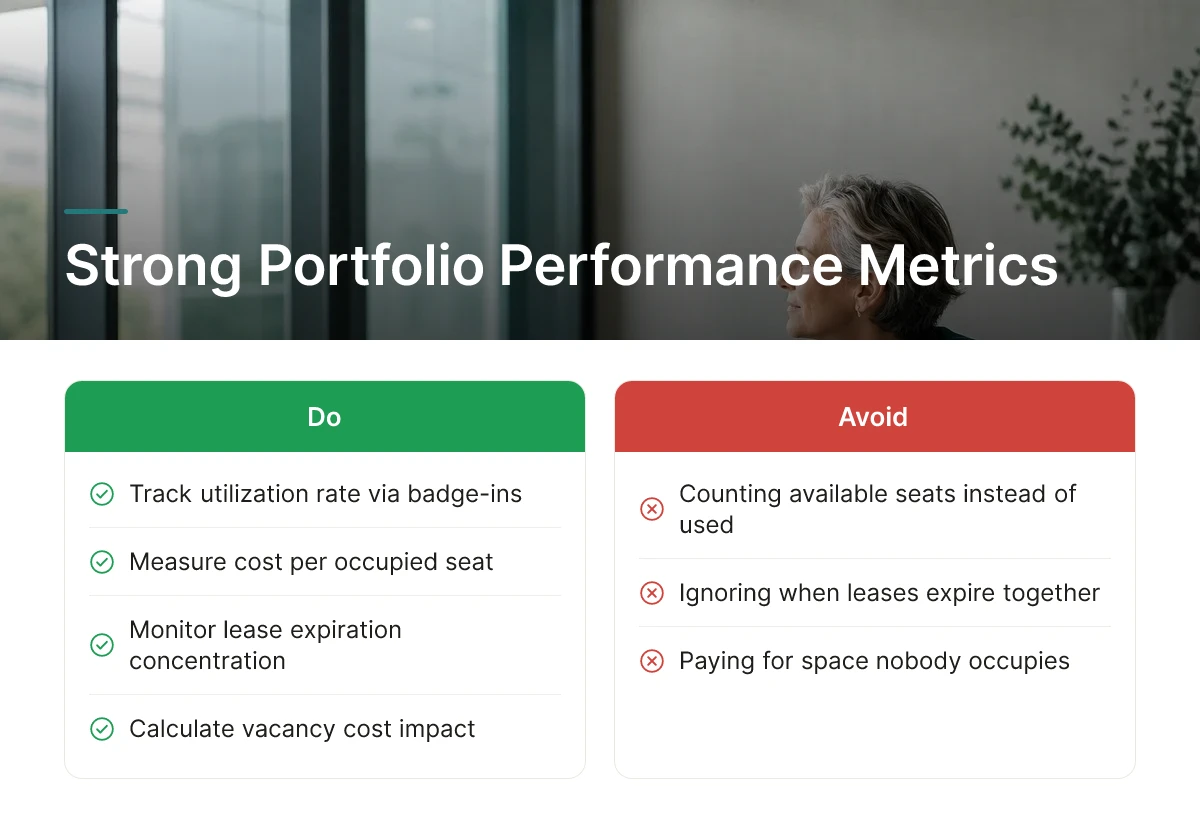
Four metrics tell a corporate real estate leader whether the portfolio is earning its keep: utilization rate, cost per occupied seat, lease expiration concentration, and vacancy cost.
Utilization rate compares actual desk use, measured through badge-ins or booking data, against total seat count, and it's the single most-cited number in board discussions about office footprint. Cost per occupied seat takes total real estate spend for a location and divides it by seats actually used, not seats available, which exposes how much a company pays for space nobody sits in. Lease expiration concentration flags how many square feet come up for renewal in the same 12- to 24-month window, a risk factor if too many decisions stack up at once. Vacancy cost quantifies the carrying cost of unused space, rent, utilities, maintenance, that delivers zero return.
Rather than chasing a single target percentage, it helps to think in three tiers: underused, right-sized, and over-capacity. An underused portfolio shows consistently low utilization across most weekdays, signaling space the company is paying for but not needing. A right-sized portfolio shows utilization that tracks closely with actual hybrid attendance patterns, with enough flex capacity to absorb peak days without permanent overbuild. An over-capacity portfolio shows the opposite problem, employees can't find desks on collaboration days, which undermines the return-to-office case entirely. JLL's 2025 Benchmark Report found that corporate real estate leaders rank portfolio optimization as their top priority, yet many admit to execution gaps between strategy and ground-level data [2]. That gap is exactly why real estate portfolio management matters: strategy without accurate measurement just produces better-informed guessing.
The translation step that matters most to a CFO is converting utilization and vacancy data into a cost-per-employee figure tied to real financial reporting, not a facilities dashboard nobody outside the real estate team opens. Relying on badge swipes alone, or on an annual space audit, creates blind spots, a once-a-year snapshot misses seasonal attendance swings, team-level collaboration patterns, and the early warning signs that a lease renewal decision needs revisiting now rather than in six months. Boards need both leading indicators, booking trends and forecast accuracy, and lagging indicators like realized lease cost per square foot. Upflex's UnifyAI engine addresses that measurement gap directly, forecasting attendance with 97% accuracy and feeding utilization data into portfolio decisions that have supported real estate spend reductions of 40% or more for enterprise customers managing distributed hybrid teams.
Portfolio sizing decides whether hybrid work functions day to day or collapses into a cycle of empty desks and frustrated employees avoiding the office. This is why real estate portfolio management matters at the operational level, not just on the balance sheet.
Over-consolidate too aggressively and the mechanism works against you: employees show up on a Tuesday expecting to sit with their team, find no desks available, and stop bothering to come in at all. A failed return-to-office push is rarely about resistance to hybrid work itself, it's often a signal that attendance was unpredictable and the office felt unreliable [1]. Once that trust breaks, rebuilding it takes longer than the initial rollout.
The opposite failure costs just as much. A sprawling headquarters sized for full daily attendance but running at 30-50% utilization doesn't create more connection, it just burns more rent on empty floors [2]. Large, half-empty space depresses energy and makes the office feel less, not more, worth the commute. For more information, see A Practical Guide To Smarter Wine Portfolio Management.
Boards read office footprint as a signal of operational discipline, alongside its direct effect on talent retention and cost control. Deloitte has noted that leaders rebalancing their portfolios are weighing long-term footprint decisions against shifting workforce patterns and collaboration needs [3], not just square footage math. A right-sized portfolio tells the CFO spend is controlled and tells the CHRO employees still get a workplace worth showing up for, the two objectives corporate real estate leaders are routinely asked to balance at once.
Utilization data shows which days and locations actually need capacity, so teams can co-locate when it matters without carrying a lease sized for every day of the week. Consider a team scattered across three cities that needs occasional collision space for planning sessions, versus a single headquarters built for full attendance five days a week, the first scenario calls for flexible, on-demand access; the second guarantees waste. Upflex's UnifyAI engine forecasts attendance with 97% accuracy, letting teams book desks against real demand while tapping an on-demand workspace network for distributed employees who need a room, not a building. Organizations using this approach have documented real estate spend reductions above 40% [reflects Upflex product data] while sustaining 88% co-attendance achievement, proof that cutting footprint and improving in-office collaboration aren't opposing goals.
The right technology turns static lease records into a live forecast of who's coming in, when, and where, which is why real estate portfolio management matters as much for the software you choose as for the strategy behind it.
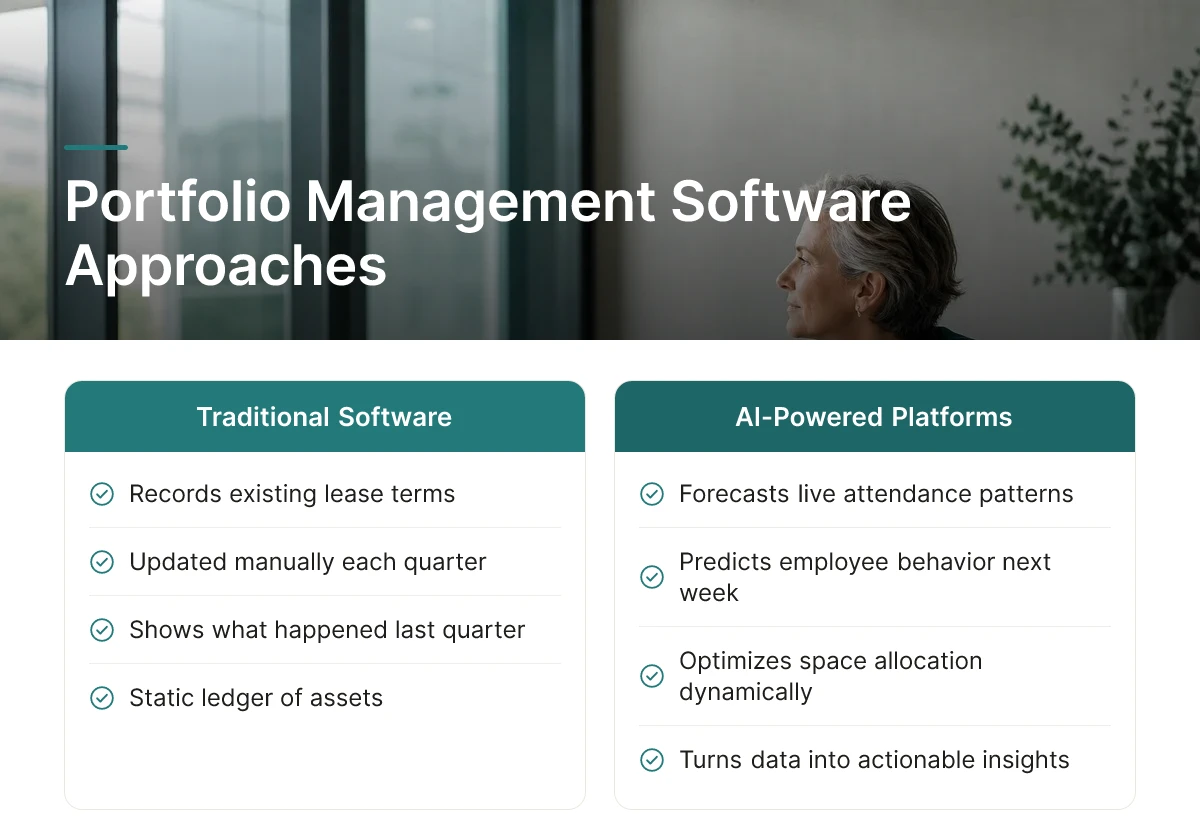
Traditional portfolio management software keeps a record of what you already own: lease terms, square footage, renewal dates, cost per seat. It's a ledger, updated manually, that tells you what happened last quarter but says nothing about what employees will actually do next Tuesday.
AI-powered workplace optimization platforms work differently. Instead of storing static facts, they process scheduling data, badge swipes, and booking patterns to forecast attendance before it happens. Upflex's UnifyAI engine, for example, forecasts office attendance with 97% accuracy, giving real estate and workplace teams a forward-looking number instead of a historical one. That shift, from recordkeeping to prediction, is the core difference between legacy IWMS platforms and the newer category of hybrid workplace tools.
Four capabilities separate a usable platform from a dashboard that just looks sophisticated.
Forecast accuracy matters operationally, not just analytically. A team that knows attendance within a few percentage points can commit to a defined ratio of owned versus on-demand space with confidence. A team guessing at attendance either overbuilds, and pays for empty desks, or underbuilds and triggers the exact desk shortages that erode trust in return-to-office mandates. Upflex customers use this accuracy to support real estate footprint reductions of 40%+ while still hitting an 88% co-attendance achievement benchmark, which shows forecasting and employee experience don't have to trade off against each other.
Budget matters too, and it's worth separating investment tiers honestly. Point tools that handle desk booking alone sit at the budget-friendly end but leave forecasting and lease strategy to spreadsheets. Enterprise-grade orchestration platforms cost more but fold forecasting, booking, and on-demand network access into one system, closer to what a CFO actually wants to see before approving a consolidation plan.
None of this works as an isolated dashboard. The platform needs to pull from HR systems to know who's on a team and where they're based, read badge data to validate actual attendance against forecasts, and connect to booking tools so employees experience one workflow instead of three disconnected logins.
Cut spend by matching square footage to measured attendance, then route overflow demand to flexible capacity instead of signing it into a new lease. This is where why real estate portfolio management matters shows up in dollars, not theory, the gap between what you lease and what employees actually use is pure margin leaking out of the real estate line.
Right-sizing starts with a simple correction: stop budgeting square footage against headcount and start budgeting it against measured utilization. US office occupancy only reached 50% in January for the first time since the pandemic [3], which means most portfolios still carry capacity built for a workforce pattern that no longer exists.
The staged approach works better than a single dramatic cut. Shorten lease renewal terms as they come up rather than locking in another 10-year commitment, shrink the owned core to match your actual peak-day attendance, and shift anything above that baseline to on-demand space. Deloitte frames this as rebalancing the portfolio deliberately rather than reacting to a single bad renewal cycle [3], and that staged discipline is what keeps consolidation from turning into a capacity crisis six months later.
A shared workspace network turns a fixed real estate cost into a variable one that moves with actual attendance instead of lease terms signed years in advance. Full consolidation into one shrunk core is the cheapest path on paper, but it risks under-capacity the moment a team reorganizes or a project pulls more people into the office on the same day. Full distribution across many small locations is flexible but nearly impossible to forecast and staff efficiently.
A blended model splits the difference: keep a right-sized core for steady-state attendance, and use on-demand workspace access to absorb the spikes. Upflex supports this directly, its UnifyAI engine forecasts attendance with 97% accuracy, and that forecast feeds both the desk booking workflow for your owned space and access to the world's largest on-demand workspace network for overflow. Customers using this model have documented real estate spend reductions above 40%, without abandoning the ability to flex up when needed.
That elasticity is the real protection against what comes next, a reorg, an acquisition, a regional hiring swing. None of those require a new lease cycle when overflow capacity is already on tap. EY's research into hybrid real estate strategy reaches the same conclusion: flexibility, not just reduction, is the goal companies should be building their portfolio decisions around [1].

Because fixed leases no longer match variable attendance, and that mismatch is now a measurable cost rather than a footnote. With more than 70% of employees working from home two to three days a week [1], offices sized for five-day attendance sit mostly empty most of the time, turning real estate from a background expense into an active, trackable liability.
Cutting square footage before confirming which days teams actually need to be in-person. Leaders who rightsize based on badge counts or guesswork often shed space employees needed for collaboration, triggering a second disruptive relocation within a year or two. Forecasting attendance first, then cutting, avoids the costly do-over.
At least annually, with a lighter check-in each quarter as attendance patterns shift. Lease renewal dates, workforce growth, and changing hybrid policies all move faster than a typical real estate cycle, so treating the portfolio as a one-time decision rather than an ongoing process leaves savings on the table.
Not if the cut is paired with better coordination, not just fewer desks. Culture suffers when employees show up and can't find a seat or a teammate, Upflex customers track this directly through co-attendance achievement, with a benchmark of 88% showing that smaller footprints and strong in-person collaboration aren't mutually exclusive.
Real estate portfolio management matters because the gap between leased capacity and actual attendance is now visible, measurable, and costly to ignore. The leaders who get ahead of it forecast attendance before cutting space, reassess their footprint on a recurring schedule rather than once per lease cycle, and treat owned offices and on-demand workspace as one coordinated system rather than separate budgets. Upflex customers have used this approach to cut real estate spend by 40%+ while still hitting 88% co-attendance. Start by pulling your next 12 months of lease renewal dates and matching them against current utilization data, that single exercise usually reveals where the first cut should happen.
Explore more from our content library: