Share This Article
No items found.


Understanding why companies need workspace flexibility is essential. Workspace flexibility reduces real estate costs by matching office capacity to actual occupancy instead of headcount, letting companies cut underused square footage while keeping productivity intact through on-demand access to space. The savings mechanism is simple: fixed leases price for peak attendance that rarely happens, while flexible models let you pay for space as it's used. Companies need this because hybrid attendance patterns make fixed, fully-leased offices structurally inefficient, most seats sit empty most days, and that gap between leased capacity and actual use is where the cost sits.
A lease is a bet on the busiest day of the year, but most companies now use their office at well below that peak every single week. That mismatch between what you pay for and what you actually occupy is the entire cost problem, and it's why companies need workspace flexibility built into how they plan real estate, not bolted on as an afterthought.
The mechanism is straightforward. Corporate real estate teams historically sized offices for worst-case attendance, the one or two days a year when nearly everyone shows up. Hybrid schedules broke that assumption. Average daily attendance now sits well below full headcount, yet the square footage, the lease term, and the rent bill are all still calculated against that old peak. The result is square footage that sits empty most of the week while the company keeps paying for it as if it were full.
This isn't a temporary dip that corrects itself once "return to office" fully lands, hybrid attendance has settled into repeatable patterns that make peak-day planning the wrong default. Many organizations now see attendance cluster around anchor days, with Tuesday through Thursday carrying far more people than Monday or Friday [3]. CBRE data shows lease renewals in the first half of 2024 came in with 21% less rentable square footage than pre-pandemic deals, and new leases averaged just over 25,000 square feet, 32% smaller than before the pandemic [2]. That's not noise. That's corporate real estate teams recognizing the old peak-attendance model no longer reflects how teams actually work, and adjusting the structure of their commitments accordingly.
Legacy real estate strategy treats office space as fixed cost, locked in years ahead of actual demand. Flexible and on-demand workspace flips that: instead of leasing for the ceiling, you pay for capacity closer to the floor and add on-demand access for the days attendance spikes. Upflex applies this by pairing attendance forecasting with a global network of on-demand workspaces, so companies can right-size owned space while still giving distributed or traveling employees somewhere to work when they need it.
Cutting footprint does not have to mean cutting output, provided space is matched to when and where teams actually collaborate rather than cut uniformly across the board. The benefit shows up as improved occupancy rate, more of the square footage you keep gets used, less sits idle, and as reduced unused space, which is where most of the waste in a real estate budget actually lives. Companies that align their portfolio to measured usage patterns, instead of assumed peak headcount, consistently find they can shrink their footprint without shrinking collaboration time.
Hybrid work is a schedule decision, remote work is a location decision, and flexible office arrangements are a real estate decision, three separate choices that companies routinely bundle into one.
That bundling is exactly why companies need workspace flexibility explained in mechanical terms, not buzzwords. A hybrid schedule tells employees how many days they split between an office and somewhere else. Remote work removes the office requirement entirely, there's no commute, no assigned desk, no square footage tied to that employee at all. Flexible office arrangements answer a different question: how does the company source and pay for the space it does use, whether that's a long-term lease, a coworking membership, or on-demand access to a third-party workspace network.
Companies that treat these as interchangeable tend to adopt hybrid schedules and then keep the exact same fully-leased office they had when everyone came in five days a week. The schedule changed; the real estate decision never did. That's how a company ends up paying for 100% of its pre-pandemic footprint while actual occupancy runs well below that, the space optimization problem BHDP describes as a market-wide shift toward smaller, better-utilized footprints rather than brute-force downsizing [2].
Flexible working governs when and how someone works, compressed weeks, staggered hours, asynchronous collaboration. Hybrid working governs where, which days are office days and which aren't. A company can offer full scheduling flexibility while still requiring everyone in a fixed physical location, and it can run a rigid 9-to-5 schedule across a hybrid office-and-home split. Eptura's guide to hybrid models breaks this further into role-based, team-based, and location-based variants, each changing which employees show up where and when [3]. Confusing the two mechanisms is what leads real estate teams to size offices around the wrong variable.
The right model depends on how predictable, or volatile, a company's occupancy actually is. A 50-person startup usually has low occupancy variance and can likely run entirely on flexible, on-demand space without ever signing a lease. A 5,000-person enterprise spread across multiple cities faces the opposite problem: thousands of overlapping schedules, seasonal travel, and regional attendance swings that no single lease size fits well. A client-facing professional services firm adds another variable entirely, consultants and account teams are on-site with clients more than they're in any company office, so fixed desks sit empty most of the week.
None of these models are mutually exclusive. A company can run hybrid schedules on top of a flexible real estate portfolio, keeping a smaller owned core for scheduled collaboration days while giving distributed or traveling employees access to an on-demand workspace network for the rest. That's the structural gap Upflex is built to close: it pairs attendance forecasting with access to a global network of external workspaces, so the real estate decision and the scheduling decision can finally move independently of each other.

Culture breaks when flexibility removes shared rhythm entirely, not when it removes a fixed desk, the fix is deliberate overlap, not a return to assigned seating.
Corporate real estate and HR leaders often treat flexibility and cohesion as opposing forces, but the evidence points elsewhere. A hybrid model becomes "a long-term operating model" precisely because organizations redesign how people move between physical and digital collaboration rather than leaving it to chance [3]. The actual failure mode is random attendance: when nobody coordinates who comes in on which day, the office empties out unpredictably and in-person collaboration disappears along with it. That's the real reason why companies need workspace flexibility paired with structure, not flexibility alone.
Anchor days solve this directly. Instead of letting individuals pick office days independently, teams agree on one or two days when collaborating groups are reliably present together. This turns attendance from a personal preference into a coordinated decision, which is what actually preserves shared rhythm.
Flexible workplaces that struggle usually suffer from a coordination gap, not an excess of flexibility itself. Employees are told they can work from anywhere but receive no structure for when "anywhere" should overlap with teammates. Smartworks' analysis of flexible workspace adoption notes that agility only delivers value when businesses actively adapt their model to it, rather than treating flexibility as a passive perk [4]. Without scheduling intent, flexibility defaults to isolation.
Measuring culture qualitatively instead of anecdotally means tracking three things over time: co-attendance rates among teams that depend on each other for collaboration, the ratio of meetings held in person versus remotely, and movement in engagement survey scores tied to belonging and connection. A single bad week of empty desks means little; a downward trend across a quarter signals a real coordination failure.
This is where Upflex's co-attendance tracking matters operationally, it reports whether teams are actually hitting in-person collaboration targets, with Upflex's benchmark customers achieving 88% co-attendance, rather than guessing from hallway conversations. The concrete implementation step is pairing space booking with team calendars, so that reserving a desk is informed by who else on the team is already scheduled in, turning flexibility into coordinated presence instead of scattered, isolated attendance.
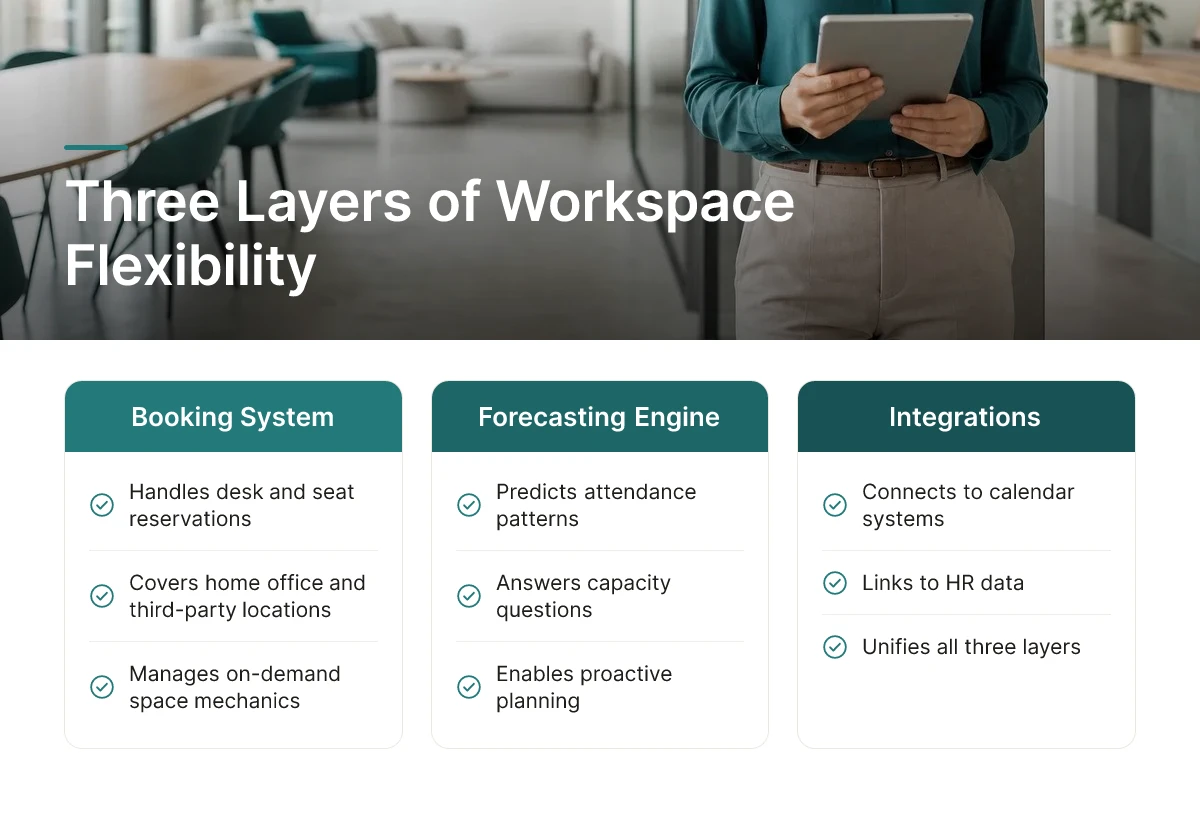
Three layers make flexibility operational rather than aspirational: a booking and access system for on-demand space, an attendance forecasting engine, and integrations that connect both to calendars and HR data. Without all three working together, a flexible footprint just shifts the chaos from one spreadsheet to another.
The booking layer handles the mechanics: reserving a desk in the home office or a seat at a third-party location when someone's traveling or working near a client site. The forecasting layer answers a harder question, who is actually likely to show up, where, and when, using scheduling inputs and historical utilization patterns rather than guesswork. The integration layer ties both back to the calendars and HR systems leaders already run, so attendance plans reflect real team structures and real meetings instead of static seating charts.
This is the practical answer to why companies need workspace flexibility as an operating capability and not just a policy statement. A flexible-work policy with no supporting infrastructure produces the exact failure mode described in the hybrid work literature: unpredictable attendance, redesigned spaces that still don't match how people show up, and leaders who can't tell the CFO with confidence what the office actually needs [3].
AI-powered orchestration predicts who's coming in, when, and where, turning space allocation from a reactive guess into a planned outcome. Upflex's UnifyAI engine, for example, processes scheduling and utilization data to forecast attendance at 97% accuracy, which lets workplace teams coordinate in-office days and track whether teams are actually hitting co-attendance targets rather than assuming they are.
Fragmented tools undercut this. A separate desk booking app, a separate room scheduler, and a separate visitor management system each solve a narrow problem but none of them talk to each other, recreating the administrative overhead and blind spots that flexibility was supposed to eliminate. A unified platform that also plugs into a broader on-demand workspace network solves the same problem an internal real estate team would, giving employees access to vetted space across multiple cities and countries, without the fixed cost of leasing in every market.
On cost, there's a real trade-off. Budget-friendly point tools are cheaper individually but multiply administrative work across the organization, while enterprise-grade orchestration platforms cost more upfront and pay back through consolidated real estate spend and fewer disconnected systems to manage.
Build the business case on four data points: occupancy versus leased capacity, cost per seat, utilization by day of week, and retention in flexibility-dependent roles, then translate each into a dollar figure finance can audit.
Start with occupancy rate versus leased capacity: how many seats you pay for versus how many are used on an average day. Most real estate leaders already sense the gap, hybrid attendance rarely fills an office built for five-day-a-week headcount, but the gap needs a number before finance will act on it.
Pair that with cost per seat, calculated as total occupancy cost (rent, utilities, services) divided by actual seats used, not seats available. This single ratio exposes waste that a simple "cost per square foot" figure hides, because it penalizes underused space rather than rewarding it.
Track space utilization by day of week next. Office usage data almost always shows a mid-week peak and thin Mondays and Fridays [3], which matters because it tells you whether your problem is total footprint or scheduling, two very different fixes with different costs.
Finally, track attrition in roles tied to your flexibility policy. If departures cluster among employees affected by a rigid attendance mandate, that's a cost signal, not just a culture one.
Don't import an external productivity statistic, measure your own. Compare project velocity, ticket closure rates, or whatever output metric your teams already track, before and after a flexibility change, for the same team and workload type. The comparison only holds if you control for team composition and project mix.
Turnover savings work through a known mechanism: every retained employee avoids a recruiting cycle, interview time, and ramp-up period that a replacement hire would require. You don't need a published multiplier to make this case, model your own hiring cost and ramp timeline, then apply it to the number of departures your flexibility policy plausibly prevented.
Run the real estate math as a simple before-and-after: baseline leased footprint and its annual cost, measured actual usage from badge or booking data, and the right-sized footprint that usage supports. The difference is your fixed-cost reduction opportunity. The remaining variable portion, workspace accessed on demand only when teams need it, becomes a cost that scales with actual attendance instead of sitting fixed on a twenty-year lease. This is the core mechanic behind why companies need workspace flexibility: it converts a fixed liability into a variable, usage-matched cost.
Platforms built for this, including Upflex, combine attendance forecasting with real estate portfolio optimization so the occupancy and utilization numbers feeding this model come from one dashboard instead of three disconnected tools.
When presenting to finance and real estate stakeholders, lead with the occupancy data and the cost-per-seat trend line, not anecdotes about empty floors. A quarter-over-quarter chart showing leased capacity against actual usage, with the right-sized target overlaid, makes the case for workspace flexibility in the terms both functions already use to approve budget.

Companies need flexibility because hybrid work has made fixed, full-time office attendance the exception rather than the rule. Office utilization at most enterprises now sits well below pre-pandemic levels, yet many are still paying for space sized to that old model [2]. Without flexibility, real estate budgets stay misaligned with how employees actually work, and leaders lose the ability to right-size costs without disrupting teams.
Three forces are driving it: shrinking lease sizes, uneven attendance patterns, and pressure to cut occupancy costs without hurting culture. Lease renewal square footage dropped 21% in the first half of 2024 compared to pre-pandemic levels, and new leases shrank 32% over the same period [2]. Finance and HR leaders are being asked to reconcile both pressures at once.
Yes, traditional leases lock in fixed costs regardless of how much space gets used, while flexible models tie spend to actual demand. A company with a legacy lease pays the same rent whether desks sit empty three days a week or not. Flexible arrangements, including on-demand workspace access, let real estate teams convert part of that fixed cost into variable spend that scales with attendance, not square footage sitting idle.
Yes, though the mechanics differ, smaller companies gain flexibility mainly through avoiding long-term leases rather than consolidating large portfolios. A 50-person company can't shed office towers, but it can skip signing a five-year lease and instead pay only for the desks and meeting rooms it actually needs. The underlying benefit is the same: spend matches usage instead of a fixed commitment made years in advance.
Workspace flexibility comes down to three decisions: stop paying for square footage nobody uses, give employees a way to work well wherever they land, and base real estate calls on attendance data instead of guesswork. Companies that get this right pair accurate forecasting with on-demand access to space, so portfolio cuts don't become employee experience problems. Upflex builds this by combining 97% accurate attendance forecasting with a global on-demand workspace network, letting corporate real estate leaders cut spend by 40%+ while still hitting co-attendance targets. The next step: pull your last quarter of badge or booking data and check how it lines up against your current lease footprint before your next renewal date arrives.
Explore more from our content library: