Share This Article
No items found.


Understanding how to cut corporate real estate costs is essential. You cut corporate real estate costs fastest by auditing actual space utilization, right-sizing your portfolio to hybrid attendance patterns, and using that occupancy data as use when you renegotiate or consolidate leases. Most teams can complete this cycle within 90 days: weeks 1-3 for data collection and analysis, weeks 4-8 for portfolio decisions and lease negotiations, and weeks 9-12 for rolling out desk booking software and hybrid policies that lock in the savings. The biggest cost reductions come from pairing hard occupancy data with a clear policy on how many days teams are expected in-office, so you're not paying for square footage nobody uses.
Pull badge-swipe records, booking logs, and sensor data for at least four to six weeks before touching a single lease decision, that baseline is the real starting point for how to cut corporate real estate costs. Without it, you're negotiating from opinion, not evidence. Global office utilization rates hover around 50% on average [1], which means half of most portfolios sits empty on any given day, but you won't know your own number until you measure it directly.
Four metrics give you the clearest picture of how your space actually gets used:
Together, these four numbers replace guesswork with a dataset your CFO and CHRO can both trust.
Compare booked capacity against actual swipe-in data floor by floor, and wing by wing, across your full multi-week window, not a single snapshot in time. A floor that looks busy on a Tuesday in a product launch week can look empty the following month. Real estate remains the second-largest line item on most corporate balance sheets after salaries [1], so the stakes of mismeasuring it are high.
This audit isn't a one-off exercise, it becomes the evidence base you'll cite in every later lease negotiation, downsizing decision, and consolidation conversation. Platforms like Upflex build this baseline automatically: its UnifyAI engine forecasts attendance with 97% accuracy from scheduling and utilization inputs, so real estate and workplace leaders see patterns across floors and teams without reconciling spreadsheets from three separate systems by hand.
Right-sizing means matching square footage to actual attendance patterns, then consolidating partially-used floors into fewer fully-used ones before touching an entire building lease. That sequence, not a blanket downsizing order, is how to cut corporate real estate costs without breaking team collaboration.
Global office utilization rates hover around 50% [1], which means most corporate portfolios are carrying roughly twice the space their attendance patterns justify. The fix isn't guessing which floors to cut. It's forecasting which floors are actually needed, then shedding the rest in a sequence that protects the days people show up.
AI-based attendance forecasting models recurring team patterns, which groups come in on Tuesdays, which project teams cluster on Thursdays, and predicts co-attendance days with enough precision to size space accurately rather than defensively. Upflex's UnifyAI engine, for example, forecasts attendance at 97% accuracy, which gives real estate leaders a day-by-day view of how many desks, rooms, and floors a building actually needs instead of how many it was built to hold.
Consolidating too aggressively without a buffer creates its own cost: overflow on the two or three days a quarter when every team wants to be in the same building. Pairing a leaner owned footprint with on-demand access to external workspace, rather than cutting straight to a fixed, smaller lease, absorbs those peak days without forcing a return to over-leasing.
Exiting or shrinking a lease is a contractual decision before it's a real estate decision, and the fine print determines how fast savings actually show up. Notice periods often run six to twelve months ahead of term end, and early termination clauses can carry penalties steep enough to erase a year or more of projected savings.
Where an outright exit isn't contractually feasible, subleasing unused floors is a middle path that recovers cost without breaking the lease. JLL notes that short-term options like this can be paired with longer-term moves, such as simply not renewing at term end, to capture savings as high as 25% on total real estate spend [3]. Treat subletting as the short-term lever and lease non-renewal as the long-term one: the first recovers cash now, the second resets the baseline for the next term.
Before sending notice to any landlord, confirm the forecast data supports the smaller footprint across at least two full quarters, including the highest co-attendance weeks. A single good month is not evidence; a sustained pattern is what should justify a lease decision that's hard to reverse.

Documented utilization data turns a lease renewal from a landlord-led conversation into one where you set the terms. This is where the audit you ran in the previous step pays for itself.
Landlords and brokers respond to numbers they can verify, not a tenant's general sense that the office feels empty. A trendline showing badge-in rates or desk utilization at 50% or below over six to twelve months [1] gives you grounds to request less square footage, a shorter term, or rent concessions at renewal, because you can show the landlord exactly what you're not using, month by month.
This is a core part of how to cut corporate real estate costs at the lease table: come in with a chart, not an opinion. A landlord facing a documented, sustained drop in occupancy has more incentive to negotiate than to risk losing you as a tenant and re-leasing the space cold. Short-term levers like this, timed right, before you've signaled you're staying regardless, can meaningfully reduce real estate spend without a single square foot of construction [3].
Weigh the tradeoff before you sign. A longer term usually buys a lower rate, but it locks you into a footprint sized for today's hybrid pattern. If your organization expects further downsizing as hybrid schedules mature, a shorter term or a lease with a contraction option may cost more per square foot but save more overall by avoiding a second round of underused space.
The lease rate is only part of the bill. Transaction costs, broker commissions, legal fees, tenant improvement allowances, and moving expenses, add up fast, and they're easiest to control when negotiated as a package rather than line by line [3]. Bundle broker fees across multiple locations if you're renewing several leases in the same cycle, and push for a tenant improvement allowance that covers reconfiguration for hybrid layouts rather than a like-for-like rebuild.
Timing matters as much as substance. Start renewal conversations months ahead of expiry, not after the clock has run out and the landlord knows you have no alternative. Negotiating from a position of having other options, including flexible workspace access for overflow teams, keeps pressure on the landlord's side of the table.
Bring in a real estate attorney or broker when the deal involves multi-year commitments, complex improvement allowances, or portfolio-wide terms across several markets. Simpler renewals, especially single-site amendments supported by clear occupancy data, can often be handled directly by the corporate real estate team.
Consolidation only sticks when desk booking software and a defined hybrid policy keep attendance predictable enough that the smaller footprint never feels cramped. Without that layer, companies tend to backfill the space they just cut.
Three features do most of the work. Real-time occupancy sensors show which floors, zones, or desks are actually in use versus what's booked on paper, the gap between the two is usually larger than facilities teams expect [1]. Booking analytics turn that sensor data into a usage trend over weeks and months, not a single snapshot. Automated no-show tracking releases desks that were reserved but never claimed, so a colleague who shows up without a booking isn't turned away while half the floor sits empty. Together, these three features are the core of how to cut corporate real estate costs without creating a new problem: employees hunting for seats.
A hybrid policy with defined in-office days stabilizes demand enough that a smaller footprint stays right-sized instead of quietly creeping back up.
When attendance is fully discretionary, it swings unpredictably, some weeks a floor is packed, others it's a third empty. Defined anchor days (say, Tuesday through Thursday for a given team) smooth that curve, giving real estate planners a demand pattern they can actually design around rather than guess at. Upflex's UnifyAI engine forecasts attendance against this kind of policy with 97% accuracy, which lets workplace leaders set co-attendance targets and verify teams are hitting them, Upflex reports an 88% co-attendance achievement benchmark among teams using the platform this way. That combination of forecasting and desk booking is what turns a one-time consolidation into a sustained reduction, with Upflex customers documenting 40%+ reductions in real estate spend tied to this kind of ongoing optimization rather than a single lease cut.
Policy design isn't uniform across functions. A finance team running a trading floor usually needs fixed, assigned seating tied to compliance and equipment requirements, so the "hybrid policy" there is about which support functions around the floor can flex. A software engineering team with fully flexible schedules can run close to a pure hot-desking model, with booking software absorbing the day-to-day variability. Applying one policy template across both groups generally produces either overcrowding or waste in one of them.
Desk booking software pays back when its cost is weighed against the lease and facilities savings it protects, not treated as a standalone expense.
The mechanism is straightforward even without a universal dollar figure: fewer underused floors means less square footage to lease, heat, cool, clean, and secure. A company that uses occupancy data to shed even one underperforming floor avoids the operating costs tied to that space indefinitely, not just once at renewal [3]. Software and implementation effort are a fixed, bounded cost; the facilities savings compound every month the smaller footprint holds. That asymmetry is the real ROI case, more than any single payback-period number.
After rollout, check utilization monthly, not annually. Attendance patterns shift with new hires, team reorganizations, and season, a policy calibrated in January can be stale by summer. Monthly reviews catch that drift early enough to adjust booking rules or anchor days before the mismatch turns into wasted space again.
Most failed attempts at how to cut corporate real estate costs share the same five errors, all rooted in moving faster than the data, the policy, or the people can support.
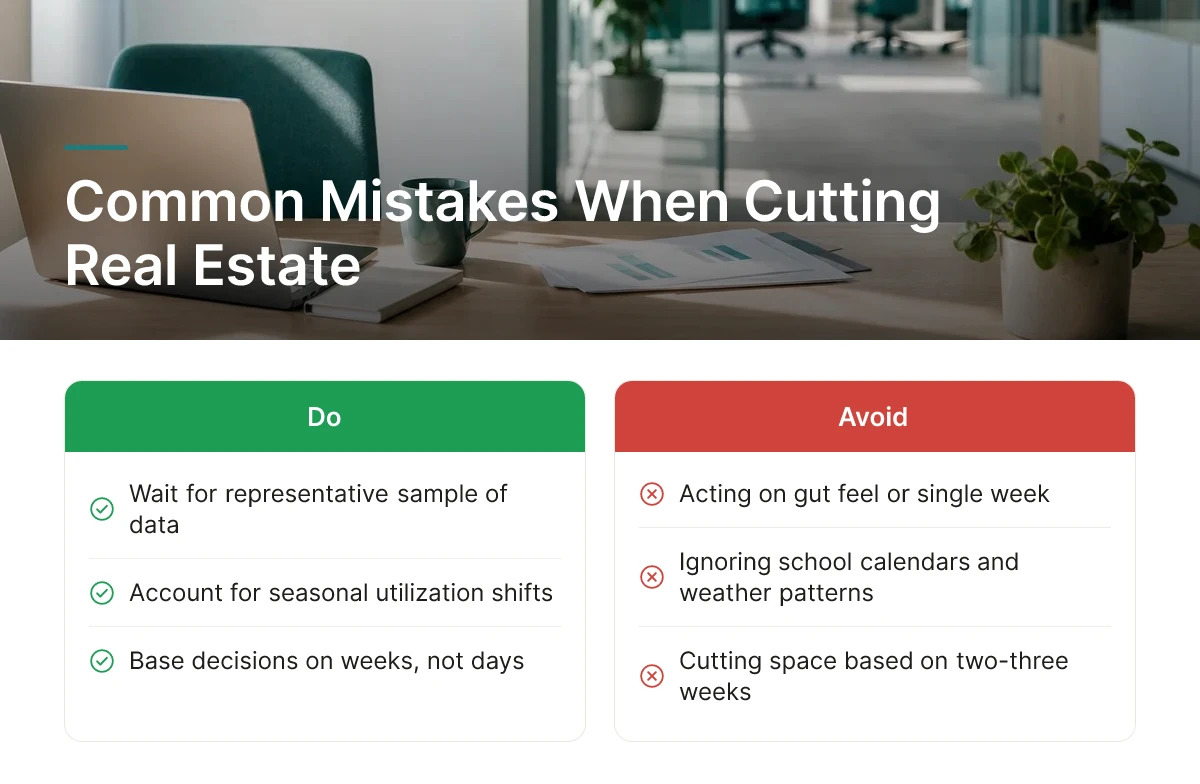
A badge swipe count from one slow week in August tells you nothing about a company's real attendance pattern. Utilization shifts with school calendars, weather, and quarterly deadlines, so a decision based on two or three weeks of data risks cutting space you'll need back by October. HubStar's benchmarking work puts global utilization around 50% [1], but that average hides wide swings week to week, which is exactly why portfolio decisions built on a short snapshot tend to misfire.
Terminating a lease or consolidating floors before leadership has locked in an in-office policy forces a scramble later. If HR reverses a three-day mandate to five days, or a department head insists on dedicated desks, re-expansion costs almost always exceed what the original cut saved.
JLL notes that landlords absorb real costs when a tenant exits, lost rent, ongoing operating expenses, and taxes [3], which is precisely why notice periods, renewal options, and termination penalties are negotiated to protect the landlord's position, not yours. Missing a notice deadline by even a month can trap a company in a full year of rent on space it no longer needs. Build lease calendars into the cost-cutting timeline from day one, not after the decision is made.
A desk booking tool nobody uses produces worse data than no tool at all, employees book out of habit, skip it entirely, or share logins, and the resulting utilization numbers mislead every decision built on top of them. Adoption requires communication, manager buy-in, and a short training push, not just a software license.
Office usage keeps shifting after the initial cut, new hires, reorganizations, and policy tweaks all move the numbers. Teams that review utilization and lease obligations monthly catch drift early; teams that treat the exercise as a single 90-day sprint end up back at square one within a year. Upflex's forecasting and booking data stay live specifically so real estate and finance leaders can treat optimization as a recurring review, not a one-off audit.
Most organizations see measurable savings within the first 90 days, with full portfolio-level reductions materializing over two to four quarters. Early wins usually come from eliminating obvious waste, unused floors, duplicate booking tools, or space held "just in case." Larger moves, like consolidating a lease at renewal, take longer because they depend on your lease calendar rather than your internal timeline.
No, badge data, Wi-Fi logs, or even manual walk-throughs can start the audit before any new software is in place. A dedicated platform like Upflex speeds this up by forecasting attendance with 97% accuracy instead of relying on lagging occupancy reports, but you can begin with the data you already have.
If early exit isn't possible, focus on subleasing unused floors, renegotiating terms at the next break clause, or shrinking your effective footprint without changing the lease itself. Companies in this position often consolidate teams onto fewer floors and offer employees on-demand workspace access elsewhere, which cuts real costs without waiting for the lease to expire [3].
Tech and finance firms typically cut costs by reducing headquarters square footage and shifting knowledge workers to hybrid schedules supported by desk booking and attendance forecasting. Manufacturing and industries with fixed production assets have less flexibility on the plant floor, so savings tend to come from administrative and back-office space instead, corporate offices, regional hubs, and support functions rather than the factory itself.
Cutting corporate real estate costs starts with accurate utilization data, not a bigger budget cut target. Once you know which floors sit empty on Tuesdays and which teams never hit co-attendance goals, the decisions, consolidate, sublease, or shift to on-demand space, become straightforward instead of political. The organizations that move fastest pair that data with forecasting tools that predict attendance before the lease renewal deadline forces a rushed decision.
Start this week: pull your last 90 days of badge or Wi-Fi occupancy data and compare it against your current leased square footage. The gap you find is your first savings target.
Explore more from our content library: