Share This Article
No items found.


An on-demand workspace network lets global enterprises give hybrid teams access to flexible offices and meeting rooms across many cities, while paying only for space actually used instead of carrying fixed leases everywhere. This matters because hybrid teams are distributed and unpredictable, a network model shifts real estate from a fixed cost tied to headcount into a variable cost tied to actual attendance. The result: lower overhead from unused square footage, and employees who can find reliable, policy-compliant workspace wherever their job takes them.
A single headquarters can't flex to match a workforce that shows up in different cities on different days, an on-demand workspace network solves this by distributing access points to wherever employees already are.
Hybrid attendance isn't a scheduling problem you can solve by building one bigger office. It's a distribution problem. Teams working hybrid schedules rarely show up on identical days, and a growing share of them aren't commuting to a central business district at all, they're near a client site, working from a home office in a secondary city, or traveling between regions. A corporate real estate strategy built around one HQ plus a few satellite offices assumes a concentration of demand that hybrid work no longer produces.
Global enterprises need more than desks, they need a mix of space types available in the specific cities where their people actually are. That means drop-in desks for an individual contributor working solo for a day, private offices for focused calls or confidential work, meeting rooms for client presentations, and larger team-collaboration spaces for periodic offsites or sprint planning. A workplace strategy that only accounts for one of these formats forces employees to improvise, booking a coffee shop table for a confidential call, or renting an external venue for a team offsite because no owned office has the room.
More locations in the network means shorter commutes and fewer failed last-minute bookings, since employees can find available space close to where they already are instead of near a lease the company signed years earlier. Density matters here: when an employee's nearest usable space is a 40-minute train ride away, workspace stops being on-demand in any practical sense.
Compare this to the legacy single-HQ-plus-satellite model. Employees deal with duplicate badge systems across offices, inconsistent amenities from one location to the next, and managers who have no visibility into who booked what, where. A network model standardizes the booking experience and space quality across every city, which is what actually builds employee trust in using flexible space rather than defaulting to working from home. Upflex's on-demand workspace network gives employees that consistent access alongside the company's own offices, so workplace teams manage one coordinated portfolio instead of a patchwork of local arrangements.
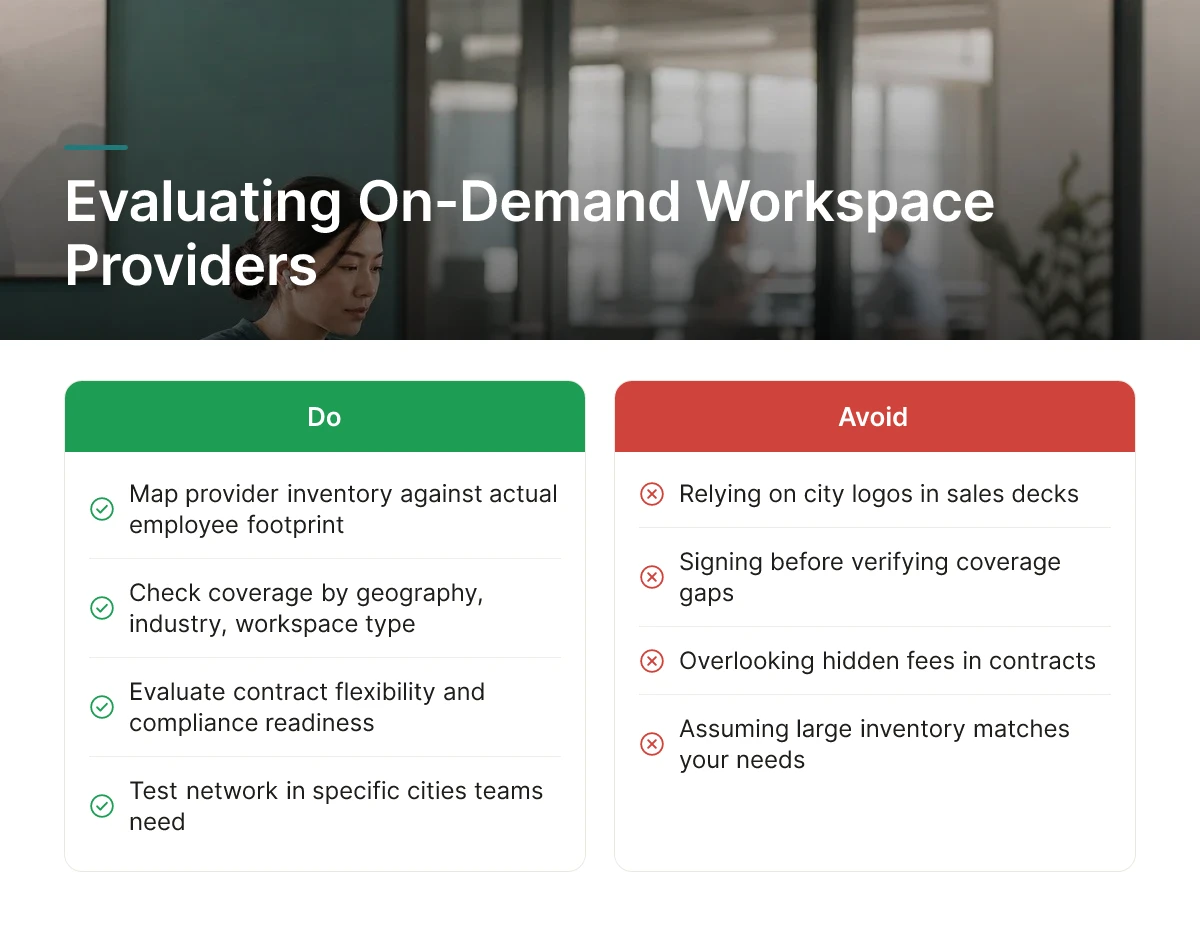
Evaluate providers on four fronts: geographic and vertical coverage, contract flexibility, hidden fees, and compliance readiness, not just the size of the inventory.
A long list of city logos on a sales deck tells you little about whether a provider can actually support your distributed teams. The real test is whether the network holds up in the specific cities, industries, and workspace types your employees need day to day.
Map the provider's inventory against your actual employee footprint before signing anything, not after. A network that's dense in gateway cities like London or New York but thin in secondary markets, where a growing share of hybrid employees actually live, pushes those workers back to expensing random coworking spots on their own. That gap becomes shadow spend: unmanaged bookings that never show up in your real estate reporting and quietly erode the cost savings you signed up for.
Coverage also needs to match workspace type, not just location. Sales teams need meeting rooms for client visits, engineers may need quiet focus space, and regulated industries like finance or healthcare may need private offices that meet confidentiality requirements. Ask for a city-by-city, space-type breakdown against your headcount map, not an aggregate city count.
Favor month-to-month or usage-based commitments over multi-year lock-ins, since hybrid attendance patterns shift faster than most real estate contracts can adapt. A provider that requires a long-term minimum commitment forces you to predict workspace demand years out, the exact problem flexible access was supposed to solve.
Read cancellation terms closely. Some providers bury booking minimums, late-cancellation penalties, or amenity upcharges, premium Wi-Fi, printing, meeting room time, in the fine print, and these add up quietly across thousands of bookings a year [4]. The mechanism to watch for: any fee structure that charges per booking rather than per use invites overuse by employees who don't see the bill, and underuse by employees worried about penalties.
Admin and compliance features matter as much as desk availability. IT and security teams will ask about single sign-on, approval workflows, and data residency before they approve any on-demand workspace network for company-wide rollout. Without SSO and centralized booking approval, you lose visibility into who is booking where, which defeats the purpose of consolidating real estate data in the first place.
Upflex addresses this by pairing its on-demand workspace network with the same office orchestration dashboard used for internal desk booking, so finance and real estate leaders see owned and flexible space usage side by side rather than in separate systems. Before signing with any provider, run through a short checklist: coverage against your real footprint, flexibility in the contract, visibility into likely hidden costs, and how fast support responds when a booking goes wrong in an unfamiliar city.
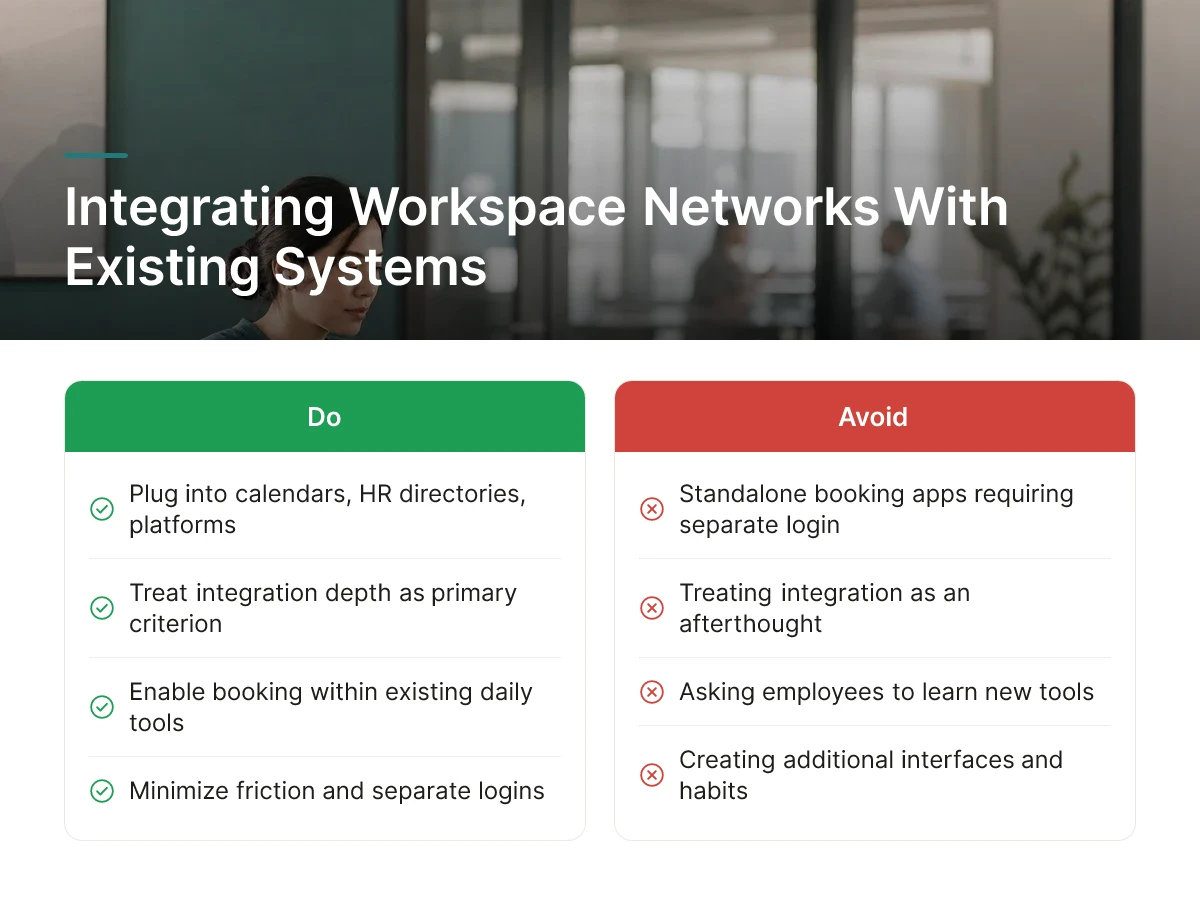
Adoption depends on whether a workspace network plugs into the systems people already use daily, calendars, HR directories, and workplace platforms, rather than asking employees to learn a separate tool.
A standalone booking app, however well designed, adds friction: another login, another interface, another habit to build. Corporate real estate and HR leaders evaluating an on-demand workspace network should treat integration depth as a primary selection criterion, not an afterthought. If booking a desk in a partner location requires leaving Outlook or Google Calendar and logging into a separate portal, usage drops regardless of how large the network is.
API and single sign-on (SSO) integrations let employees book external workspace through the same credentials and calendar they already use for internal meetings. Typical integration points include SSO so employees authenticate with existing corporate credentials instead of creating new accounts, automatic sync so a booked desk or office appears on the employee's calendar alongside their meetings, and a centralized directory that limits bookings to locations the company has pre-approved for cost, security, or compliance reasons. For workplace experience teams, this directory layer matters as much as the booking mechanism itself, it keeps flexible access aligned with policy without requiring manual review of every request.
AI-assisted booking removes the manual back-and-forth of requests and approvals by matching an employee to available nearby space automatically, based on location, team schedule, and real-time availability. Instead of a facilities coordinator fielding one-off requests for a traveling employee or a hybrid team member near a client site, the system handles matching in the background. Upflex applies this through its UnifyAI engine, which forecasts attendance with 97% accuracy and pairs that forecast with automated booking recommendations across both owned offices and the on-demand workspace network, reducing the coordination load that otherwise falls on workplace teams.
Booking and occupancy data generated through these integrations should also flow back into real estate portfolio planning. Patterns in where and how often employees use external space give corporate real estate leaders evidence for lease renewal, consolidation, or footprint reduction decisions, closing the loop between daily usage and long-term planning.
Before rollout, enterprises should confirm data residency and security requirements, where booking and location data is stored, how it's encrypted, and whether the vendor meets the company's existing compliance standards.
The ROI comes from converting a fixed lease cost tied to headcount into a variable cost tied to measured attendance, so you stop paying for desks nobody uses.
A traditional lease charges for square footage regardless of who shows up. A company with 2,000 employees and a headquarters sized for 80% daily occupancy is paying full carrying cost even on the Monday or Friday when half the building is empty. An on-demand workspace network breaks that link: instead of provisioning for a theoretical peak, finance can size the owned footprint to typical attendance and route the overflow, new hires in a city without an office, travelers, project teams, to flexible space booked only when it's used. The spend becomes proportional to actual demand rather than headcount on a roster.
The measurement mechanism is simple: compare booked desks against actual check-ins, location by location, over a full quarter.
A floor that shows strong booking volume but weak check-in follow-through is a signal, either the space doesn't suit how the team actually works, or the commute isn't worth it for the days planned. Tracking that gap across every office in the portfolio tells corporate real estate leaders which buildings are carrying cost without carrying people, and which locations are candidates for downsizing or exit at the next lease event. Utilization data, not anecdote, becomes the input for the consolidation decision.
In practice, the hard-dollar outcome is a smaller, better-matched footprint; the soft-dollar outcome is a workforce that feels supported rather than mandated.
Giving employees workspace choice near where they actually live, or wherever they're traveling, directly addresses a recurring complaint behind failed return-to-office pushes: people resent commuting to an office that doesn't fit their week. Flexible access reframes the office as a benefit rather than a rule, which matters for recruiting and retention in distributed hiring markets [3].
The internal business case should set current real estate carrying cost, rent, utilities, vacancy, against flexible network spend plus the utilization data justifying it, without leaning on borrowed percentages from other companies' circumstances. Upflex structures this comparison directly: its UnifyAI engine forecasts attendance, its desk booking data shows real usage, and its on-demand workspace network supplies the flexible capacity, so the three inputs a CFO needs sit in one dashboard instead of three disconnected systems. Returns compound as forecast accuracy improves, since each cycle of better data sharpens the next footprint decision.
Governance across a distributed workspace network runs on three controls: consolidated billing, funding rules set by department, and utilization reporting that flags spend drifting off-plan.
Without this layer, an on-demand workspace network turns into a management burden instead of a cost saver. Dozens of employees booking desks and day offices across different cities, vendors, and currencies produces exactly the kind of fragmented expense data that corporate real estate and finance leaders are trying to escape in the first place.
Centralized billing consolidates every booking, vendor, and location into one invoice and one finance view, instead of hundreds of individual expense reports. That single view is what lets a finance team reconcile real estate spend monthly rather than chasing receipts from employees who booked a desk in Austin one week and a meeting room in Berlin the next.
Funding models should flex by who's spending and why. A department can carry its own allocation, a team can draw from a shared allowance for travel-heavy months, and bookings above a certain threshold can route through manager approval before they're confirmed. None of this requires rigid per-person caps, it requires rules that match how each group actually works, so a sales team traveling constantly isn't boxed in by the same policy as a finance team that visits a flex location twice a quarter.
Reporting needs to answer one question clearly: where is spend going, and does usage match intent. That means surfacing which locations get booked repeatedly, which departments are running under their allocation, and which teams are quietly overspending relative to what leadership expected when the budget was set.
Policy guardrails keep this from drifting region by region, who can book what space, in which cities, how far in advance, and at what approval level. Upflex applies this governance directly inside its office orchestration dashboard, pairing desk booking and on-demand network access with the same utilization data used for internal space decisions, so finance and workplace leaders see one picture instead of two disconnected systems.
This reporting isn't a dead end. It feeds back into the scheduling and calendar integrations that coordinate where teams work, and it becomes the evidence base for measuring real estate ROI, closing the loop between what gets booked, what gets spent, and what the portfolio actually needs.

No, but the economics favor organizations with distributed teams across multiple cities or countries. A 500-person company with offices in three markets gets more value from on-demand access than a single-location business, since it avoids opening small satellite offices for a handful of traveling or remote employees in each city.
A traditional membership locks you into one coworking brand or location, while an on-demand network gives pay-as-needed access across many providers and cities [4]. Memberships assume steady, predictable usage; on-demand models fit the irregular attendance patterns typical of hybrid and traveling teams, so you're not paying for desks that sit empty most of the month.
Rarely, most organizations use it to supplement, not replace, a core office. A headquarters still anchors company culture, leadership visibility, and planned in-person collaboration days, while the on-demand network handles overflow, remote hires, and employees who travel or live far from that hub.
Employee choice drives whether a workspace network actually gets used instead of ignored. When employees can pick a location near home or a client meeting rather than commute to a half-empty office, adoption rises and real estate leaders get cleaner utilization data to act on.
An on-demand workspace network only pays off when it's paired with real visibility into attendance patterns, guessing at demand defeats the purpose. Start by forecasting which days and locations your teams actually need, then match that demand against your owned office footprint before adding external capacity. Upflex builds this sequence into one platform: UnifyAI forecasts attendance at 97% accuracy, desk booking handles the owned-office side, and the on-demand network fills the gaps, together supporting the kind of real estate decisions that have driven 40%+ cost reductions for other enterprises. Next step: audit one underperforming office location this quarter and model what a hybrid mix of owned and on-demand space would cost against it.
Explore more from our content library: