Share This Article
No items found.


Understanding why is hybrid work difficult is essential. Hybrid work is difficult because office presence, technology, and real estate decisions all have to flex around individual schedules instead of a fixed routine, and most companies run that variability on fixed costs and manual coordination. The friction shows up as underused office space, scattered tools that don't talk to each other, inconsistent visibility into who's working where, and policies that weren't built for a workforce that isn't in one place at one time. The fix isn't picking office or remote, it's matching real estate, scheduling, and technology to actual attendance patterns instead of guessing.
Hybrid work is difficult operationally because headcount no longer predicts space needs, attendance swings day to day, but leases, desks, and staffing stay fixed.
A fully in-office model is a planning problem you solve once: count employees, lease space, done. A fully remote model removes the space problem entirely. Hybrid sits in between, and that middle ground is what makes it structurally harder to run than either extreme.
When attendance fluctuates by day of week, by team, and by individual choice, office occupancy stops being a fixed number and becomes a moving target that has to be re-forecast constantly. Gallup's research on hybrid workers found the office is still the preferred setting for collaborative work, which means demand for desks spikes on certain days and drops on others rather than spreading evenly across the week [1]. Without visibility into who's actually coming in, companies tend to overprovision space to cover worst-case crowding, then pay for square footage that sits empty most days.
Scheduling friction compounds the problem. When a manager can't see which of their direct reports plan to be in the office on a given Tuesday, coordinating in-person collaboration becomes guesswork, employees show up expecting teammates and find half the floor empty, or they stay home on a day their team actually gathered. This is the gap Upflex's UnifyAI engine is built to close, forecasting attendance with 97% accuracy so real estate and workplace teams can plan desk supply and team coordination around actual patterns instead of assumptions.
Scale changes the nature of the problem more than it changes its existence. A startup running one lease can adjust manually, a spreadsheet and a Slack poll might cover it. An enterprise managing a multi-city, multi-country portfolio is reconciling attendance forecasts, badge data, and booking tools across dozens of buildings simultaneously, where the same underutilization problem multiplies into millions of dollars of fixed cost.
Industry context matters just as much. The nature of the friction tends to shift by role and function:
A single company policy rarely fits all of these groups, which is part of why hybrid work challenges solutions tend to fail when they're applied uniformly instead of tailored by team and function.
Hybrid setups split information, attention, and relationship-building between two physical realities that rarely stay in sync, that gap is a core reason why is hybrid work difficult for teams that look fine on an org chart but feel fractured day to day.
The most common failure point is the hallway conversation. Two colleagues sitting near each other settle a question, align on a decision, or share a piece of context in 90 seconds, and nobody writes it down, because why would they. The remote employee on that same team never hears it, finds out a week later in a different meeting, and starts to feel like decisions are being made without them.
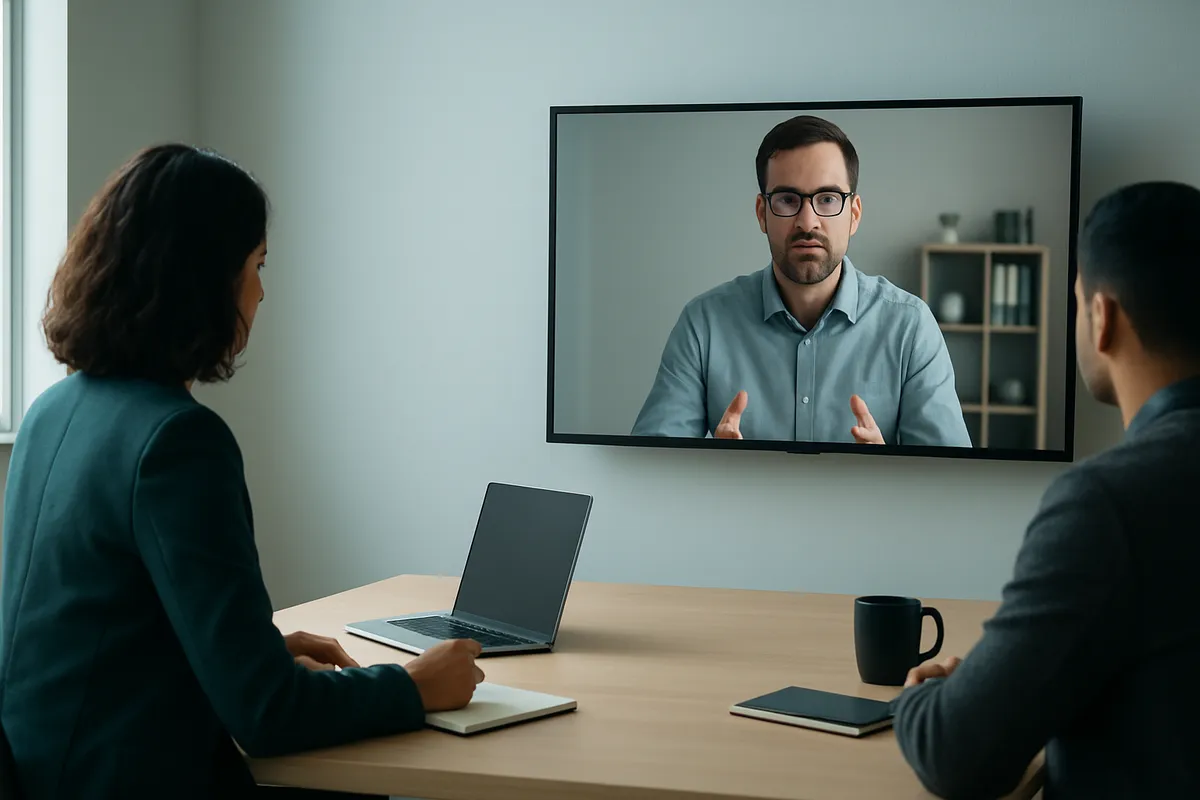
Meeting format makes this worse, not better. A hybrid meeting with five people in a conference room and three on a laptop screen almost always favors the room: side comments, body language, and the natural back-and-forth of people sharing physical space crowd out remote voices who are limited to a single video feed and whoever remembers to unmute them [2]. Gallup's research on hybrid arrangements confirms the office still functions as the stronger setting for collaborative work [1], which is exactly why remote participants in split meetings tend to disengage faster than their in-room peers. Over time, that imbalance shapes who gets credit, who gets asked follow-up questions, and who gets left off the next project.
Teams rarely agree on what "enough" in-person time looks like, and that disagreement runs along generational lines as often as role or seniority. Employees earlier in their careers tend to want more structured office time for mentorship and visibility, while employees with more tenure often see hybrid flexibility as an earned efficiency gain they're reluctant to give up. Research into hybrid work's architectural and organizational effects notes these competing expectations as a persistent source of tension between individual preference and collective norms [3]. Without an explicit team agreement, these mismatched expectations turn into quiet resentment rather than open negotiation.
Culture rituals built for a five-day office, birthday cake in the kitchen, impromptu lunches, all-hands in the big room, don't survive a straight copy-paste into hybrid. Adecco's analysis of hybrid collaboration points out that relationships formed primarily online build differently than those formed face-to-face, and weaker ties show up later as weaker teamwork [2]. Rituals need deliberate redesign, rotating who's on camera first, structured show-and-tell agendas, documented decisions by default, or they quietly become office-only perks that remote staff stop expecting to be part of.
Fixed leases paired with variable attendance create a cost structure that punishes you no matter which way occupancy swings, one part of why is hybrid work difficult from a budget standpoint rather than just a culture one.
A 10-year lease signed in 2019 assumed five-day occupancy. Hybrid schedules rarely deliver that anymore, and the gap between what you're paying for and what employees actually use becomes a permanent line item, not a temporary dip. That mismatch is exactly what pushes corporate real estate leaders toward a blended model: keep a smaller owned footprint sized to real peak demand, then fill gaps with on-demand workspace instead of carrying a second underused building. Upflex approaches this directly, its utilization data and attendance forecasting are built to support exactly this kind of portfolio right-sizing, with customers using the insight to pursue real estate consolidation rather than guessing at what to cut.
Tool sprawl happens because hybrid work was bolted onto systems designed for a single, fixed office, and each new need got solved with a separate point tool.
Desk booking lives in one platform, badge swipe data sits in a security system, and team schedules get negotiated over email or a shared calendar nobody fully trusts. None of these systems talk to each other, so facilities teams end up manually cross-referencing spreadsheets to answer a question as basic as "how many desks do we need on Wednesday." ClearPeople's research on digital working challenges identifies this fragmentation, too many apps, too many silos, as one of the most persistent friction points in hybrid operations, alongside the difficulty of giving employees one unified place to find information and resources [4].
The deeper cost is that nobody owns a single source of truth for who's actually where. Common silos include:
That leaves three different pictures of the same workforce, none reconciled in real time. That gap is what inflates admin overhead: every utilization report becomes a manual reconciliation project instead of a dashboard query.
Distributed work means more access points, more device types, and more locations outside IT's direct control, which widens the attack surface compared to a single-office setup.
An employee working from a co-working space one day and a home office the next connects through different networks, sometimes on personal devices. Enforcing consistent access policies, multi-factor authentication, VPN use, device management, matters more under hybrid than it ever did when everyone sat behind the same corporate firewall. ActivTrak's review of hybrid work challenges flags security and compliance as a standing risk category precisely because policy enforcement gets harder as physical control over the work environment decreases [5]. Centralizing access management alongside booking and attendance data, rather than treating security as a separate workstream, reduces that exposure.
Measure outcomes, not presence, badge swipes and login timestamps show who showed up, not whether work actually got done. This distinction is a big part of why is hybrid work difficult for managers trained to equate visibility with performance.
Activity monitoring tells you someone was logged in for eight hours. It says nothing about whether they shipped the project, closed the deal, or helped a teammate solve a problem. Gallup's research on hybrid workers found that flexibility improves efficiency and autonomy when employees control how they structure their time [1], which is hard to reconcile with tools that track keystrokes or active-window time. Leaders chasing productivity through surveillance tend to get compliance, not better output, and they erode the trust that hybrid arrangements depend on.
Pair attendance pattern data with output-based check-ins instead of monitoring software that tracks individual activity minute by minute. Attendance patterns, who's in on which days, how consistently teams overlap, give managers a planning signal without watching anyone's screen. Layer in regular check-ins focused on deliverables and blockers, and you get a picture of performance that respects autonomy while still giving managers something concrete to act on.
This is also where inconsistent enforcement does damage. When one manager insists on four in-office days and another allows two, employees start comparing notes, and the comparisons rarely land in the company's favor. Research on hybrid work's lived experience points to exactly this tension, individual choice colliding with organizational policy in ways that feel arbitrary to employees [3]. Uneven rules don't just create resentment; they make it impossible to compare productivity data across teams, since one team's "underperformance" might just reflect a stricter attendance mandate.
Three numbers matter more than the rest:
Upflex's UnifyAI engine forecasts attendance at 97% accuracy and tracks co-attendance against team-level targets, giving real estate and HR leaders a shared number to manage against instead of competing anecdotes about who's "never in."
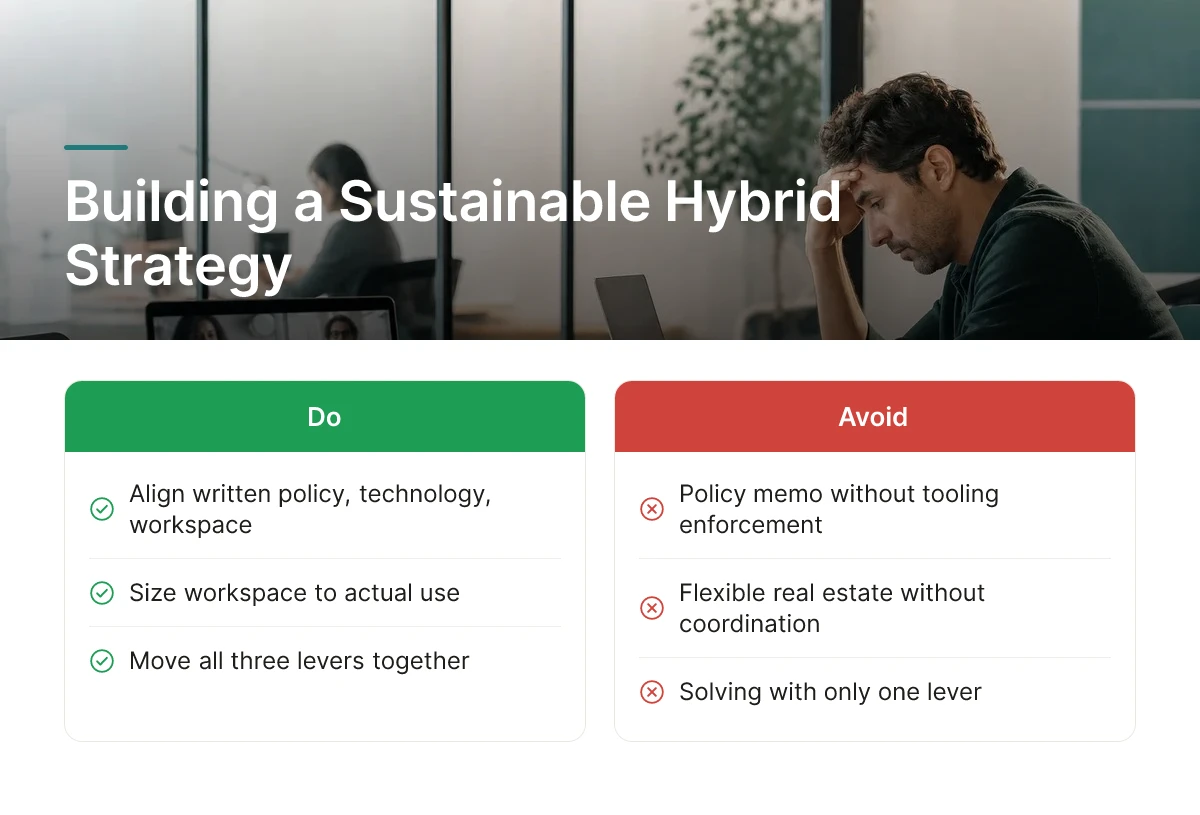
A durable hybrid model needs three things moving together: a written policy, a shared technology stack, and a flexible workspace footprint sized to actual use. Skip any one of them and the same problems resurface within a quarter or two.
This is the answer to why is hybrid work difficult in the first place, most companies try to solve it with only one of these three levers instead of all three. A policy memo without tooling to enforce it is a suggestion. A flexible real estate footprint without policy just recreates the original utilization problem, with expensive square footage sitting empty on the days nobody coordinated to show up.
Policy sets the expectation, which days teams are expected in, how much notice is required, what "core collaboration days" mean for a given department. Technology makes that expectation visible and measurable: scheduling tools, desk booking systems, and attendance forecasting that tell leaders whether the policy is actually being followed. Workspace strategy then responds to what the data shows, consolidating underused floors or adding on-demand access for traveling and distributed staff rather than locking into fixed long-term leases.
Upflex's UnifyAI engine fits this middle layer directly, it forecasts attendance with 97% accuracy and automates the coordination work that policy alone can't enforce, while desk booking and access to an on-demand workspace network give the real estate decision a flexible, data-backed foundation instead of a guess.
Most organizations don't flip this on company-wide. They run a pilot with one or two teams, collect feedback on what's breaking, scheduling conflicts, unused desks, confusion over expectations, and adjust before expanding. A phased rollout, informed by real usage data rather than assumption, is consistently how companies move from chaotic hybrid to a model that holds up across a full portfolio.
Once policy, tooling, and space decisions are aligned, the visible friction drops. Scheduling conflicts become rarer because teams can see who's coming in and when. Real estate footprint shrinks relative to actual attendance instead of sitting sized for a workforce that no longer shows up five days a week. In-office days become predictable enough that collaboration actually happens on them, rather than employees commuting in to sit alone on video calls [1].
None of the hybrid work challenges solutions covered earlier work in isolation, they hold only when the policy, the stack, and the space decision move at the same pace.
Yes, in most cases hybrid work demands more coordination than either extreme because schedules vary by person, team, and week. Fully remote eliminates office logistics; fully in-office eliminates attendance guesswork. Hybrid keeps both variables live at once, which is why forecasting who's coming in, and when, becomes a core operational task rather than an afterthought.
Most hybrid policies fail because they set attendance rules without any way to predict or coordinate who actually shows up. Leadership mandates two or three office days, but without forecasting or team-level coordination, offices end up empty on "required" days and crowded on others, undermining trust in the policy itself.
Most organizations need two to three full quarters to stabilize a hybrid model, as teams adjust schedules and leaders refine policy based on real attendance data. Stabilization comes faster when companies track utilization from day one instead of waiting to react to complaints or empty floors.
Smaller companies struggle more with informal coordination and culture-building, while large enterprises struggle more with real estate costs and cross-location consistency. A 200-person company can often align schedules through direct manager conversations; a 5,000-person enterprise spread across multiple offices needs structured forecasting to avoid the same breakdown at scale.
No, technology alone can't fix hybrid coordination problems without clear policy and manager accountability behind it. Booking tools and forecasting platforms like Upflex remove the guesswork, but leaders still need to set expectations for team co-attendance and act on the data the system provides.
Hybrid work is difficult because it asks organizations to manage two variables at once, unpredictable attendance and fixed real estate costs, without the simplicity of a fully remote or fully in-office model. The fix isn't a stricter mandate; it's visibility. Leaders who forecast attendance, track co-attendance against real goals, and right-size their portfolio based on actual usage consistently outperform those relying on policy alone.
Start by auditing one week of real attendance data against your current office capacity. If the gap is wide, that's your evidence for where forecasting and flexible workspace access, the approach Upflex is built around, should enter the conversation next.
Explore more from our content library: