Share This Article
No items found.


A workplace transformation strategy works when real estate decisions, space utilization data, and employee experience are managed as one connected system instead of three separate problems. Cutting office footprint without tracking how space is actually used typically damages morale and adoption; the fix is pairing utilization data with employee input before consolidating. Done this way, organizations typically reduce real estate costs while improving, not degrading, the day-to-day office experience.
Before changing a single square foot of office space, pull three data sets: badge-in and desk-booking records, real estate costs broken down by location, and current adherence to your hybrid policy. Without this baseline, any workplace transformation strategy is a guess dressed up as a decision.
Start with the numbers that already exist in your systems. Badge data and desk-booking logs show how people actually use space, not how policy says they should. Real estate costs per location, lease terms, operating expenses, cost per seat, tell you where the money is going. Hybrid policy adherence, measured by actual in-office days against required days, reveals the gap between what leadership expects and what employees do. Most CRE teams have fragments of this data scattered across badge systems, booking tools, and finance spreadsheets; the first job is consolidating it into one view.
Office footprint decisions are being forced by a simple mismatch: fixed lease costs against variable, unpredictable attendance. Hybrid work has made utilization swing by day of week and by team, and many organizations are still managing real estate as if attendance were constant [3]. Traditional space planning, built around fixed seating and static headcounts, no longer reflects how hybrid teams actually show up [3].
This is why footprint and policy decisions can't be made in isolation. A lease renewal decision made by CRE alone, without input on headcount plans or which departments are growing, risks cutting space a team will need in six months. Tying real estate moves to the broader business plan, hiring forecasts, department-level attendance patterns, expansion or contraction by function, keeps the workplace transformation strategy aligned with where the business is actually going, not just where it's been.
Space design shapes whether employees actually use the office or treat it as optional. Workplace experience has become a competitive factor in attracting and retaining talent, and getting the physical environment wrong undermines hybrid adoption regardless of policy [1]. That makes space utilization a concrete, measurable thing: occupied-versus-booked ratios, peak-day attendance versus average-day attendance, and floors or zones running well below capacity. Get these numbers right before cutting anything, so reductions target genuinely underused space rather than the days or teams that drive the most collaboration.
None of this works as a solo CRE exercise. Finance needs to validate the cost assumptions, HR needs to flag morale and retention risk, IT needs to confirm the systems generating utilization data are accurate, and department leads need to confirm attendance patterns match what their teams actually experience. Looping these groups in early avoids the common failure mode: a real estate decision announced top-down, then reversed or reworked once department leads surface problems that could have been caught in the baseline review.
Every effective workplace transformation strategy starts with one number: how much of your leased square footage sits empty on a typical Tuesday. Occupancy data, not headline rent, determines whether an office is actually overpriced.
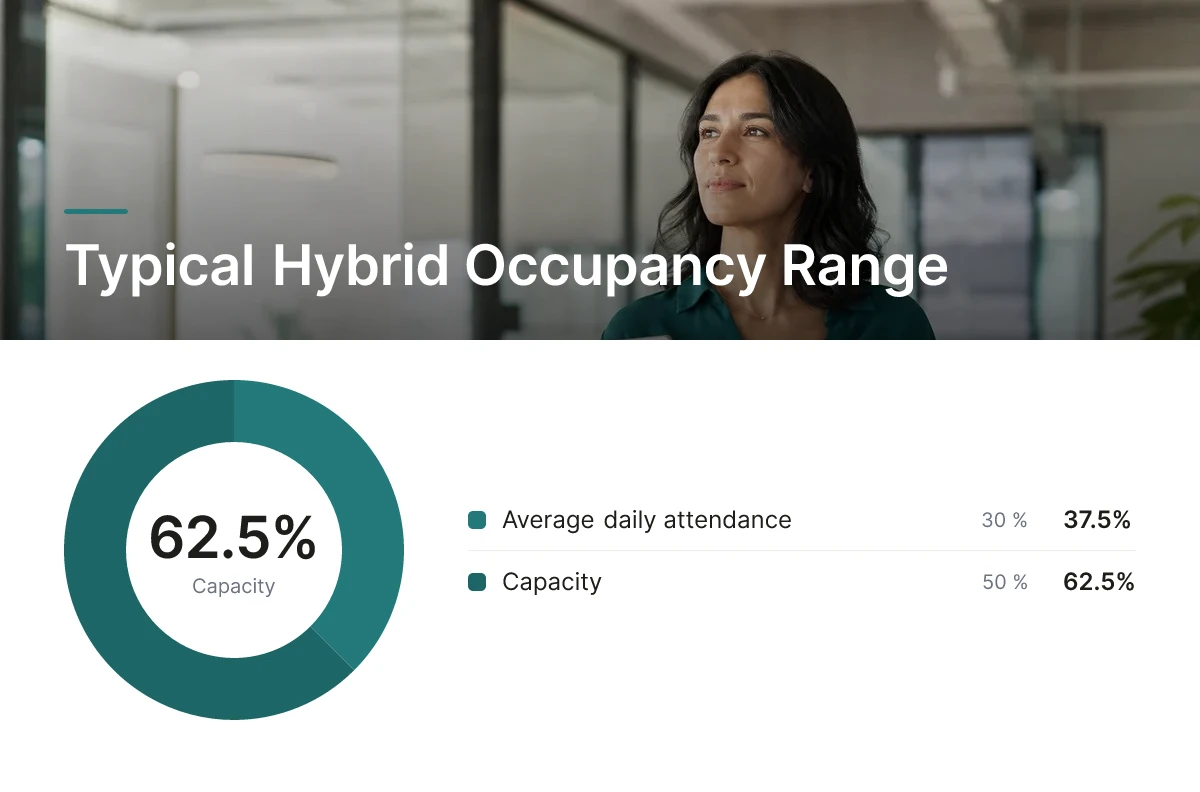
Real estate cost per employee is a function of utilization, not square footage alone. A 200,000-square-foot office at a below-market rate can still be a bad deal if average daily attendance runs at 30-50% of capacity, a range now typical across hybrid portfolios [3]. You are paying full fixed cost, lease, utilities, cleaning, security, for a building that performs like a half-empty one most days. Lowering cost-per-employee means either shrinking the footprint or raising the attendance rate that justifies it, and you can't choose intelligently between those two levers without badge data, booking records, and sensor-based occupancy counts segmented by floor, team, and day of week.
That segmentation matters because hybrid attendance is not uniform. A sales team that comes in four days a week and an engineering team that comes in one day a week have no business under the same space policy. Group teams by actual attendance rhythm, not department charts or job title, and size space decisions to each group: consolidate floors for teams with thin, inconsistent attendance; preserve or even expand space for teams that show up predictably and in numbers. Blanket mandates ("everyone three days a week") tend to produce the exact uneven, hard-to-plan-for attendance that makes space planning difficult in the first place [2].
Protect sentiment by making consolidation a negotiated redesign, not an announcement. Three practices separate cuts that stick from cuts that trigger attrition and complaints.
This is where on-demand workspace access functions as a release valve. Upflex pairs its UnifyAI forecasting, accurate to 97%, with access to a global network of on-demand workspaces, so employees who lose a fixed desk during consolidation can book space nearby on days they need it, rather than treating the cut as a pure loss of options. Combined with desk booking and portfolio-wide utilization dashboards, that mix lets real estate and HR leaders reduce footprint by 40%+ while reporting co-attendance achievement in the high 80s, evidence that the strategy traded square footage for flexibility rather than eliminating the office experience altogether.
Prove the value of a workplace transformation strategy with four metrics tracked together, cost, utilization, employee sentiment, and forecast accuracy, not in isolation.
Cost per occupied seat is the number finance cares about most. It divides total real estate spend by actual seats used, not seats available, so it exposes the gap between what you pay for and what gets used. For more information, see Ai Seo For Small Business Complete 2026 Strategy Guide.
Space utilization rate, the share of desks, rooms, and floors in active use during business hours, tells you where that gap is coming from. Pair it with employee satisfaction or eNPS scores specific to the workplace experience, since cutting square footage without protecting employee experience tends to backfire within a year.
Attendance forecast accuracy rounds out the set. If your platform predicts Tuesday and Wednesday will be busy and Friday will be quiet, check that prediction against badge or booking data weekly. Upflex customers use UnifyAI to forecast attendance at 97% accuracy, which gives real estate and HR leaders a shared number to plan around instead of competing guesses.
Measuring over two or three weeks produces misleading results, because attendance swings with holidays, school calendars, weather, and one-off events. Track across at least one full quarterly cycle before drawing conclusions about utilization trends or cost savings, a quarter smooths out the noise enough to show a real pattern rather than a seasonal blip.
Organization size changes how fast you can validate the plan. A single-site team of a few hundred people can test a new seating ratio or booking policy and see clean results within one quarter, since there's one lease, one floor plan, and one population to track.
A multi-site enterprise portfolio is slower by design. Lease events stagger across markets, each site has its own attendance rhythm, and consolidation decisions in one city often depend on renewal dates in another. Expect two to four quarters before portfolio-wide numbers stabilize enough to support a consolidation decision.
Tie every metric back to the original business case presented to finance, not just a utilization dashboard. If the pitch promised a 40%+ reduction in real estate spend, report progress against that specific target each quarter, alongside co-attendance rates, Upflex customers benchmark against 88% co-attendance achievement, so the CFO sees a running scorecard, not a one-time snapshot.
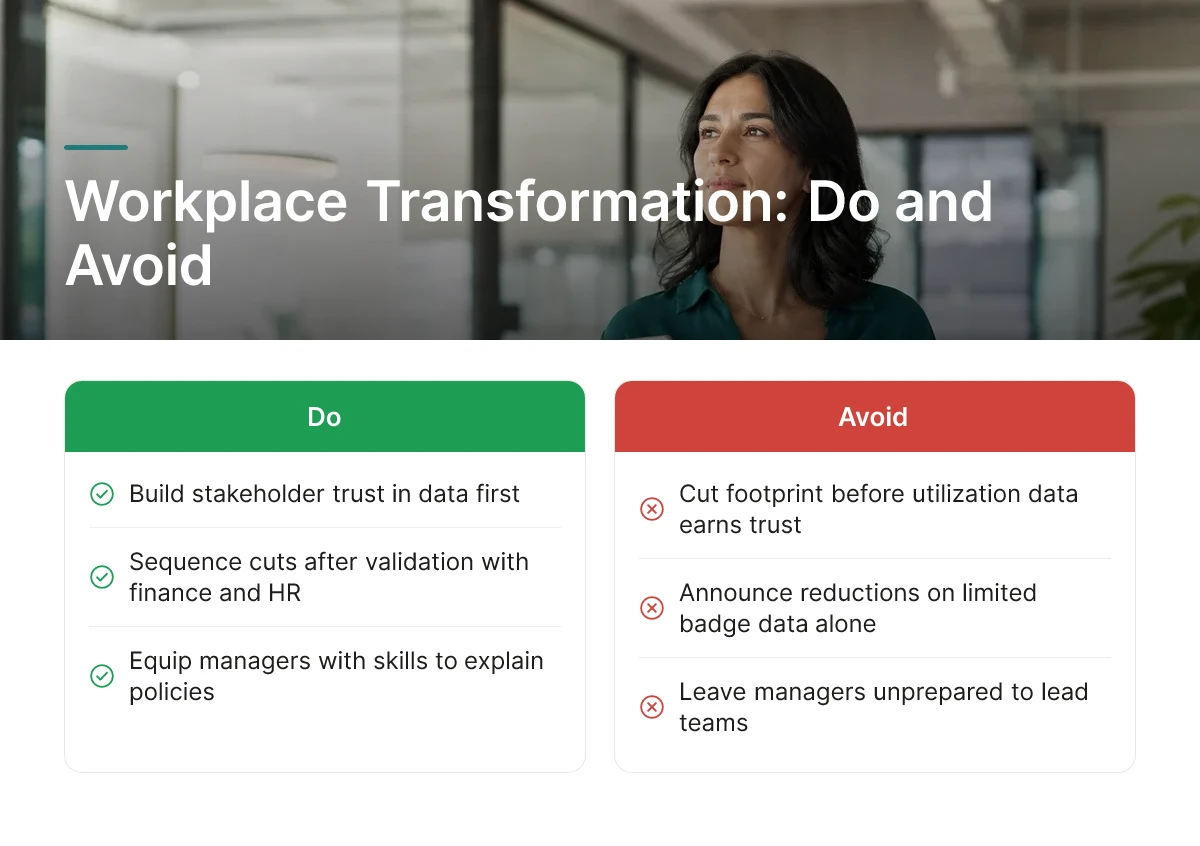
Most workplace transformation initiatives stall for one of two reasons: leadership moves on real estate cuts before stakeholders trust the data, or managers lack the skills to explain new policies to their teams. Both are preventable with the right sequencing.
The single most common failure point is cutting office footprint before utilization data has earned stakeholder trust. A real estate lead who announces a 30% space reduction based on two months of badge data, without first showing finance and HR how that data was validated, invites pushback from department heads who suspect the numbers don't reflect their team's reality. That pushback often forces a reversal, which costs more credibility than moving slowly would have in the first place.
Nuvolo's research notes that many companies adopting hybrid work are still in the early stages of building occupancy strategies, which creates both risk and missed opportunity when space decisions outpace the data behind them [3]. The fix isn't more data, it's a longer runway between presenting utilization findings and acting on them, so stakeholders can question the methodology before it drives a lease decision.
Resistance usually isn't about the policy itself, it's about sequencing. Communicate the reasoning behind a change before announcing what's changing: tell employees why desk ratios are shifting before you tell them which floor is closing. Give them a direct channel to flag problems, whether that's a feedback form tied to the booking tool or a standing office-hours session with facilities, so friction surfaces early rather than after rollout.
Pilot any material change with one team or one floor before rolling it out company-wide. A pilot exposes scheduling conflicts and software gaps while the blast radius is small, and it gives you a internal reference point when skeptical teams ask whether this has actually worked anywhere.
Treat the rollout as a feedback loop, not a launch event. Attendance patterns shift by quarter, by season, and by team reorganization, so a workplace transformation strategy that locks in policy after one rollout will drift out of step with reality within months. Upflex's UnifyAI forecasting re-reads attendance signals continuously, which lets real estate and HR teams adjust desk ratios and booking rules as patterns change instead of waiting for the next annual review.
Finally, invest in manager enablement. Managers who can't clearly explain why hybrid schedules changed, or who don't know how to handle a team member's complaint about desk availability, become the bottleneck that slows adoption regardless of how good the underlying system is.
A workplace transformation strategy only holds up if the underlying platform keeps forecasting demand and flexing capacity long after the initial redesign is done. Spreadsheets and badge-swipe reports can tell you what happened last quarter. They can't tell you what's going to happen next Tuesday, and that gap is where real estate decisions go wrong.
AI-powered office orchestration replaces guesswork with forecasting: it predicts who's coming in, when, and to which location, so space planning becomes proactive instead of reactive. Upflex's UnifyAI engine, for example, processes scheduling inputs and utilization data to forecast attendance with 97% accuracy, giving corporate real estate teams a reliable basis for decisions on consolidation, desk ratios, and lease renewals. That accuracy matters because traditional space planning breaks down once attendance varies by hour, day, and team rather than following a fixed headcount [3]. Instead of reacting to a packed office on Tuesday and an empty one on Thursday, teams can see the pattern coming and adjust staffing, cleaning, and catering accordingly.
On-demand workspace access lets a company shrink its owned footprint and still cover the weeks when attendance spikes, without signing a permanent lease to cover peak demand. This is the mechanism that makes aggressive square-footage cuts safe rather than risky: instead of holding onto excess space "just in case," a company holds a smaller core and taps a flexible network for overflow. Upflex pairs this with access to the world's largest on-demand workspace network, so employees traveling or working outside a core office still get a desk, while finance leaders avoid paying for capacity that sits empty most of the year.
When evaluating any platform for this purpose, check it against four capabilities:
Costs vary widely across this category. Budget-friendly point tools typically cover one capability, like desk booking alone, while enterprise-grade orchestration platforms bundle forecasting, booking, and portfolio reporting into one system built for multi-site organizations. The right tier depends on how many of these four capabilities your current stack is missing.

Space utilization measures how much of your office capacity employees actually use, compared to how much you pay for. In a hybrid model, that means tracking occupancy by day, floor, and team rather than relying on fixed headcounts [3]. A desk sitting empty four days a week still costs full rent. Accurate utilization data is the starting point for deciding what to keep, consolidate, or cut.
Show employees the data behind the decision and protect in-person time for the collaboration that matters to them. Share utilization numbers openly, involve team leads in deciding which days matter most, and use attendance forecasting to guarantee their colleagues will actually be there when they come in, co-attendance, not just presence, is what makes cuts feel reasonable rather than punitive.
Smaller companies benefit too, though the mechanics scale down. A single office with inconsistent attendance still wastes money on unused desks and confuses employees about which days to come in. The same data-driven questions apply, how much space do you need, and when, just applied to one lease instead of a multi-city portfolio.
A hybrid work policy sets the rules, which days people work from where. A workplace transformation strategy uses data to decide how much real estate those rules actually justify. Policy answers "when do people come in"; strategy answers "what should our footprint look like given how people actually show up," backed by utilization and attendance data rather than assumption.
Cutting real estate costs without data is a gamble dressed up as a decision. The leaders who get this right start by measuring actual attendance and utilization, then use that data, not guesswork or mandates, to decide what space to keep, consolidate, or replace with on-demand access. Upflex's UnifyAI forecasts attendance with 97% accuracy, which is precisely the kind of evidence a CFO wants before approving portfolio changes and a CHRO wants before telling employees to adjust their routines.
Start small: pull your last quarter of badge or booking data for one office and compare it against your current lease cost per desk. That gap is your first transformation target.
Explore more from our content library: