Share This Article
No items found.


Half your office sits empty on Mondays and Fridays. You're paying full rent for it anyway. That's the core problem that space performance management was designed to solve. Space performance management is the practice of measuring, analyzing, and continuously optimizing how physical workplace environments are used relative to business goals. It combines utilization data, occupancy analytics, and workforce behavior to turn static square footage into a dynamic, cost-accountable asset. This article covers what space performance management is, how it works, the frameworks that drive it, and the practical steps your organization can take to get measurably better results from every workspace you pay for.
Space performance management is the discipline of tracking, evaluating, and improving how well your physical office environments serve their intended purpose, using real occupancy data rather than assumptions or lease commitments.
According to IBM's definition of space management, the practice involves strategically managing physical spaces to align with broader organizational goals for productivity, sustainability, and cost efficiency [1]. Space performance management takes that foundation a step further by adding a continuous performance loop: measure, benchmark, adjust, and repeat.
At its heart, space performance management sits at the intersection of three disciplines:
Accruent describes space management as the process of optimizing a facility's physical space through planning, organizing, and maintaining usage patterns [2]. Performance management adds the accountability layer: are those spaces actually delivering value against defined metrics?
Hybrid work has fundamentally changed the relationship between headcount and square footage. Organizations that staffed 500 people in 2019 may now have 350 people showing up on peak days and 80 on slow days. Yet many still carry the same lease footprint.
Research from FM:Systems indicates that effective space management directly enhances productivity, reduces costs, and improves employee experience during return-to-office transitions [3]. As of 2026, organizations that treat space as a performance variable rather than a fixed cost are consistently outperforming those that don't on both real estate spend and employee satisfaction metrics.
| Traditional Space Management | Space Performance Management |
|---|---|
| Tracks assigned desks and floor plans | Tracks actual utilization vs. capacity in real time |
| Reactive: responds to complaints or overcrowding | Proactive: forecasts demand and adjusts ahead of time |
| Measured annually during lease reviews | Measured continuously with daily and weekly KPIs |
| Owned by facilities team only | Shared accountability across CRE, HR, and Finance |
| Outputs: floor plans, headcount ratios | Outputs: cost-per-seat, utilization rates, co-attendance scores |
Space performance management works by creating a closed feedback loop between occupancy data collection, analysis, and operational decisions, so that every space-related choice is grounded in actual usage patterns rather than historical assumptions.
The process typically follows four distinct phases. Understanding each one helps you identify where your current approach might be breaking down.
The biggest limitation of traditional space management is that it tells you what happened, not what's about to happen. AI-powered attendance forecasting changes that equation entirely.
Platforms like Upflex use proprietary AI engines to predict office attendance with 97% accuracy. That means your facilities team knows on Monday morning how many people will actually show up on Thursday, not just how many are theoretically assigned to the building. This forecast accuracy is what makes proactive space performance management possible rather than just reactive reporting.
Planon's research on space management software confirms that AI-driven platforms are increasingly central to hybrid work support and space utilization optimization [5]. The shift from descriptive analytics (what happened) to predictive analytics (what will happen) is the defining feature of mature space performance management programs in 2026.
Pro Tip: Don't wait for your lease renewal to start measuring utilization. Start collecting occupancy data at least 90 days before any major real estate decision. You need enough historical data to identify patterns across different days, seasons, and team schedules before you can draw defensible conclusions.
Space performance management delivers measurable financial, operational, and employee experience benefits when implemented with the right data infrastructure and organizational commitment.
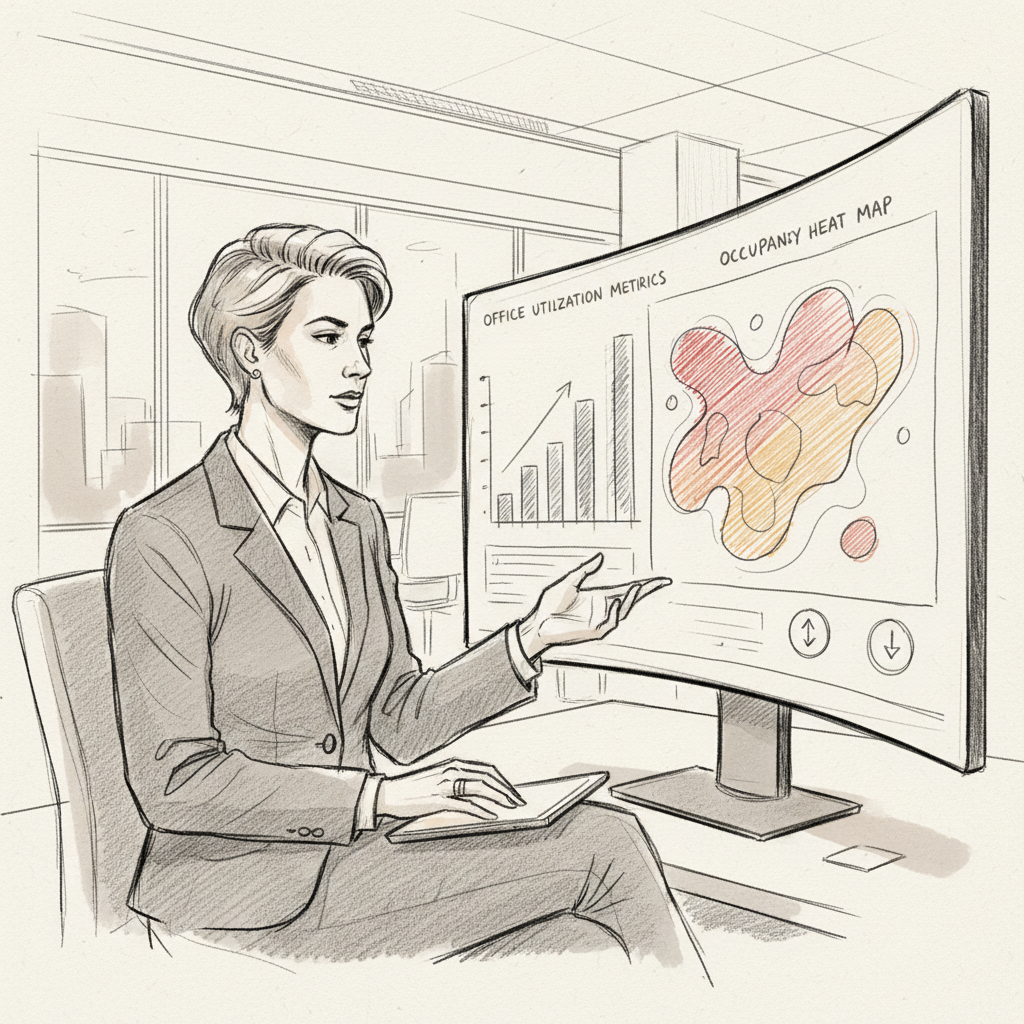
The most immediate benefit is cost reduction. Organizations that implement structured space performance management programs consistently reduce real estate spend, often dramatically. Upflex customers have achieved 40%+ reductions in real estate costs by using utilization data to right-size their portfolios with confidence rather than guesswork.
The financial case is straightforward:
According to Gable's analysis of space management strategy, organizations that align space decisions with business objectives consistently outperform peers on both cost efficiency and employee satisfaction scores [6].
it isn't only about cutting costs. Done well, it improves the in-office experience for the people who do show up.
One common frustration in hybrid environments is the mismatch between who shows up and when. A team that needs to collaborate in person on Wednesdays can't do that effectively if half the team chose Tuesday instead. This is where co-attendance management becomes critical.
At Upflex, we've found that organizations using AI-powered attendance coordination achieve 88% co-attendance rates, meaning teams that need to work together in person actually do. That's a direct product of treating space and scheduling as a performance problem, not just a logistics one.
Industry analysts suggest that employee satisfaction with the office environment is closely tied to predictability: people want to know the office will be worth the commute before they make it. this method creates that predictability by ensuring the right people are in the right place at the right time.
Most this strategy programs underdeliver not because the concept is flawed, but because organizations make avoidable mistakes in how they implement and sustain them.
The most common mistake is treating badge swipe data as a proxy for actual utilization. Badge data tells you who entered the building. It doesn't tell you which floor they went to, whether they stayed for an hour or eight, or whether the meeting room they booked was actually used.
A more complete measurement stack typically includes:
Kadence's research on space utilization notes that organizations relying on a single data source consistently undercount or overcount actual utilization, leading to flawed portfolio decisions [7]. Cross-referencing multiple data streams gives you a far more accurate picture.
A second major pitfall is siloing this approach within the facilities team. Real estate cost decisions involve Finance. Attendance and scheduling decisions involve HR. If those teams aren't sharing data and aligned on goals, you end up with facilities optimizing for square footage while HR is optimizing for headcount, and neither is looking at the same problem.
From experience working with enterprise clients, the programs that fail most often are those where:
One limitation worth acknowledging: this can surface uncomfortable truths about how space is being used. A floor that a senior leader championed and personally designed may show up in the data as chronically underutilized. Having executive sponsorship and a clear mandate before you start measuring is essential.
For organizations managing complex, multi-site projects, tools like those reviewed in this guide to Best Construction Project Management Software illustrate how performance-oriented thinking from adjacent disciplines (like construction management) can inform how you approach space accountability across your portfolio.
Pro Tip: Assign a named owner for each space performance KPI, not just a team. "The facilities team owns utilization rate" is too diffuse. "Sarah, our VP of Corporate Real Estate, owns the cost-per-seat metric and reports it to the CFO monthly" creates real accountability.
The most effective it programs share a common set of practices: they're data-rich, cross-functional, forward-looking, and tied directly to financial outcomes.
Start by defining what "performance" means for your specific organization. The metrics that matter for a 10,000-person global enterprise with 30 offices are different from those that matter for a 500-person company with two locations.
That said, most mature programs track some version of these core KPIs:
| KPI | What It Measures | Target Benchmark |
|---|---|---|
| Peak utilization rate | Highest occupancy as % of capacity | 70-85% |
| Average daily utilization | Mean occupancy across all working days | 40-60% for hybrid |
| Cost per occupied seat | Total real estate cost ÷ average daily occupants | Varies by market |
| Co-attendance rate | % of team members present on same days | 80%+ for collaborative teams |
| Meeting room efficiency | Booked rooms actually occupied ÷ total bookings | 75%+ |
Skedda's definitive guide to space management recommends establishing baseline measurements before setting targets, so you understand your starting point before committing to improvement goals [8].
The second critical practice is pairing your performance measurement with forward-looking forecasting and flexible workspace options.
Here's the practical sequence:
This is where access to an on-demand workspace network becomes operationally valuable, not just a nice-to-have. When your owned office is at capacity on a peak day, employees need somewhere productive to work. When it's nearly empty on a slow day, you need the financial flexibility to not be paying for that emptiness permanently.
Research from GetDX on the SPACE framework (Satisfaction, Performance, Activity, Communication, and Efficiency) demonstrates that multi-dimensional measurement frameworks consistently outperform single-metric approaches in capturing true workspace effectiveness [9].
Pro Tip: Review your space performance data by team, not just by building. A floor that averages 45% utilization overall might contain one team at 90% and another at 10%. Team-level granularity is where the actionable insights live.
The 5 C's of performance management are Clarity, Context, Consistency, Courage, and Commitment. In the context of this method specifically, Clarity means defining measurable utilization targets; Context means understanding why space is or isn't being used; Consistency means tracking metrics on a regular cadence; Courage means acting on data even when it challenges existing decisions; and Commitment means sustaining the program beyond initial implementation. Together, these principles create a performance culture that applies equally to people management and workplace optimization.
The 4 pillars of facility management are People, Processes, the Facility itself, and Technology. People refers to the teams responsible for managing and using the space; Processes covers the operational workflows and standards that govern space usage; the Facility pillar addresses the physical environment, infrastructure, and assets; and Technology encompasses the software, sensors, and platforms used to monitor and optimize performance. Effective this strategy requires all four pillars to be aligned and data-connected, not managed in isolation.
The 5 elements of performance management are Planning, Monitoring, Developing, Rating, and Rewarding. Applied to this approach, Planning means setting utilization targets and defining what success looks like for each workspace; Monitoring means continuously tracking occupancy and utilization data; Developing means iterating on space configurations and policies based on what the data reveals; Rating means scoring spaces against defined benchmarks; and Rewarding means allocating resources and investment toward high-performing spaces while rationalizing underperforming ones.
The SPACE framework is a multi-dimensional measurement model originally developed for software engineering teams that measures Satisfaction, Performance, Activity, Communication, and Efficiency. In workplace contexts, it's been adapted to evaluate how well physical environments support each of these dimensions. Rather than reducing workspace performance to a single occupancy number, the SPACE framework encourages organizations to ask whether the space is actually enabling the work it's meant to support, making it a valuable complement to pure utilization metrics in any this program.
Effective space utilization measurement requires combining multiple data sources rather than relying on any single signal. Badge access data, desk booking records, IoT occupancy sensors, Wi-Fi session logs, and employee scheduling inputs each capture a different dimension of how space is actually used. The most accurate picture comes from cross-referencing these streams to calculate metrics like peak utilization rate, average daily occupancy, and cost per occupied seat. AI-powered platforms can automate this aggregation and surface anomalies that manual analysis would miss.
Traditional space management focuses on planning and organizing how space is allocated, typically through floor plans, desk assignments, and headcount ratios. it adds a continuous accountability layer: it tracks whether that allocation is actually delivering value against defined KPIs, benchmarks performance over time, and drives operational decisions based on real utilization data. The key distinction is the shift from static planning to dynamic optimization, where every space is treated as a performance variable rather than a fixed cost.
this method isn't a facilities project. It's a financial discipline with measurable ROI. Organizations that treat their physical workplaces as performance assets rather than fixed overhead are making better real estate decisions, spending less money on space that doesn't earn its keep, and creating better in-office experiences for the people who do show up.
The shift requires three things: better data, better forecasting, and the organizational will to act on what the data tells you. That last part is often the hardest.
Upflex is built specifically for this challenge. By combining AI-powered attendance forecasting (97% accuracy through UnifyAI) with desk booking, co-attendance coordination, and access to the world's largest on-demand workspace network, Upflex gives corporate real estate and HR leaders the complete toolkit for this strategy at enterprise scale. The result isn't just a prettier dashboard. It's 40%+ reductions in real estate spend and 88% co-attendance rates that you can take to your CFO and your CHRO with confidence.
If your office is costing you more than it's contributing, that's a this approach problem. And it's a solvable one.
Explore more from our content library: