Share This Article
No items found.


Understanding why employees prefer flexible work is essential. Employees prefer flexible work over higher salaries because it returns control over time, location, and energy, resources a raise can't buy back. Surveys of job seekers consistently show flexibility ranking above pay increases when workers evaluate job offers, largely because autonomy reduces burnout and commute-related stress while improving focus. For employers, this preference is strategic use: flexible arrangements lower attrition and let companies shrink underused office space, cutting real estate overhead while meeting what talent actually wants.
Employees weigh flexibility against pay by calculating what a raise actually buys them, and a raise can't buy back two hours lost to a daily commute. This is the mechanism behind why employees prefer flexible work: autonomy over time and location removes friction that salary increases never touch. A worker who can start at 7 a.m. to avoid traffic, or skip the commute three days a week, recovers hours that no incremental pay bump replaces.
Flexibility also signals something pay cannot: trust. When an employer stops tracking hours in a seat and starts measuring output, employees read that as respect for their judgment [2]. That perceived trust compounds, it shows up in engagement, discretionary effort, and willingness to stay through a rough quarter instead of updating a resume.
Flexible scheduling removes two of the most common resignation triggers, rigid hours and forced relocation, which directly reduces voluntary turnover [3]. Flexible work arrangements function as a retention lever precisely because they address the structural reasons people quit, not just the compensation reasons.
Lower turnover has a second-order financial effect that corporate real estate and finance leaders care about even more: recruiting and onboarding costs drop when fewer seats need refilling. Every employee who stays instead of leaving avoids a cycle of job postings, interview hours, training time, and the productivity dip that comes with a new hire ramping up. Research on flexible work arrangements ties this directly to engagement, productivity, and retention outcomes that compound across a workforce [3].
Hybrid attendance patterns mean fewer employees are in the building on any given day, which lets companies size offices around actual occupancy instead of a theoretical 100% headcount. Desk-sharing ratios and occupancy forecasting replace the old model of one desk per employee, and that shift is what makes real estate consolidation possible without disrupting the in-office experience teams still rely on for collaboration.
This is the dual-benefit case for flexibility: it is simultaneously what employees rank above a raise and the lever that shrinks one of the largest fixed costs on a corporate balance sheet. Platforms like Upflex make this concrete by forecasting attendance with 97% accuracy through its UnifyAI engine, so real estate leaders can right-size square footage with data instead of guesswork, while giving distributed employees access to an on-demand workspace network when they need a desk outside the home office. Companies using this approach have documented real estate spend reductions of 40% or more, proof that satisfying employee preference and cutting overhead are not competing goals.
Flexible arrangements give employees control over when, where, and how they structure their day, and that control reduces decision fatigue, sharpens focus, and builds the trust that drives real engagement. These mechanics explain why employees prefer flexible work over rigid, fixed-hour models, even when total hours worked stay the same.
A fixed 9-to-5 schedule forces every employee into the same rhythm regardless of when they think best. Control over scheduling cuts the number of small daily negotiations, commute timing, childcare handoffs, appointment conflicts, that otherwise interrupt attention before real work even starts. Fewer context switches early in the day translate into longer, less-interrupted focus blocks once work begins, which is the practical reason flexible employees often report getting more done in less clock time.
Autonomy signals trust, and trust is what converts a compliant employee into an engaged one. When a manager lets someone choose their own hours or workspace, the employee reads that as confidence in their judgment rather than suspicion of their output, and workplace research consistently links that kind of trust to stronger engagement and well-being [1]. Flexibility in the workplace has also been tied to creativity and morale gains, because employees who set their own pace report feeling more supported and more willing to contribute ideas rather than just execute tasks [2]. Energy patterns matter here too. Creative and analytical work rarely fits neatly into an 8-hour block starting at 9 a.m. Letting people work during their natural high-energy windows, early morning for some, late afternoon or evening for others, produces better creative output than forcing everyone into identical hours regardless of when their attention actually peaks.
Flexible schedules strengthen collaboration when they're paired with deliberate in-person anchor days, not left to chance, unstructured flexibility alone can fragment teams. Research on workplace flexibility points to stronger engagement and collaboration as an outcome, but only when organizations pair autonomy with intentional coordination rather than treating flexibility as a purely individual perk [2]. This is where schedule flexibility and remote flexibility need to be treated as separate levers: schedule flexibility solves for when someone works, while remote flexibility solves for where. A sales team might need fixed anchor days in the office for pipeline reviews while still allowing flexible start times, conflating the two creates coordination gaps that undermine exactly the teamwork flexibility is meant to support. Upflex's UnifyAI attendance forecasting addresses this directly by predicting which days teams will actually show up, so anchor-day coordination happens by design rather than guesswork.

Flexibility preferences shift sharply by sector and generation, which is why employees prefer flexible work in different forms depending on their job and life stage.
Knowledge-work sectors, technology, finance, professional services, have the fewest structural barriers to flexibility, since most tasks don't require a specific physical location or shift coverage. These industries can offer remote days, asynchronous schedules, and choice of workspace without disrupting operations. That's a large part of why employees prefer flexible work in these fields at higher rates than in roles tied to a fixed site.
Healthcare, manufacturing, and retail face different constraints. A nurse can't deliver patient care remotely, and a production line can't run itself. Flexibility in these sectors looks less like remote work and more like shift-swapping platforms, compressed workweeks, or self-scheduling within fixed shift blocks. The intent is the same, giving workers more control over when and how they work, but the mechanism has to fit the physical or regulatory reality of the job.
Talent market tightness also drives the pace of adoption. Employers competing for scarce specialized talent tend to add flexibility faster because it functions as a recruiting and retention lever rather than a perk [4]. Firms in labor markets with more abundant supply feel less pressure to move quickly, since they can usually fill open roles without matching every competitor's schedule offerings. This dynamic matters for corporate real estate and HR leaders deciding which teams or sites need flexible policies first, the sharpest talent competition usually points to where flexibility will have the most retention impact.
Generational context changes what flexibility needs to deliver, even when the underlying desire for control over time and location is shared. Gen Z workers, many early in their careers, often weigh flexibility alongside mentorship and visible career development, they want autonomy, but not at the cost of learning from colleagues in person. Millennials tend to balance flexibility against advancement visibility, wary that remote time might reduce their exposure to decision-makers. Gen X and older employees more frequently cite caregiving responsibilities and life-stage demands as the reason flexibility matters to them [3].
These differences explain why a single, company-wide flexibility policy tends to underperform compared to a segmented approach that accounts for role, sector, and workforce demographics. Upflex's attendance forecasting and desk booking tools let workplace leaders build coordination patterns around actual team composition rather than a uniform mandate, which supports co-attendance goals without flattening the varied reasons different groups show up.
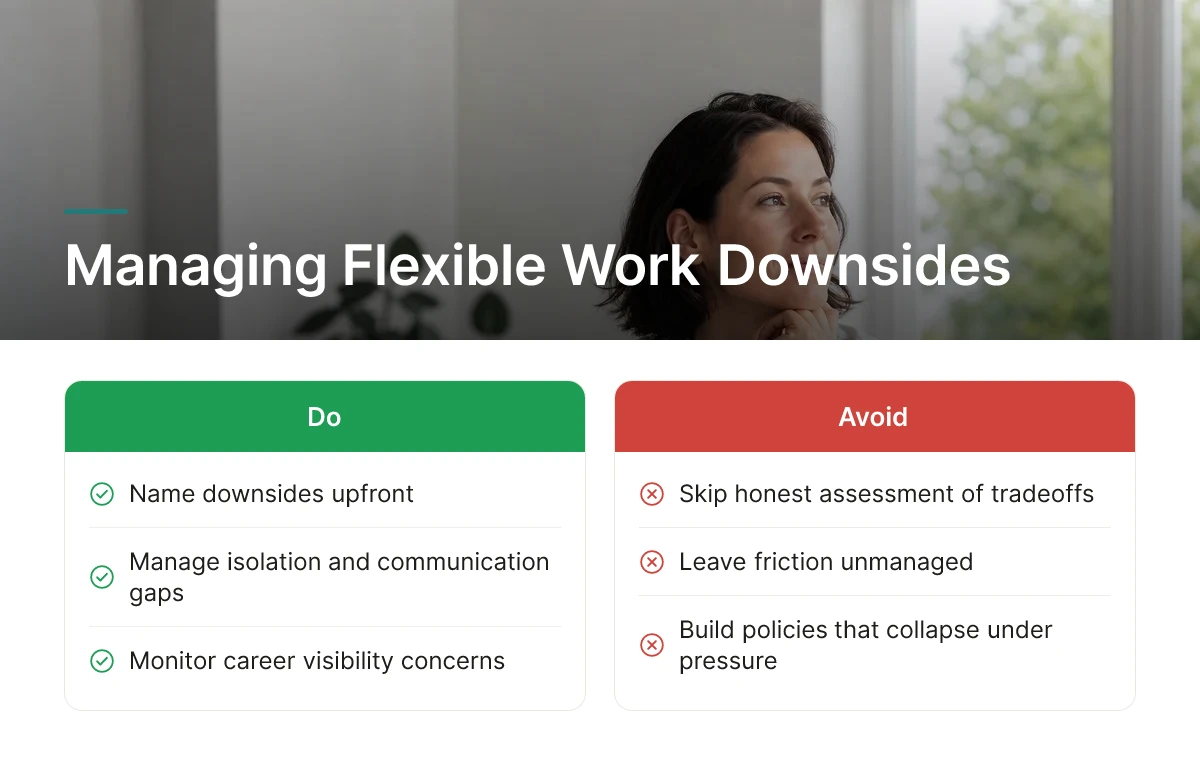
Flexible work creates real friction around isolation, communication gaps, and career visibility, problems that undermine results if left unmanaged, but not reasons to reverse course.
Any honest account of why employees prefer flexible work has to include what they give up to get it. Corporate real estate and HR leaders who skip this step tend to build policies that collapse under their first hard case, a missed promotion, a disengaged new hire, a team that stops trusting each other. Naming the downsides upfront is what makes a flexible work policy durable.
The most consistent risk is a quiet erosion of informal connection. Hallway conversations, desk-side questions, and the casual mentorship that happens when a junior employee overhears a senior one working through a problem don't translate well to calendars and chat threads. Over months, this can weaken team cohesion in ways that don't show up in any single week's metrics but compound into disengagement.
Communication friction compounds the problem. Distributed and asynchronous schedules push more coordination into written form, Slack messages, shared docs, email threads, which strips out tone and context that in-person conversation supplies automatically. Without a deliberate rhythm of check-ins, teams drift into misalignment: two people quietly build different assumptions about a deadline or a decision, and nobody notices until the work collides.
Career advancement worries sit underneath both issues. Employees working remotely more often report concern about being passed over for assignments, promotions, or stretch projects that go to colleagues who happen to be visible in the office that week, a dynamic commonly called proximity bias. This fear is rational: if promotion decisions run on informal manager impressions rather than documented criteria, the people in the room have an edge regardless of output.
Each of these frictions has a structural fix, not just a cultural aspiration.
Platforms like Upflex support this by forecasting attendance with 97% accuracy through its UnifyAI engine, so leaders can schedule those in-person windows around when teams will actually show up, and by tracking co-attendance against a target, Upflex customers see 88% co-attendance achievement, rather than leaving collaboration to chance. Treated this way, these downsides become a design problem companies solve, not a reason to pull back on flexibility.
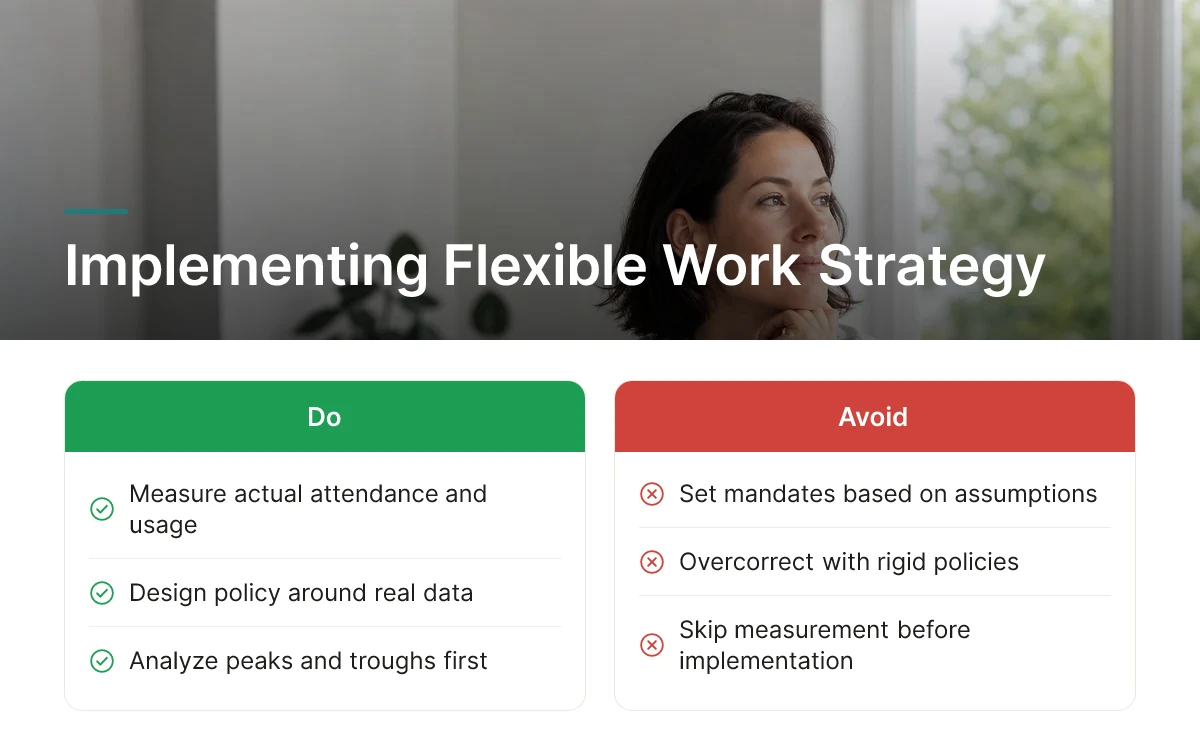
Successful implementation starts with measuring actual attendance and space usage, then designs policy and real estate decisions around that data, not assumptions. Companies that skip this step tend to either overcorrect with rigid mandates or underuse the cost-saving potential sitting in their real estate portfolio.
The starting point is always the same: measure before you mandate. Before setting an in-office ratio or anchor-day policy, leaders need a clear read on who is actually showing up, which days see peaks and troughs, and how much square footage sits empty on an average Tuesday versus a packed Thursday.
This is where occupancy data becomes a real estate decision, not just a workplace experience metric. If utilization data shows a floor running at 40% capacity for months, that's evidence to consolidate or sublease, but only if leaders can confirm the drop isn't concentrated in one team that still needs dedicated space for coordination. Guessing at ratios without this data is how companies end up with either overcrowded offices on mandated days or leases they can't justify to the CFO.
Flexibility also shows up as a retention lever, not just a cost lever. Employers already treat flexible scheduling as part of the compensation package, alongside pay, because it drives engagement and recruiting outcomes [3]. Firms responding to tight labor markets have leaned on flexible schedules specifically because workers are asking for them [4]. Understanding why employees prefer flexible work, autonomy, reduced commute burden, better control over focus time, gives leaders the context to design policy that keeps people rather than one that just fills seats.
Shift the management mindset from tracking hours and location to evaluating outcomes, what got done, not where or when it happened. This single change resolves most of the tension between flexibility and accountability, because it stops forcing managers to police attendance as a proxy for productivity.
Anchor days solve the coordination problem that pure remote flexibility creates. Instead of mandating five days or leaving attendance fully optional, companies set one or two fixed in-office days per team, so collaboration happens predictably while individuals keep control over the rest of their week. This is the structural compromise that lets flexibility and co-attendance coexist.
Technology that forecasts attendance and supports desk booking is what makes this sustainable at scale, it prevents the two failure modes of hybrid policy: offices that are overcrowded on anchor days and leased space that sits wasted the rest of the week. Upflex's UnifyAI engine forecasts attendance with 97% accuracy, which lets real estate and workplace leaders set anchor-day policy with confidence and track whether teams are hitting co-attendance targets, rather than finding out after the lease renewal that the office never matched actual demand.
For many employees, yes, flexibility now competes directly with salary as a deciding factor in job choice. Employers responding to tight labor markets have had to combine higher wages with flexible schedules and remote options, because pay alone no longer secures or retains talent [4]. Evidence also shows flexibility ranks higher than many expected relative to compensation [5].
Not when attendance is coordinated, collaboration suffers from unpredictable schedules, not flexibility itself. Research on workplace flexibility links it to stronger engagement and collaboration, not weaker teams [2]. The real risk is uncoordinated in-office days, which is why forecasting tools like Upflex's UnifyAI target 88% co-attendance achievement instead of leaving overlap to chance.
Caregivers, long commuters, and employees managing health conditions see the largest gains from flexible arrangements. Flexible schedules support recruitment and retention of a diverse workforce by accommodating varied life circumstances, which strengthens engagement and reduces turnover across the organization [3]. Knowledge workers with deep-focus tasks also benefit from control over when and where they work.
Companies track attendance accuracy, co-attendance rates, space utilization, and turnover, not just survey sentiment. Well-being research ties work flexibility to measurable outcomes like stress and job satisfaction, giving HR leaders quantifiable signals beyond anecdote [1]. Platforms that forecast attendance and monitor desk utilization, Upflex reports 97% forecasting accuracy, let real estate and HR leaders validate policy decisions with data rather than guesswork.
Employees prefer flexible work because it respects their time, health, and autonomy, and companies that treat flexibility as a data problem, not a culture slogan, capture both the retention benefits and the real estate savings. The leaders who win here forecast attendance instead of guessing, coordinate in-office days instead of mandating them, and measure utilization instead of assuming it. Upflex pairs that forecasting with access to an on-demand workspace network, helping real estate and HR leaders cut costs without sacrificing the flexibility employees now expect. Start by auditing your current office utilization data, you can't right-size a portfolio you haven't measured.
Explore more from our content library: