Share This Article
No items found.


Understanding why companies are downsizing offices is essential. Companies are downsizing offices to cut occupancy costs and match real estate to how teams actually use space under hybrid work, not simply to shrink headcount. The driver is a math problem: badges show offices sitting mostly empty several days a week, so leases, utilities, and maintenance pay for square footage nobody uses. The fix is rightsizing, consolidating locations, shifting to flexible or on-demand workspace, and reinvesting the savings into tools and space that make in-office time worth the commute.
The core pressure is a mismatch between fixed occupancy costs and variable attendance, companies pay full rent for space that sits empty most of the week. Hybrid schedules mean the average office fills to a fraction of capacity on any given day, yet lease terms, utilities, and maintenance contracts don't flex downward just because fewer people show up. That gap between what you pay for and what you use is the financial engine behind why companies are downsizing offices right now.
Real estate portfolios built for pre-hybrid headcount tend to accumulate costs quietly. A company that signed five-year leases in 2019 is often still paying for floors designed around five-day attendance, plus duplicate amenities, kitchens, conference rooms, reception staff, spread across locations that could consolidate into one. Without utilization data, finance and real estate teams can't see which floors or buildings are the worst offenders, so the overhead compounds until a lease renewal or budget review forces the question.
Downsizing looks different depending on how much a business depends on physical, on-site work. Finance and professional services firms, where work is largely digital and roles are desk-based, have led the way in shrinking trading-floor-style space and consolidating multiple regional offices into fewer, denser locations [1]. Tech companies have followed a similar logic, though some are expanding campuses for specific talent or culture reasons even as peers shrink [5].
Healthcare and manufacturing sit at the other end. Labs, clinical floors, and production lines require fixed physical footprint regardless of hybrid policy, so these industries retain more square footage even as they trim administrative office space [1]. The common thread, as EY notes, is that corporate real estate strategy now has to account for hybrid work patterns rather than assume a static, fully-occupied building [1].
The savings show up through specific mechanisms, not just smaller buildings. Consolidating several leases into one flexible footprint cuts duplicate rent, utilities, and facilities staff in one move. Swapping owned square footage for on-demand workspace for distributed or traveling employees removes the cost of maintaining capacity that sits idle most days [2].
This is portfolio strategy, not panic. Cost-cutting in a crisis means slashing budgets reactively; cost optimization means using occupancy data to decide, deliberately, how much space you actually need and where.
Hybrid work breaks the old formula of one desk per employee, replacing fixed daily capacity with a variable number that swings by the day of the week, and that swing is one of the central reasons why companies are downsizing offices.
Under a five-day in-office model, a real estate team sizes a building for close to 100% of headcount, every day, regardless of whether everyone actually shows up. Hybrid schedules break that assumption. With most organizations now running some version of a hybrid program [4], the real planning question isn't "how many employees do we have," but "how many show up on our busiest day." That's a materially smaller number, and it's the number that should drive square footage, not total headcount.
Some companies are reversing course and mandating more in-office days because unmanaged hybrid schedules can make a smaller office feel just as broken as an oversized one. When employees pick their own in-office days with no coordination, attendance clusters unpredictably, a floor sits half-empty on Monday and overflows by Wednesday, with no meeting rooms free and coworkers who rarely overlap. That pattern erodes the three things leadership tends to cite when reinstating office mandates: spontaneous collaboration, culture-building for newer employees, and manager visibility into day-to-day work. None of those require a bigger building, they require more people in the same building on the same days, which is a scheduling and forecasting problem before it's a square-footage problem. This is exactly where platforms like Upflex fit in: its UnifyAI engine forecasts attendance with 97% accuracy, which lets workplace teams coordinate who's in on which days and hit measured co-attendance targets, Upflex customers report 88% co-attendance achievement, without needing to add space back.
Downsizing and return-to-office mandates aren't contradictory, even though headlines often treat them that way. A company can shrink its total footprint while increasing the number of in-office days per employee, as long as it consolidates into fewer, better-used locations instead of spreading the same headcount thin [2]. The lever isn't the amount of space, it's whether attendance on any given day is coordinated enough to make full use of whatever space remains.

Office downsizing reduces leased square footage or consolidates locations; layoffs reduce headcount, they're separate decisions, often made by different teams, for different reasons.
Corporate real estate leaders own the downsizing decision: which buildings to keep, which leases to let lapse, how many square feet the company actually needs. HR and business unit leaders own headcount decisions, driven by budget, demand, or restructuring. The two can move independently of each other, and understanding why companies are downsizing offices starts with recognizing that a shrinking footprint doesn't require a shrinking workforce at all.
A company can keep every employee on payroll, or keep hiring, and still cut its real estate footprint by half. Hybrid schedules mean fewer people are in any given building on any given day, so the company needs fewer desks overall. Flexible workspace arrangements and hub-and-spoke models, where a company keeps a smaller anchor office and gives employees access to on-demand workspace near where they live, let a business maintain the same headcount while occupying less permanent square footage. Real estate strategy built around flexibility rather than fixed assignment is a core reason enterprises can right-size space without touching staffing levels [1].
No, downsizing and layoffs sometimes coincide, but one doesn't require the other. When layoffs happen first, space reduction often follows as a practical consequence: fewer employees simply need less room, and keeping an oversized office stops making financial sense. In other cases, downsizing happens entirely on its own, triggered by a lease renewal, a utilization study showing occupancy well under capacity, or a shift to hybrid scheduling, with no connection to staffing decisions at all [2].
The two get conflated because they often get announced in similar language, "restructuring," "optimization," "consolidation", even when the underlying driver is completely different. That conflation creates unnecessary anxiety: employees hear about a floor closing or an office consolidating and assume cuts are coming, even when the real story is a company simply reorganizing how it uses space it already pays for.
Transparent communication about which decision is actually happening, and why, is what protects trust during the transition. A company that clearly explains "we're consolidating offices because utilization data shows we need less space", distinct from any statement about staffing, gives employees a reason to stay engaged rather than assume the worst.
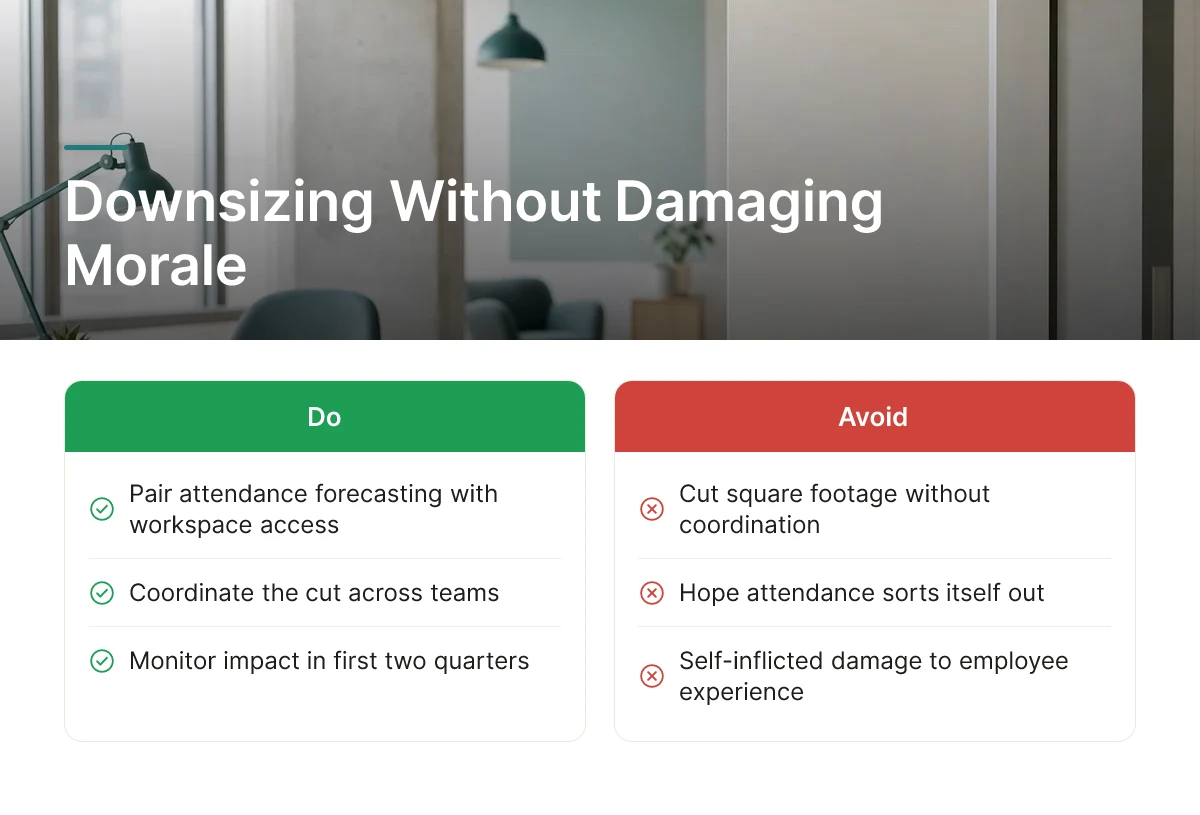
Downsizing protects employee experience when it pairs attendance forecasting with on-demand workspace access, rather than just cutting square footage and hoping attendance sorts itself out.
Most of the damage from office downsizing is self-inflicted. The square-footage cut isn't the problem, the lack of coordination behind it is. Understanding why companies are downsizing offices matters less than understanding how they execute the cut, because the same decision can read as smart cost control or as a morale crisis depending on what happens in the first two quarters.
Four failure patterns show up repeatedly when space reduction isn't paired with coordination. Overcrowding on popular in-office days is the most visible: employees show up on the same two or three days by habit, and a smaller floor plate can't absorb the spike, leading to desk shortages and complaints that defeat the purpose of coming in at all. Loss of quiet or focus space follows close behind, when leadership trims square footage, conference rooms and phone booths are often the first thing cut, leaving an open floor with no option for concentrated work. Consolidation can also lengthen commutes if closing one location pushes employees toward a single remaining office that's farther from where they live. And without coordinated scheduling, team cohesion erodes, people come in but their teammates don't, so the office delivers commute cost without collaboration benefit.
Space-utilization patterns typically take a few quarters to settle after a major change, as hybrid teams adjust routines and managers recalibrate in-office expectations. Treating opening-week attendance data as final is a common misstep, early patterns reflect novelty and habit, not the steady state. Companies that build in a review checkpoint at 90 and 180 days, rather than locking in the floor plan permanently at launch, catch overcrowding or underuse before it hardens into either complaints or a visibly empty office.
This is where forecasting earns its place in the decision. Predicting which teams are coming in on which days, and coordinating that across departments, prevents both failure modes: an office so crowded it feels chaotic, and one so empty it signals to employees that the space wasn't worth keeping. Upflex's UnifyAI engine forecasts attendance with 97% accuracy and tracks co-attendance against a benchmark of 88% achievement, giving real estate and HR leaders a shared, data-backed view instead of competing anecdotes.
Pairing a smaller core office with on-demand access to additional workspace near employees' homes also preserves flexibility that a pure headcount-based cut removes, someone who loses their assigned desk in a consolidation still has a professional space to work from without a long commute. Ignoring these mechanisms carries real costs: attrition risk from employees who feel the office no longer serves them, productivity dips during a rocky transition, and the expense of reversing a downsizing decision that went further than attendance data actually supported.
Rightsizing follows five steps: audit actual usage, model future demand, decide the portfolio shape, transition vendors, then communicate and monitor. Skipping the audit is the single most common reason downsizing projects miss their savings target or trigger an employee backlash.
Start with badge data, Wi-Fi logs, or sensor-based occupancy, not the attendance policy on paper. Many of the reasons why companies are downsizing offices trace back to exactly this gap: leadership assumed 60% occupancy because that's what the hybrid policy requires, while actual swipe data showed far less. Hybrid workplaces now run at 30–50% utilization against fixed real estate costs built for a fully in-office workforce, and 87% of companies have already adopted some hybrid model [4], which means most portfolios are sized for a workforce that no longer shows up the way it used to.
Separate peak-day capacity from average daily use, a space planned for Tuesday's crowd will sit mostly empty the other four days. Traditional space planning assumed fixed seating and static headcounts; hybrid occupancy instead varies by hour, day, and team [4], so the model needs to account for both the busiest day of the week and the typical one.
Three paths dominate: consolidate into fewer owned or leased locations, shift a portion of the footprint to flexible, on-demand workspace, or blend both into a hub-and-spoke model with a smaller core and flexible satellite access. CRE portfolio reduction is fundamentally a strategic exercise in matching square footage to real demand while protecting operational efficiency [2], the right shape depends on how concentrated or distributed the workforce actually is.
Evaluate any workspace or facilities partner on three criteria: geographic coverage matching where employees actually sit, flexibility of contract terms versus long-term lease lock-in, and integration with existing booking and HR tools. A platform like Upflex fits this stage directly, its UnifyAI engine forecasts attendance with 97% accuracy and pairs that forecast with on-demand access to a global workspace network, so a shrinking core office doesn't leave traveling or distributed employees stranded. Organizations using this kind of combined approach have documented real estate spend reductions above 40%.
Give employees a specific timeline before any physical change happens, then keep measuring utilization after the move, adjust before the next renewal rather than after.

Companies pursuing data-driven real estate optimization have documented real estate spend reductions of 40%+ by combining utilization data with attendance forecasting. Corporate real estate portfolio reduction can cut rent, utilities, and maintenance costs substantially while improving operational efficiency [2]. Platforms like Upflex pair AI attendance forecasting with consolidation decisions, letting finance and real estate leaders tie square-footage cuts directly to measured occupancy rather than guesswork.
No, downsizing office space and reducing headcount are separate decisions, though they're often confused. Many companies shrink their real estate footprint specifically because employees already work remotely or hybrid, not because the workforce itself is shrinking [5]. Portfolio right-sizing is a space-utilization response, not automatically a staffing one.
If badge-swipe or sensor data shows persistent underutilization across most days and floors, your portfolio is likely oversized. Traditional space planning built on fixed seating and static headcounts no longer reflects how hybrid teams actually show up by hour, day, and team [4]. A space needs assessment comparing booked capacity against actual attendance patterns is the standard starting point [2].
Unlikely to reverse broadly, though it isn't uniform, some companies are shrinking while others, notably large tech employers, are expanding campuses at the same time [5]. The divergence comes down to each company's hybrid policy and talent strategy, not a single industry-wide direction. Expect continued portfolio differentiation rather than a wholesale swing back to pre-pandemic footprints.
Office downsizing works when it's driven by attendance data, not guesswork or blanket mandates. The companies getting this right start with a space needs assessment, track utilization continuously, and make consolidation decisions based on actual co-attendance patterns rather than assumptions about who should be in the office [2][4]. Layoffs and square-footage cuts are separate levers, conflating them leads to bad decisions on both fronts.
Before your next lease renewal, pull 90 days of badge or booking data and compare it against your current footprint. That single analysis will tell you more about your real portfolio needs than any industry benchmark.
Explore more from our content library: