Share This Article
No items found.


Understanding desk booking platforms is essential. Most desk booking rollouts fail not from bad software but from five predictable mistakes: skipping integration with existing calendar and access-control tools, underestimating change management, ignoring data security requirements upfront, launching without clear utilization metrics, and treating deployment as a one-time project instead of an ongoing process. Hybrid teams adopt desk booking successfully when IT, facilities, and HR align on rollout ownership before go-live, and when the platform connects natively to the tools employees already use daily. Avoiding these mistakes determines whether the technology gets used or quietly abandoned within months.
Desk booking platforms fail when employees must leave the calendar app they already check daily to reserve a workspace. If booking a desk means opening a fifth tool instead of clicking inside Outlook or Google Calendar, most people simply stop trying after the first week.
The mechanism is simple friction math. Every extra login, separate app, or disconnected workflow is one more decision point where an employee can give up and walk to the office without a reservation at all. Multiply that across a few hundred employees and adoption collapses within weeks, not months.
Microsoft 365 and Google Workspace integrations matter most because that's where employees already manage their day [1]. A desk booking tool that syncs with the calendar employees use for meetings removes the need to context-switch entirely.
The best desk booking software connects to badge access and visitor management so a reservation automatically grants building entry, closing the gap between booking and showing up. This mistake hits hardest at companies running multiple legacy workplace systems that never ran an integration audit before signing a contract. Map your required integrations, calendar, access control, visitor management, before evaluating vendors, not after the contract is signed.
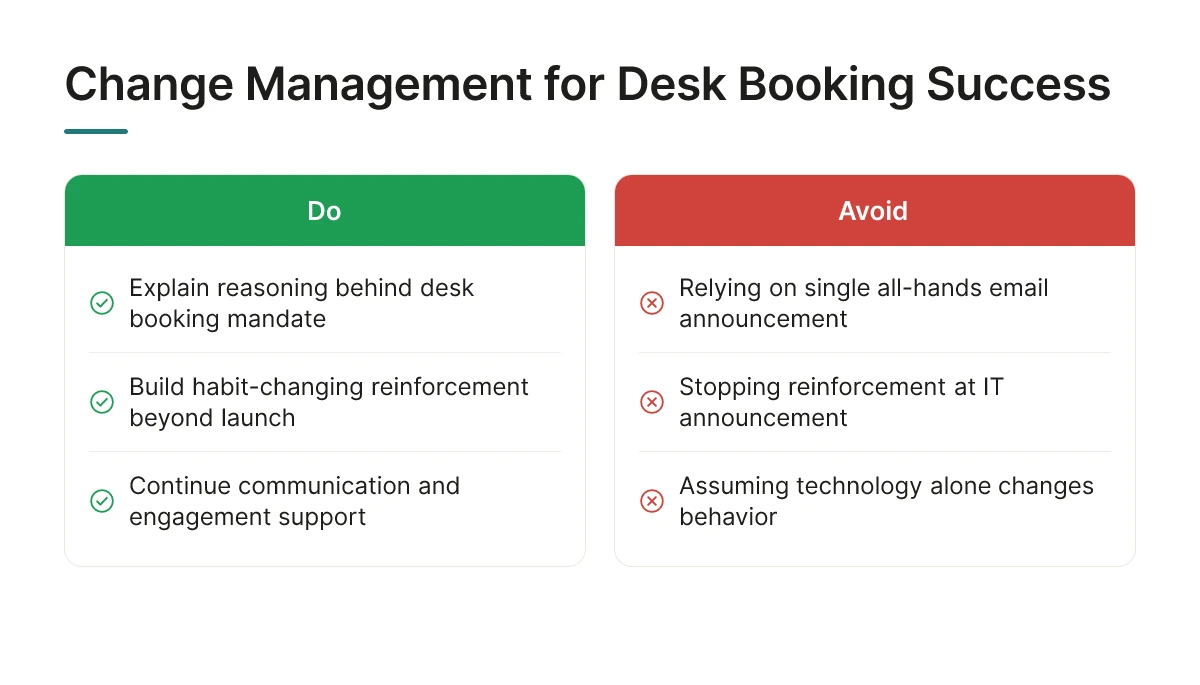
Strong desk booking platforms still fail when organizations skip the communication and habit-building work required to change daily behavior.
Walking to the same desk every day is a habit, not a decision, and an app doesn't interrupt that pattern on its own. When leadership mandates desk booking without explaining the reasoning behind it, employees find workarounds: booking a desk to satisfy the policy, then never actually showing up or sitting somewhere else entirely.
Adoption fails when reinforcement stops at an all-hands email or an IT announcement instead of continuing at the manager level. Teams follow the behavior their direct manager models and asks for, not a one-time companywide memo. This problem hits large or multi-generational teams hardest, where tech comfort varies widely and a single onboarding format won't reach everyone.
Short, repeated formats work better than a single onboarding session, think five-minute team huddles, quick-reference guides pinned in Slack or Teams, and a point person per floor for the first month. One-off training sessions get forgotten by the second week; recurring, low-effort touchpoints build the habit instead.
Desk booking platforms collect location and attendance data that counts as sensitive personal information under most privacy frameworks, and skipping compliance review before rollout creates legal exposure later.
Records of where an employee sat, when, and how often reveal patterns about health, religious practice, and personal habits that regulators increasingly treat as protected information.
Require a current SOC 2 attestation and documented GDPR-aligned data handling practices before signing, not after rollout. Retrofitting compliance into a live system, renegotiating data retention terms, rebuilding access controls, notifying employees of a changed policy, costs far more in time and legal review than vetting it upfront.
Ask vendors directly how long attendance data is retained and exactly who inside their organization, and yours, can access individual-level records versus aggregated utilization data. This mistake carries the highest stakes for regulated industries and multinational teams subject to cross-border data transfer rules, where a vague answer from a vendor should be disqualifying.
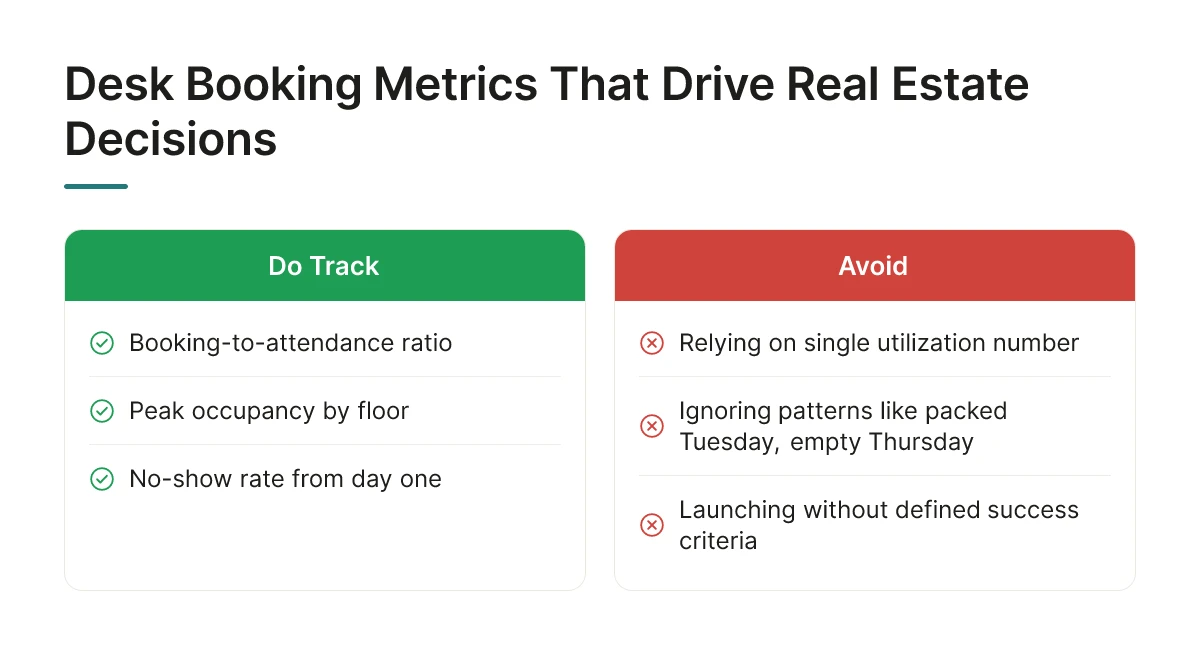
Going live without defined success metrics makes it impossible to prove ROI or catch problems before they become expensive real estate decisions.
Utilization rate on its own is misleading, a floor showing 40% average utilization could mean steady moderate use or a packed Tuesday and an empty Thursday, and those two patterns call for opposite real estate responses.
Track booking-to-attendance ratio, peak occupancy by floor, and no-show rate from day one rather than relying on a single utilization number. These metrics reveal whether a space problem is a scheduling problem. For more information, see Ai Seo Software Complete Guide To Tools Platforms 2026.
Consistent underuse of a floor across several weeks, not one slow Friday, is what justifies consolidation or lease renegotiation. This matters most for real estate and facilities leaders under pressure to justify portfolio decisions with data the CFO will trust. Insist on a baseline measurement period before rollout, without a pre-launch number, nothing you measure after go-live means anything. Platforms like Upflex pair this kind of utilization tracking with AI-based attendance forecasting, giving real estate leaders a documented basis for portfolio reduction decisions rather than a guess.
Declaring victory at go-live and never revisiting configuration is the mistake that quietly erodes a desk booking rollout over the following year.
Team sizes shift, hybrid schedules change, and floor plans get reconfigured, a desk zone set up for a 12-person team in January can be wrong by June. Skipping a regular feedback loop means small frustrations, like a neighborhood zone that no longer matches the actual team sitting there, compound into employees quietly abandoning the tool.
This matters most for organizations still finalizing hybrid policy or expecting headcount changes within the year, where static rules become outdated fast. Set a recurring quarterly review tied to utilization data, not just an annual check-in, to catch mismatches before they turn into disuse.
Adding locations or users without reconfiguring booking rules and zone structures creates the same scaling pain at a larger scale, a system tuned for one office rarely fits five without adjustment. Enterprises managing this across multiple sites need a platform built for portfolio-wide orchestration, which is where a unified view across owned offices and on-demand workspace access becomes necessary rather than optional.
A booking flow that takes more than two taps or loads a slow floor map pushes employees back to informal booking over chat messages within weeks. Evaluation teams tend to spend most of their time on admin dashboards and reporting screens, then open the employee app for a two-minute glance before signing a contract.
Quality varies more than feature lists suggest, some platforms render floor plans natively while others load a cropped PDF that's unreadable on a phone screen. Desk booking platforms with real-time availability views and mobile-first design cut the time from "open app" to "desk confirmed" to under 30 seconds, which matters most on the morning commute when a decision has to happen fast [1].
Two gaps show up repeatedly: weak recurring-booking support, which forces employees to rebook the same Tuesday desk every single week, and no one-step team booking for coordinating a group sitting together. Both gaps matter more for distributed teams where most bookings happen from a phone, not a desktop.
Test the actual booking flow on a phone during a trial period rather than relying on a vendor's feature checklist. Usability for an occasional visitor booking their first desk matters as much as usability for an employee who books five days a week.
Expecting full adoption and measurable ROI within the first month is the most common timeline mistake, since patterns normally take a full quarter to stabilize.
Setup effort scales with how many existing systems need to connect, calendar platforms, badge access, HR directories, not simply with headcount. A single-office rollout with one calendar integration moves faster than a 500-person deployment tied into five regional identity systems, even if the smaller company has more desks to configure.
A realistic phased approach starts with a pilot on one floor or one team, runs long enough to gather real feedback on booking friction and desk ratios, then expands floor by floor. Organizations rolling out across multiple offices or departments at once benefit most from this staging, because it catches configuration errors, wrong desk counts, missing meeting room links, incorrect floor maps, before they multiply across every location.
Utilization data needs roughly a full quarter to smooth out seasonal noise, onboarding effects, and early-adopter bias before it reflects real patterns [2]. Rolling out to the entire organization simultaneously without a pilot phase removes the chance to fix these issues early, and the cost of that mistake multiplies with every additional office added at once.
ROI estimates that stop at subscription cost miss implementation effort, training time, and the fact that payback speed differs sharply by company size.
Small teams see faster payback because there's less integration overhead, fewer systems to connect, fewer stakeholders to train, often a single office to configure. Enterprise deployments carry a longer implementation runway but enable larger absolute savings, since even small utilization improvements translate into real square footage across multiple leases.
Three metrics build a credible business case: reduction in underused square footage, admin hours saved on manual scheduling and seat assignment, and any shift in lease renewal decisions tied directly to utilization data. Platform cost itself should be weighed in qualitative tiers, budget-friendly, mid-range, or premium/enterprise, rather than treated as the only input, since implementation and training time often cost more than the license itself over year one.
Real estate savings materialize over lease cycles, not in the first billing period, so framing ROI as an immediate win misleads the finance and real estate stakeholders who need a believable business case rather than a vendor's marketing number. Upflex ties its utilization data directly to portfolio decisions, with enterprise customers reporting more than 40% reduction in real estate spend once consolidation decisions follow the data rather than guesswork.
Choose based on a pilot-tested evaluation across integration, security, mobile usability, and reporting depth, weighted by company size and location count.
Assigned seating guarantees a desk whether or not someone shows up; desk booking ties space to actual attendance, which shifts the evaluation question from "does this track who sits where" to "does this predict and coordinate who's coming in." That shift is why features like attendance forecasting and team coordination matter more now than static seat charts did a decade ago.
Calendar tools show meetings; badge systems show who entered the building. Neither tells a real estate leader whether a floor is worth keeping or a workplace leader whether a team is hitting its in-person collaboration goals. A short checklist covers the gap: integration fit with existing calendar and HR systems, security posture for employee location data, mobile usability tested by hand rather than reviewed on a spec sheet, reporting depth for lease and headcount decisions, and vendor support available through the rollout, not just at the sales stage.
Weight these differently by size: a single-office team should prioritize mobile usability and fast setup, while a multi-location enterprise should weight integration and reporting depth higher, since that data feeds portfolio-level consolidation decisions. Favor a pilot-first evaluation over a feature checklist, it's the only way to catch the mobile friction, timeline overreach, and hidden costs covered above before they show up at full scale. Upflex pairs its UnifyAI forecasting engine, built for 97% attendance accuracy, with desk booking and access to an on-demand workspace network, giving real estate and HR leaders one dataset to evaluate instead of three disconnected tools.

Desk booking lets employees reserve a workspace before they arrive, matching available desks to the people actually coming in [1]. For hybrid teams, this matters because attendance now swings 30-50% week to week, and fixed desk assignments leave large portions of the office empty on any given day. Without a booking system, teams either overbuild space or create daily scrambles for seats, both of which erode the case for keeping an office at all.
Desk booking solves the mismatch between how many desks you own and how many people actually show up on a given day. General calendar or facilities tools track meetings and maintenance, not seat-level occupancy. Platforms like Upflex go further, pairing booking with AI attendance forecasting so coordination happens before people arrive, not after they're already stuck without a desk.
They scale by centralizing data across every office location instead of treating each site as a separate spreadsheet or point tool [2]. As headcount or office count grows, a platform with unified analytics lets real estate and HR leaders compare utilization across regions and make portfolio-wide consolidation decisions. Platforms that also connect to an on-demand external workspace network scale further, absorbing overflow without new leases.
Most organizations move from pilot to company-wide rollout over one to two quarters, not weeks. Early phases require mapping floor plans, setting booking rules, and testing with one team or floor before wider deployment [1][2]. Rushing this stage is the most common cause of poor adoption, since employees abandon tools that create double bookings or confusing interfaces early on.
Track actual desk utilization against booking rates, plus whether teams are hitting in-office collaboration targets, not just whether the tool is installed. A platform reporting co-attendance achievement, like Upflex's 88% benchmark, gives real estate and HR leaders a concrete signal beyond login counts. If utilization data isn't feeding real estate decisions, the rollout isn't finished.
Successful desk booking adoption comes down to three things: start with a pilot before a company-wide rollout, tie booking data to real utilization and co-attendance metrics rather than login counts, and choose a platform that forecasts attendance instead of just recording reservations after the fact. Organizations that skip forecasting end up repeating the same guesswork that made hybrid scheduling painful in the first place.
Before your next lease renewal comes up for review, pull your current utilization data and compare it against actual badge-in or booking rates for the past quarter. That gap is where your next decision, and your next conversation with finance, should start.
Explore more from our content library: