Share This Article
No items found.


Workplace optimization software pays for itself by shrinking the real estate footprint a company actually needs to pay for, then proving the savings with occupancy data finance leaders can audit. AI-powered office orchestration tracks how much space gets used, flags underused floors or buildings, and models consolidation scenarios before a lease decision gets made. Paired with on-demand workspace access for remote or traveling staff, the software replaces fixed square footage with flexible capacity, turning a sunk real estate cost into a variable one that scales with actual attendance, not headcount on paper.
Office orchestration cuts real estate spend by replacing lease decisions based on headcount with decisions based on who actually shows up, where, and when. Most companies size their offices for peak theoretical attendance, every employee, every desk, every day, even though hybrid schedules mean a large share of that square footage sits empty most weeks. Attendance forecasting breaks that habit by predicting real occupancy patterns, so a real estate team can right-size a floor instead of leasing for a headcount that rarely shows up in full.
Upflex's UnifyAI engine forecasts attendance with 97% accuracy, giving corporate real estate leaders a defensible basis for shrinking a footprint rather than guessing at it. Once a company can see which days, teams, and floors run at 30% occupancy versus 80%, the case for consolidation writes itself. This is the mechanism finance leaders actually trust: not an assumption about hybrid work, but a dataset showing exactly how much space gets used and when.
Four metrics move first, and in a predictable order: utilization rate, cost per occupied seat, square footage per employee, and lease renewal use. Utilization rate is the leading indicator, once historical and real-time occupancy data exposes a building or floor running consistently below capacity, it becomes a consolidation target. Cost per occupied seat follows, because it reframes rent and operating expense around actual use rather than nominal capacity, which is the number a CFO wants to see.
Square footage per employee drops as teams consolidate onto fewer floors without losing desk availability on the days people actually come in. Lease renewal use is the compounding payoff: a real estate team walking into a renewal negotiation with 12 months of utilization data can argue for a smaller footprint, a shorter term, or better terms, instead of renewing out of uncertainty about future attendance.
On-demand workspace access lets a company shed owned square footage it no longer needs while still covering overflow, travel, and satellite locations without signing new long-term leases. Instead of holding extra floors "just in case" a regional team needs a desk, employees book space on demand in a city where the company has no office at all. Upflex provides access to the world's largest on-demand workspace network, so capacity scales with actual travel and distributed work patterns rather than sitting on the balance sheet as unused leased space.
The savings mechanism here is reduced square footage need, not a smarter calendar for existing space. Workplace optimization software that only improves booking and scheduling within a fixed footprint caps its own upside, the real financial lift comes from converting a portion of fixed lease obligations into variable, usage-based access. That shift is what has let organizations using Upflex report real estate spend reductions of 40% or more, with the on-demand network absorbing demand that would otherwise justify keeping extra leased space on the books.
The right mix of features ties desk-level booking data to real estate decisions, anything less leaves cost and coordination questions unanswered. Workplace optimization software needs to do four things well before it earns a place in your tech stack.
Desk and room booking is the baseline, employees need to reserve a spot before they show up, and facilities teams need a record of who's where. Occupancy sensing adds a layer of truth to that record, catching the gap between what people book and what they actually use.
Attendance forecasting is where the category gets useful to finance and real estate leaders. Rather than guessing at Tuesday turnout, AI-driven forecasting predicts who's coming in, when, and where, Upflex's UnifyAI engine, for example, does this with 97% accuracy, which turns a facilities guess into a planning input finance can actually use.
Team co-attendance coordination closes the loop: it's not enough to know the building will be 60% full if the one team that needs to collaborate in person is split across three different days. Software that actively coordinates schedules toward shared in-office days, rather than just reporting on them after the fact, is what separates booking tools from true workplace optimization software.
HR and payroll integration keeps space allocation accurate as headcount and team structures change, without it, your booking data drifts from reality within a quarter. New hires, departures, and reorgs happen weekly at any sizable enterprise, and a workplace platform that doesn't sync with the org chart ends up allocating desks for people who left the company months ago. Integration with HR systems also feeds the attendance forecasting models with real team rosters, which is what makes co-attendance coordination possible in the first place. For more information, see Ai Seo Complete Guide To Generative Engine Optimization.
Cloud deployment fits most hybrid organizations because it rolls out faster and gives multi-site visibility from day one, on-premise fits organizations with strict data-residency rules or IT teams that require direct infrastructure control. A single-HQ company mostly needs solid booking and utilization data to answer one question: are we over- or under-provisioned for the space we have. A multi-city portfolio needs more, portfolio-wide analytics that compare utilization across locations, plus on-demand workspace access for employees traveling between offices or working outside any leased footprint.
Analytics and reporting round out the feature set, and they matter most when finance teams can use them directly rather than treating them as a facilities-only dashboard. Utilization trends, cost-per-seat data, and portfolio consolidation signals should be exportable in a form a CFO's team can act on, not just a chart a facilities manager checks monthly.

ROI from workplace optimization software equals real estate cost avoided, consolidated, or renegotiated, minus what you spend on the software and the change management to adopt it.
That sounds simple. In practice, most finance teams struggle to isolate AI's contribution from other variables, a challenge that shows up across AI investment broadly, not just in real estate. Research on AI ROI measurement notes that many organizations still treat returns as "elusive, imprecise, and industry-dependent" rather than something they can track with a repeatable method [1]. Workplace optimization is actually one of the easier AI use cases to measure, because the output, square footage, lease cost, seat count, is concrete and already sits on the balance sheet.
Four metrics carry the most weight when you present a business case to a CFO.
That last metric deserves attention because it's a direct ROI lever, not just a quality check. When forecasts are unreliable, real estate teams build in a safety margin, leasing more space than needed because nobody wants to be the one who caused a desk shortage. Accurate forecasting removes that margin. Upflex's UnifyAI engine forecasts attendance at 97% accuracy, which lets real estate leaders commit to a smaller footprint with confidence instead of padding the lease for worst-case scenarios.
Payback period scales with how many sites and how much data complexity you're untangling, not with company size alone.
A single-site organization with one lease and a few hundred employees can usually baseline utilization, roll out desk booking, and see a cost-benefit pattern emerge within a couple of quarters, the decision chain is short and there's one lease to renegotiate. A multi-site global enterprise carries a longer runway: integrating badge data, calendar systems, and regional real estate contracts across dozens of offices takes longer to stabilize, but the payoff compounds, since each site consolidated adds to the same savings pool. Portfolio complexity, not headcount, is the real driver of timeline.
Start by baselining current utilization and occupancy cost per site before any change takes effect. Then re-measure the same metrics after you consolidate space or adjust in-office policy, holding the comparison window consistent (same season, same days of week) so the before/after numbers aren't distorted by seasonal attendance swings.
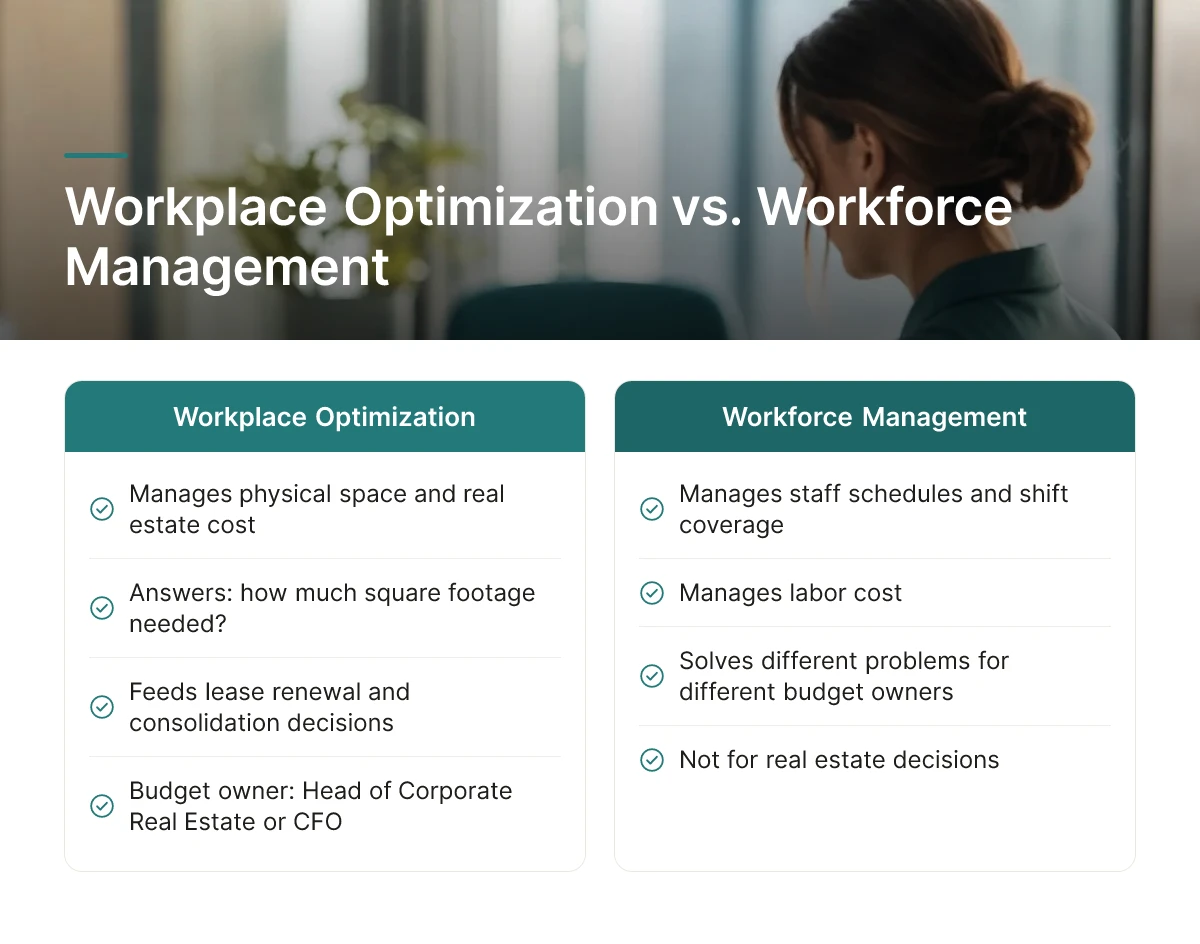
Workplace optimization software manages physical space and real estate cost; workforce management tools manage staff schedules, shift coverage, and labor cost. The two categories solve different problems for different budget owners, and buying the wrong one wastes a procurement cycle.
Workplace optimization software exists to answer a real estate question: how much square footage does the company actually need, and where should it be. The output feeds decisions about lease renewals, consolidation, and portfolio size, the kind of decision a Head of Corporate Real Estate or CFO signs off on. Workforce management software exists to answer a labor question: who is scheduled, who showed up, and whether shift coverage matches demand. The output feeds payroll, overtime control, and compliance with labor regulations [5].
Office orchestration tracks where and when people occupy a building; workforce scheduling tracks who is clocked in and whether they're productive during that time. A desk booking and attendance forecasting platform cares whether 400 people will show up to a floor built for 300, so facilities can plan accordingly. A scheduling tool cares whether a call center has enough agents covering the 2 p.m. shift, so operations can avoid understaffing a service line. Neither system substitutes for the other, even though both touch the word "attendance."
That overlap is where confusion starts. A badge swipe or desk check-in is attendance data, but what happens to it downstream differs completely. For a real estate team, that data point feeds a lease-renewal model or a consolidation business case. For an HR or operations team, the same kind of signal, clock-in time, feeds payroll accuracy or shift-coverage adjustments. Mixing up which system owns which decision is how a real estate team ends up evaluating a product built for timekeeping rather than square-footage reduction.
Larger enterprises often need both, run by separate stakeholders. Upflex is built for the real estate side: it forecasts attendance with 97% accuracy to inform office orchestration and space decisions, not payroll. Treating the two categories as interchangeable is the fastest way to buy a tool that can't answer the cost question finance is actually asking.
Choosing workplace optimization software comes down to four checks: integration fit, deployment complexity, scalability, and finance-grade reporting, validated through a phased pilot before full rollout.
Before any vendor conversation, build an evaluation checklist that covers the mechanics your team will live with for years, not just the demo that looked impressive.
Assess three things before signing anything: how much data migration the switch requires, how much IT resourcing the rollout needs, and how much change management your workforce will tolerate. Pulling historical badge data, booking records, and floor plans into a new system is rarely trivial, and vendors who understate that effort tend to produce implementation delays later. Ask how many internal IT hours the rollout typically consumes and whether the vendor provides a dedicated implementation team rather than a self-service onboarding link. Change management matters just as much as the technical lift. Employees used to fixed desks or informal "just show up" habits need a clear reason to adopt booking workflows, and HR should own that communication rather than leaving it to IT.
A phased rollout reduces risk on both fronts. Start with a pilot on one site or a single floor, run it long enough to validate that utilization data matches what people actually observe, then expand floor by floor or site by site once the forecasting numbers hold up. This mirrors how AI initiatives succeed elsewhere in the enterprise: impact tends to show up incrementally through operational embedding rather than one dramatic rollout [4], and establishing a clean baseline before scaling is what separates teams that can prove ROI from teams still guessing at it [2].
When comparing vendors, categorize rather than chase feature lists. A point solution that only handles desk booking solves one problem; an integrated platform that combines attendance forecasting, space management, and access to an on-demand workspace network solves the portfolio problem. Upflex, for example, pairs its UnifyAI forecasting engine with booking tools and a global on-demand workspace network, so you're not choosing between managing your own offices and giving distributed employees flexible access elsewhere, you get both in one system. Pricing tiers run budget-friendly to enterprise; match the tier to your portfolio size and reporting needs, not to the longest feature list.
None of this works without stakeholder alignment upfront. Real estate, HR, and finance need to agree on one shared set of metrics, utilization rate, co-attendance achievement, cost per square foot, before evaluation starts, or the ROI case will fracture into three competing narratives after launch.

Yes, but the return is smaller until hybrid patterns create variable attendance to forecast. A fully in-office team with fixed desks gains less from attendance prediction, though utilization tracking still exposes wasted square footage worth addressing before a lease renewal or expansion decision.
No, it informs those negotiations rather than replacing them. Utilization data and attendance forecasts give your broker or negotiator a documented, data-backed case for downsizing, subleasing, or renegotiating terms, turning a guess into a number the landlord can't easily dispute.
Most organizations see actionable utilization patterns within one to three months of deployment. Confident real estate decisions, like consolidating a floor or exiting a lease, typically follow after a full quarter of attendance data, since forecasting accuracy improves as the system learns your team's actual rhythms rather than projected ones.
Leaders typically consolidate floors, sublease the space, or let the lease expire and redirect displaced employees to on-demand workspace instead. Upflex pairs that consolidation decision with access to its on-demand workspace network, so cutting owned square footage doesn't strand traveling or distributed employees without a place to work.
Cutting real estate spend without data is a gamble; cutting it with attendance forecasting and utilization tracking is a plan your CFO can approve. The organizations seeing 40%+ reductions aren't guessing which floors to give up, they're acting on months of co-attendance data that shows exactly where space sits empty. Start by measuring utilization for one quarter before your next lease renewal forces a decision under pressure. Upflex's UnifyAI forecasting and on-demand workspace network give you that data and a fallback for displaced employees in one platform, a reasonable first step is requesting a portfolio utilization review before your next lease deadline.
Explore more from our content library: