Share This Article
No items found.


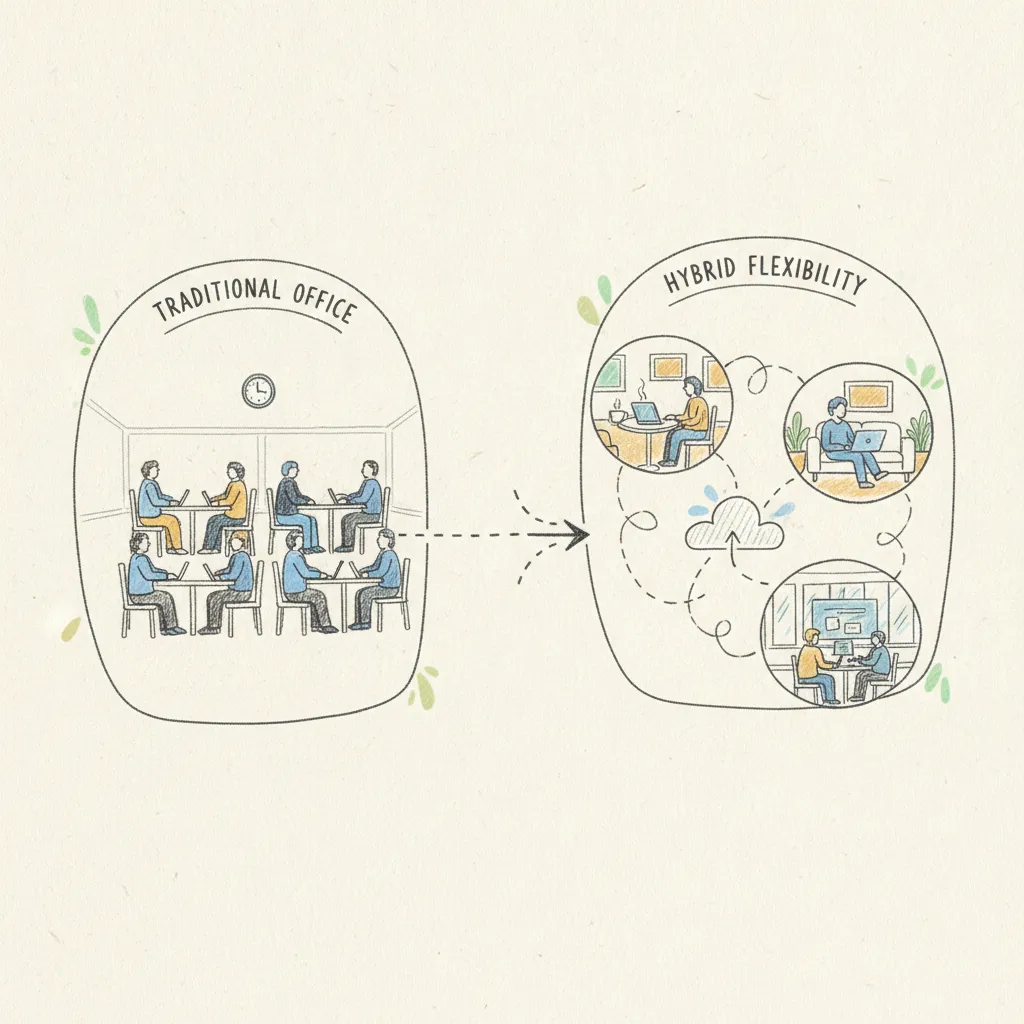
Hybrid workplace flexibility is a work model that lets employees split time between a central office and remote locations, on schedules tailored to role, team, and individual need rather than a fixed company-wide mandate. Unlike rigid hybrid policies that prescribe exact in-office days, true hybrid flexibility treats the office as a destination chosen for its value, not a default. The result is a workforce that can optimize for focus, collaboration, and wellbeing without sacrificing organizational cohesion.
Hybrid workplace flexibility puts schedule control in the hands of employees and teams, not a company-wide calendar mandate.
Structured hybrid, the older model, assigns fixed in-office days across the organization. A company might require everyone in on Tuesday and Thursday, regardless of role, project phase, or individual circumstance. Hybrid workplace flexibility replaces that top-down rule with a team- or role-level decision: a product team coordinates in-person sprints around launch cycles; a sales team books the office around client visits. The criteria for showing up are business-driven, not policy-driven.
This distinction matters because it changes who owns the schedule. In structured hybrid, HR or leadership sets the cadence. In flexible hybrid, the team lead and the employee negotiate it based on what the work actually requires that week.
Hybrid flexibility is also not the same as fully remote work, unmanaged hot-desking, or a blanket "work from anywhere" policy. Structure still exists, it just operates at a finer grain, with clear expectations around co-attendance, collaboration goals, and desk availability.
The five Cs, connection, collaboration, coordination, culture, and community, reframe why employees come to the office at all [2].
Each C describes a high-value activity that benefits from physical presence: connection between colleagues who rarely overlap, collaboration on complex problems, coordination of cross-functional work, culture built through shared rituals, and community maintained through informal interaction. When the office serves these five purposes, attendance becomes intentional rather than obligatory.
That shift moves the office from a compliance requirement, a place people must be, to a purposeful destination people choose when the work calls for it.
The office now competes for employee time rather than commanding it, which changes what the space needs to deliver.
Brainstorming sessions, new-hire onboarding, client meetings, and team rituals are the activities that draw people in under a flexible model [1]. Rows of assigned desks for heads-down individual work are a poor fit for that demand profile. Organizations that have adopted hybrid workplace flexibility are redesigning floor plans around collaboration zones, quiet focus rooms, and hospitality-style amenities, because the office earns attendance by being better than the alternatives, not by requiring it.
The practical implication for real estate leaders is significant: space must be planned around peak collaboration demand, not average headcount. That requires accurate attendance data, something that becomes a core operational input rather than a nice-to-have.
Hybrid workplace flexibility raises retention and productivity for many employees, but creates real coordination costs and culture risks when managed poorly.
Schedule autonomy is the core retention mechanism. When employees control when and where they work, their sense of autonomy rises, and voluntary attrition falls. The inverse is also well-documented: mandated return-to-office policies, particularly those announced without employee input, routinely trigger attrition spikes among high performers who have the market options to leave.
Hybrid flexibility does not benefit every role equally. Creative and knowledge workers, analysts, engineers, writers, often produce their best output during uninterrupted remote work blocks. Operational and client-facing roles, by contrast, frequently require structured in-office presence to maintain service continuity and team coordination. A single policy applied to both groups fails both: it over-constrains the first and under-supports the second.
Three culture risks deserve specific attention. Proximity bias means in-office employees gain more visibility with managers, accumulating promotion advantages over equally capable remote colleagues. Coordination debt builds when teams never overlap in person, tacit knowledge, the informal context that explains why decisions were made, stops transferring. Meeting inequality is structural: remote participants on hybrid calls see a room of people who can read each other's body language while they cannot, which systematically reduces their influence in decisions.
The most common failure pattern is announcing flexibility without redesigning anything else. Companies declare a hybrid policy, then leave workflows, meeting norms, and office layouts unchanged from the pre-pandemic default.
The result is a "worst of both worlds" experience [2]: employees commute in to sit on video calls they could have taken from home, while remote colleagues feel excluded from decisions made in hallway conversations. Neither group gets the benefit the model promised. Fixing this requires deliberate choices about which work happens where, not just permission to work elsewhere. For more information, see Senejac.
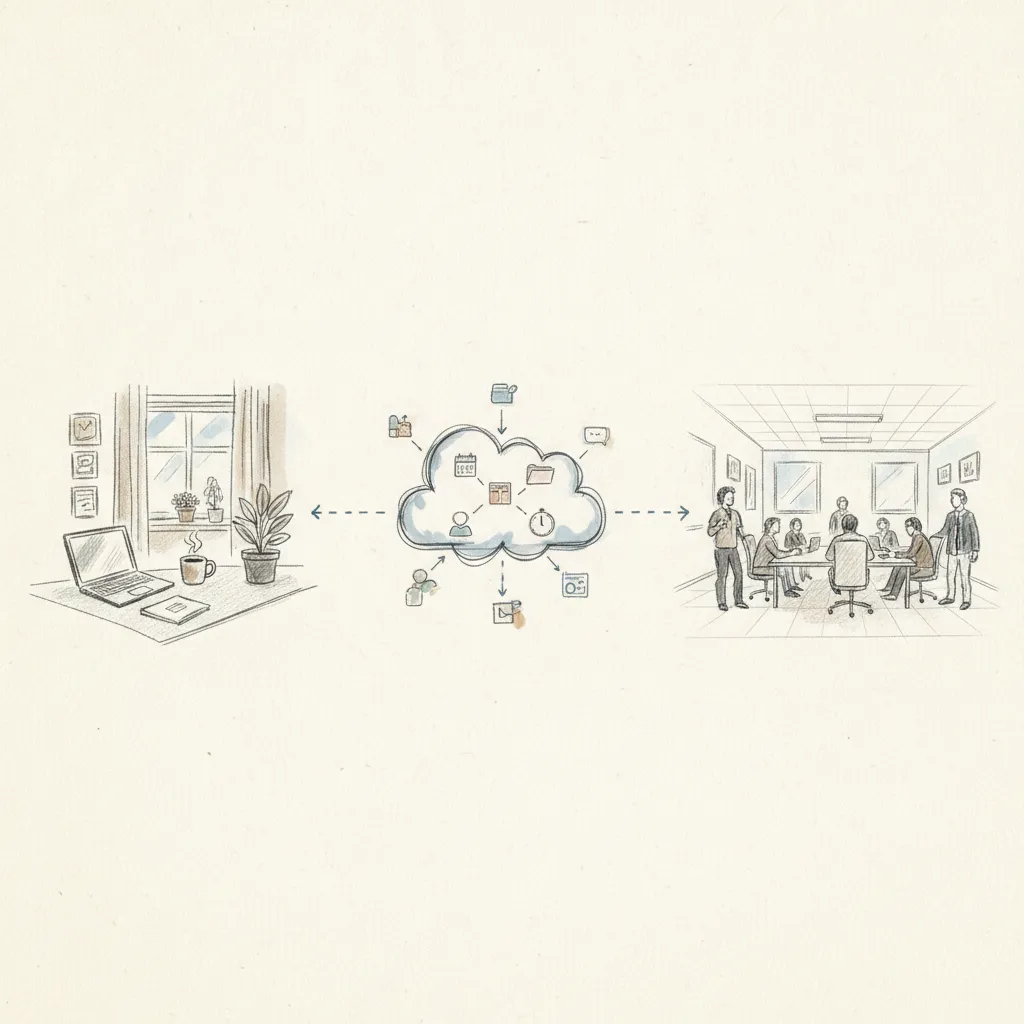
Most hybrid schedules fall into one of four models, and the right in-office frequency depends on role type, team interdependency, and how the physical space is designed.
Four in-office days per week sits at the outer edge of what most employees and workplace researchers recognize as hybrid. At that frequency, the remote component shrinks to a single day, not enough to deliver the commute reduction or schedule autonomy that define hybrid workplace flexibility in practice.
The practical threshold most organizations use is two to three in-office days per week [2]. Below four days, employees retain meaningful control over where they work. At four days, the arrangement functions more like a traditional office with one remote concession.
Four schedule archetypes cover most real-world deployments:
Platforms like Upflex use AI-powered attendance forecasting to predict which model a team's natural behavior already resembles, then automate desk booking around that pattern to hit co-attendance targets without manual coordination.
Successful hybrid implementation starts with a space and attendance audit, not a policy document, so your decisions are grounded in actual behavior, not assumptions.
Most organizations get this backwards. They draft a blanket policy first, then discover it either over-provisions space for days when few employees show up or under-provisions it when everyone arrives at once. Auditing current utilization and role requirements first gives you the data to design a policy that fits reality.
Once you have utilization data, define which roles genuinely require in-person presence, which can operate remotely without productivity loss, and which need a blend. Only then should you write the policy, and that policy should specify co-attendance expectations, not just minimum days-in-office counts.
Remote work across borders can trigger tax nexus, employment law obligations, and data privacy requirements that a single global policy cannot address.
An employee working from home in Germany, for example, may bring GDPR obligations around home-office data handling that differ from requirements in the United States or Singapore. Payroll tax nexus rules vary by country and, in the US, by state. Multi-country hybrid programs require jurisdiction-specific legal review, not a single templated policy applied globally.
Engage employment counsel in each operating jurisdiction before rolling out hybrid workplace flexibility at scale. The compliance cost of getting this wrong typically exceeds the cost of getting the review done upfront.
Flexible hybrid models tend to reduce real estate footprint more aggressively than structured ones because peak occupancy is lower and more predictable.
When employees choose their own in-office days within a flexible model, attendance distributes across the week. Structured models, where the entire company comes in on fixed days, create artificial peak loads on those days, forcing you to maintain space for maximum capacity even though average daily occupancy is much lower. That gap between peak and average is wasted square footage you're still paying for.
Upflex's UnifyAI engine addresses this directly: by forecasting attendance with 97% accuracy, it lets real estate leaders see true peak demand rather than assumed peak demand, and right-size the portfolio accordingly, with documented outcomes of 40%+ reductions in real estate spend.
Manager enablement is the step most organizations skip entirely. Hybrid flexibility fails when managers evaluate performance by visibility rather than output. Shifting to output-based metrics and establishing clear asynchronous communication norms, documented response-time expectations, recorded decision logs, written project updates, are non-negotiable foundations, not optional culture initiatives. Without them, employees who work remotely more often face structural disadvantages that undermine the entire model.
A hybrid workplace requires four distinct tool categories: space booking, presence coordination, async collaboration, and occupancy analytics, each serving a different function.
The core stack maps to specific jobs. Desk and room booking systems manage physical space reservations. Scheduling and presence tools answer the question of who plans to be in and when. Collaboration platforms, video, shared documents, messaging, keep distributed teams aligned across time zones. Workplace analytics close the loop by turning raw occupancy data into portfolio decisions: which floors are underused, which anchor days are actually drawing attendance, and where you can consolidate.
Without real-time occupancy data, hybrid workplace flexibility becomes guesswork. A company can write a policy requiring teams to co-attend on Tuesdays and Thursdays, but without a platform that tracks actual presence against that target, there is no way to know whether the policy is working, whether desks sit empty, or whether teams are missing each other entirely. Upflex addresses this directly, its UnifyAI engine forecasts attendance with 97% accuracy and tracks co-attendance achievement, giving corporate real estate leaders the data to right-size their portfolio with confidence rather than assumption.
Tool sprawl is its own risk. When booking, scheduling, messaging, and analytics run on disconnected systems, information sits in silos, coordination overhead grows, and employees default to workarounds, which defeats the purpose of having a policy at all.
Feature count is the wrong evaluation criterion. The questions that matter are: Does the tool tolerate latency well enough for globally distributed calls? Is it designed for async-first use, or does it assume everyone is online simultaneously? Does it integrate with your calendar and desk booking system so employees see one coherent picture? And does it give remote participants the same experience as those in the room, or does it create a two-tier meeting where in-person attendees dominate?
A tool that scores well on all four criteria will do more for hybrid team cohesion than one with a longer feature list that fails on equity between remote and in-room participants.
Hybrid work is not going away, it has become the dominant employment model for knowledge workers and shows no sign of reversing [1]. While some large employers have issued return-to-office mandates, most have settled on structured hybrid arrangements rather than full-time onsite requirements. The pressure now is not whether to offer flexibility, but how to manage it precisely enough to control real estate costs and maintain team cohesion without rigid scheduling that drives attrition.
Proximity bias is best countered by standardizing how work is evaluated, measuring output and outcomes rather than visibility. Practical steps include running meetings in a camera-on, remote-first format even when some attendees are in the office, documenting decisions in shared channels rather than hallway conversations, and training managers to assess performance against defined deliverables. Tracking co-attendance data, rather than raw presence, helps distinguish meaningful collaboration from performative attendance.
Remote work means employees work entirely outside a company office, with no expectation of regular onsite presence. Hybrid work combines remote and in-office days, with employees splitting their time between locations [1]. The key distinction is that hybrid models retain a physical office as a deliberate part of the work structure, used for collaboration, culture, and coordination, rather than eliminating it.
The right office footprint depends on your peak attendance days, not your headcount. Most hybrid organizations operate at 30–50% average utilization, which means a desk-to-employee ratio of 0.5:1 or lower is often sufficient. Accurate attendance forecasting is what makes right-sizing safe rather than speculative, platforms like Upflex use AI to predict which days teams will be in, allowing real estate leaders to consolidate space with data behind the decision rather than guesswork, with documented outcomes of 40%+ reductions in real estate spend.
Hybrid workplace flexibility is not a policy problem, it's a data and coordination problem. The organizations getting it right have stopped guessing which days employees will show up and started forecasting it, then aligning their real estate footprint to match. Three actions matter most: define co-attendance targets by team rather than by company-wide mandate, tie your office footprint decisions to utilization data rather than headcount, and give distributed employees access to quality workspaces wherever they are.
If your next lease renewal is approaching and you don't yet have reliable attendance data to support the decision, that's the gap to close first. Request a demo from Upflex to see how AI-powered attendance forecasting translates directly into a defensible real estate consolidation plan.
Explore more from our content library: