Share This Article
No items found.

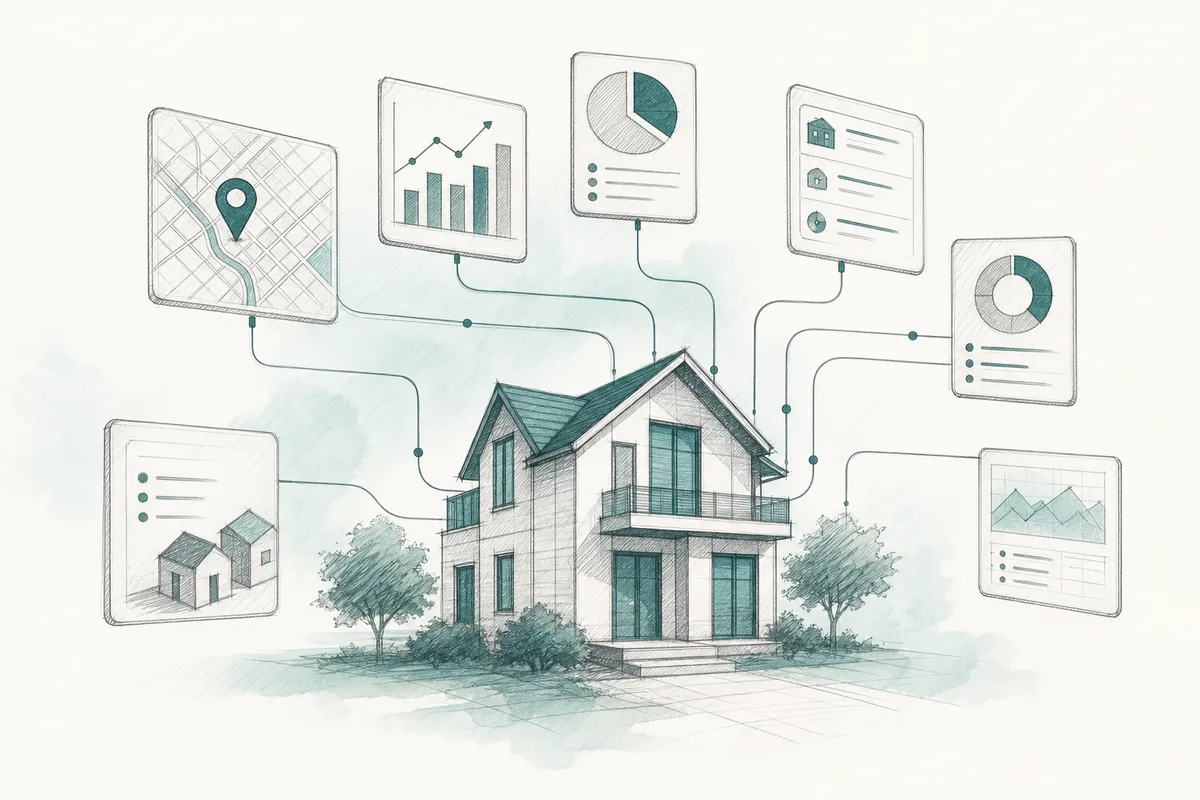
Property data aggregation is the process of pulling information from multiple sources — MLS feeds, public records, lease databases, market indices — into a single, unified system for analysis and decision-making. It eliminates the manual effort of reconciling fragmented datasets and gives corporate real estate teams, investors, and operators a consistent, accurate view of their portfolio. The quality of the aggregation layer — how it handles data freshness, source conflicts, and compliance — determines how reliable the insights downstream actually are.
Real estate data aggregation ingests raw property data from multiple disconnected sources, normalizes it, removes duplicates, and unifies it into one queryable layer.
The process covers four distinct operations. Ingestion pulls data from sources — MLS feeds, county assessor records, lease abstracts, IoT occupancy sensors, and third-party market indices. Normalization converts that data into consistent formats. Deduplication removes records that represent the same property under different identifiers. Unification merges the cleaned records into a single system that downstream analytics tools can query reliably.
This transformation layer is not a data warehouse, not a BI tool, and not a raw API connection. Those systems depend on aggregation having already done its job. Without it, a query across sources returns conflicting records, mismatched units, and gaps that make any output unreliable.
Aggregation systems use two primary update models, and the right choice depends entirely on how quickly the underlying data changes and how fast decisions need to follow.
Real-time streaming is event-driven and low-latency. It suits data that changes continuously — occupancy sensor readings, live pricing signals, or desk availability in a hybrid office environment. When a corporate real estate team needs to know right now how many workstations are occupied across three floors, batch data from last night is useless.
Batch processing runs on a schedule — hourly, daily, or weekly. It suits slower-moving sources like public assessor records, historical comparable sales, or lease abstracts where a 24-hour lag carries no material cost. Most aggregation architectures combine both: streaming for operational signals, batch for reference data [2].
The breadth of inputs involved in property data aggregation is wider than most teams initially expect.
The normalization challenge across these sources is significant. The same building can appear under a suite address in one system, a parcel ID in another, and a shortened street name in a third [1]. Aggregation systems resolve these conflicts through identifier-matching logic and source hierarchy rules that determine which record wins when two sources disagree.
These platforms differ most on coverage breadth, accuracy guarantees, integration depth, and how easily you can exit if the vendor stops serving your needs.
The most immediate difference between platforms is how many data sources they connect to natively. Some platforms maintain hundreds of pre-built integrations — MLS databases, county assessor records, lease management systems, ERP platforms, and workplace tools — while others require custom API work for every non-standard source. Each gap in native coverage is a blind spot: if your platform can't pull occupancy data from your IWMS or lease terms from your ERP without a bespoke connector, your portfolio analysis is working from an incomplete picture.
Pre-built connectors to common corporate real estate tools reduce implementation time from months to weeks and eliminate the ongoing engineering cost of maintaining custom integrations. That operational cost difference compounds quickly across a multi-location portfolio.
Vendor lock-in is a related risk that buyers frequently underestimate. Platforms built on proprietary data schemas or closed export formats make it expensive to switch — your historical data may not be portable in a usable structure. Before signing, confirm that the platform supports open export formats and that your data portability rights are explicit in the contract.
A meaningful SLA names a refresh cadence (daily, hourly, or near-real-time), defines an acceptable error rate, and specifies conflict resolution logic when two sources disagree on the same data point. A vague claim like "high-quality data" with no measurable commitment is a marketing statement, not a service guarantee.
Ask vendors specifically how they handle source conflicts — whether they apply weighted scoring, timestamp priority, or human review — and what remedies exist when accuracy falls below the stated threshold.
The market breaks into three broad tiers. Budget-friendly, self-serve tools typically offer limited source coverage and no formal SLA, acceptable for small portfolios with simple reporting needs. Mid-range platforms add broader integrations and basic accuracy commitments, making them suitable for growing enterprises that need reliable data without a dedicated data engineering team. Premium and enterprise solutions include dedicated support, custom data pipelines, compliance guarantees, and the kind of audit trails that satisfy CFO and legal scrutiny on major portfolio decisions.
The right tier depends less on company size than on the cost of a bad decision. When a lease consolidation or office exit is on the table, the gap between a vague data feed and a verified, SLA-backed unified property data platform can exceed the platform's annual cost many times over.
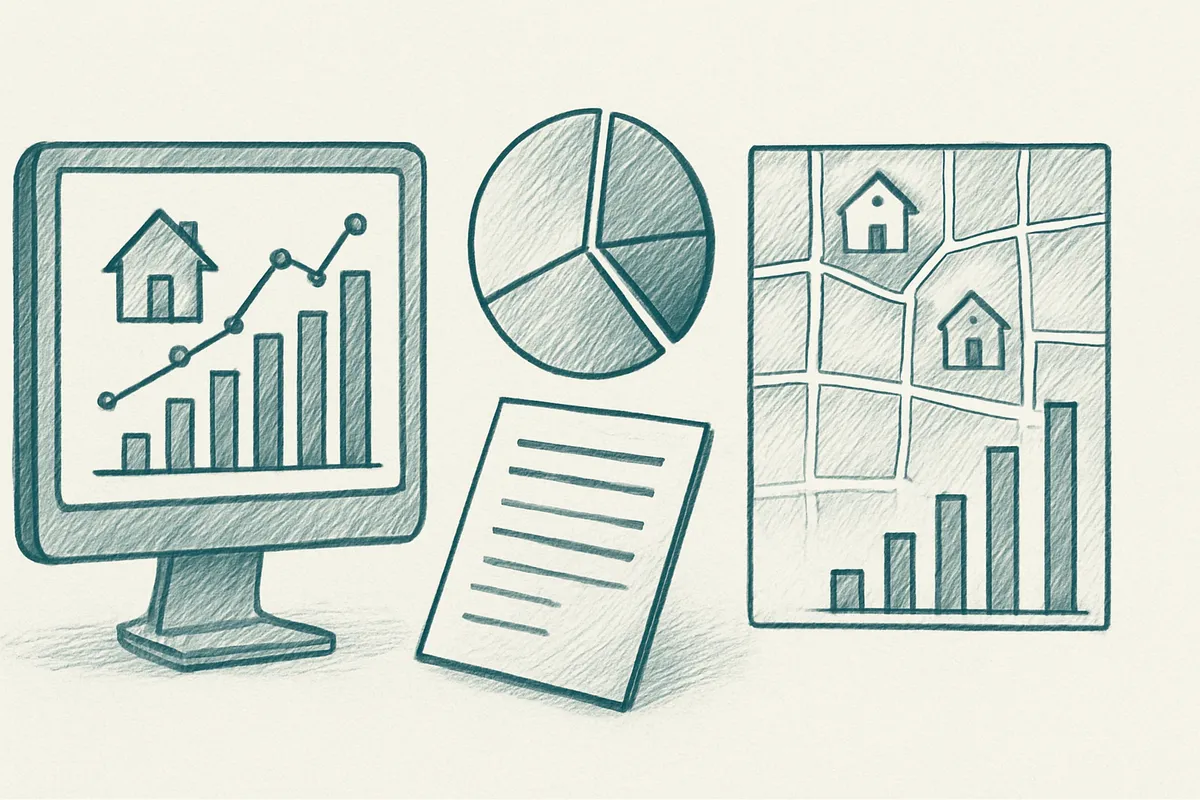
A unified data layer cuts costs, accelerates decisions, and reduces the risk of acting on incomplete or conflicting information across every real estate function.
Portfolio right-sizing. Cross-source utilization benchmarking — comparing occupancy data against lease obligations and market vacancy rates simultaneously — lets corporate real estate leaders identify which assets are underperforming before a lease renewal forces the question. That evidence base replaces gut instinct with a defensible consolidation case for the CFO.
Forecasting accuracy. No single data source produces a reliable space demand forecast. Combining historical lease data, market comparable transactions, and real-time demand signals produces models that hold up under scrutiny. Upflex's UnifyAI engine demonstrates what high-quality aggregated inputs enable: attendance forecasting at 97% accuracy, giving workplace leaders the confidence to reduce committed square footage without creating a capacity crisis.
Faster transaction execution. Pre-aggregated, normalized market data compresses due diligence timelines for acquisitions, dispositions, and lease renewals. When comparable lease terms, vacancy rates, and property histories are already structured and current, analysts spend time on analysis, not manual data gathering [2].
Vendor and cost negotiation. Structured property data gives tenants and buyers access to the same benchmarking information their counterparts use: market rents, flex space pricing, and comparable lease structures. That parity shifts negotiating leverage toward the side that has historically lacked it.
Operational continuity. Decisions made on stale or conflicting data are the root cause of the most costly real estate missteps — signing a lease on a floor that utilization data would have flagged as redundant, or missing a break option because lease records lived in three separate systems. A single source of truth eliminates that exposure [2].
Real estate data aggregation triggers GDPR, CCPA, and data sovereignty obligations the moment it touches tenant records, occupancy signals, or employee location data.
GDPR applies to any aggregation platform processing data about individuals in the European Union, including tenant personally identifiable information, lease contact records, and behavioral occupancy signals such as badge swipes or desk booking histories. CCPA extends similar protections to California residents, covering employee location data and any identifier that can be linked to a specific person.
Both regulations impose concrete obligations: lawful basis for collection, documented consent workflows, defined retention periods, and the right to deletion. A platform aggregating data from a multi-country property portfolio must enforce these rules per jurisdiction, not apply a single global policy and hope it holds.
Cross-border data flows add another layer. Transferring occupancy data from EU offices to a US-based processing environment, for example, requires either Standard Contractual Clauses or an equivalent transfer mechanism under GDPR Article 46. Buyers should require vendors to offer regional data residency options and document exactly where processing occurs, not just where data is stored. For a deeper look at how these obligations play out in practice, the Alpha FMC analysis of data aggregation in European real estate investment provides useful context on compliance frameworks across jurisdictions.
Before signing with any aggregation vendor, procurement teams should verify a defined set of controls. Encryption in transit and at rest, role-based access controls, audit logging, and a documented penetration testing cadence are the baseline. SOC 2 Type II or ISO 27001 certification provides independent confirmation that those controls are operating, not just documented.
Data lineage is both a compliance requirement and an operational safeguard. Knowing where each data point originated, when it was last refreshed, and how it was transformed lets you catch corrupted inputs before they drive a bad portfolio decision. Platforms that cannot produce a full audit trail for any given data point are a liability.
Ask every vendor these questions before contracting:
Enterprise property data systems run on a three-layer pipeline: ingestion, transformation, and serving — each with distinct components that determine reliability and cost.
The ingestion layer pulls data through API connectors, file-based imports (CSV, XML, JSON), and webhook listeners that receive updates in near real time. Raw data then passes through a transformation layer that normalizes field formats, deduplicates records, and enriches entries with reference data such as geocoding or property classifications. The final serving layer exposes a queryable data store, REST API endpoints, and BI connectors so analysts and downstream systems can access clean records without touching the pipeline directly.
Production-grade systems embed data quality checks directly into this pipeline, not as a separate audit step. Schema validation flags malformed records at ingestion. Freshness alerts fire when a data source goes silent longer than its expected refresh interval. Anomaly detection flags sudden value shifts — such as a property assessed value doubling overnight — before bad data reaches reporting dashboards [2].
Modern systems handle volume spikes through horizontal scaling and queue-based processing rather than synchronous full reloads. When thousands of property records refresh simultaneously, jobs enter a processing queue and distribute across additional compute instances automatically. Incremental update strategies — writing only changed records rather than replacing entire datasets — cut processing time and infrastructure cost significantly.
Pre-built connectors to common CRE platforms, workplace tools, and ERP systems reduce implementation time to days rather than weeks, but limit customization. Open API access gives internal engineering teams full control over data routing — useful when connecting to a proprietary IWMS or a platform like Upflex, which consolidates utilization data across owned offices and external workspaces into a single portfolio view — but requires ongoing maintenance as schemas evolve.
Large enterprises also increasingly require multi-cloud or hybrid deployment options. Data sovereignty regulations in the EU and APAC often prohibit certain property or occupancy data from leaving a specific jurisdiction, so vendors that support on-premises or region-specific cloud deployment have a structural advantage in enterprise procurement decisions. Organizations evaluating their data collection infrastructure can also review how specialized providers approach this challenge — for example, The Warren Group's data collection and aggregation solutions illustrate how dedicated providers structure multi-source property data pipelines at scale.
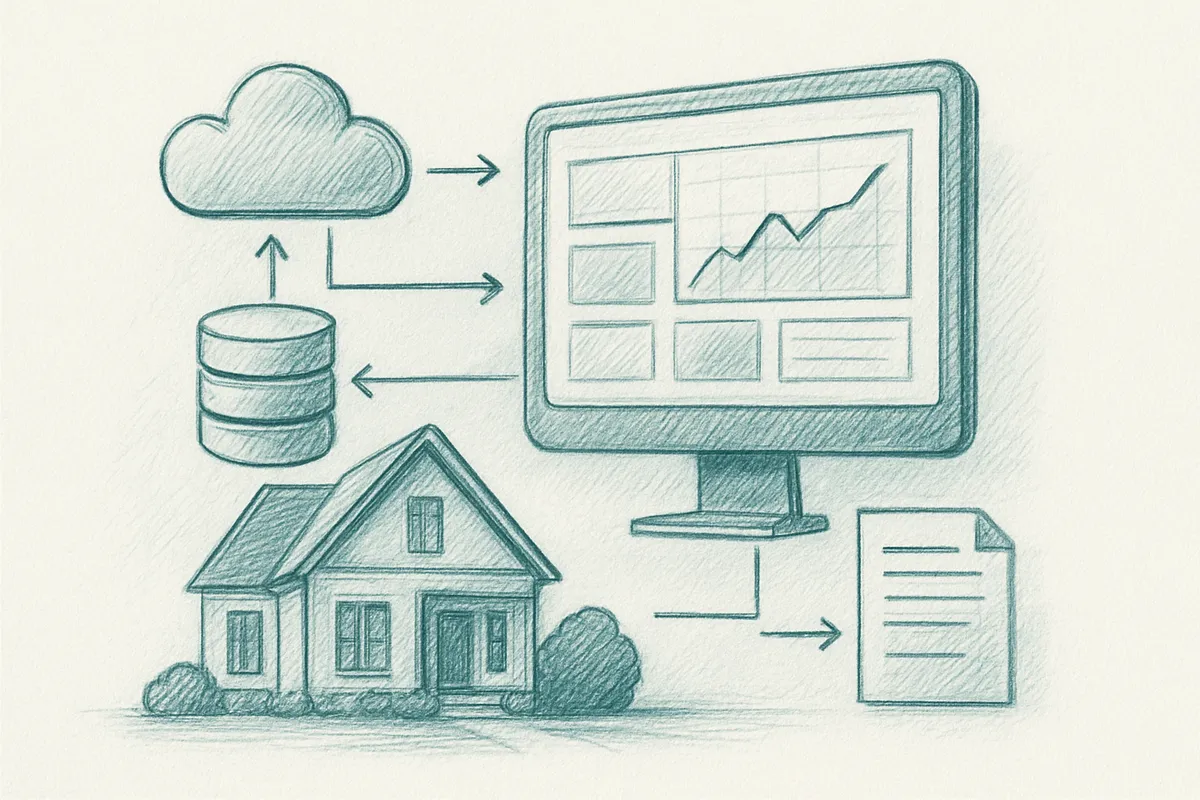
A data aggregator collects and normalizes data from multiple external sources; a data warehouse stores that data for internal querying and reporting. Aggregators focus on ingestion and standardization — pulling from MLS databases, property records, and sensor feeds — while data warehouses focus on structured storage and retrieval. In practice, most enterprise real estate teams use both: an aggregation layer to unify incoming data and a warehouse to run analytics against it.
Most platforms apply a hierarchy of source trust, then flag discrepancies for human review. A property's square footage from a county assessor record, for example, typically outranks a listing-site estimate when the two conflict [1]. Advanced platforms use automated deduplication algorithms alongside human validation to resolve conflicts at scale [1]. The output is a single "golden record" per property or asset — one authoritative entry that downstream reporting tools can rely on without reconciling contradictions manually.
No, data aggregation is useful at any portfolio scale where data comes from more than one source. Mid-market companies managing a handful of offices across two or three cities still face fragmented data from lease management systems, badge readers, and desk booking tools. The complexity that makes aggregation worthwhile scales with the number of data sources, not just the number of properties. Even a 500-person company with hybrid teams benefits from a unified utilization view.
Implementation timelines vary widely depending on the number of data sources, data quality, and the platform's integration architecture. Simple deployments connecting a handful of internal systems can go live in weeks; enterprise implementations pulling from dozens of sources — badge systems, IWMS platforms, HR tools, and external property databases — often take three to six months. The longest phase is usually data cleaning and mapping, not the platform configuration itself [2].
Data governance defines who owns each data source, how conflicts are resolved, how long records are retained, and who can access specific datasets. Without a governance framework, aggregation systems accumulate inconsistencies over time — duplicate records, outdated entries, and undocumented transformations that erode trust in the output. A clear governance policy, covering ownership, refresh schedules, and audit procedures, is what keeps an aggregation layer reliable as the portfolio and its data sources evolve.
Real estate data aggregation is the foundation any data-driven portfolio decision rests on. Without it, utilization numbers are incomplete, lease decisions are based on gut feel, and cost-reduction targets stay aspirational rather than achievable. Three things matter most: standardizing data at the point of ingestion, connecting internal sources (badge data, booking systems, HR tools) before adding external feeds, and building a governance layer that keeps records current as conditions change.
If your team is still reconciling occupancy data in spreadsheets before every portfolio review, that process is your starting point. Map every data source your real estate function currently touches, identify where conflicts occur most often, and use that audit as the brief for evaluating aggregation platforms — including whether a workplace optimization tool like Upflex can consolidate the internal utilization layer for you.
Explore more from our content library: