Share This Article
No items found.


Enterprise coworking works by pairing distributed workspace networks with on-demand booking so large organizations can offer employees office access near where they live, without signing new long-term leases. Instead of committing to fixed square footage in every city, companies pay for actual usage across a network of third-party locations, then layer software on top to manage booking, budgets, and occupancy data. This lets real estate and workplace teams match supply to demand as hybrid work patterns shift, rather than guessing years in advance.
Large enterprises turn to distributed workspace networks because their headcount is scattered across suburbs, secondary cities, and client sites where no company office exists. Enterprise coworking solves this gap by giving employees access to a third-party workspace near where they actually live or work, instead of forcing a commute to the nearest owned office.
A workforce spread across dozens of metro areas rarely lines up with a company's real estate footprint. Sales teams live in cities without a regional office, project staff get assigned to client sites for months at a time, and remote hires join from wherever they were recruited. Hybrid work has made this mismatch a daily operational issue rather than an edge case, with the shift toward flexible office arrangements now standard across most companies [2]. Enterprise coworking addresses this directly: employees book a nearby workspace on demand instead of the company deciding, years in advance, exactly which cities deserve a lease.
A traditional owned-and-leased portfolio is fixed by design, fixed locations, fixed square footage, fixed capacity that doesn't flex with headcount changes. A distributed network is the opposite: locations vary by where employees actually are, and capacity expands or contracts with real usage rather than lease terms signed years earlier.
That elasticity matters most when demand spikes unexpectedly. A company entering a new market, standing up a temporary project team, or absorbing an acquired workforce through M&A integration needs workspace immediately, not after a nine-to-eighteen-month lease negotiation. A network absorbs that spike by routing employees to existing third-party locations, so real estate teams never have to sign a new lease just to cover a few quarters of improved demand.
The same logic works in reverse for underused space. When several company-owned offices each run below capacity, one at 30% utilization, another at 45%, that slack sits idle inside separate leases with no way to pool it. A shared network solves this by letting demand flow to wherever capacity exists, rather than trapping it inside individual buildings. This is the structural difference between owning or leasing every location a workforce might touch, versus accessing a curated network only when a desk is actually needed. Upflex applies this model by combining a company's own office data with access to a global on-demand workspace network, giving real estate leaders one view of utilization across both owned and third-party space.
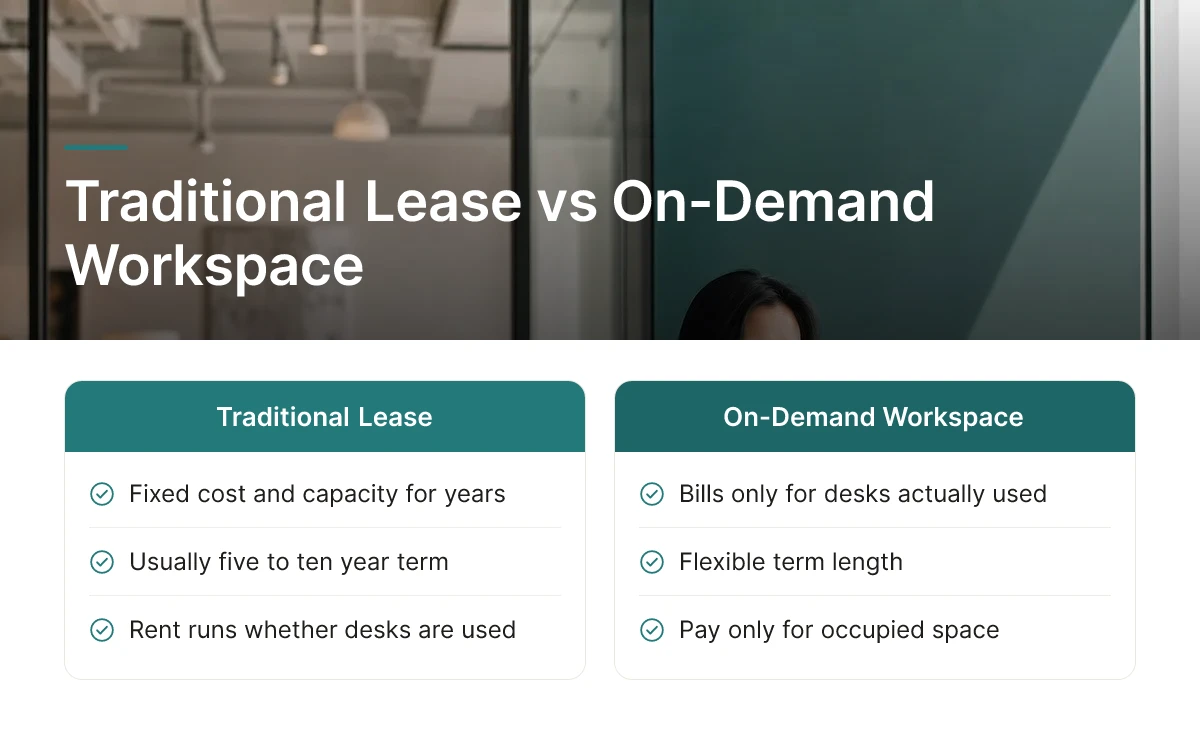
A traditional lease locks a company into fixed cost and fixed capacity for years, while on-demand workspace access bills only for the desks actually used. That single mechanical difference is what makes enterprise coworking worth evaluating against a renewal.
A lease is a sunk cost. A company signs for a fixed term, usually five to ten years, and commits to a fixed square footage regardless of how many people actually show up on a given Tuesday. Rent, utilities, and maintenance keep running whether the floor is at 90% occupancy or 30%.
Pay-per-use workspace inverts that structure. Instead of paying for capacity, a company pays for consumption: a desk booked, a room reserved, a location used for a week during a regional push. As of mid-2024, 58% of organizations already operate under a hybrid or flexible attendance policy [3], which means the traditional assumption of full, daily occupancy no longer holds for most enterprise floor plans. Enterprise coworking access lets real estate cost track that reality instead of a five-year projection made before hybrid work existed.
Fixed leases create stranded capacity the moment headcount varies. A seasonal sales team, a project that staffs up for six months, or a regional office that's growing faster than the lease term anticipated all produce the same problem: square footage the company is paying for but not using. That gap is the core financial argument against locking enterprise coworking needs into permanent leases.
Shifting to pay-per-use converts real estate from a capital commitment into an operating expense that scales with actual demand. There's a procurement benefit too. Managing owned offices across multiple regions typically means negotiating with a different local landlord in every market, each with its own contract terms, renewal timeline, and service standard. A single network agreement for on-demand access consolidates that fragmentation into one vendor relationship instead of dozens.
None of this makes long-term leases obsolete. Rate certainty still matters for a headquarters or a market where a company expects stable, high-density attendance for years. The honest tradeoff: on-demand access buys flexibility at the cost of locked-in rates, which is why most enterprises land on a hybrid, a smaller owned core supplemented by flexible access for overflow, travel, and regional growth.
Integration works by connecting a workspace network to your existing single sign-on, calendar, and expense systems rather than standing up a separate process employees have to learn. Done right, enterprise coworking access looks like an extension of the tools your teams already use, not a new destination they have to remember.
Three connections matter most: identity, scheduling, and spend. Single sign-on through your existing identity provider means employees log into a workspace network with the same credentials they use for email, not a separate password. Calendar and booking sync, through Microsoft 365 or Google Workspace, means a desk reservation at a third-party location shows up next to internal meeting invites, so managers see one calendar instead of two. Expense and procurement integration routes workspace charges through existing approval workflows instead of creating a reimbursement process finance has to build from scratch.
Upflex's office orchestration dashboard is built around this principle: it unites internal desk booking, attendance forecasting, and on-demand workspace access into one interface, so IT and finance manage one system rather than reconciling several.
Consistency comes from setting baseline standards, badge access, meeting room equipment, wifi security, that any third-party location must meet before it's added to the network. Without that baseline, employees hit a different experience at every location: one site requires a front-desk check-in, another has no reliable video conferencing, and a security team ends up fielding questions about network access it never approved.
Policy also has to mirror what's already in place for your owned offices. If your hybrid policy says employees qualify for flexible workspace access after a defined tenure, or that spend above a threshold needs manager approval, those same rules should apply automatically inside the workspace network, not get reinvented location by location. A single admin dashboard is what makes this enforceable: without it, individual teams book workspace on their own cards, spend goes untracked, and real estate and finance leaders lose the utilization data they need to make portfolio decisions.
Rollout works best in stages. Pilot with one team or region, connect the identity and calendar systems, then expand to additional regions based on actual usage data rather than deploying everywhere at once.
Four metrics matter most: utilization rate per location, cost per booked seat, booking-to-attendance ratio, and idle capacity in owned space. Together they tell you whether your enterprise coworking model is earning its keep or quietly bleeding budget.
Each metric should map to a specific decision, not just sit in a dashboard. Utilization rate per location tells you which offices are worth keeping at their current size. Cost per booked seat lets finance compare owned space against on-demand access on equal footing. Booking-to-attendance ratio exposes the gap between what people schedule and what they actually do, a gap that, left untracked, makes every other number unreliable. Idle capacity in owned space quantifies the square footage you're paying for but not using, which is usually the single largest lever in a real estate reduction plan.
Compare your pre-switch fixed cost baseline against post-switch consumption cost over a matching time period, ideally two comparable quarters or fiscal years.
Fixed cost baseline includes lease payments, utilities, cleaning, and facilities staff tied to owned locations, costs you carry whether a desk is empty or full. Consumption cost under an on-demand model scales with actual use: you pay for workspace access when employees need it, not for square footage sitting idle. The comparison only works if you hold team size and work patterns roughly constant across both periods; a hiring surge or a return-to-office mandate will distort the read. Upflex customers use this baseline-versus-consumption comparison to document real estate spend reductions of 40%+ when presenting portfolio changes to finance leadership.
Rising no-show rates, bookings clustering on the same two or three days, and repeated overflow to external workspace all signal a strategy misaligned with real attendance patterns.
No-shows inflate utilization numbers artificially and mask how much space you truly need. Day clustering, everyone booking Tuesday through Thursday, means your office is over-capacity three days a week and nearly empty the other two, a pattern that fixed-lease real estate can't flex around on its own. Frequent overflow to external space is a signal your owned footprint is undersized for peak days, even if average utilization looks fine. Feed these patterns back into portfolio decisions: shrink locations with chronic idle capacity, renew ones running near capacity with healthy attendance, and exit properties where enterprise coworking access consistently covers demand more cheaply than the lease.
Avoid treating total bookings as a standalone success metric. A location can show thousands of monthly bookings and still waste money if attendance and cost-per-use aren't tracked alongside it, bookings without context tell you activity happened, not whether it was worth what you paid for it.
Forecasting who is actually coming in, not just who's on payroll, lets you size space commitments to predicted attendance instead of headcount, cutting the square footage you pay for but never use. That single shift is the operational layer that makes enterprise coworking manageable at scale rather than a scheduling headache.
Most portfolios are sized for a worst-case Tuesday that rarely happens. Legacy real estate planning assumes every desk needs a body most days, which is why enterprises routinely carry office space built for 30-50% higher occupancy than they see in practice. Attendance forecasting flips the planning input from "how many employees do we have" to "how many will actually show up, and where." Upflex's UnifyAI engine does this at 97% accuracy, which means real estate decisions get made against a number leadership can trust, not a guess buried in a spreadsheet.
It means the system matches a team's size and collaboration needs to the right location and room type automatically, before anyone has to ask. A six-person product team meeting on Thursday gets routed to a room built for six, in a location that's actually convenient for where those six people are that week, whether that's a company-owned floor or a workspace pulled from an on-demand network. Nobody manually cross-checks three calendars and two booking tools to make that happen.
Automation closes the gap between predicted demand and real occupancy by handling the booking logistics that used to eat hours of admin time every week. Instead of employees pinging a workplace coordinator, checking a legacy IWMS, and then booking a separate desk through a different provider for an off-site day, the coordination happens in one workflow. That removes the back-and-forth that made hybrid scheduling feel harder than it should, and it's the reason enterprise coworking works operationally instead of just conceptually on a slide.
The productivity case rests on a simple fact: forecasting-driven coordination raises the odds that teammates land in the same place on the same day, which is the entire point of coming in. Upflex tracks this directly, with organizations reaching 88% co-attendance achievement when scheduling is orchestrated rather than left to individual preference. Every actual check-in also feeds back into the model, retraining the forecast and tightening its accuracy release over release, a loop that turns real estate planning from a static annual exercise into something that corrects itself continuously.

No, for most global enterprises, on-demand workspace access complements a smaller owned or leased footprint rather than replacing it entirely. Anchor offices still support culture, security needs, and fixed teams. On-demand networks absorb overflow, satellite headcount, and travel, which is what lets you right-size the core portfolio instead of eliminating it.
It can, if access isn't centrally managed, but a single orchestration layer controls that risk. The exposure comes from fragmented booking tools and unmanaged vendor relationships, not from flexible space itself. Platforms like Upflex consolidate booking, forecasting, and network access into one dashboard, so IT and real estate teams retain visibility over who's using which location and when.
Rollout speed depends on integration with existing HR and calendar systems, but enterprises typically pilot with one region or business unit first. Connecting attendance data to a forecasting engine like UnifyAI takes longer than granting network access itself, since access to a global workspace network is largely instant once contracts are signed.
Heads of Corporate Real Estate and Workplace Strategy typically lead the decision, working closely with the CFO and CHRO. Real estate owns the cost case, finance validates the savings against lease commitments, and HR confirms the model still delivers a workable in-office experience for hybrid teams.
Enterprise coworking isn't a wholesale replacement for your office portfolio, it's the flexible layer that lets you right-size it with evidence instead of guesswork. Start by pairing attendance forecasting with on-demand network access before you touch a single lease renewal, since accurate co-attendance data is what turns a downsizing decision from a gamble into a defensible plan for the CFO. Upflex's UnifyAI engine (97% forecast accuracy) combined with its global on-demand workspace network gives real estate and HR leaders that shared data set. The next step: audit one underutilized location's actual attendance patterns over the past quarter before your next lease decision.
Explore more from our content library: