Share This Article
No items found.


Understanding workspace as a benefit is essential. Physical workspace access functions as an employee benefit because it gives hybrid workers control over where they do focused work, meet collaborators, or escape a poor home setup, without forcing a daily commute to one fixed office. Companies deliver this through on-demand access to third-party offices and coworking spaces near where people actually live, positioning it alongside health coverage or a wellness stipend as a perk that shapes where people choose to work. As commute-averse talent weighs offers, workspace flexibility is becoming a deciding factor alongside salary and remote-work policy.
Workspace access works as a benefit because it solves two problems salary and PTO never touch: isolation and a bad desk setup at home. Give employees a choice of where to work, and both issues disappear without anyone needing to commute to a fixed headquarters.
The mechanism is straightforward. A parent with a noisy house, a new hire craving in-person mentorship, or an employee who just wants a change of scenery all have the same underlying need, a place to do focused or collaborative work that isn't their kitchen table. Access to a coworking space or an on-demand office nearby meets that need directly, which is why workspace as a benefit now sits next to health coverage and wellness stipends in how companies frame total compensation.
The old model offered one answer to every employee: a fixed office and a mandatory commute, regardless of where people actually lived or what kind of work they had that day. The new model offers a network of locations an employee can opt into, home, a coworking desk five minutes away, or a third-party office in another city while traveling. The benefit isn't any single location; it's the optionality itself, the ability to match the workspace to the task and the day.
Employees favor flexible access because it gives back time and reduces burnout in ways an office-only policy can't. Reclaiming a commute is the clearest win, even a partial reduction in daily travel frees up hours for rest, family, or deep work.
Flexible access also holds up under travel and relocation. An employee visiting another office, working from a second home, or relocating mid-year doesn't lose access to a professional workspace; they just book a different one. Over 80% of employees expect to work remotely at least part of the week [2], and a hybrid workforce that mobile needs workspace options that move with them, not a single building that doesn't.
Workspace flexibility widens the hiring pool past commuting distance from one headquarters and signals trust rather than surveillance. Candidates read flexible work arrangements as a top-three benefit outside insurance, and 59% say they're more likely to choose a job that offers remote work over one that doesn't [2].
That preference has teeth in retention data too: flexible work options are consistently linked to employees staying longer [3]. For corporate real estate and HR leaders, this reframes workspace decisions, a network like Upflex's on-demand access to third-party offices worldwide isn't just a facilities line item, it's a recruiting tool that lets a company hire the best person for the role, wherever they live.
An effective strategy has three ingredients: workspace located near where employees actually live, booking that takes seconds rather than a help desk ticket, and a written policy on how much access each employee gets. Miss any one of these and the benefit reads as a nice idea rather than something people use.
Geographic coverage matters most. If a company has clusters of remote hires in five cities but only owns office space in two, the benefit does nothing for the other three. This is where an on-demand workspace network changes the math, instead of signing a lease in every city with a handful of employees, a company can give those employees access to workspace wherever they happen to be. Upflex, for instance, provides access to a global network of on-demand offices, letting distributed employees book a desk near home without the company carrying a long-term lease on space it barely uses.
Booking friction kills adoption fast. If reserving a desk requires emailing facilities or navigating a clunky portal, employees default to their kitchen table. The policy layer matters just as much: employees need clear rules on how many days of access they get, whether it covers coworking spaces or client meeting rooms, and how the benefit interacts with any in-office attendance expectations.
Health stipends, wellness apps, and learning budgets are valuable, but employees experience them as add-ons rather than daily infrastructure. Workspace access is different because it solves an operational problem every workday, where does someone actually get work done, rather than sitting as a line item employees redeem occasionally. A wellness perk competes for attention against dozens of other benefits; a place to work reliably is something employees rely on five days a week.
Flexible and remote work arrangements already rank among the top three benefits employees want outside of insurance coverage [2]. That preference signal is stronger than most discretionary perks companies fund, yet workspace access rarely gets the same budget line or executive attention as wellness or learning programs.
Companies that treat workspace access as a real benefit typically see fewer regretted departures among employees who value flexibility, because the alternative, a bad commute or a home office that doesn't work, is a common reason good performers start job hunting. Recruiting benefits too: candidates evaluating remote-friendly roles are more likely to accept an offer when flexible work is explicitly part of the package, and 59% of candidates say they are more likely to choose a job that offers remote work over one that doesn't [2]. Time-to-fill often improves as well, since removing a rigid office requirement widens the candidate pool.
None of this works if workspace access is buried in an expense policy PDF nobody reads. Naming it as a benefit, with clear terms, visible in onboarding and total rewards materials, changes how employees perceive and use it, turning a reimbursement afterthought into something they actually factor into their decision to stay.

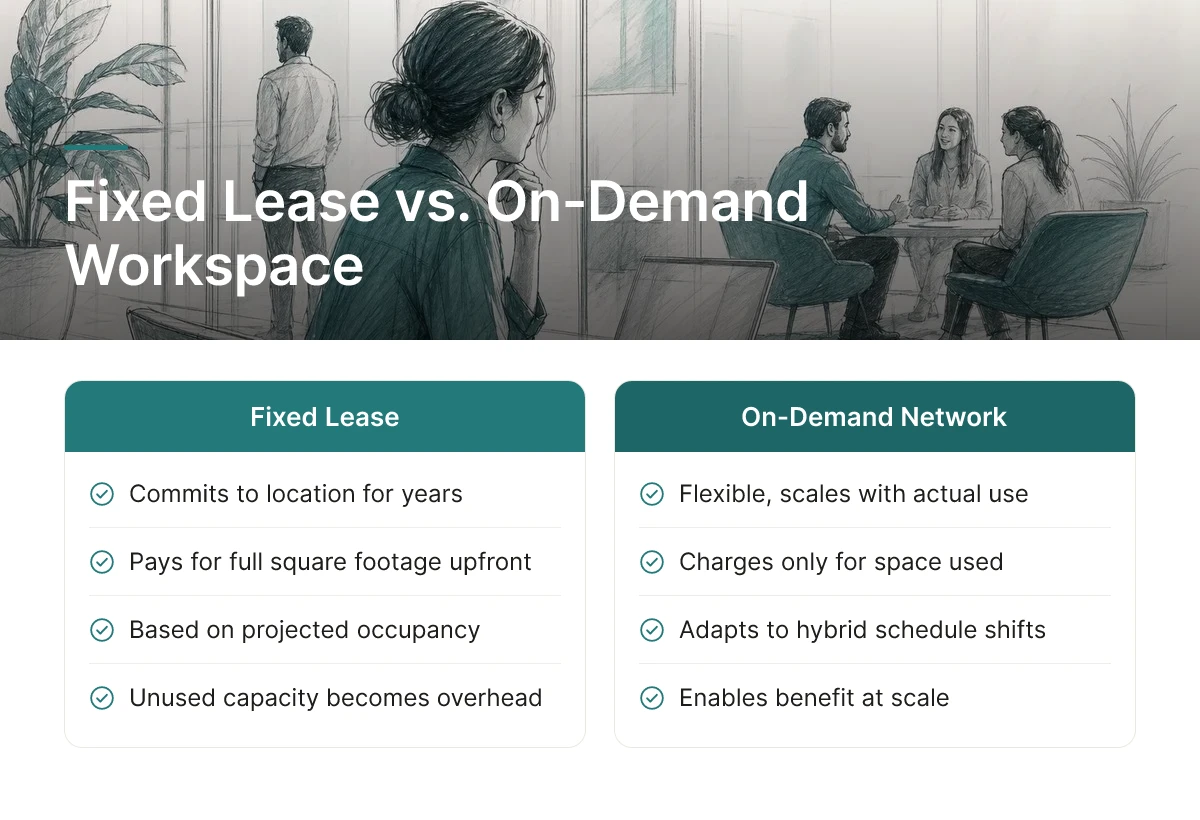
A fixed lease commits a company to a location and a square footage number for years; an on-demand network charges only for the space employees actually use. That structural difference is what makes workspace as a benefit possible at scale, companies can offer employees a place to work without pre-buying years of unused capacity.
A traditional lease is a bet on future headcount and attendance patterns that rarely holds for the full term. Real estate leaders sign five- or ten-year commitments based on projected occupancy, then watch hybrid schedules shift the actual numbers within a year or two. An on-demand network sidesteps that bet entirely: access scales up or down as team distribution changes quarter to quarter, without renegotiating a master lease.
Fixed leases lock in premium-tier costs regardless of how many desks are actually occupied on a given day. Rent, utilities, cleaning, and security run at full rate whether the floor is at 20% occupancy or 90%, the cost structure doesn't flex with demand. Underused space, which is common given that many enterprises now run hybrid schedules well below full attendance [3], keeps costing the same as full space.
On-demand access changes the shape of that spend. Instead of paying a fixed premium for capacity that sits empty most of the week, companies pay for workspace as employees book it, which moves overall spend toward mid-range or budget-friendly territory as underused locations get dropped from the portfolio. This is the mechanism behind real estate portfolio consolidation: cut the office nobody's filling, keep the network access that follows wherever employees actually are.
Companies track three things instead of guessing at utilization: forecast accuracy against actual attendance, in-person co-attendance rates for teams that need to collaborate face to face, and employee-reported focus time. Upflex's UnifyAI engine forecasts attendance with 97% accuracy and reports an 88% co-attendance achievement benchmark, giving real estate and HR leaders a shared number to evaluate whether the flexible model is actually working rather than relying on badge swipes and spreadsheets that don't talk to each other.
Fixed real estate still offers something on-demand can't fully replace: a permanent address and a visible brand presence. What a company gives up in exchange for flexibility is that permanence, a tradeoff worth naming plainly rather than glossing over.
The ROI calculation weighs the cost of an on-demand workspace program against the fixed costs it replaces: underused leases, turnover, and rehiring. Framed this way, workspace as a benefit stops looking like a perk line item and starts looking like a real estate and retention decision with a measurable trade-off.
Most corporate leases get signed for peak headcount, not average daily attendance. As hybrid schedules settle into a routine, often three days a week or less, the square footage sized for everyone showing up at once sits empty most of the time, and empty square footage still costs full rent, utilities, and maintenance regardless of how many desks are occupied.
This is the mechanism worth naming explicitly to a CFO: the lease doesn't shrink when attendance drops. Only a deliberate decision to downsize, consolidate, or shift spend to flexible access does that.
A usable comparison doesn't require sophisticated modeling. Start with two numbers: current real estate spend per location and actual utilization rate, then compare that against projected on-demand workspace spend based on real attendance patterns rather than headcount on paper.
Upflex's UnifyAI engine forecasts attendance with 97% accuracy, which gives real estate and finance teams a data-driven baseline for this comparison instead of guesswork, and organizations using the platform have documented real estate spend reductions of 40% or more by right-sizing owned space around actual, not assumed, usage.
Not every return shows up as a line item. Reduced regretted attrition among employees who value location flexibility, faster hiring in markets without a company office, and fewer relocation costs all matter to a workplace experience or HR leader building the case alongside finance.
Flexible and remote arrangements already rank among the top three benefits employees want outside of insurance [2], and candidates are more likely to choose an employer that offers it [2]. Those preferences translate into hiring speed and retention numbers that belong in the same ROI conversation as square footage.
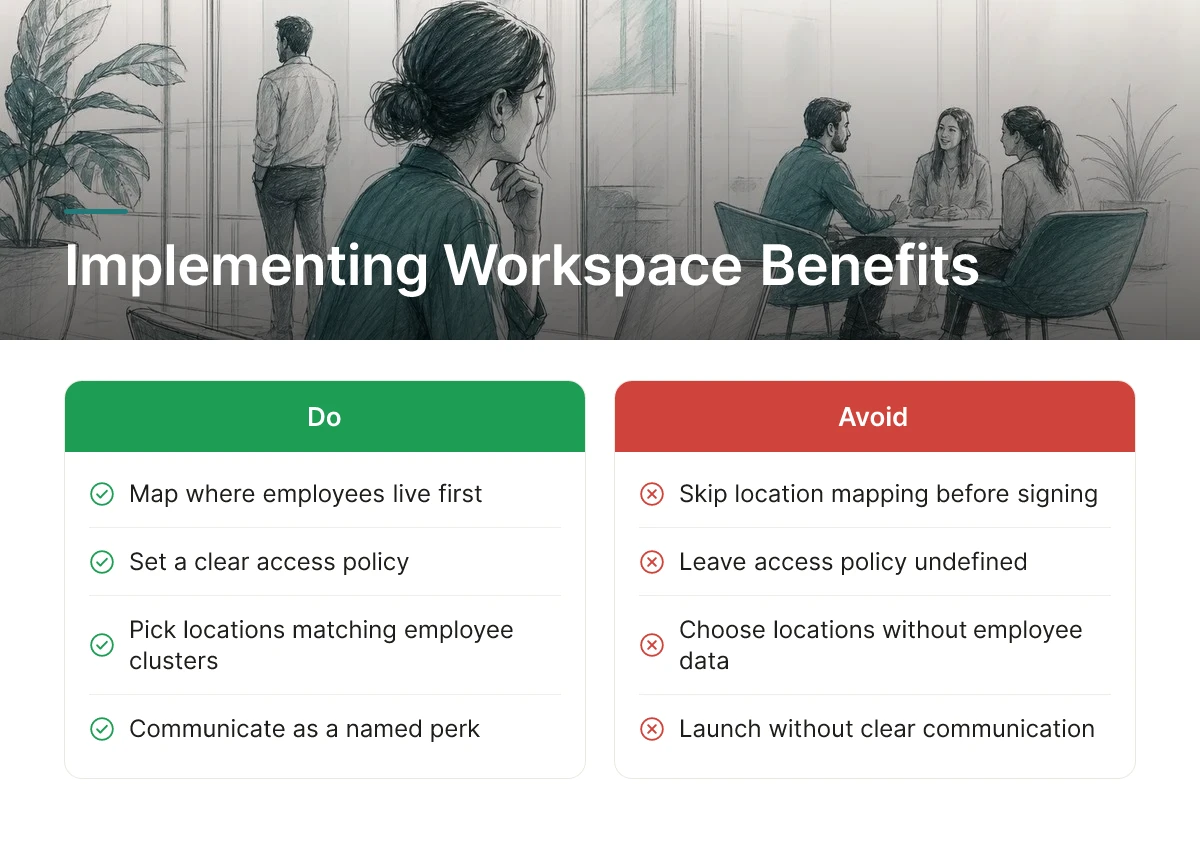
Rolling out workspace as a benefit takes four steps: map where employees live, set an access policy, pick locations that match, then communicate it as a named perk. Skip any one of these and the program either underdelivers or overspends.
Before signing anything, pull employee home addresses and commute patterns and overlay them on your existing office footprint. This shows where the gaps actually are, often clusters of employees in cities where you have no lease at all, a pattern remote and hybrid growth has made increasingly common [1].
From there, set the policy: how many days per month qualify, which roles or levels are eligible, and whether the benefit extends to contractors. Employees consistently rank flexible and remote arrangements among the benefits they value most outside insurance [2], so a vague or unadvertised policy wastes the goodwill it should be building.
Pick locations against that map, not against where real estate happened to be cheap five years ago. Then put the benefit in writing: name it in onboarding materials and total-rewards statements the same way you'd name health coverage or a 401(k) match, so employees actually know it exists and use it.
You need three layers: a booking system for reserving desks and rooms, an attendance forecasting engine, and an admin dashboard that shows real usage instead of guesswork. Without forecasting, you're managing a hybrid workforce with a lagging indicator, badge swipes from last month, instead of a forward view of who's coming in and where.
This is the layer where Upflex fits: its UnifyAI engine forecasts attendance with 97% accuracy, feeding directly into desk booking and a dashboard that shows utilization across both owned offices and on-demand locations. Real estate and HR leaders see one consolidated view instead of reconciling spreadsheets from three different systems.
Use attendance forecasting to right-size fixed space to what's reliably needed, then cover overflow through on-demand access instead of a permanent lease. This lets you cut square footage without cutting the benefit, employees still get a place to work, just not always the same four walls your company owns outright.
Upflex customers apply this model to cut real estate spend by 40%+ while still hitting an 88% co-attendance benchmark, proof that space reduction and employee experience aren't a trade-off when forecasting drives the decision.
Companies that roll out workspace access with no forecasting layer end up with overbooked flagship locations on Tuesdays and empty desks everywhere else. That mismatch is the single most common reason workspace benefits get quietly cut in year two, not because employees didn't want them, but because nobody could see the pattern in time to fix it.
Tax treatment depends on jurisdiction and how the benefit is structured, so companies should confirm rules with their tax and payroll teams before rolling out a policy. In the U.S., employer-provided workspace generally isn't taxed as income when it's a business expense tied to work location, unlike a cash stipend, which may be taxable. Legal and compliance review stays essential for multi-country hybrid teams [2].
A stipend hands employees cash to spend on a home office or coworking pass; workspace as a benefit gives direct, booked access to real offices and on-demand locations. Stipends require employees to source and manage their own setup, while a managed workspace benefit, like access through Upflex's global network, removes that legwork and gives HR and real estate teams visibility into actual usage and cost.
Mid-size companies benefit too, often more visibly, since they typically lack the real estate footprint large enterprises already have. Without a headquarters in every city where employees live, on-demand workspace access lets smaller companies compete for talent against bigger firms offering in-office perks [4], without signing new leases. The commitment scales down as the company does.
Most companies size access around expected in-office frequency rather than a flat allotment per person. Since employee preference varies, some want an office daily, others a few days a month [3], usage data and attendance forecasting help set a realistic budget instead of guessing and overpaying for unused capacity.
Workspace as a benefit works when it's treated as infrastructure, not perk theater: tied to real attendance data, backed by flexible access, and sized to actual demand rather than headcount. Companies that guess at office capacity either overpay for empty desks or underdeliver on the flexibility employees now expect [4]. The fix isn't more office space, it's smarter allocation of the space you already have plus on-demand access when you don't.
Start by pulling your last quarter of badge or booking data and comparing it against your real estate footprint. If the gap is wide, that's your business case for a platform like Upflex.
Explore more from our content library: