Share This Article
No items found.


Fractional office space lets enterprises pay for only the desk count and square footage they actually use, on rolling or short-term terms, instead of signing a 5-10 year lease for fixed capacity. This shifts real estate from a fixed liability on the balance sheet to a variable operating cost that scales with headcount. The result: lower exposure to vacancy risk, no long-term liability for space you outgrow or underuse, and the ability to adjust footprint city by city as hybrid work patterns shift.
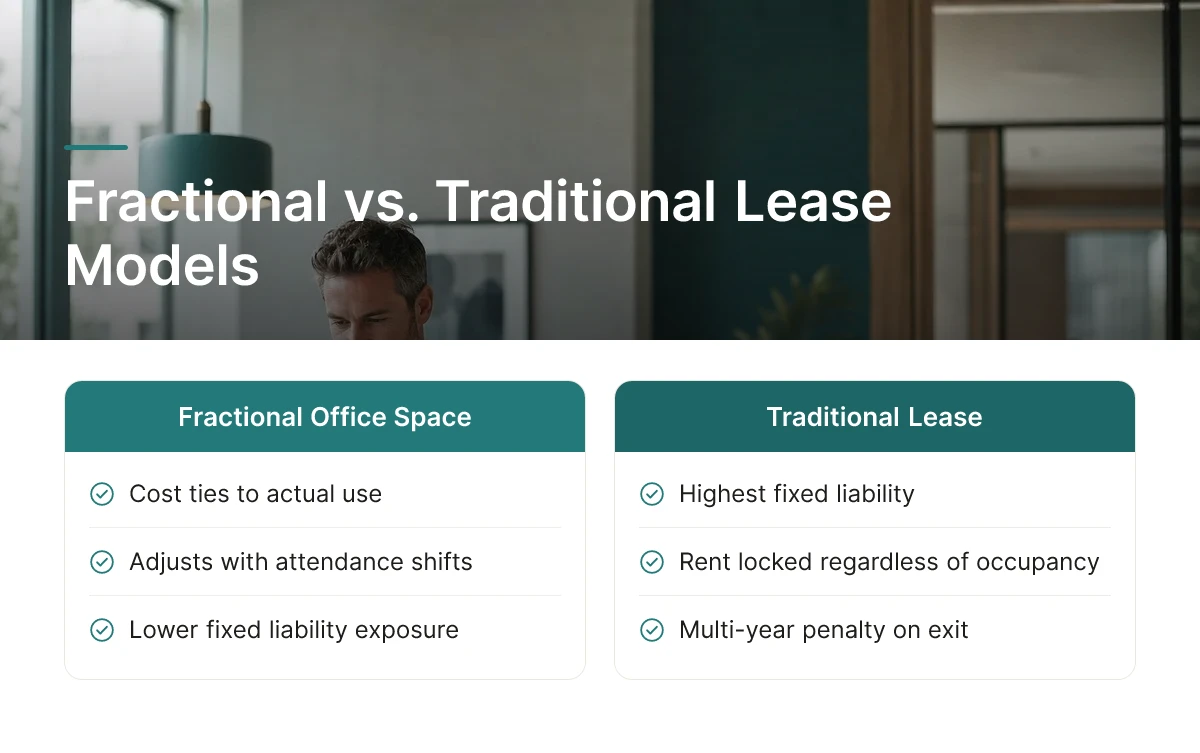
A traditional lease locks a company into fixed square footage for a fixed term, while fractional office space converts that same need into a variable, usage-based commitment that scales up or down with headcount.
A conventional office lease typically runs 5 to 10 years, requires a corporate guarantee, and locks in a specific square footage regardless of how many employees actually show up on a given day [2]. That structure was built for a workforce that came in five days a week. It becomes a liability the moment attendance drops or a team shrinks, because the rent obligation doesn't move with occupancy. Tenants today are actively pushing landlords for shorter terms, early termination rights, and the ability to contract their footprint rather than accept that rigidity [1]. Fractional arrangements replace that single fixed-term liability with rights to space across several locations at once, without a company owning or signing a full lease at each one. Instead of negotiating a 10-year term in every city where it has a team, a company draws on a pool of available space and pays based on actual usage. This is the structural shift driving the broader move away from long-term lock-in contracts toward more scalable leasing agreements [4].
A coworking membership typically grants access to one building or one provider's location, while fractional office space pools access across a network of providers and cities under a single arrangement.
Coworking solved a real problem: it gave individuals and small teams a desk without a lease. But a standard membership is tied to a specific address, useful if your team sits in one city, less useful if you have employees in Chicago, Austin, and London who each need a place to work near where they live. Fractional office space extends the same pay-for-use logic across an entire network, so one commercial relationship covers many markets rather than one.
Enterprises keep access to private offices, dedicated desks, and meeting rooms, but give up long-term customization and permanent branding rights.
Companies moving to this model still get functional control: bookable private offices for confidential work, dedicated desks for regular team members, and meeting rooms for client-facing work. What they give up is the ability to build out a space permanently, custom signage, fixed floor plans, or built-in infrastructure tied to a specific lease term. For a distributed team, that trade-off is usually favorable: it supports a multi-city footprint without a separate lease negotiation, broker relationship, and legal review in every location. Upflex applies this logic directly, giving employees access to on-demand workspace across a global network of external providers while a company's own offices are managed through the same platform, so real estate and finance leaders see one consolidated view of usage instead of a portfolio of disconnected lease terms.
Traditional leases carry the highest fixed liability, coworking simplifies pricing but caps negotiating use, and fractional office space ties cost to actual use across a network.
Each model allocates risk differently. The question for a corporate real estate leader isn't which sticker price looks lowest in a proposal, but which structure exposes the company to the least waste when attendance patterns shift.
A traditional lease's total cost of ownership extends well past base rent. It includes buildout and tenant improvement costs, furniture and equipment, and the ongoing salaries of facilities staff who manage a space regardless of how many desks are occupied on a given day. When a downturn hits or a hybrid policy reduces average attendance, the company remains liable for the full footprint for the remainder of the term, often years [2].
Coworking membership pricing is more transparent on paper, typically structured as a per-seat or per-desk rate. But that simplicity has a ceiling: enterprises with teams across multiple cities or countries generally can't negotiate the kind of volume pricing they'd expect from a single landlord relationship, and costs scale linearly with headcount rather than with actual usage [5].
Fractional office space works differently again. Instead of paying for a fixed footprint or a flat per-seat membership, the company pays based on consumption across a network of locations. This reduces exposure to vacancy risk, but it shifts the burden onto the organization to actively manage utilization, booking patterns, attendance forecasting, and space allocation all need ongoing attention rather than a one-time leasing decision.
The costs that don't show up in a lease abstract or membership invoice are often the ones that matter most. Dormant square footage during low-attendance hybrid weeks is the most common: a company can be paying premium rates for a headquarters that's a third empty on Mondays and Fridays [1]. Duplicated facilities headcount across regional offices is another, many enterprises maintain redundant management teams for buildings that are each individually under-optimized.
Traditional leases also bury exit penalties in the fine print: early termination clauses, restoration obligations, and holdover rent that only surface when a company tries to downsize [2]. Positioned on relative cost, traditional long-term leases sit at the premium end for flexibility-adjusted cost, coworking lands mid-range depending on scale, and fractional space is generally budget-friendly for distributed or fluctuating headcount, provided utilization is actively managed rather than left on autopilot.
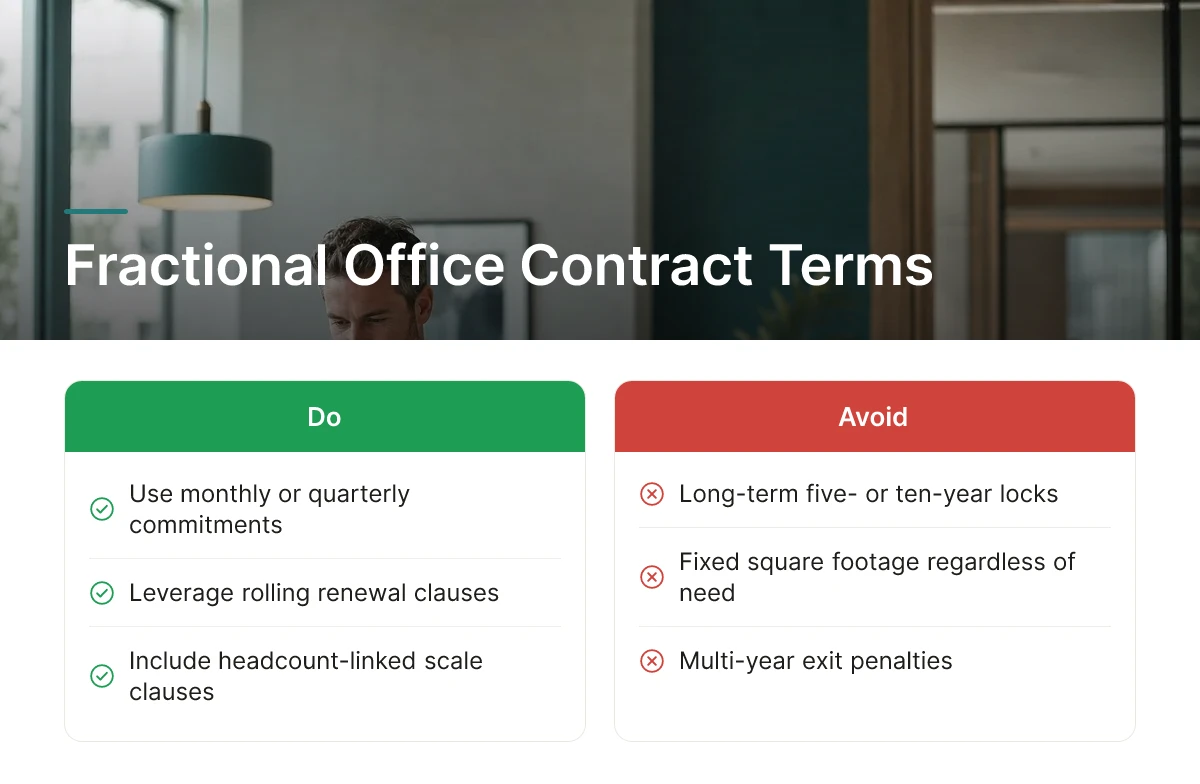
Fractional office space agreements typically run on short commitment cycles with rolling renewals, letting a company adjust its footprint without the multi-year penalties baked into a standard lease.
Most fractional arrangements are structured around monthly or quarterly commitments rather than the five- or ten-year terms common to traditional office leases. Renewal is rolling: the agreement continues automatically until either party gives notice, and headcount-linked scale-up or scale-down clauses let a company add or drop capacity as teams grow or contract. There's no build-out to amortize and no long runway to justify to a landlord.
Traditional leases work differently. Exiting early usually means finding a subtenant, absorbing a termination penalty, or continuing to pay under a personal or corporate guarantee that outlives the business's actual need for the space [2]. Tenants in a softening leasing market do have more room to negotiate shorter terms and early termination rights [1], but those concessions are won case by case, not built into the contract by default.
Shorter commitment cycles let finance and corporate real estate teams treat office footprint as a variable cost they adjust each quarter, rather than a fixed liability locked in for years [3]. That distinction matters most when headcount shifts unevenly across a portfolio.
Consider a company shrinking its Chicago office by 30% while opening a new hub in Austin. Under a traditional master lease, that usually means renegotiating terms across multiple properties or eating vacant square footage in one city while paying for a build-out in another. With shorter, region-specific commitments, the company exits or reduces the Chicago agreement on its own timeline and scales up Austin independently, without touching the rest of the portfolio.
Before signing any fractional office space agreement, check three things: the notice period required to reduce or exit, any minimum usage threshold that triggers penalties if utilization falls below it, and exactly how capacity changes are priced when headcount moves up or down. Platforms like Upflex pair this kind of flexible access with utilization data, so real estate leaders can time footprint changes to actual attendance patterns instead of guesswork.
Fractional office space works best for distributed teams, companies in active growth or contraction, and multi-city organizations where attendance swings week to week rather than following a predictable pattern. A single-site company with stable headcount rarely needs it. A company operating across six markets with 40% average attendance almost always does.
Start with team size and trajectory, not square footage. A stable, single-location team that has held headcount flat for several years is usually better served by a traditional lease, since the negotiating use and rate certainty of a longer term outweigh the flexibility premium [2]. Volatile or distributed teams flip that math: a company scaling from 200 to 500 employees, or one restructuring after a divestiture, cannot forecast its space needs far enough out to justify a decade-long commitment.
Industry shapes the decision further. Client-facing functions, sales teams hosting prospects, professional services firms meeting clients on-site, usually need a consistent, premium address in a predictable location, which argues for a smaller committed footprint layered with flexible overflow. Back-office, engineering, or support functions that rarely see clients in person can flex far more aggressively, shifting between fractional locations as headcount and attendance change without damaging the client relationship.
Hybrid and virtual office solutions serve as a lighter-weight complement for teams that need a mailing address, occasional meeting-room access, or a local presence without daily desks. A company entering a new market to test demand, or supporting a handful of remote employees in a state where it has no lease, doesn't need a fractional desk commitment, it needs a registered address and on-demand access when someone actually shows up. Layering these lighter options alongside fractional space lets real estate leaders match commitment level to actual usage instead of defaulting to a full lease everywhere.
A short checklist keeps the decision grounded in data rather than instinct:
Platforms like Upflex help answer the attendance question directly, UnifyAI forecasts office attendance with 97% accuracy, giving real estate leaders the utilization data needed to size fractional commitments instead of guessing.
Measure ROI on fractional office space by comparing cost per attended seat, utilization against leased capacity, reduced lease liability, and how fast your footprint adjusts to headcount changes.
None of these numbers mean much in isolation. They only become useful once you have a baseline: current lease cost per square foot, total leased capacity, and actual attendance data pulled from badge swipes or booking systems over a representative period, ideally two to three months minimum. Without that baseline, any comparison against a fractional model is guesswork.
Four metrics matter more than the rest. Cost per attended seat divides total real estate spend by the number of seats actually occupied on a given day, not the number leased, this is the metric that exposes waste that square-footage cost alone hides. Utilization rate versus leased capacity shows the gap between what you're paying for and what's being used, and that gap is the entire business case for moving toward a fractional model.
Liability reduction tracks how much square footage is no longer tied to a multi-year obligation, which matters directly to finance leaders managing balance sheet exposure in a market where tenants already hold more negotiating use over landlords [1]. Speed of footprint adjustment measures how many months it takes to resize space after a change in headcount or attendance pattern, under a long-term lease this can take years; under a fractional structure it can happen in a single quarter.
A real evaluation looks less like a single before-and-after number and more like a trend line. Plot footprint cost per quarter against headcount and attendance over the same period. If footprint cost tracks attendance closely, the model is working. If footprint cost stays flat while attendance swings, you're still carrying dead weight.
Forecasting narrows this gap before it happens. Upflex's UnifyAI engine predicts attendance with 97% accuracy, which lets teams size fractional and owned space against what will actually be used rather than what was booked last quarter, tightening the link between paid-for and occupied capacity. The mechanism behind the savings isn't a fixed percentage, it's reduced vacancy exposure and the ability to right-size faster than a traditional lease term allows, which is the same flexibility driving demand for shorter commitments across the broader leasing market [2] [3].

Yes, but the value shifts from daily desk capacity to occasional, high-purpose gathering space. A fully remote company can use fractional terms to book space for quarterly team offsites, client meetings, or regional hubs without carrying a lease for space that sits empty most weeks. The model works best when attendance is infrequent but still matters.
Most fractional agreements bundle meeting rooms and private offices alongside desk access, though the mix varies by provider. Enterprises should confirm room availability and booking priority upfront, since shared inventory can get tight during peak hours in popular locations.
Capacity changes can typically happen within weeks rather than the months or years required to renegotiate a traditional lease [2]. Because fractional terms avoid the long lock-in periods landlords built into pre-pandemic leases [1], real estate leaders can adjust footprint as headcount or attendance patterns shift, rather than waiting for a renewal cycle.
It can work, but regulated companies need to vet each location's security, data handling, and access controls before committing. Financial services, healthcare, and government contractors should treat vendor due diligence as a checklist item, not an afterthought, since compliance requirements don't loosen just because the lease term did.
Shorter, flexible terms give corporate real estate leaders room to match office footprint to actual attendance instead of guessing years in advance. The trade-off is real: less rate certainty and less control over build-out, weighed against the ability to downsize, relocate, or expand as hybrid patterns shift [3][4]. The leaders who get this right pair flexible terms with real attendance data, rather than negotiating blind.
Start by pulling your last two quarters of badge or booking data and comparing it against your current leased capacity. That gap is your negotiating use for the next renewal conversation.
Explore more from our content library: