Share This Article
No items found.


A coworking stipend works best when treated as a flexible line item that replaces or supplements fixed office costs, letting each employee choose a workspace that fits their week instead of paying for unused desk space. Companies typically size the budget by role, location cost-of-living, and how often someone actually needs a physical space, then track utilization to see whether the stipend is reducing real estate overhead or just adding a new expense on top of it. Done well, it shifts spend from long-term leases to variable, usage-based costs while giving employees more control over where they work.
Allocation should follow actual attendance patterns and business goals, not a flat per-head number handed out the same way to every employee regardless of how they work.
A long-term lease charges the same rent whether every desk is full or half the floor sits empty on a given Tuesday. A coworking stipend flips that structure: spend scales with how many people actually show up and use space, rather than with a fixed square-footage commitment signed years in advance.
That difference matters because unused desk space under a multi-year lease is a sunk cost, the bill arrives whether or not anyone sits at the desk. A stipend model shifts that risk to a pay-for-use structure, where the company only funds workspace when an employee needs it. For finance leaders watching real estate as a top-three cost line, that shift from fixed to variable spend is the core financial argument for reworking how workplace budgets get built.
Four outcomes should shape how a coworking stipend gets distributed, and none of them are served well by a one-size-fits-all number.
Getting these outcomes requires segmenting the budget by employee type rather than issuing a flat amount. A fully remote employee who needs a professional space several days a week has different requirements than a hybrid employee who already has a company desk two days a week, or an occasional traveler who needs a workspace only when visiting a client city. Attendance forecasting helps size this correctly, platforms like Upflex use AI-driven forecasting to predict how often a given team or role actually shows up in person, which turns stipend sizing from a guess into a calculation grounded in real attendance data rather than assumed headcount.
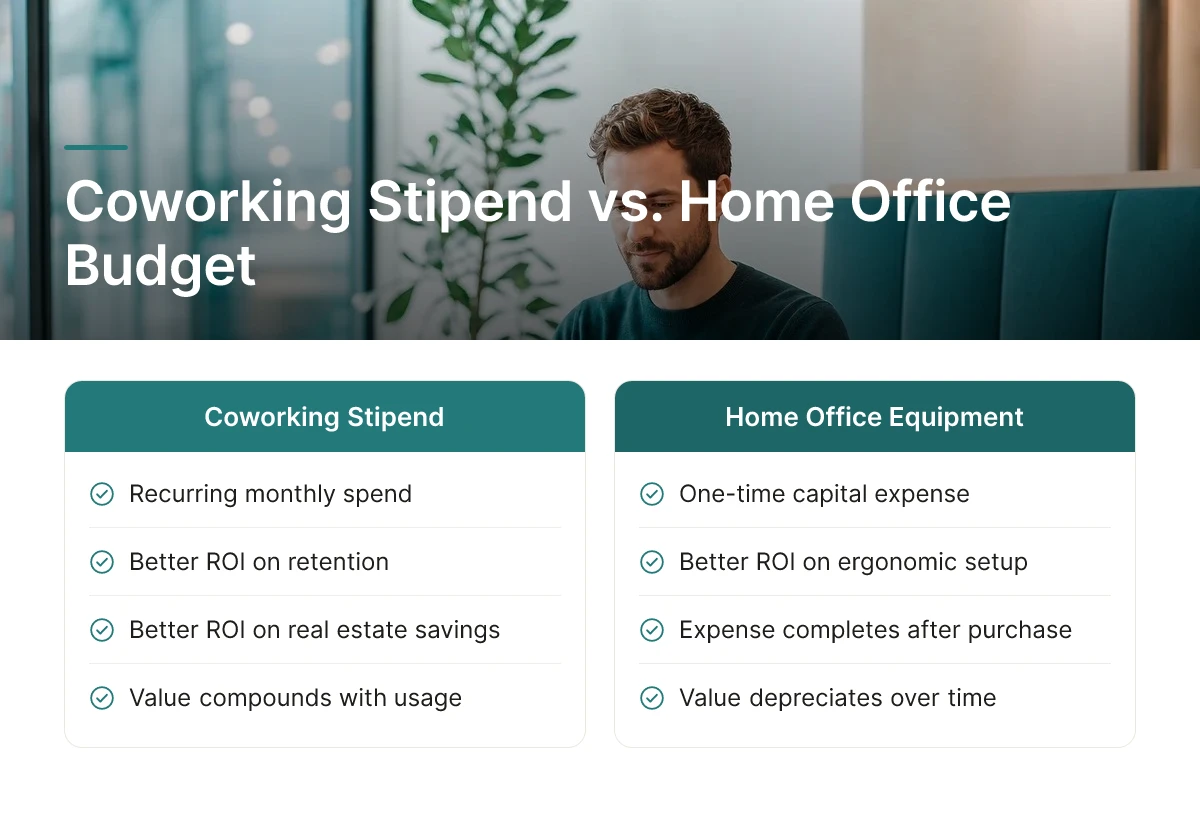
A coworking stipend delivers better ROI on retention and real estate savings, while a home office budget delivers better ROI on one-time ergonomic setup costs.
The two are structured differently, and that difference matters more than most benefits comparisons acknowledge. A home office equipment budget is a capital-style spend: you buy a desk, a monitor, a chair, and the expense is done. A coworking stipend is recurring, it pays for ongoing access to a space, month after month, which means its value compounds with usage instead of depreciating on a shelf.
Equipment solves ergonomics; it does nothing for isolation. Remote employees cite loneliness and lack of in-person contact as recurring frustrations, and a better monitor doesn't fix either [3]. A coworking stipend addresses this directly by giving employees a place with other people in it, surrounding professionals in a working environment rather than a kitchen table [2].
Employers already treat flexibility as a retention lever, not just a convenience. Work-from-home stipends are frequently framed as a way to stand out to candidates and reduce turnover [3], and coworking access extends that further by giving employees somewhere to go when isolation, not equipment, is the problem.
Home office budgets never touch the real estate line. You can furnish every remote employee's desk and still carry the same leased square footage, because equipment spend has no relationship to office footprint. A coworking stipend can, routing distributed employees into on-demand space instead of a leased seat directly offsets the square footage a company needs to hold.
Company size determines which model scales better. A small, single-metro company can outfit a home office cheaply and skip coworking access entirely, there's no distributed footprint to optimize. A company with clusters across multiple metros faces the opposite problem: leasing permanent space in every city is expensive and rigid, which is where a coworking stipend paired with an on-demand workspace network, the kind Upflex provides access to, lets real estate leaders offset footprint city by city instead of signing another five-year lease.
The strongest model isn't either-or. A modest equipment allowance covers ergonomics once, while a coworking stipend covers ongoing flexible access, letting each budget do the job the other can't.
There's no universal dollar figure that works for every company, the right coworking stipend depends on local cost of living, how often someone actually needs a desk, and their role.
Companies that ask "what's the standard amount" are asking the wrong question. A stipend sized for a sales rep in a high-cost metro who needs a desk five days a week looks nothing like one for a marketing coordinator in a smaller market who drops into a space twice a month. Treating both the same wastes budget on one and shortchanges the other.
Four variables should drive the number: local cost of living, frequency of in-person need, role seniority, and industry norms. A coworking day rate in a major financial hub costs multiples of the same access in a secondary market, so location alone can swing the right budget significantly. Frequency matters just as much, someone who needs a desk daily has fundamentally different requirements than someone who only wants a professional space for client calls once a week.
A flat, company-wide stipend ignores all of this. Set it high enough to cover your most expensive market and daily users, and you overpay everyone in a lower-cost city or with occasional needs. Set it low enough to stay lean in cheaper markets, and employees in expensive cities can't actually afford meaningful access, which defeats the purpose of offering the benefit at all.
Rather than one number, think in tiers tied to usage:
Role seniority and industry also factor in. Client-facing roles in professional services often warrant higher tiers because the workspace doubles as a meeting venue, while back-office roles in lower-touch industries may need less.
Benchmark by looking at what similar employers actually offer, not by repeating an unverified average pulled from a blog post. Three sources give a grounded picture: competitor job postings that list stipend or workspace benefits, internal employee surveys asking what they'd actually use and how often, and regional coworking or flex-space rates in the markets where your team is concentrated. Coworking itself has grown fast enough that pricing data is more available than it used to be, the number of coworking spaces in the U.S. has grown by roughly 55% since 2017 [2], which means more comparable rate data in most metro areas. Before rolling a stipend out company-wide, pilot it with one team or region. A pilot lets you validate whether the tier you picked actually matches usage patterns before you commit budget across the whole organization, and it's far cheaper to correct a miscalibrated coworking stipend for 20 people than for 2,000.
A coworking stipend is usually taxed as cash compensation unless it's structured as a reimbursement against documented business expenses, in which case many tax authorities treat it differently. The distinction sounds minor, but it determines whether payroll withholds tax on the amount and how finance records it on the books.
A flat monthly cash stipend, say, a fixed amount deposited regardless of what the employee actually spends, is typically treated as additional wages, subject to standard income tax and payroll withholding [3]. A reimbursement model, where the employee submits a receipt for a coworking day pass or membership and the company pays that specific amount back, can qualify for different treatment in some jurisdictions because it's tied to a substantiated business expense rather than discretionary income [4].
This is not a rule you can apply globally. Treatment varies by country, by state or province, and by the local tax authority's definition of a legitimate business expense [3]. A structure that works cleanly for a US-based employee may not translate to a team member in Germany or Singapore. Employers running a coworking stipend across a distributed workforce should confirm classification with a tax advisor or accountant in each relevant jurisdiction before finalizing the policy, rather than assuming one framework applies everywhere.
Most companies book a coworking stipend as a recurring operating expense, similar to how they'd treat a phone or internet allowance, it hits the income statement in the period it's paid. This is fundamentally different from how real estate leases are accounted for, where long-term lease obligations are capitalized on the balance sheet under standards like ASC 842. A stipend is variable and short-term by design; a lease is a fixed, multi-year liability. Finance teams comparing the true cost of flexible stipends against a traditional office footprint need to keep this distinction in mind rather than comparing the two figures as if they were the same category of spend.
On documentation, employers generally need three things: expense receipts or invoices from the coworking provider, some form of usage log showing the stipend was applied to actual workspace access, and a written policy defining what counts as eligible spend. That policy should specify caps, eligible vendors or space types, and submission deadlines. Because tax treatment often hinges on whether spend is substantiated, missing documentation can turn what was meant to be a reimbursement into taxable wages after the fact.
Build this policy jointly with payroll and finance, not in isolation inside HR. Inconsistent withholding across employees, some treated as reimbursement, others as wages, without a clear policy basis, creates compliance exposure and makes year-end reconciliation harder than it needs to be.
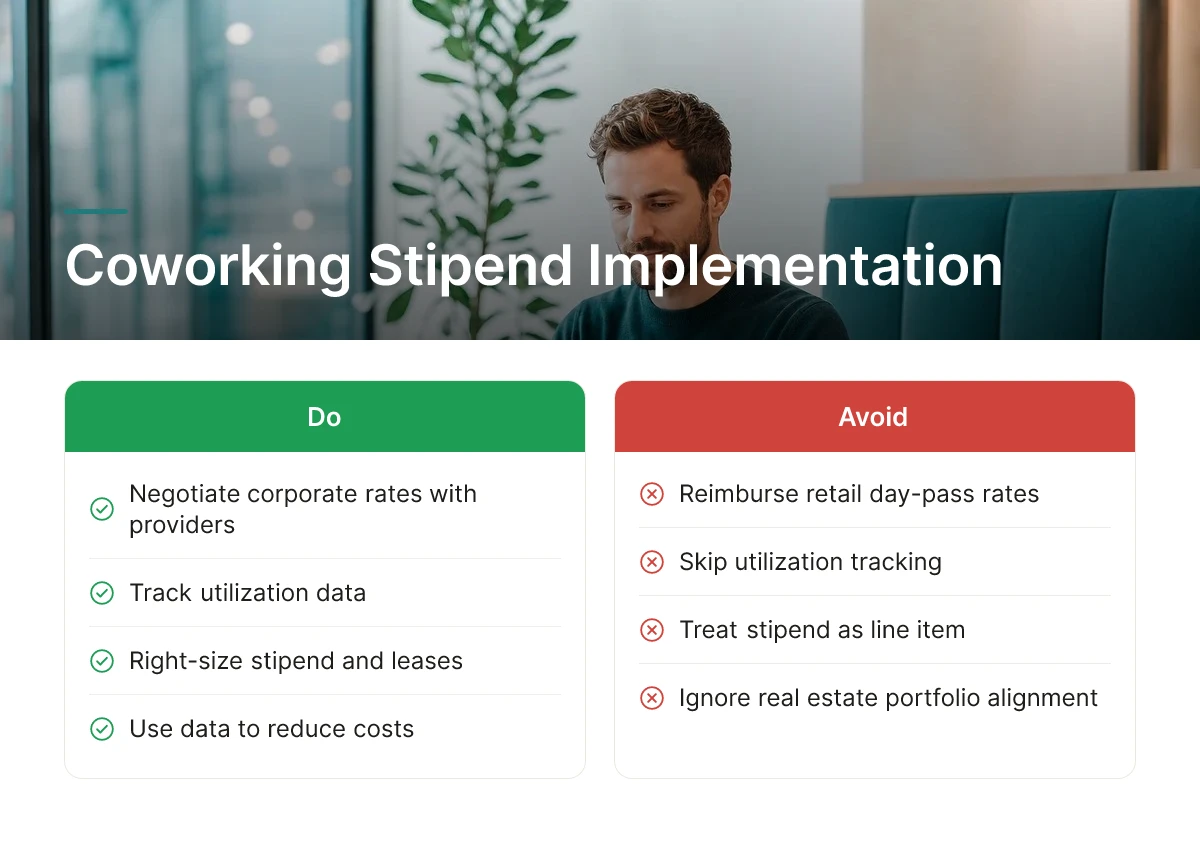
Implementation works in three stages: negotiate volume access instead of reimbursing retail rates, track utilization data against your real estate portfolio, and use that data to right-size both the stipend and your leases. Skip any of these and a coworking stipend becomes another line item rather than a lever for cost reduction.
Negotiate corporate or volume rates directly with coworking providers rather than letting employees expense individual day-passes at retail prices. Retail day-rates carry markups that disappear once you're buying access at scale across a portfolio of locations. This is also where procurement fragmentation quietly erodes savings: if fifty employees are each expensing different providers in different cities, finance ends up reconciling dozens of invoices and vendor relationships instead of one.
Consolidating access through a single managed network solves this administrative overhead directly. Instead of negotiating separately with providers in every market where you have distributed employees, a platform like Upflex gives your team access to a global on-demand workspace network under one contract, with usage data flowing into a single dashboard rather than scattered expense reports. That consolidation is what turns a coworking stipend from a reimbursement policy into a manageable, trackable real estate line item.
Track three metrics before declaring the program a success: attendance forecast accuracy, co-attendance rates on days teams intend to be together in person, and square footage reduction in owned or leased offices over time. Attendance forecasting matters because you can't right-size a lease around guesswork, Upflex's UnifyAI engine, for example, forecasts attendance with 97% accuracy, which gives real estate leaders a defensible basis for reducing footprint rather than a hunch. Co-attendance tracking matters separately, since a coworking stipend that scatters people across disconnected spaces on the days they're supposed to collaborate defeats its own purpose; a documented benchmark of 88% co-attendance achievement is the kind of number that should show up in your own reporting if the program is working.
These metrics feed a loop: utilization data tells you whether the stipend budget is sized correctly and whether your owned real estate is oversized, undersized, or roughly right. Resist the urge to cut office space before that data exists. A phased rollout, pilot the coworking stipend with one team or region, measure attendance and cost for two to three quarters, then renegotiate lease footprint based on what you actually observed, protects you from the mistake of downsizing on assumptions and then scrambling to find space when demand doesn't match the model.
Most companies restrict stipends to a pre-approved list rather than an open reimbursement policy. This keeps costs predictable and lets HR or finance track utilization by location. A platform like Upflex simplifies this by giving employees direct access to a vetted network of workspaces, so approval happens automatically at booking rather than through manual expense review.
No, stipends work best as a supplement to a core office, not a full replacement. Most enterprises still maintain a headquarters or regional hub for team collaboration and culture, while stipends cover employees who are remote, traveling, or located far from a company office. The goal is a right-sized portfolio, not zero real estate.
A quarterly review is a reasonable starting cadence for most organizations. This lets finance and workplace teams track utilization data against actual attendance patterns and adjust budgets before a lease renewal or annual planning cycle forces a bigger, reactive decision.
Policies vary, but most companies do not let unused stipend funds roll over or convert to cash. Treating it as a use-it-or-lose-it workplace benefit, similar to a wellness allowance, keeps the budget tied to its intended purpose rather than becoming an informal pay supplement.
Balancing a coworking stipend against your core real estate footprint comes down to data, not guesswork. Track actual attendance before setting budgets, tie stipend access to a vetted workspace network rather than open reimbursement, and revisit allocations every quarter as usage patterns shift. Companies that treat flexibility spend as a portfolio decision, not a scattered perk, are the ones hitting real estate savings targets of 40%+ without sacrificing employee experience. As a next step, pull your last two quarters of badge or desk-booking data and compare it against current stipend or coworking spend by location, that gap is usually where the first optimization opportunity sits.
Explore more from our content library: