Share This Article
No items found.


Understanding agile real estate is essential. Companies cut real estate costs and gain flexibility by replacing fixed, multi-year office leases with on-demand workspace access, coworking passes, day offices, and shared hubs booked as needed. This shift matters because a long-term lease locks in cost and square footage regardless of actual attendance, while on-demand models let real estate spend track real usage, which becomes critical as hybrid work makes daily headcount unpredictable. Companies typically start by auditing utilization, then reallocating budget from fixed leases toward flexible capacity in the locations where employees actually show up.
The transition runs through a sequence: measure actual usage, let existing leases wind down instead of breaking them, then replace the shrinking footprint with space booked on demand.
Long leases were built for a workforce that showed up five days a week. Hybrid work broke that assumption, office attendance still sits roughly 30% below pre-pandemic levels in many markets [3], which leaves real estate leaders paying for square footage nobody uses most days. Moving to agile real estate means treating office space as a variable cost that tracks headcount, not a fixed liability locked in for a decade.
Start with a utilization audit. Badge swipes, Wi-Fi logs, and desk-booking data reveal which floors, buildings, or entire regions are running at a fraction of capacity before any lease decision gets made. Skipping this step is how companies end up cutting the wrong office or holding onto one nobody uses.
Once the data is in hand, the sequence typically looks like this:
Lease laddering makes this financially workable. Rather than terminating contracts early, which usually triggers penalties, companies let leases run to term and either exit or downsize at renewal. Some real estate teams stagger renewals across a portfolio deliberately, so no single lease decision forces an abrupt, disruptive move.
On-demand access, day passes, coworking hubs, and shared workspace networks, fills the gap as owned square footage shrinks, without leaving distributed teams stranded. Upflex gives employees access to a global network of third-party workspaces, so a team that gives up a satellite office can still book a desk near a client site or in a city with no company lease at all. Combined with UnifyAI's attendance forecasting, which predicts office attendance with 97% accuracy, real estate teams can right-size owned space with more confidence about how much flexible capacity they'll actually need.
The trade-off is real: companies give up some predictability over exactly where a team will sit on any given day in exchange for lower fixed cost and the freedom to place people wherever demand shows up.
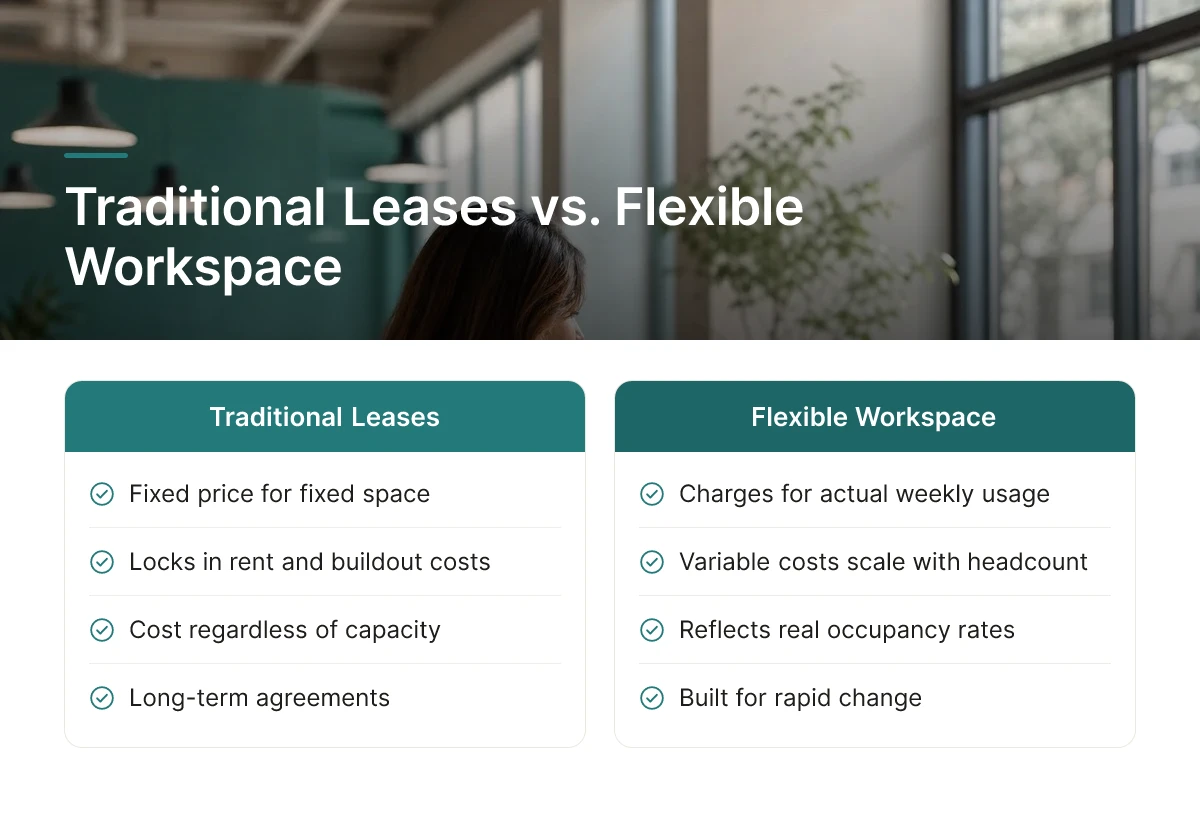
Traditional leases charge a fixed price for fixed space regardless of how many desks sit empty, while flexible workspace models charge for what teams actually use week to week.
A multi-year commercial lease locks in rent, buildout costs, and ongoing maintenance for the full term, whether the office is at 90% capacity or 20%. Real estate tends to operate around low-volume, high-dollar transactions built on long-term agreements, which is precisely why the sector has historically moved slower than industries built for change [4]. Flexible workspace spend, by contrast, scales with headcount and usage, the cost structure of a technology subscription rather than a capital commitment [1].
Hybrid attendance in 2026 varies so much by day that a fixed square footage number rarely matches real demand. Office occupancy in major markets remains well below pre-pandemic levels even as hybrid becomes the default model [3], which means a lease sized for Monday's headcount sits half-empty on Friday. This is the core mismatch driving agile real estate decisions: paying for consistent capacity against inconsistent demand no longer makes financial sense for real estate and finance leaders under pressure to justify every square foot.
Companies also cite the deeper shift in how they think about space itself. The move toward flexible workspaces reflects a more cost-conscious approach to how organizations view productivity and collaboration, not just a search for savings [2].
Long-term leases still offer something flexible space can't fully replicate: price stability over the lease term and a fixed brand presence that signals permanence to clients and employees. Pay-as-you-go models trade that certainty for elasticity, companies can expand, contract, or exit a market without renegotiating a lease, but they give up guaranteed access to the identical desk, floor, or building day after day [1].
Few organizations choose one model outright. The more common pattern is a smaller anchor lease covering a stable core headcount, paired with on-demand capacity for overflow, travel, and satellite teams. Upflex supports this middle path directly: its real estate portfolio optimization tools combine a company's own office data with access to a global on-demand workspace network, so leaders can right-size the anchor lease with confidence and cover the rest of the workforce, without gambling on an all-or-nothing switch.
Track four metrics: cost-per-used-seat, utilization rate, forecast accuracy, and a quarterly spend-to-headcount ratio, together they show whether agile real estate is actually paying off, not just changing shape.
Raw lease cost is a misleading starting point. A building that costs less per square foot can still be a worse deal if half the desks sit empty three days a week.
Cost-per-seat, total real estate spend divided by available desks, is the baseline. But cost-per-used seat, which divides that same spend by seats actually occupied on a given day, is the number that exposes waste. A portfolio with low cost-per-seat and high cost-per-used-seat is bleeding money on space nobody sits in, and that gap is exactly what a shift toward flexible, on-demand space is meant to close.
Utilization rate is the flexibility-gain signal underneath that math. It's calculated as badge-ins or confirmed bookings divided by total capacity, and a rising trend line means the strategy is working, more of the space you pay for is getting used. Falling or flat utilization, even after downsizing, signals that the wrong space was cut or that attendance patterns shifted somewhere the data didn't catch.
Attendance forecast accuracy rounds out the metric set. The tighter the forecast, the less a company either overbooks desks or holds unused capacity as a buffer against guesswork. This is where platforms like Upflex fit directly into the measurement framework: its UnifyAI engine forecasts attendance with 97% accuracy, which narrows the margin of error real estate teams have historically had to plan around.
Comparing this year's lease cost to last year's misses the variable that actually matters: headcount and attendance patterns change faster than annual reviews can catch. A quarterly review that plots real estate spend against current headcount, attendance trends, and utilization rate gives finance and workplace leaders a live picture instead of a stale one.
Cost is only half the scoreboard. Track qualitative wins too, how long it takes to open a new location or add desks in a new city, and how easily a team can scale up for a project or down after a reorg without a multi-year lease standing in the way. Those two measures capture the agility side of agile real estate that a spreadsheet of dollars per square foot never will.
Companies practicing agile real estate typically run three connected layers of technology: booking systems, utilization analytics, and access to a network of on-demand locations outside their owned footprint.
The first layer is reservation infrastructure, the desk and room booking systems employees touch daily. On their own, these tools solve a narrow problem: they let someone claim a desk, but they don't tell a real estate leader whether the floor is worth keeping open three days a week or one.
The second layer is analytics: attendance and utilization data that shows how space actually gets used, not how it was designed to be used. Lease management teams already struggle with fragmented data across portfolios, one industry review found lease administration hampered by scattered records, missed deadlines, and limited visibility across distributed holdings [5]. The same fragmentation problem shows up in workspace usage data when booking, badge, and calendar systems don't talk to each other.
The third layer is a network of on-demand locations, coworking spaces, day offices, and drop-in sites employees can access when they're traveling, working from a satellite city, or simply skipping a long commute to an underused office. This is where a distributed real estate portfolio stops being a single building problem and becomes a coordination problem across dozens or hundreds of locations at once.
Office orchestration means coordinating who's coming in, when, and where across every location a company controls or can access, not managing one building's calendar in isolation. Upflex's UnifyAI engine handles this by forecasting attendance with 97% accuracy, turning scattered scheduling inputs into a prediction of actual demand for a given day, floor, or city.
That forecasting accuracy matters because most real estate decisions are still made on guesswork, assumptions about how many people will show up rather than data on how many actually do. When forecasting is accurate, space and cost get matched to real demand instead of padded for a worst case that rarely happens. Upflex customers use this same data to track co-attendance goals, with an 88% co-attendance achievement benchmark showing teams are actually landing on the same days rather than missing each other in a half-empty office.
None of this works without integration. Booking has to read from the calendars and HR systems that already hold team schedules, or employees end up manually re-entering plans that already exist somewhere else. A platform that pulls from Microsoft 365 or Google Workspace calendars, plus HR system data on team structure, can automate coordination instead of asking each employee to plan around a static seating chart.
Tool selection should match the scale of the problem. A single-city company with one office might get by with a budget-friendly booking tool and a spreadsheet. A global enterprise juggling a distributed portfolio, hybrid schedules, and overflow demand in cities without a company office needs an enterprise-grade orchestration platform, one that combines forecasting, booking, and on-demand network access rather than stitching together three disconnected tools.
Agile real estate needs a named owner for portfolio decisions and a separate owner for the utilization data that justifies them, not a facilities team working alone. Lease negotiations used to sit with one department for years at a time; a flexible model spreads accountability across the people who plan headcount, control spend, and track how space actually gets used.
Two roles anchor the structure. A workplace or corporate real estate lead owns portfolio decisions, which offices to keep, downsize, or exit, and when to add on-demand capacity for distributed teams. A second role, often sitting in analytics or operations, owns utilization tracking: attendance patterns, co-attendance rates against team goals, and cost per square foot over time.
These roles don't need to be new hires. In many companies they're existing positions with an expanded mandate, supported by a platform like Upflex, where UnifyAI's attendance forecasting and desk booking data give both roles a shared source of truth instead of separate spreadsheets pulled from badge swipes and calendar invites.
Facilities-only ownership breaks down once space decisions depend on headcount plans and budget constraints that facilities teams don't control. HR needs a seat at the table for hiring and hybrid schedule planning; finance needs visibility into spend as it happens, not at renewal time [5]. The teams best positioned for agile real estate treat portfolio strategy as a standing cross-functional function, not a single department's side project.
Decision cadence changes just as much as reporting lines. A lease cycle that once ran on a near-decade timeline now gets reviewed quarterly, with utilization data and forecast accuracy feeding each check-in rather than a one-time market survey [4]. Tango Analytics notes that limited portfolio visibility and fragmented lease data are among the most common obstacles real estate teams face when trying to make timely decisions [5], a gap that quarterly reviews, backed by shared dashboards, are designed to close.
Smaller companies don't need a dedicated department to run this well. A single fractional owner, often someone in HR or operations wearing a real estate hat part-time, can manage the same cadence at a smaller scale, expanding responsibility as the office footprint grows rather than building out headcount ahead of need.

No, the underlying math (paying for space you don't fully use) hits companies of every size, though enterprises with multi-city portfolios feel it hardest. A 500-person company and a 5,000-person company both benefit from tying real estate cost to actual attendance rather than fixed square footage. The scale of the fix differs; the logic doesn't.
Yes, most organizations run a hybrid portfolio rather than dropping leases entirely. A company might keep a core headquarters lease sized to actual peak attendance, then use on-demand workspace for overflow, satellite teams, or new-market entry without signing another multi-year commitment [1].
Timelines depend on existing lease terms, but many companies start redirecting overflow within weeks of adopting on-demand access, while full portfolio consolidation typically tracks to lease renewal or expiration dates. Upflex customers use attendance forecasting data to build the case for downsizing at the next renewal, rather than waiting years to gather evidence. Documented outcomes include real estate spend reductions above 40%.
Yes, fully remote companies use on-demand workspace networks to give distributed employees occasional access to professional space without carrying any permanent office cost. It replaces the need for a headquarters lease entirely while still supporting in-person meetings or team gatherings when needed.
Cutting real estate cost without breaking hybrid work comes down to three moves: forecast attendance before deciding how much space to keep, size any owned office to real usage instead of headcount on paper, and fill the gaps with on-demand workspace instead of another lease. Upflex pairs 97%-accurate attendance forecasting with desk booking and a global on-demand network, which is how customers reach 40%+ real estate savings while still hitting co-attendance targets. Start by pulling your last two quarters of badge or booking data and comparing it against your current square footage, the gap you find is your next move.
Explore more from our content library: