Share This Article
No items found.


A workspace stipend outperforms traditional office perks because it converts fixed real estate costs into a flexible, per-employee allowance that scales with actual usage instead of leased square footage. Companies pay only for the coworking access, home office setup, or on-demand desk time employees actually need, which cuts wasted capacity in hybrid environments where daily attendance fluctuates. This shifts the cost model from committed lease overhead to variable, demand-matched spend while giving employees more control over where they work.
A fixed lease charges you for 100% of a floor whether 30% or 90% of your team shows up that day, this kind of allowance charges you only for the days someone actually uses a desk.
That gap between leased capacity and daily attendance is the core cost problem in hybrid work. Corporate real estate leaders already know the pattern: badge data shows attendance swinging between 30% and 50% depending on the day of the week, yet the lease payment, utilities, and cleaning contract stay flat regardless of who's actually in the building. Every empty desk on a Monday or Friday is capacity you've already paid for and can't recover. A workspace stipend restructures that spend so it tracks real usage, employees draw on an allowance for coworking access or on-demand desk time only when they need it, and the company stops paying for space that sits empty. A coworking stipend is one common way companies structure this kind of allowance.
Traditional office benefits lock you into fixed commitments regardless of attendance, while this approach keeps spend tied to actual demand and leaves you free to adjust month to month.
Fixed office commitments typically include:
A flexible allowance carries none of that lock-in. You can scale it up or down as headcount or attendance patterns shift, without renegotiating a lease or decommissioning a floor. That flexibility is exactly what a CFO wants to see when real estate is a top-three line item and attendance is still unpredictable.
These allowances give distributed employees a way to work near home without the company signing a lease in every city they live in.
Instead of opening a satellite office in every market where you have a handful of remote employees, this kind of allowance lets those employees book coworking space or on-demand desk access close to home. This matters most for companies with distributed teams spread across secondary cities or regions where a dedicated office would sit underused most days. Upflex supports this model by combining stipend-style flexibility with access to a global on-demand workspace network, so employees get a professional space to work from without the company carrying a long-term lease obligation for a market that doesn't justify one.
None of this argues for eliminating your real estate portfolio. The goal is rebalancing it, keep a smaller core office for the collaboration days that matter, and let a flexible workspace allowance absorb the overflow, the distributed headcount, and the markets too small to justify a dedicated lease.
There is no universal figure that works for every company, the right budget depends on local cost of living, coworking supply density, and how much in-person work a given role actually requires.
A single flat number applied across an entire company almost always misfires somewhere. It looks generous in a market flush with budget-friendly coworking options and inadequate in a market where desk space is scarce and expensive. Corporate real estate leaders evaluating this kind of program need a framework, not a borrowed number from a competitor's benefits page.
Three variables should drive the math:
A city with a dense coworking market gives employees more negotiating use and more inventory at different price points, while a market with limited flexible workspace supply pushes prices up regardless of company size. Role matters too, a field sales rep who needs a professional space for client meetings has a different need than an engineer who mostly wants quiet focus time away from a noisy apartment.
Treating these as inputs to a formula, rather than guessing at a round number, is what separates an allowance that gets used from one that gets ignored or abused.
This is also why location-tiered or role-tiered structures tend to outperform flat allowances. A single company-wide amount either overpays employees in low-cost markets, money that could fund real estate consolidation elsewhere, or underpays employees in expensive, undersupplied markets, pushing them back to overcrowded home setups or unreliable coffee-shop work [4]. Tiering by metro area and by role need closes both gaps at once.
Company size shapes how precisely a stipend gets structured, not just how large it is. Larger enterprises with dedicated corporate real estate teams typically build multi-tier models tied to metro cost bands and job function, similar to how they already structure travel or relocation policies. Smaller companies more often default to a simple flat allowance, distributed as a one-time or recurring payment, because they lack the headcount to administer anything more granular [2]. Industry norms shift the baseline further, professional services and technology firms with distributed, client-facing teams tend to treat workspace access as a retention lever, while operationally focused industries with fewer knowledge workers offer it more sparingly.
Rather than benchmarking against a competitor's published number, tie the budget to your own real estate savings target. A company aiming to consolidate underused square footage should size its allowance against the seats it plans to eliminate, since local market conditions vary too much for one figure to travel between cities or companies. Upflex's utilization data helps real estate teams quantify exactly how much office space is going unused, giving finance leaders a defensible number to weigh against any proposed stipend spend. For more context on how organizations approach this decision, see this overview of work-from-home stipends.

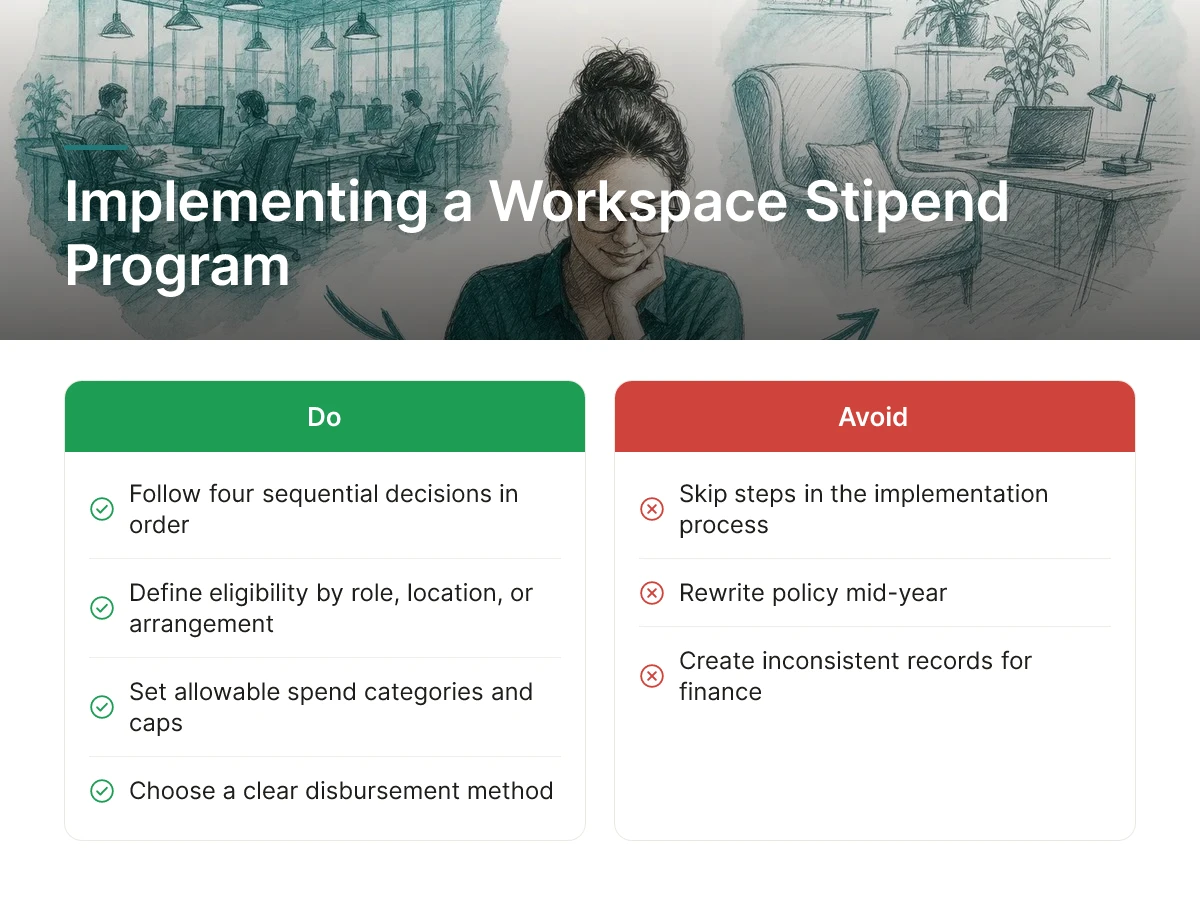
A workspace stipend program runs on four sequential decisions:
Skip a step and you end up rewriting policy mid-year, which frustrates employees and creates inconsistent records for finance.
Start with eligibility. Define it by role, location, or work arrangement, for example, employees who live more than a set distance from a company office, or those on a fully remote contract. Next, set the allowable spend categories and dollar caps per category. Then choose a disbursement method: expense reimbursement, a prepaid allowance loaded onto a card, or a managed platform that handles approval and payment in one flow. Only after those three decisions are locked in should you publish guidelines company-wide. Announcing the program before the mechanics are settled invites a flood of ad hoc requests HR then has to adjudicate one by one.
A dedicated management platform replaces scattered receipts and email approvals with centralized visibility into who spent what, where, and against which budget line.
Manual reimbursement through expense reports works for a handful of employees, but it breaks down once a program spans multiple offices, countries, or currencies. A platform gives finance a single dashboard to see spend by team, by location, or by category, which matters when a CFO asks whether the coworking allowance in the Austin office is actually cheaper than leasing more desks there. It also produces audit-ready records automatically, rather than requiring someone to reconstruct a paper trail during tax season or a compliance review. Some companies, like Ramp, have published details on how they built their own WFH stipend spend program, which offers a useful reference point for structuring disbursement.
This is also where the conversation connects to broader real estate strategy. Upflex, for instance, pairs on-demand access to a global network of third-party workspaces with attendance forecasting, so real estate leaders can see workspace usage alongside office utilization data in one place rather than treating stipend spend as a disconnected HR line item.
Typical allowable uses include:
Clear guidelines, spending caps per category, receipt requirements, and a defined list of ineligible purchases, prevent disputes before they start. Without caps, one employee's coworking day pass sits next to another's premium standing desk, and finance has no consistent basis to approve or deny either one [3]. Written rules also make the program auditable: if a state or country requires expense reimbursement for remote work costs [3], documented guidelines show you're meeting that obligation rather than guessing at it.
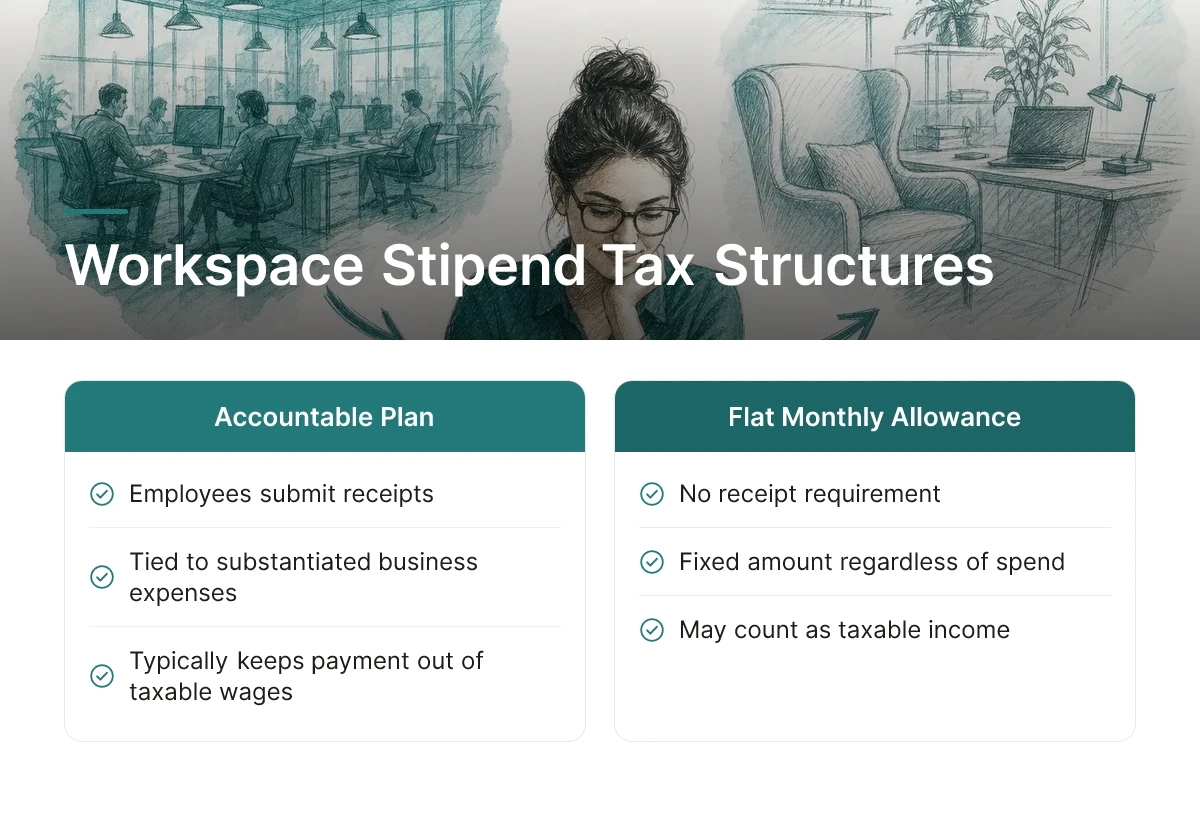
Whether this kind of allowance counts as taxable income depends on how it's structured and paid, the design decision matters more than the dollar amount.
Tax authorities generally look at whether a stipend runs through an accountable plan or arrives as a flat allowance. Under an accountable plan, employees submit receipts for coworking passes, internet bills, or desk rentals, and the reimbursement is tied to substantiated business expenses, that structure typically keeps the payment out of taxable wages. A flat monthly amount handed out with no receipts, by contrast, is usually treated as additional taxable income, similar to a cash bonus.
Requirements are not uniform. Some jurisdictions impose specific obligations around remote-work expense reimbursement, while others leave the decision entirely to employer discretion [3]. Even within a single country, rules can vary by state or province, a company with employees in California and Texas, for example, may face different reimbursement expectations depending on where each person is legally based [3]. A global enterprise running this kind of program across a dozen countries is effectively managing a dozen separate compliance environments, not one policy.
This is why a workspace stipend program should not be finalized without payroll and legal or tax counsel in the room. Misclassifying an allowance as non-taxable when it doesn't meet accountable-plan requirements creates back-tax and penalty exposure, and that risk sits with the employer, not with any workspace platform or vendor involved in delivery. Legal and finance teams need to weigh in on plan design before the first payment goes out, not after an audit flags it.
None of this is a reason to avoid offering flexible workspace support. It's a reason to treat the tax structure as a design variable alongside eligibility and amount. Platforms like Upflex don't set tax policy, but by consolidating workspace access and utilization data in one dashboard, they give payroll and finance teams a clearer paper trail to support whichever structure counsel recommends, accountable plan or otherwise.
Measure this kind of program on two sides at once: real estate dollars avoided per employee, and retention or engagement shifts among the people using it. Treat either metric alone as incomplete, the program only earns its budget line when cost savings and workforce outcomes move together.
The cost-side metric that matters most is real estate spend avoided or reduced per employee, compared against what a dedicated desk in owned or leased space would have cost that same employee. If a company would otherwise carry a fixed seat at full occupancy cost, and instead funds a flexible allowance for occasional flex-space access, the delta is the real number for the CFO. This is the same math corporate real estate leaders already run when deciding whether to consolidate a floor or exit a lease, the allowance is just one more input into that portfolio model.
Three signals matter on the people side: retention rate among eligible employees, engagement survey sentiment specifically about flexibility, and the program's own utilization rate. Retention is straightforward to track by comparing turnover among employees with access against those without it over the same period. Engagement surveys should ask a direct question about whether flexible work location support affects satisfaction, not just general happiness, vague satisfaction scores don't isolate the program's contribution.
Utilization, the share of eligible employees actually claiming the allowance, is the metric most companies underweight. Low uptake doesn't mean employees don't want flexible workspace access; it usually means the allowance amount, approved vendors, or awareness of the benefit are misaligned with actual need. Ramp built its own version of this logic into a one-time work-from-home stipend for new hires [2], reasoning that a well-funded, simple-to-use allowance removes friction that otherwise suppresses adoption. The same principle applies to recurring coworking or on-demand workspace stipends: if uptake sits well below eligibility, the fix is usually redesign, not cancellation. For a broader look at how these programs are structured, see this guide to remote work stipends.
Run this review on a quarterly or semi-annual cadence, and route the findings directly into space planning. A platform like Upflex, which pairs attendance forecasting with access to an on-demand workspace network, gives real estate teams the utilization data to close that loop, showing not just how much spend went out, but how it maps against actual office occupancy and where footprint can be right-sized next.

No federal law in the U.S. requires workspace stipends, but some states mandate reimbursement for necessary remote work expenses [3]. California requires reimbursement for necessary remote work costs, and Illinois mandates coverage for phone bills and internet access [3]. Requirements vary by country too, so global employers should check local labor law before setting policy.
Yes, most workspace stipends can cover home internet, utilities, and other remote work expenses, depending on company policy. Common eligible costs include office furniture, equipment, phone bills, and a portion of utility bills [3]. Some companies also let employees apply the allowance toward coworking day passes or desk memberships instead [4].
No, this kind of allowance covers individual work-from-home costs but doesn't solve team coordination or collaboration needs that a shared office provides. Companies with hybrid teams still need a way to forecast attendance and manage space when people do come in together. Platforms like Upflex address that gap by pairing on-demand workspace access with AI-driven attendance forecasting, so stipends and shared space work as a combined strategy rather than a replacement for one another.
Review stipend amounts at least annually, alongside broader real estate and hybrid work policy reviews. Inflation, changes in average coworking or utility costs, and shifts in office attendance patterns can all justify an adjustment sooner than a fixed yearly cycle.
Yes, many companies pair a flexible allowance with access to a network of coworking locations so employees can choose a space near home rather than defaulting to whatever's cheapest or closest. This combination tends to increase uptake, since employees get both funding and a curated list of vetted options rather than having to research workspace on their own.
A workspace stipend works best as one piece of a larger hybrid work budget, not a standalone fix for real estate costs. Pair stipend spending with real attendance data before deciding whether to shrink a lease, consolidate offices, or add on-demand workspace access for distributed employees. Companies that guess at utilization tend to overspend on both stipends and square footage they don't need.
Start by pulling your last two quarters of badge or booking data and comparing it against what you're paying in stipends and rent. That comparison, not assumption, should drive your next real estate decision.
Explore more from our content library: