Share This Article
No items found.


A facility management platform helps hybrid teams by matching office space and resources to actual attendance patterns instead of fixed headcount, so you stop paying for desks nobody uses. It coordinates bookings, forecasts who's coming in and when, and gives real estate leaders the data to consolidate or renegotiate space with confidence. For hybrid organizations, that combination of accurate forecasting and on-demand workspace access directly lowers real estate costs while keeping employees able to find a desk, room, or workspace near them whenever they need one.
A facility management platform replaces guesswork about who shows up with forecasting data, so real estate leaders can cut square footage instead of renewing leases on assumption alone. Legacy planning relies on badge counts from last quarter or a gut sense of how full the office "feels." Neither tells you whether Tuesday's crowd is permanent or a one-off team offsite.
Attendance forecasting changes the decision. When a system predicts who's coming in, on which days, and to which floor, a corporate real estate team can see six months out whether a building is structurally underused rather than just quiet this week. That's the difference between consolidating two floors into one with confidence and carrying empty space because nobody wanted to risk a wrong call before a lease renewal. A definitive guide to the hybrid workplace outlines why this forward-looking approach has become central to modern space planning [Eptura].
Coordination works by syncing booking data across every location a company operates, so the same employee can't hold a desk in Chicago and another in Denver on the same day. Without that sync, distributed teams generate duplicate reservations and idle desks in multiple cities at once, the exact pattern that inflates real estate spend while utilization reports still look fine on paper. Platon's research on space management notes that reservable workstations and dynamic seating are now standard tools for supporting flexible, hybrid models in corporate offices [3]. This kind of coordination tool extends that logic across a whole portfolio, not just one building, matching resources to where people actually are.
The metrics that matter for a downsizing decision are specific:
Measuring utilization this way is what lets a company identify rarely used meeting rooms or entire floors and convert or shed that space rather than guess at it [2].
Consider a real estate leader reviewing a 12-floor headquarters ahead of a lease renewal. Utilization data shows three floors running below 35% peak occupancy for two consecutive quarters. That evidence, not a hunch, supports subletting a floor or consolidating teams onto fewer floors, with the CFO able to see the cost-per-square-foot math behind the call.
On-demand workspace access covers the gap that fixed leases can't: when attendance spikes on a collaboration day, employees can book nearby flexible space instead of the company holding permanent capacity for rare peaks. Upflex pairs that network with its UnifyAI forecasting engine, which predicts attendance at 97% accuracy, so portfolio decisions rest on data rather than assumption.
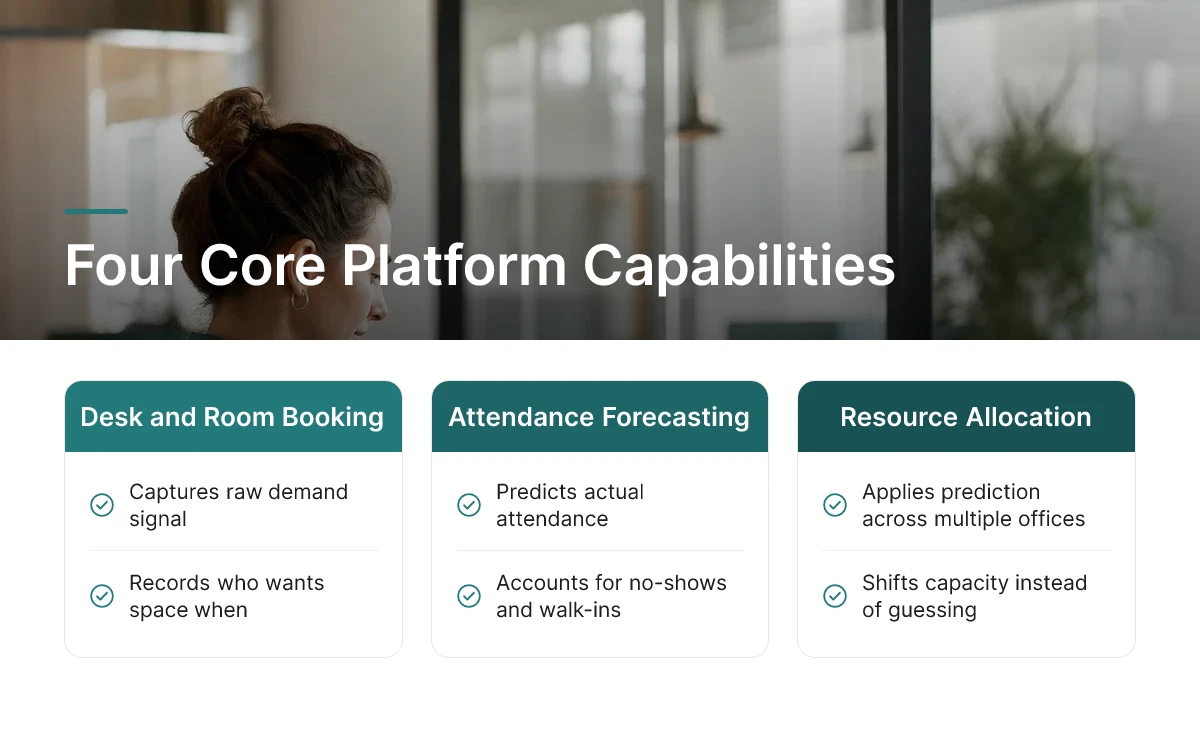
A system built for hybrid coordination needs four capabilities at minimum:
These four work together. Booking tools capture the raw demand signal, who wants a desk and when. Forecasting turns that signal into a prediction of actual attendance, since not everyone who books shows up and not everyone who shows up books in advance. Resource allocation applies that prediction across multiple offices, so a company with locations in five cities can shift capacity instead of guessing site by site. Analytics dashboards translate all of it into the one question a CFO or Head of Corporate Real Estate actually cares about: is this square footage earning its cost? Upflex approaches this stack through its UnifyAI engine, which forecasts attendance at 97% accuracy and feeds that prediction directly into desk booking and space planning, rather than treating booking and forecasting as separate tools that someone has to reconcile manually.
Space utilization data matters here because occupancy rates, not lease size, are what justify downsizing decisions. Measuring how a floor is actually used, not just how many desks exist, is what lets a real estate team convert underused square footage into a defensible cost case [2]. Workplace analytics approaches built for hybrid environments reinforce the same point: decisions should follow observed behavior, not assumed headcount [OfficeSpace].
Mobile-first design matters because hybrid employees make booking decisions in transit, not at a desktop, a tool built for a facilities back office assumes the wrong user and the wrong moment.
An employee deciding whether to go into the office usually makes that call from a phone, often on the morning commute or the night before, checking whether teammates will be there too. A tool designed primarily for a facilities team's internal workflows, work orders, vendor scheduling, compliance logs, tends to bury booking three menus deep because it was never the primary use case. A system designed for employee-facing coordination puts booking, attendance visibility, and co-attendance status on the home screen, because that's the decision it's built to support.
Integration depth determines whether a facility management platform replaces manual reconciliation work or just adds another spreadsheet to it.
Shallow integrations are a common failure point. A booking tool that doesn't sync with the HRIS doesn't know who's actually employed or which team someone sits on. One that lacks SSO creates login friction that suppresses adoption. One that can't pull data from occupancy sensors has to rely on self-reported bookings, which overstate usage because people book desks they don't use. Calendar integration matters too, without it, in-office days live in one system and meetings live in another. Workplace apps that connect booking with maintenance requests and space data in one interface reduce this kind of fragmentation [3].
Offline or low-connectivity functionality is a practical, often overlooked requirement. Employees booking a desk from an airport, a train, or a client site need a tool that queues the request and syncs once connectivity returns, rather than one that simply fails.
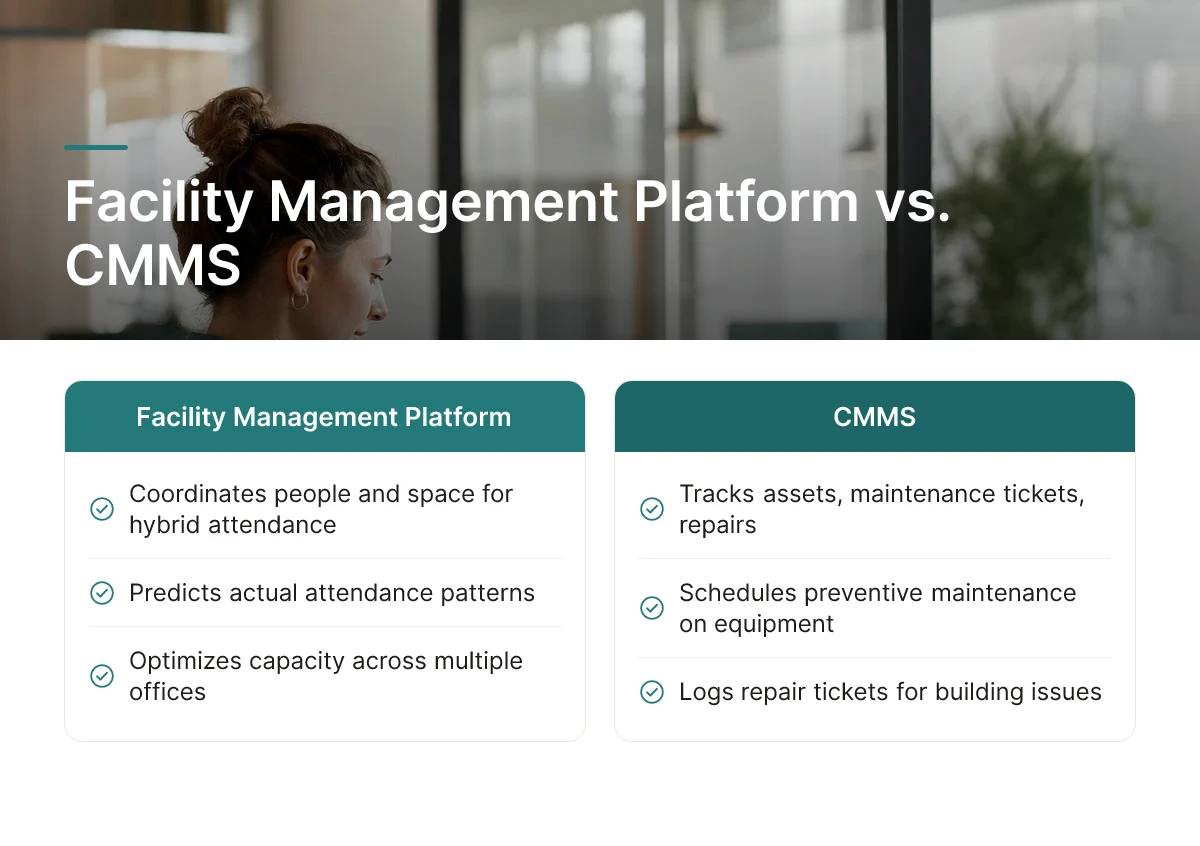
A hybrid coordination system handles people and space for hybrid attendance, while a CMMS tracks assets, maintenance tickets, and physical repairs, they solve different problems.
Computerized maintenance management systems (CMMS) and broader work-order tools grew out of industrial and commercial building operations: tracking HVAC service intervals, scheduling preventive maintenance on elevators, logging repair tickets when a pipe bursts. They answer a narrow set of questions well, what's broken, who fixes it, when was it last serviced. What they were never designed to answer is a more human question: which employees are coming in on Tuesday, and do they have a desk near their team.
That distinction matters because the workflows look nothing alike. A legacy maintenance system is reactive by design, someone files a ticket, a technician gets dispatched, the ticket closes. A hybrid-coordination platform runs the opposite way: it forecasts who's showing up before the day starts, then arranges desks, teams, and schedules around that prediction. Upflex's UnifyAI engine, for example, forecasts attendance at 97% accuracy and uses that forecast to drive desk booking and office orchestration automatically, rather than waiting for a problem to get reported [1].
Modern workplace platforms are cloud-based and employee-facing, while legacy CMMS tools are typically administered only by facilities staff. Employees book their own desks, see real-time availability, and get coordination nudges directly, no ticket, no facilities-team intermediary. Deployment also moves faster: a cloud SaaS rollout can reach a distributed workforce in weeks, where legacy on-premise maintenance software often requires longer implementation cycles tied to IT infrastructure [1].
Few enterprises replace one system with the other. A CMMS or work-order tool keeps running the building, fire suppression inspections, janitorial schedules, equipment lifecycle tracking, while a workplace coordination platform handles space allocation and team presence. The practical pattern is integration, not displacement: utilization and booking data flow from the workplace platform into facilities operations, so a facilities team sizing HVAC capacity or planning maintenance windows can see which floors are actually occupied [3]. Corporate real estate leaders evaluating this kind of tool should expect it to sit alongside their existing maintenance stack, not replace it.
ROI comes from square footage you stop paying for, not from the software subscription itself, the platform is the mechanism, the real estate decision is the payoff.
The savings mechanism has three parts: reduced total square footage, lower utility and cleaning costs per occupied seat, and avoided lease renewals on space you no longer need. None of these show up by simply installing software, they show up when leadership acts on the utilization data the platform produces. Upflex, for example, ties attendance forecasting to real estate portfolio decisions, with customers using the data to justify consolidation and reporting reductions in real estate spend of 40% or more.
The most reliable way to quantify gains is internal, not external. Measure utilization before rollout, actual desk and room occupancy, not badge-in counts or lease-assumed capacity, then measure again after three to six months of forecasting and booking data [2]. Industry benchmarks are useful for context, but your own before-and-after numbers are what a CFO will trust when approving a lease exit. Space utilization studies consistently show that identifying underused areas is what enables the cost conversation, whether that means downsizing or converting rarely-used rooms to other purposes [2].
Rollout generally moves through four phases:
That last phase never ends, forecast accuracy improves as the system accumulates more cycles of actual versus predicted attendance.
Timeline depends heavily on organizational complexity. A single-site team with one calendar system and a few hundred employees can run a pilot in a matter of weeks. A multi-country enterprise with multiple HR systems, works councils, and regional IT approval processes needs considerably longer, integration work and change management, not the software itself, are usually the bottleneck.
Total cost of ownership also scales with this complexity. A budget-friendly deployment suits a single office testing desk booking and basic forecasting; mid-range deployments typically add multi-site coordination and deeper analytics; enterprise-tier contracts cover global portfolios, on-demand workspace network access, and dedicated implementation support. Match the tier to the number of sites and the real estate decisions actually on the table, not to the size of the organization alone.
Most facility management platforms optimize the space you already own; Upflex optimizes attendance first, then matches space, owned or on-demand, to match it.
Legacy systems were built around a fixed inventory: desks, rooms, floors, and the occupancy sensors that track whether someone sat in them. That model worked when offices had assigned seating and headcount was predictable. It breaks down under hybrid schedules, where attendance swings week to week and the question isn't "how was this room used last Tuesday" but "who's actually coming in next Tuesday." Upflex starts from that forward-looking question rather than the backward-looking one. This shift mirrors broader findings on how facilities management is evolving to support hybrid work experiences rather than static office attendance [Circles].
Upflex's UnifyAI engine forecasts who's coming in, when, and where, with 97% accuracy, so space planning happens before the week starts instead of after the fact. That forecast feeds directly into desk booking and workplace coordination, which means a workplace team can see Wednesday's crunch coming on Friday, not discover it at the front desk.
Forecasting alone still leaves a gap: what happens when the home office is genuinely over capacity, or an employee is traveling, or the nearest company location doesn't make sense for a given day? Systems that only manage owned real estate have no answer beyond "find a seat somewhere" or "work from home." Upflex closes that gap with access to the world's largest on-demand workspace network, giving employees a place to work that isn't limited to the company's own floor plan. Forecasting tells you the demand is coming; the on-demand network makes sure there's always somewhere to put it.
A tool that only reports on owned-space utilization can tell you a floor is 40% full. It can't tell you whether that's a problem worth fixing or who needs a desk tomorrow. Upflex blends owned space, on-demand space, and employee experience into one view, so a real estate leader sizing down a lease and a workplace leader planning team days are looking at the same data, not two disconnected systems.
That combination is also why co-attendance coordination matters as a differentiator. Occupancy sensors tell you who showed up after the fact; they don't help a team actually land on the same days. Upflex tracks and reports against co-attendance targets directly, with a documented benchmark of 88% co-attendance achievement, so coordination becomes a managed outcome rather than a hope. The result, in Upflex's own terms, is real estate portfolio savings of 40%+ alongside stronger employee experience, not a tradeoff between cutting cost and keeping people happy, but both delivered from the same data set.

The strongest options combine space management with attendance prediction, not just desk reservations after the fact.
Legacy suites like Archibus and Planon handle portfolio analytics and compliance reporting well but were built before hybrid schedules existed, so they treat attendance as a fixed input rather than a variable to forecast [3]. Newer entrants, including Upflex, pair AI-driven attendance forecasting with desk booking and access to an external workspace network, which matters most when teams split time across owned offices and remote locations.
No, a facility management platform and a CMMS solve different problems and usually need to coexist.
A CMMS tracks maintenance tickets, equipment lifecycles, and work orders. A system focused on hybrid work handles space allocation, booking, and attendance coordination. Most enterprises run both, often integrated, rather than retiring one for the other.
Track utilization rate against leased square footage before and after rollout, then tie the gap to a real consolidation decision.
Look at occupancy data over at least one full quarter, not a few weeks, since attendance patterns shift around holidays and project cycles [2]. The real test is whether utilization data leads to an actual lease renegotiation, floor consolidation, or sublease, Upflex customers have used this data to document reductions of 40%+ in real estate spend.
Small teams benefit less from forecasting and more from simple booking and visibility tools.
The heaviest returns, attendance forecasting, portfolio consolidation, multi-site coordination, accrue to organizations managing several offices or hundreds of hybrid employees. A 20-person team rarely needs AI-driven forecasting; a basic booking tool usually covers it.
Space management practices, reservable desks, dynamic seating, zone-based allocation, determine how well any coordination tool performs once deployed, since the software can only work with the physical layout it's given. Organizations that pair flexible space design with booking and forecasting tools typically see faster adoption than those that bolt software onto a rigid, assigned-seating floor plan [Planon].
Hybrid work made office attendance unpredictable, and unpredictable attendance makes real estate decisions expensive guesswork. The fix isn't another booking app bolted onto a legacy system, it's combining attendance forecasting, space data, and flexible workspace access into one view of your portfolio.
Three things to act on: audit your current utilization data before your next lease renewal, require forecasting accuracy (not just booking volume) from any platform you evaluate, and pilot a consolidation decision backed by at least one full quarter of data. Start by pulling your last 90 days of badge or booking data and comparing it against leased square footage, that gap is where the savings conversation begins.
Explore more from our content library: