Share This Article
No items found.


Real estate portfolio software centralizes property data, financial performance, and asset management into one platform, replacing spreadsheets with live dashboards, automated reporting, and scenario modeling. The best options in 2025 include AppFolio, MRI Software, Quickbase, Yardi Voyager, and Buildium, each suited to different portfolio sizes and asset types. Choosing the right tool depends on portfolio complexity, integration needs, and whether you manage residential, commercial, or mixed-use assets.
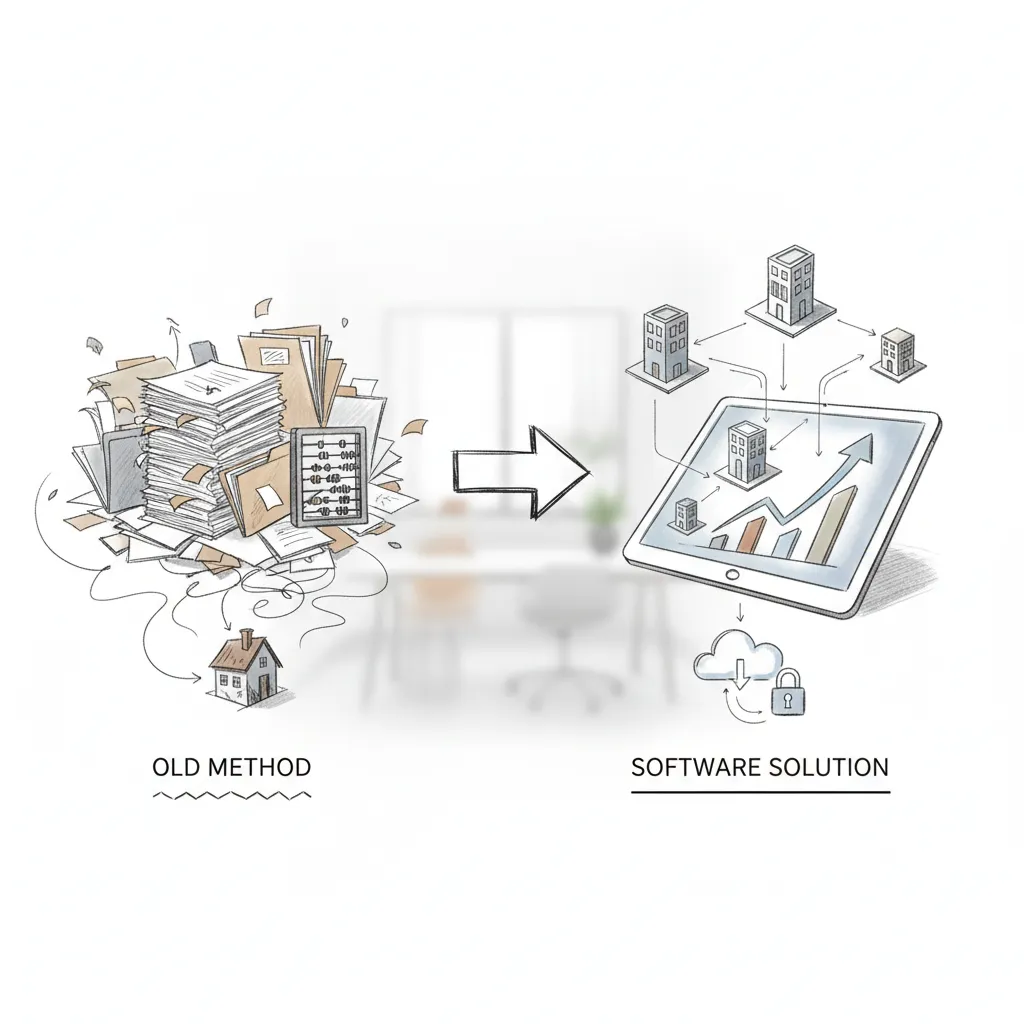
Real estate portfolio software aggregates property financials, occupancy data, lease terms, and asset valuations into one system, replacing disconnected files with a single source of truth.
The core workflow runs in three stages: data ingestion pulls from property records and connected accounting systems; automated engines calculate KPIs including NOI, cap rate, and cash-on-cash return; and reporting dashboards surface those metrics for decision-makers without manual compilation. The result is a live picture of portfolio performance, not a snapshot that's already stale.
Spreadsheet management breaks at scale. Manual entry introduces error rates that compound across assets, version control failures mean teams work from conflicting data, and scenario modeling across 50+ properties in Excel is functionally impossible. Real estate portfolio software eliminates all three problems by design.
According to industry analysts, the most critical features to evaluate when selecting a platform include:
Platform choice depends on portfolio size. Enterprise tools like MRI [2] and Yardi support portfolios of 500+ units with institutional-grade reporting, while platforms like Buildium target operators under 100 units. Most tools integrate directly with accounting systems, QuickBooks, NetSuite, Yardi, to eliminate double-entry and keep financial records synchronized.
"The shift from spreadsheet-based tracking to integrated portfolio software isn't just an efficiency gain — it's a fundamental change in how quickly operators can identify underperforming assets and act on that intelligence." — National Association of Realtors Research Division, NAR Research & Statistics
Automated KPI calculation means underperforming assets surface faster. When cap rate compression or occupancy decline triggers an alert automatically, operators can act on data rather than discover problems during quarterly reviews. That speed-to-insight gap is where returns are won or lost.
According to the Urban Institute's Metropolitan Housing and Communities Policy Center, data-driven asset management practices are increasingly linked to stronger portfolio performance outcomes, particularly for operators managing mixed-income and mixed-use properties at scale.
AppFolio Investment Management is built for residential and mixed-use portfolio operators running anywhere from 50 to 50,000+ units who need investor reporting without a finance team overhead.
The platform's investor portal delivers real-time waterfall distribution modeling and automates K-1 generation at tax time, two tasks that typically consume weeks of manual work per fund cycle. For general partners managing multiple LP relationships, that automation alone justifies the platform cost.
The differentiator AppFolio carries that MRI and Quickbase don't match natively: a built-in investor CRM that tracks LP communications, capital calls, and full distribution history in one view [1]. Operators don't need a separate CRM to manage investor relationships alongside portfolio financials.
Pricing starts at approximately $1.40/unit/month with a $280/month minimum, verify current rates directly on AppFolio's site, as pricing updates periodically. Implementation for portfolios under 1,000 units typically runs 60–90 days, making it one of the faster enterprise onboarding timelines in this category.
MRI Investment Management is purpose-built for commercial real estate, office, retail, industrial, and mixed-use portfolios, where institutional underwriting standards are non-negotiable.
Its core strength is advanced lease abstraction paired with ARGUS-compatible cash flow modeling [2], giving acquisition and asset management teams the underwriting depth that residential-focused platforms can't match. Institutional investors managing billions in AUM rely on MRI precisely because its outputs hold up under LP scrutiny.
"Institutional-grade real estate portfolio software must do more than track rents — it needs to model complex lease structures, integrate with capital markets data, and produce outputs that satisfy both internal asset managers and external LP auditors." — Dr. Peter Linneman, Professor Emeritus of Real Estate, Wharton School of the University of Pennsylvania
AppFolio wins on speed and simplicity for residential operators. MRI wins on depth and flexibility for commercial portfolios. The structural differentiator is MRI's open API architecture, which allows deep integration with third-party PropTech tools, a meaningful advantage over AppFolio's more closed ecosystem [2]. Teams can connect MRI to specialized valuations, market data feeds, or workplace analytics platforms without rebuilding core workflows.
Pricing is enterprise-negotiated with no public rate card. Average implementation for enterprise deployments with data migration from legacy systems like Yardi or RealPage runs 3–6 months, longer than AppFolio but expected given the data complexity involved. Learn more about MRI Software's real estate investment management capabilities.
Quickbase is a no-code application platform that corporate real estate teams configure for portfolio tracking, project pipelines, and lease management, without writing a line of code.
It is not a purpose-built real estate tool [3], which is both its limitation and its advantage. Teams build custom dashboards and automate workflows without IT involvement, cutting time-to-value for mid-market operators who can't wait six months for an enterprise implementation. A portfolio manager can have a working lease-expiration tracker live in days, not quarters.
The differentiator Quickbase holds over AppFolio and MRI: its workflow automation layer connects construction project milestones directly to portfolio financials [3]. Operators managing development-stage assets alongside stabilized properties can track both in one system, a gap neither purpose-built real estate platform bridges natively.
Pricing starts at $35/user/month on the Teams plan, which is cost-effective for smaller teams but scales with headcount. It fits best for corporate real estate teams managing a mix of owned, leased, and development-stage assets rather than pure residential or institutional commercial portfolios. Explore Quickbase's real estate portfolio software solutions for more detail on available configurations.
Yardi Voyager is the market-share leader for enterprise real estate portfolio software, used by REITs, institutional owners, and large property managers running portfolios of thousands of units. For more information, see 2nd Infantry Division Trailer Hitch Cover Official Licensed Indianhead.
The platform covers accounting, leasing, maintenance, and investor reporting in one system, eliminating the point-solution sprawl that plagues large operators. For a REIT managing 20,000 units across six states, consolidating those functions into a single platform removes the reconciliation overhead that separate tools create.
The differentiator no competitor in this list matches natively: Yardi's built-in energy and sustainability tracking module, Yardi Pulse, lets portfolio managers monitor ESG metrics alongside financial KPIs in the same dashboard. AppFolio, MRI, and Quickbase don't offer this natively, and with institutional LPs increasingly requiring ESG reporting, that gap matters.
According to the National Council of Real Estate Investment Fiduciaries (NCREIF), ESG reporting standards for institutional real estate portfolios are becoming a baseline expectation among pension fund and endowment investors, making integrated sustainability tracking a competitive necessity rather than a differentiator.
Implementation is the trade-off. A typical enterprise rollout runs 6–12 months with dedicated Yardi implementation consultants, and total cost of ownership lands in the six-figure annual range for most enterprise clients. For organizations managing assets at institutional scale, that investment is standard. For portfolios under 500 units, the cost and complexity will likely outweigh the benefit.
For corporate real estate teams whose priority is office utilization and hybrid workforce coordination rather than investor accounting, a platform like Upflex, which uses AI-powered attendance forecasting to identify underused space and support portfolio consolidation decisions, addresses a different but equally pressing cost problem: paying for square footage your employees aren't using.

Buildium is the go-to real estate portfolio software for independent landlords and small property management companies handling 1–5,000 residential units.
The platform covers the full operational stack, tenant screening, rent collection, maintenance requests, and owner reporting, without requiring separate tools or enterprise contracts. It's built for residential use only; commercial and institutional portfolios are outside its scope.
The Essential plan starts at $55/month for up to 150 units. The Growth plan at $174/month adds performance analytics for managers tracking portfolio-level metrics.
The clearest differentiator at this price tier is Buildium's resident center app, which drives 80%+ of rent payments online. That tenant-facing UX reduces manual collection overhead in a way AppFolio, MRI, and Quickbase don't prioritize at comparable price points.
Best for: Independent landlords and small property management companies scaling from single-family homes to small multifamily portfolios.
Juniper Square is purpose-built real estate portfolio software for fund managers, syndicators, and private equity firms, not general property managers.
The platform manages the full investor lifecycle: fundraising, subscription documents, capital calls, distributions, and tax document delivery. Teams running closed-end funds or opportunity zone vehicles get a single system for every stage of the GP-LP relationship.
The sharpest differentiator is Juniper Square's fundraising CRM, which tracks investor pipeline stages and automates accreditation verification. AppFolio, MRI, and Quickbase don't support that workflow natively, making Juniper Square the only option here built around capital formation, not just asset management.
Over 1,900 real estate investment firms use the platform, managing more than $1 trillion in investor capital, per Juniper Square's published figures.
Best for: GPs running closed-end funds, opportunity zone vehicles, or syndications with 10–500+ LPs.
RealPage Investment Management combines portfolio accounting, asset management, and market analytics in one platform, with particular depth in multifamily and affordable housing.
Its AI-driven revenue management module, formerly known as LRO, benchmarks rents against real-time market data to optimize pricing across the portfolio. That's the core financial benefit: fewer manual pricing decisions, more defensible rent positioning.
The differentiator that separates RealPage from every other tool on this list is its AIM (Asset and Investment Management) module, which draws on a proprietary market intelligence database covering 20M+ apartment units. No other platform offers external benchmarking at that scale alongside portfolio financials.
Pricing is enterprise-negotiated; RealPage typically bundles AIM with its property management modules rather than selling it as a standalone product.
Best for: Institutional multifamily owners and affordable housing operators who need market-rate benchmarking alongside portfolio-level financial reporting.
Upflex targets corporate real estate and workplace teams, not investment managers, helping companies right-size office footprints using real attendance data, not assumptions.
The platform's UnifyAI engine forecasts office attendance with 97% accuracy, giving CRE leaders the hard data they need to make lease consolidation and expansion decisions with confidence. That matters most when a major lease renewal is approaching and leadership is asking whether to downsize or exit a location entirely.
Clients report 40%+ reductions in real estate spend by replacing underutilized fixed leases with on-demand workspace from Upflex's network of 5,000+ locations globally. The cost case is direct: pay for space your teams actually use, not square footage that sits empty three days a week.
No other platform on this list combines portfolio analytics with an on-demand workspace marketplace. When teams shed fixed space, Upflex provides the flex supply to replace it, without switching tools or signing new leases.
Best for: Enterprise CRE teams managing hybrid workforces across multiple cities who need both portfolio visibility and flexible space supply in one platform.
The right platform depends on four variables: portfolio type, portfolio scale, team size, and the integrations your existing tech stack requires.
Start with portfolio type. Residential investors managing units need Buildium or AppFolio [1]. Fund managers and syndicators need Juniper Square. Institutional commercial owners need MRI [2] or Yardi. Corporate occupiers optimizing hybrid office footprints need a platform like Upflex. These categories don't overlap, choosing the wrong tier means paying for features you'll never use while missing the ones you need most.
A useful framework for narrowing your shortlist by portfolio type:
Pricing structures vary significantly across the market. Buildium starts at $55/month; Quickbase from $35/user/month [3]; AppFolio at roughly $1.40/unit/month. MRI, Yardi, and RealPage operate on enterprise contracts, pricing is negotiated based on module count, unit volume, and support tier. Budget 3–6 months for procurement on any enterprise platform.
SMB tools like Buildium and Quickbase [3] deploy in days to weeks with minimal IT involvement. Enterprise platforms, MRI, Yardi, RealPage, typically require 3–12 months, dedicated migration planning, and parallel-run periods before go-live.
Data migration is the most common delay. Legacy exports from Excel, older Yardi versions, or RealPage often require field mapping and deduplication before any data moves. Before signing any contract, confirm native connectors or open API support for QuickBooks, NetSuite, Salesforce, and ARGUS, gaps there create integration projects that outlast the implementation itself.
Most enterprise teams see a 20–40% reduction in real estate operating costs within 12–18 months of deployment. The gains come from three sources: eliminating underutilized space, reducing manual reporting hours, and making lease decisions with actual utilization data rather than estimates. Platforms like Upflex document 40%+ reductions in real estate spend by pairing AI-driven attendance forecasting with portfolio consolidation recommendations, giving finance leaders a defensible number to bring to the CFO.
Most platforms connect to accounting systems via API or pre-built connectors that sync lease obligations, operating expenses, and asset valuations automatically. MRI Software [2], for example, maps client trial balances to a single chart of accounts, cutting report creation from three weeks to under two hours. Before purchasing, confirm whether the integration is native or requires a middleware tool, the latter adds implementation time and ongoing maintenance cost.
Inconsistent data formats, duplicate asset records, and missing historical lease terms are the three most common blockers. Legacy IWMS platforms like Archibus store data in proprietary schemas that don't export cleanly to modern SaaS tools. Budget for a dedicated data-cleaning phase before go-live, teams that skip it typically spend the first 90 days post-launch correcting records rather than acting on insights. A phased migration by portfolio region reduces risk.
The 7% rule, targeting properties priced at roughly 7% of their gross annual rent, requires accurate, current income and valuation data across every asset. Portfolio software centralizes that data, flags assets where the ratio has drifted, and surfaces underperforming properties for disposition or renegotiation. Without a single source of truth, applying the rule manually across a multi-asset portfolio produces errors that compound at scale.
Real estate portfolio software is available at every scale. Platforms like Buildium start at $55/month and are designed specifically for independent landlords managing 1–150 units, covering rent collection, maintenance, and owner reporting without enterprise complexity. As portfolios grow beyond 500 units or add LP investors, operators typically graduate to AppFolio or Juniper Square. The key is matching platform depth to your current portfolio size and projected growth over the next 24 months.
The right this approach closes the gap between what you're paying for space and what you're actually using. Three things matter most when choosing: AI-driven forecasting that predicts utilization before you commit to a lease decision, accounting integrations that eliminate manual reconciliation, and a data migration plan that doesn't derail the first quarter post-launch.
If your portfolio includes hybrid teams spread across multiple offices, audit your current attendance data first. If it's coming from badge readers and spreadsheets, you're making six-figure decisions on unreliable inputs. Request a demo from Upflex specifically to see how its UnifyAI engine forecasts attendance at 97% accuracy, and what that number does to your next lease renewal conversation.
Explore more from our content library: