Share This Article
No items found.

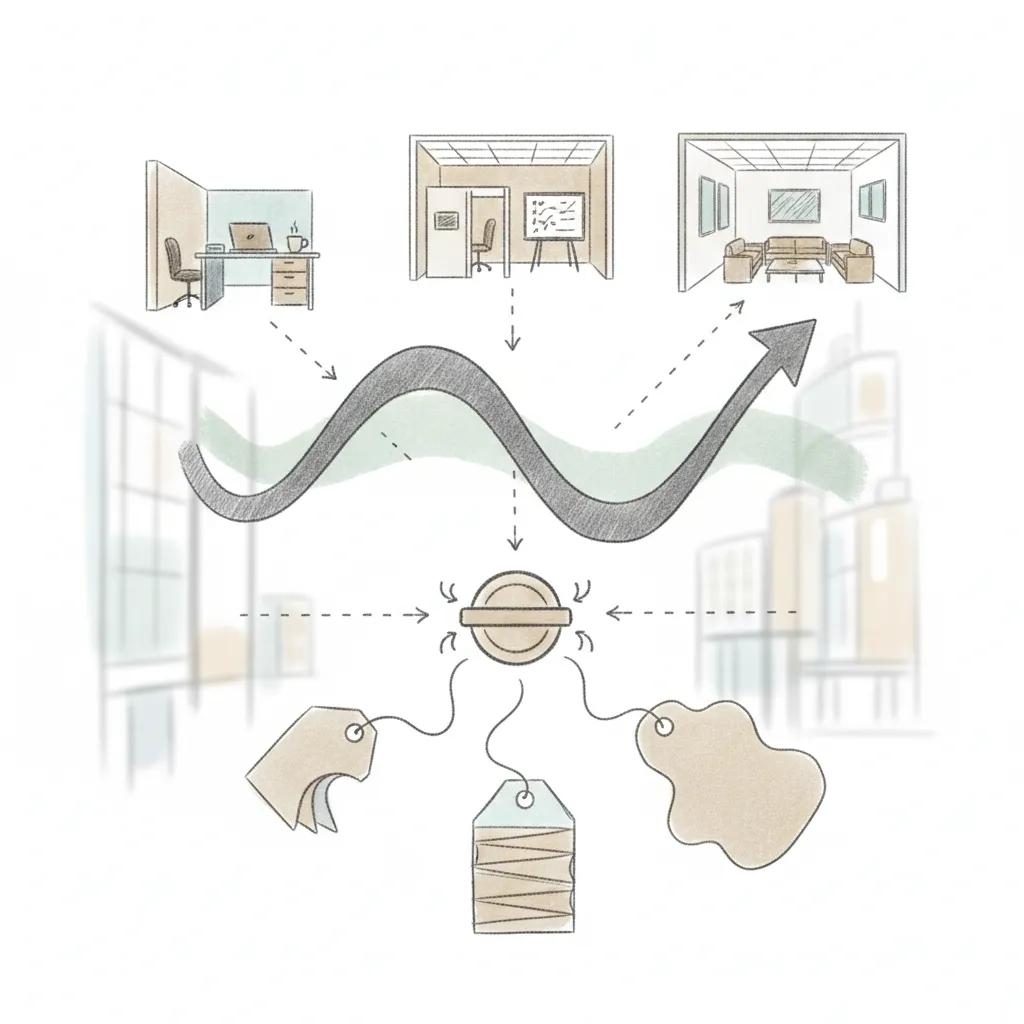
Flexible office space pricing typically ranges from $10–$50 per hour, $25–$150 per day, or $300–$2,500+ per month per desk, depending on location, amenities tier, and contract length. Unlike traditional leases that lock you into 3–10 year commitments with full build-out costs, flexible spaces bundle utilities, internet, and furniture into one quoted price, though setup fees, meeting room credits, and overage charges can add 15–30% to your base rate.
Flexible office space covers any workspace available on short notice or short terms, coworking desks, private offices, day offices, and team suites, priced without a multi-year lease. This is particularly relevant for flexible office space pricing.
Traditional commercial leases typically run 3–10 years and charge base rent separately from taxes, insurance, and maintenance (the NNN costs that can add 20–40% on top of headline rent). The all-in pricing model for flexible workspaces bundles all of that into a single monthly or daily rate, which makes budgeting more predictable and eliminates the build-out capital a conventional lease demands on day one. According to the U.S. General Services Administration, federal agencies increasingly use flexible workspace arrangements to reduce long-term real estate commitments and overhead costs.
Price ranges vary significantly by format. Hot desks, unassigned seats in a shared area, run $150–$500 per month. Dedicated desks with a fixed seat and lockable storage run $300–$800 per month. Private offices start around $700 per desk per month and can exceed $2,500 in markets like New York City, San Francisco, and London, where demand consistently pushes rates to the top of those ranges. For example, you can explore private office space for rent in NYC through Deskpass to compare current market rates across Manhattan and Brooklyn neighborhoods.
Space planning affects cost directly. The industry benchmark for private office density is roughly 100 sq ft per person. A 5-person team typically occupies 400–600 sq ft in a flexible office environment, a footprint that maps to mid-tier private suite pricing in most major cities.
"The shift toward flexible workspace is not just a trend — it's a structural change in how organizations think about real estate. Companies that right-size their space commitments to actual utilization consistently outperform those carrying excess fixed capacity." — Dr. Julie Whelan, Global Head of Occupier Research at CBRE
Base-tier flexible office pricing almost always covers high-speed internet, daily cleaning, reception services, and kitchen access. These inclusions are what separate the all-in flexible office rate from a traditional lease, where each line item arrives as a separate invoice.
Premium tiers add phone booths for private calls, access to event or conference space, and dedicated IT support, amenities that matter to teams running client-facing operations or frequent video calls. Meeting room access is often credit-based at the base tier, meaning heavy users pay overages once they exceed their monthly allocation.
Understanding exactly which amenities sit inside your quoted rate, and which trigger additional charges, is the first step to comparing workspace costs accurately across providers. The following amenities are commonly included at each tier: When considering flexible office space pricing, this point stands out.
Flexible office space typically costs 30–60% less than a traditional lease for teams under 15–20 people once fit-out, NNN charges, and capital outlay are factored in.
Traditional office leases in major U.S. cities average $60–$100 per square foot per year in base rent, and that's before you add fit-out costs of $80–$150 per square foot as a one-time capital expense, plus triple-net charges for taxes, insurance, and maintenance. Workspace rates for flexible offices, by contrast, bundle most of those costs into a single monthly rate, typically $1,500–$3,000 per desk per month for a private office in a major market.
For teams under 15–20 people, coworking and flexible private offices almost always win on total cost when you amortize fit-out over the lease term. A 5-year traditional lease with $100/sq ft fit-out adds roughly $20/sq ft/year to your effective occupancy cost before you pay a single month's rent.
The math flips for larger, stable headcounts on 5-year-plus leases. Once a team exceeds 20–25 people and occupancy is predictable, the per-square-foot rate on a direct lease can drop below what flexible operators charge. Most cost analyses put the break-even at 18–24 months of continuous occupancy, below that threshold, flexible space wins on total cost; above it, a traditional lease can be cheaper per square foot.
A 1,000 sq ft traditional office runs $60,000–$100,000 per year in base rent alone, with no furniture, no build-out, and no utilities included. An equivalent flexible private office for the same footprint runs $18,000–$36,000 per year, all-in, with zero capital outlay.
That gap is why companies using on-demand workspace networks report 40%+ reductions in real estate spend. Upflex clients, for example, achieve those savings by replacing underutilized permanent space with flexible access, paying only for the capacity their teams actually use, rather than carrying fixed square footage through low-attendance periods. For those exploring flexible office space pricing, this matters.
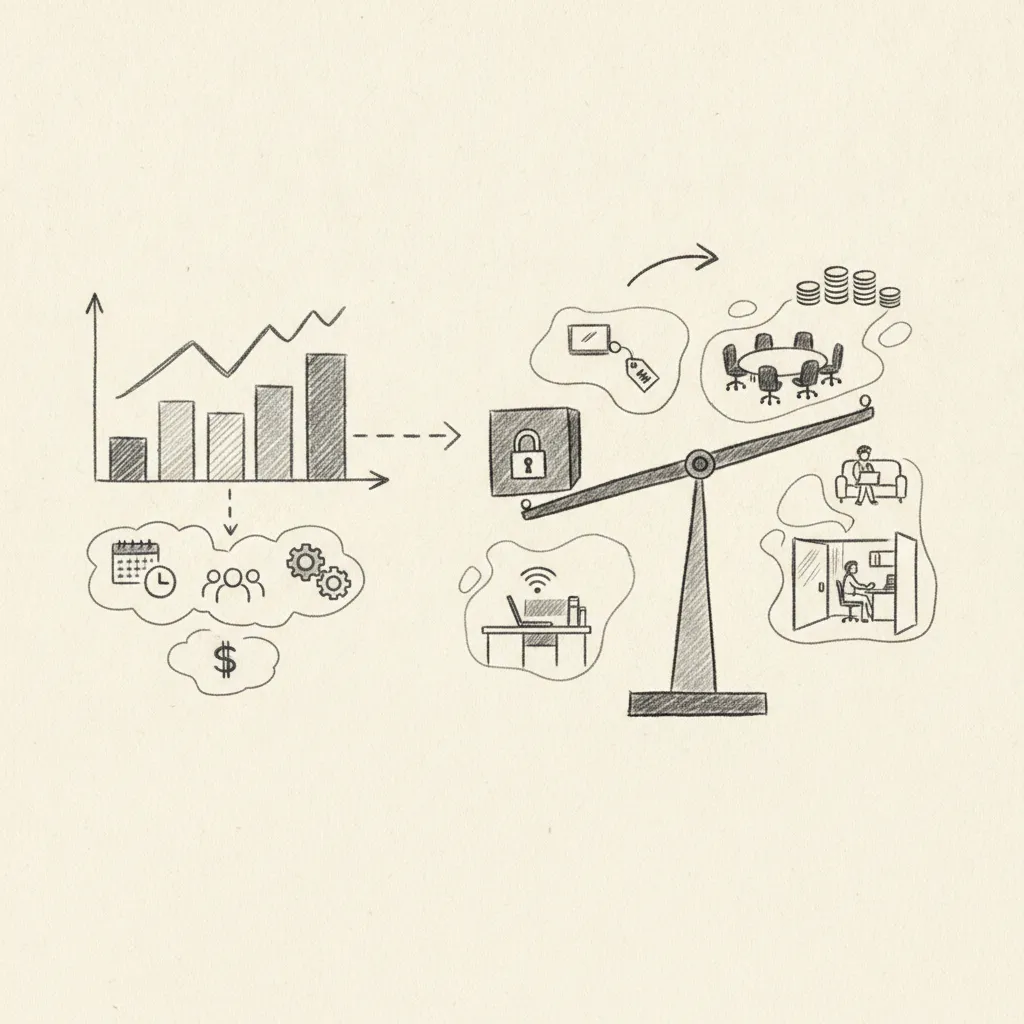
Workspace cost structures break into five main contract formats — hourly, daily, monthly, annual, and credit-based — each with distinct cost trade-offs depending on how often your team uses the space.
"Hybrid work has fundamentally changed the calculus of office leasing. The organizations winning on real estate costs are those treating workspace as a variable expense rather than a fixed overhead line." — Peter Miscovich, Managing Director of Strategy and Innovation at JLL
Hourly rates run $10–$50 per hour for day offices or meeting rooms. They suit occasional use well, but the math turns punishing fast. A team member paying $30/hour for eight hours a day, five days a week, spends $62,400 per year, versus roughly $18,000 on a monthly desk plan covering the same access.
Daily passes cost $25–$150 per day for hot desks or drop-in private offices. Most coworking networks sell these in bundles of 5 or 10 at a 10–20% discount, which makes them a practical middle ground for employees who come in two or three days a week.
Monthly rolling contracts are the most common entry point, priced at $300–$2,500+ per desk per month. You keep full flexibility to exit, but expect to pay a 10–20% premium over equivalent annual rates for that optionality.
Here is a quick-reference summary of typical rate ranges by contract type:
Committing to a 12-month term typically saves 15–25% compared to month-to-month pricing. Enterprise agreements covering 20 or more desks, or multi-location access across a portfolio, can push discounts to 30–40%, often with dedicated account management included. This directly impacts flexible office space pricing outcomes.
A separate model worth understanding is the membership or workspace credit system. Platforms like Upflex let companies buy blocks of credits redeemable across hundreds of global locations. For hybrid teams with distributed headcount and variable attendance patterns, this delivers the best cost-per-use, you pay for actual occupancy rather than reserved capacity that sits empty on low-attendance days. Operators such as Spaces offer both monthly and annual membership structures across multiple U.S. markets, making it straightforward to compare commitment tiers side by side.
The headline rate for flexible workspace rarely reflects the true total — setup fees, meeting room overages, and excluded services routinely add $500–$1,500/month to quoted costs.
Many providers charge a one-time activation or onboarding fee of $100–$500 that never appears in the monthly rate card. You only see it on the first invoice.
Meeting room access is the most common budget trap. Most plans bundle 4–10 hours of meeting room time per month. Overage rates run $15–$75 per hour, and a team running two weekly all-hands meetings can exhaust that allowance within the first week, generating $300–$600 in monthly overages alone.
Dedicated phone lines, mail handling, printing beyond a set page limit, IT support beyond basic Wi-Fi, and after-hours building access are all typically excluded. These add-ons routinely total $50–$200/month per member, depending on the provider and location.
Parking, storage, and guest passes rarely appear in base quotes. In New York City or San Francisco, monthly parking runs $300–$600 per car, enough to erase the cost advantage over a suburban traditional lease before you factor in anything else. This is particularly relevant for flexible office space pricing.
Yes. Day offices in major central business districts can cost 20–40% more during the 9am–12pm prime window. Some operators apply dynamic pricing that mirrors hotel revenue management, the same desk or office carries a different rate depending on the day and hour you book it.
When comparing providers, request an itemized cost breakdown that covers all fees, not just the monthly membership rate. The true total cost of flexible office space is what matters for a fair comparison. According to research published by the Urban Institute, commercial real estate cost transparency remains one of the most significant barriers to informed decision-making for small and mid-sized businesses evaluating workspace options.
Flexible office space delivers 25–40% net savings over traditional leases when your team occupies less than 70% of your leased capacity, but only if you account for every cost variable.
The core ROI formula is straightforward: subtract your total flexible space cost (including all fees and overages) from the combined cost of a traditional lease, fit-out, and facilities overhead, then divide the result by your flexible space cost. The output tells you your net savings rate. Most corporate real estate teams that run this calculation honestly, including NNN charges and fit-out amortization, find the gap is larger than they expected.
"When organizations honestly account for fit-out amortization, NNN charges, and underutilized square footage, the financial case for flexible workspace becomes difficult to argue against — especially for teams under 25 people." — Kate Lister, President of Global Workplace Analytics
Fully remote costs $0 in office rent, but the hidden costs add up fast. Home office stipends, productivity tools, and team offsites typically run $1,500–$3,000 per employee per year. That figure doesn't include the productivity drag from teams that lack a dedicated space to collaborate in-person when it matters.
On-demand flexible office space fills that collaboration gap at a fraction of a permanent lease. You pay only for the days your team actually uses, which makes it a practical middle path between a fixed lease and a fully distributed model. The Society for Human Resource Management (SHRM) notes that access to professional workspace on demand is increasingly cited as a key factor in employee satisfaction and retention for hybrid workforces. When considering flexible office space pricing, this point stands out.
Workspace costs move on three variables beyond location and headcount. Amenities tier, basic versus premium, adds 20–35% to monthly cost. Contract length matters too: month-to-month access runs 15–25% more than an annual commitment. Network breadth is the third lever; single-location access limits value for distributed teams, while multi-city access lets employees work near clients or home without triggering a new lease.
To build a reliable comparison, follow these steps: audit actual days-in-office per employee per month, multiply by the daily flexible rate, add meeting room and amenity overages, then compare the total against your pro-rated traditional lease cost including all NNN charges and fit-out amortization.
Attendance forecasting is where this calculation gets precise. Teams that know, with 90%+ accuracy, which days employees will come in can right-size their flexible space commitment and stop paying for unused capacity. Upflex's UnifyAI engine delivers 97% attendance forecast accuracy, which means your cost model is built on real utilization data rather than assumptions that inflate your commitment. The Global Coworking Unconference Conference (GCUC) reports that operators who provide detailed utilization data to enterprise clients see significantly higher contract renewal rates, underscoring the value of data-driven space decisions.
100 sq ft is sufficient for a single-person private office, but tight for two or more people. Most coworking providers size private offices for one occupant at 80–120 sq ft, with team suites starting around 200–250 sq ft. If you need regular video calls or client meetings, budget for a larger suite or book a dedicated meeting room separately to avoid the space feeling cramped during calls.
Yes, most providers will negotiate, especially on longer commitments or multi-location bookings. Coworking operators typically have 10–20% flexibility on listed rates for teams committing to three months or more. Enterprise buyers with multi-city requirements have the most leverage: bundling locations, prepaying credits, or signing an annual agreement instead of month-to-month can each reduce the effective per-desk cost. Always ask for a volume discount before signing.
Enterprise teams pay on a per-seat or credit-bundle model negotiated centrally, while individual users typically pay per day or per visit at published rates. Enterprise agreements usually include centralized billing, usage reporting, and access across multiple locations, features that don't exist on individual plans. Platforms like Upflex are built specifically for this enterprise layer, giving corporate real estate teams a single contract that covers a global workspace network rather than requiring employees to expense individual bookings. For those exploring flexible office space pricing, this matters.
Day passes at coworking spaces in secondary neighborhoods, away from prime CBD locations, consistently offer the lowest per-day cost, often $15–$30 compared to $50–$75 in central business districts. Hot-desk memberships are the next step up, cutting the per-day rate by 30–40% versus walk-in pricing. For teams, a credit-based corporate plan that lets employees book across multiple operators typically delivers the lowest blended cost per seat when utilization is tracked and managed centrally.
Location is one of the strongest pricing drivers in the flexible workspace market. Tier-1 cities like New York, San Francisco, and Chicago command the highest rates, with private offices often exceeding $2,000–$2,500 per desk per month. Tier-2 markets such as Austin, Denver, and Nashville typically run 30–50% lower for comparable space and amenities. Even within a single city, neighborhood matters: a private office in Midtown Manhattan can cost twice as much as an equivalent space in Brooklyn or Long Island City, making location flexibility a meaningful cost lever for hybrid teams.
The rates and structures covered in this guide reward buyers who understand what they're actually paying for. The model, whether day pass, hot desk, private office, or enterprise credit bundle, should match how often your team uses space, not how much space feels safe to reserve.
Three things to act on: audit your current office utilization before signing any flexible agreement; compare the all-in cost per seat (including amenities and access fees) across at least three providers; and if you manage a distributed team, consolidate bookings under a single corporate plan to capture volume pricing.
If your organization is evaluating whether to reduce its fixed real estate footprint, request an Upflex portfolio analysis, it maps your current spend against projected costs under a hybrid model, with attendance data to back the decision.
Explore more from our content library: