Share This Article
No items found.

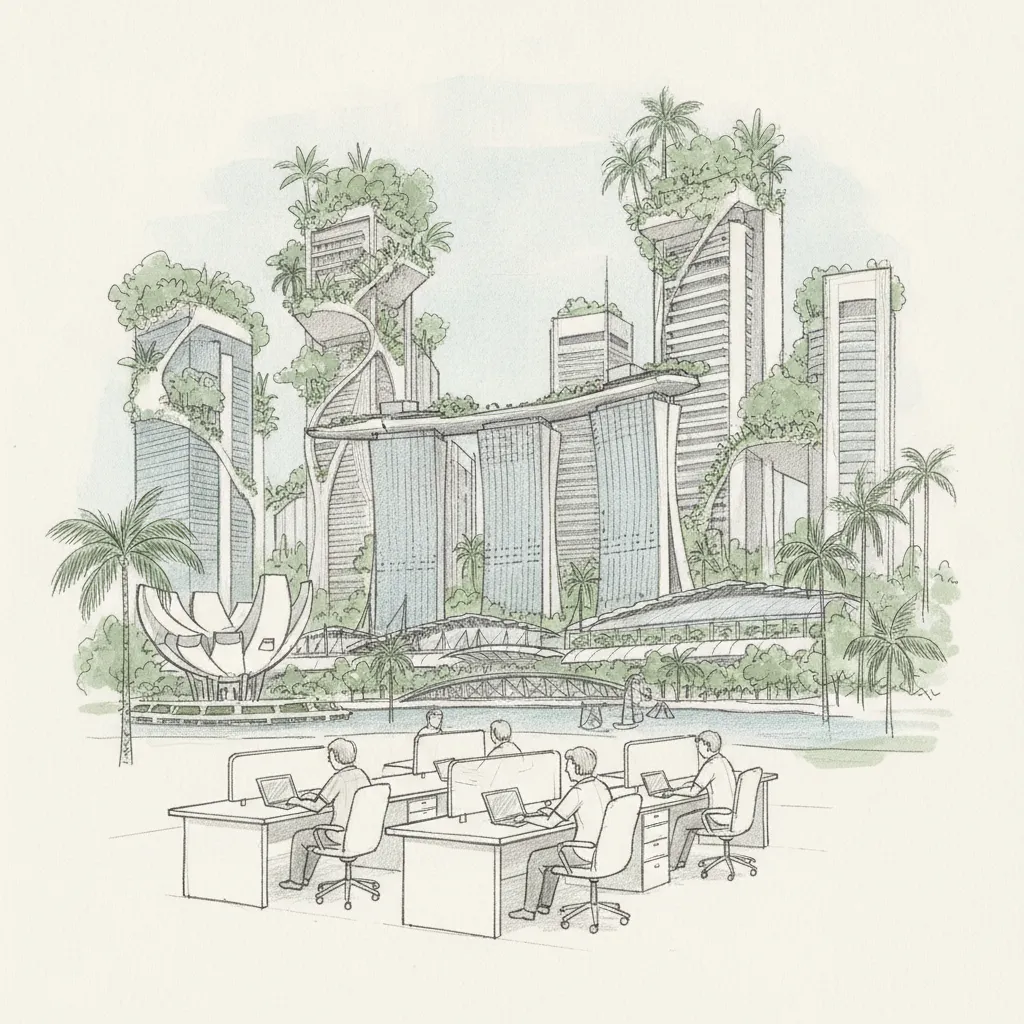
Office space in Singapore typically costs SGD 8–15 per sq ft per month in the CBD, and SGD 4–8 per sq ft in non-CBD districts like Jurong or Paya Lebar. Coworking desks start around SGD 400–800/month, while private serviced offices run SGD 1,200–3,500/month depending on size and location. Lease terms range from flexible month-to-month arrangements to traditional 3-year leases, each with distinct cost structures and exit penalties you need to understand before signing.
Singapore offers four main office formats, traditional leases, serviced offices, coworking spaces, and on-demand networks, each suited to a different headcount and cash-flow profile. According to the Urban Redevelopment Authority (URA), Singapore's commercial property market is actively monitored to ensure sustainable supply across all districts, making it one of the most transparent office markets in Asia.
Traditional leased offices run on 2–3 year terms, with the tenant responsible for full fit-out costs. That upfront capital commitment makes them practical only when your headcount exceeds 50 and you can project space needs 24–36 months out with confidence.
Serviced offices remove the fit-out burden entirely. All-inclusive private offices in Singapore typically price between SGD 1,200 and SGD 3,500 per month, with flexible exit clauses built into the contract. You pay a premium for that flexibility, but you avoid the capital outlay of a raw shell fit-out, which can run SGD 80–120 per sq ft in the CBD.
Coworking spaces split into two products with meaningfully different price points. A hot desk, no guaranteed seat, first-come-first-served, starts around SGD 400/month. A dedicated desk, which reserves a fixed workstation (typically 4–6 sq ft of personal space) for your exclusive use, starts around SGD 650/month. The SGD 250/month gap buys you a locked drawer, a consistent monitor setup, and a seat that's yours when you walk in.
On-demand workspace networks, such as Upflex, take a pay-per-use model across multiple Singapore locations. Teams book space only on the days they need it, no fixed monthly commitment, no minimum headcount. For hybrid teams where daily attendance fluctuates, this format eliminates the cost of paying for desks that sit empty three days a week.
When evaluating which format suits your business, consider these key factors:
Monthly contracts for office space in Singapore carry a 15–25% price premium over equivalent 12-month commitments. That surcharge is the market's price for optionality, you can exit without penalty, scale up or down each month, and avoid locking capital into space you may not need in six months.
A 12-month lease reduces your per-desk cost but introduces a fixed liability. If your headcount drops or you restructure your hybrid policy mid-term, you're still paying for every desk in the agreement.
Breaking a traditional office lease in Singapore before the end of term typically triggers an early termination penalty equal to 3–6 months' rent. On a 2,000 sq ft CBD office at SGD 12/sq ft/month, that's SGD 72,000–144,000 in exit costs, a material line item for any finance leader's scenario planning.
Serviced office contracts and coworking memberships usually carry shorter notice periods of 30–90 days, with no penalty beyond the notice window. Before signing any agreement, confirm whether the exit clause is a notice period, a buyout formula, or both.
Office space in Singapore ranges from SGD 4 to SGD 15 per sq ft per month, depending on district, a gap that translates to six-figure annual savings for mid-sized teams.
Grade A offices in the CBD, particularly Marina Bay Financial Centre and Raffles Place, command SGD 10–15 psf/month, the highest rates on the island. These addresses carry prestige and density of financial services clients, but the cost is substantial for any team occupying more than 1,500 sq ft.
Step back to the city fringe and the numbers shift immediately. Orchard and Novena offices run SGD 7–10 psf/month, roughly 10–15% below CBD rates, while remaining on the North-South MRT Line with direct access to the core. For professional services firms that need a credible address without a Marina Bay price tag, this tier is worth serious consideration. For more information, see Studiodentistico-oberti.
Decentralized hubs cut costs further. Jurong East averages SGD 4–6 psf/month; Paya Lebar sits at SGD 5–7 psf/month. The one-north and Buona Vista cluster, favored by tech and biomedical companies for its proximity to A*STAR and NUS research facilities, runs SGD 5–8 psf/month. A 2,000 sq ft office relocated from Marina Bay to Paya Lebar saves SGD 60,000–120,000 per year at current market rates.
"Decentralised office hubs in Singapore are no longer a compromise — they are a strategic choice. Businesses that relocate to nodes like Paya Lebar or Jurong East benefit from lower occupancy costs, improved staff commute times for west- and east-side residents, and access to a growing ecosystem of amenities that rival the CBD." — Dr. Lim Wei Seong, Senior Research Fellow, Institute of Real Estate and Urban Studies (IREUS), National University of Singapore
| District | Typical Rate (psf/month) | Best For |
|---|---|---|
| Marina Bay / Raffles Place | SGD 10–15 | Financial services, headquarters |
| Tanjong Pagar | SGD 9–13 | Legal, professional services |
| Orchard / Novena | SGD 7–10 | Retail-adjacent, regional offices |
| Paya Lebar | SGD 5–7 | Back-office, ops teams |
| Jurong East | SGD 4–6 | Cost-sensitive, west-side workforce |
| one-north / Buona Vista | SGD 5–8 | Tech, biomedical, R&D |
Jurong East and Paya Lebar both sit within 20–30 minutes of Raffles Place MRT by train, a manageable commute that makes the cost savings easier to justify to employees. one-north connects via the Circle Line to Dhoby Ghaut in under 25 minutes. Orchard and Novena are 10–15 minutes from the CBD on the North-South Line, which runs at high frequency during peak hours.
For teams with employees distributed across Singapore, MRT proximity matters as much as the office address itself. A decentralized location that sits directly on a major interchange, Paya Lebar is served by both the East-West and Circle Lines, can outperform a fringe CBD address on actual door-to-desk commute time. The Land Transport Authority (LTA) publishes real-time MRT network maps and planned expansion routes, which are worth consulting when evaluating long-term accessibility for any office location you are considering.
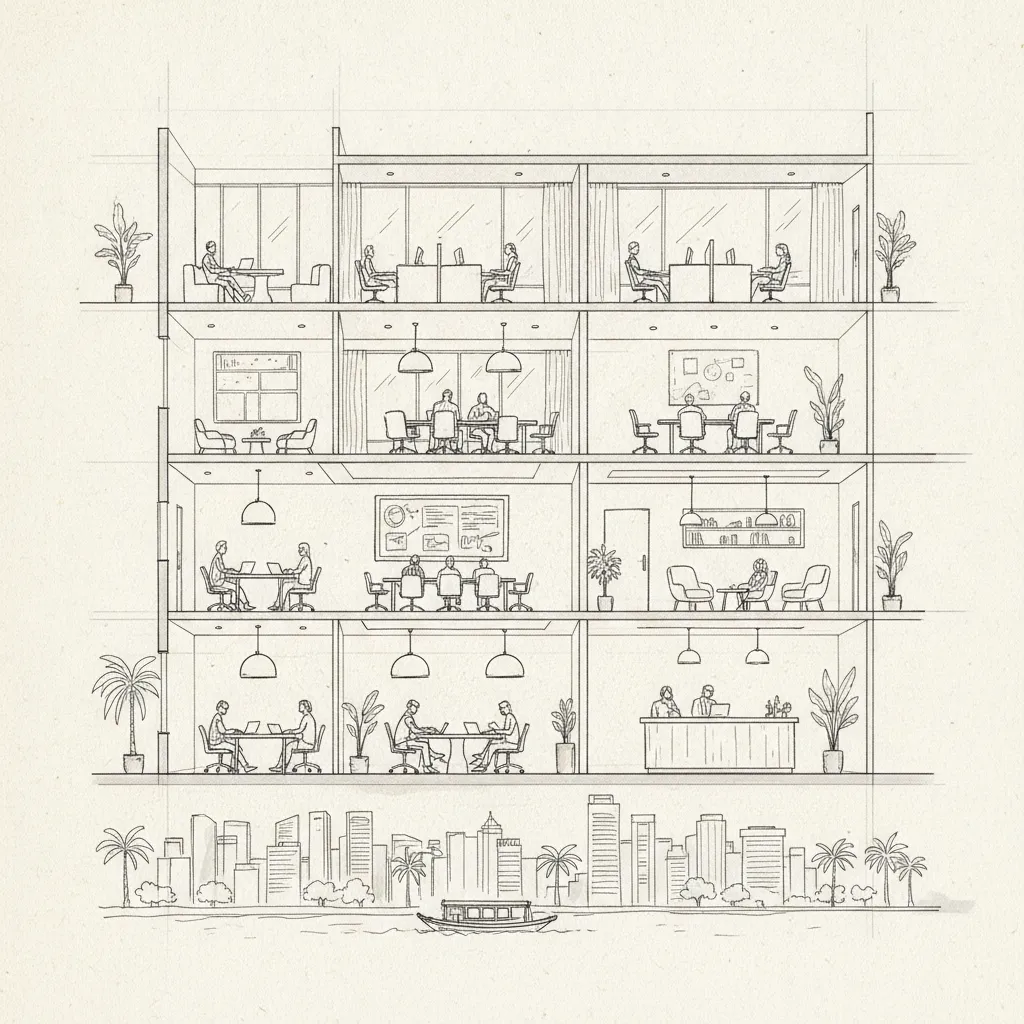
Size your office space in Singapore to peak daily occupancy, not headcount, then add 25% for support areas to avoid both over-leasing and under-leasing.
Conventional offices in Singapore typically allocate 100–150 sq ft per person, covering the desk, circulation space, and a share of common areas. Coworking environments run leaner, at 50–80 sq ft per workstation, because operators share amenities across multiple tenants.
Raw desk count alone understates your true requirement. Breakout zones, meeting rooms, and reception add 20–30% on top of the desk footprint, so build that buffer in before you approach any landlord or operator.
Use this formula to arrive at a defensible number:
(Peak daily headcount × sq ft per person) × 1.25 = recommended total sq ft
A team of 20 people in on peak days, at 100 sq ft each, needs (20 × 100) × 1.25 = 2,500 sq ft, not 3,000 sq ft for 30 full-time desks.
If 60% of your team comes in on peak days, size for 60–70% of total headcount. A 30-person team needs space for 18–21 desks, not 30, that single adjustment can cut your monthly rent by thousands of dollars.
The numbers bear this out in practice. A 25-person hybrid team in Tanjong Pagar leased 1,800 sq ft at SGD 9 per sq ft, SGD 16,200 per month, instead of a full 2,500 sq ft traditional layout that would have cost SGD 24,000 per month. The SGD 7,800 monthly saving required only an accurate occupancy estimate and a willingness to right-size before signing.
Attendance forecasting tools, Upflex's UnifyAI engine predicts office attendance with 97% accuracy, give you the peak-day data to make that estimate defensible to a CFO, not just a gut feel.
"The single biggest driver of wasted real estate spend in Singapore is the gap between the headcount on a lease agreement and the people who actually show up. Organisations that measure peak daily attendance before signing — rather than after — consistently secure better value from their office commitments." — Sarah Tan, Director of Corporate Real Estate Advisory, JLL Singapore
The most costly mistakes when renting office space in Singapore come from underestimating total occupancy costs and signing lease terms you haven't fully pressure-tested.
Base rent is only part of what you'll pay. The most frequently overlooked costs include:
Combined, these line items can push your actual monthly outlay 20–35% above the headline rent figure your landlord quoted. Build this into your cash flow plan before you sign anything.
Early termination is equally expensive if you haven't negotiated ahead of time. Standard penalty clauses equal 3–6 months' remaining rent. Push for a diplomatic clause, the right to exit with 3 months' notice after month 12, during lease negotiation, not after.
Bare shell leases carry a hidden price tag that many tenants discover too late. Fit-out costs run SGD 50–120 psf, meaning a 2,000 sq ft bare shell space can cost SGD 100,000–240,000 to make move-in ready, before you've paid a single month's rent.
Stamp duty is another overlooked liability. Singapore's Additional Conveyance Duties apply to certain commercial leases, and the exposure varies by transaction structure. Confirm your liability with a qualified lawyer before execution, not after the lease is stamped. The Inland Revenue Authority of Singapore (IRAS) provides detailed guidance on stamp duty obligations for commercial leases, including an online calculator to estimate your exposure before you commit.
Teams managing distributed employees across multiple locations often find that holding large fixed leases amplifies these cost risks. Platforms like Upflex help corporate real estate leaders track actual space utilization against committed square footage, so you can right-size your lease commitment with data rather than guesswork, and avoid locking into more space than your hybrid team will actually use.
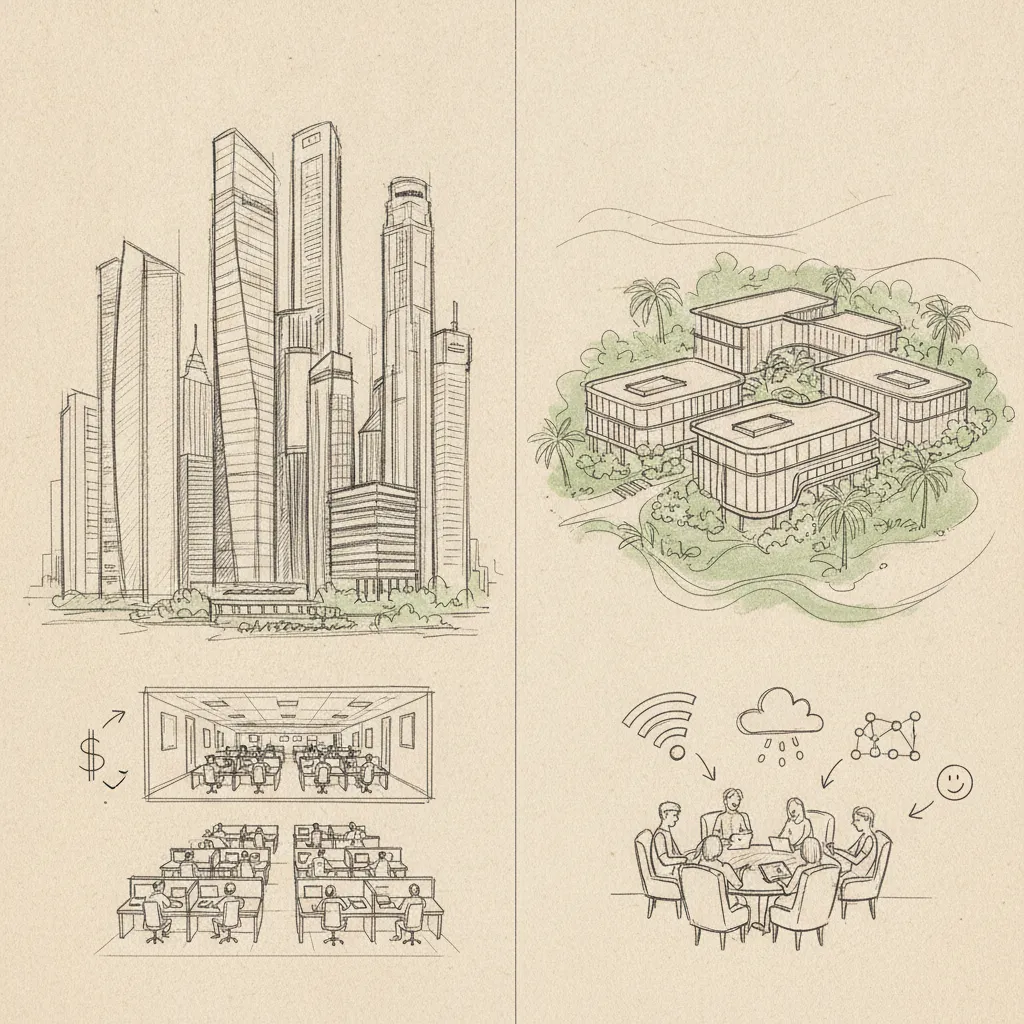
Marina Bay Financial Centre and One Raffles Quay command the highest rents in Singapore, typically SGD 14–18 per square foot per month. These buildings sit within the Marina Bay district, Singapore's premier Grade A financial hub, and attract global banks, law firms, and asset managers that need prestigious addresses close to the Monetary Authority of Singapore. Limited supply of waterfront Grade A stock, combined with consistently high demand from financial services tenants, keeps rents at the top of the market.
Yes, a foreign company can rent office space in Singapore, but most landlords require a locally incorporated entity or a registered branch office before signing a lease. The Accounting and Corporate Regulatory Authority (ACRA) handles incorporation, which typically takes one to three business days. Without a local entity, a serviced office or coworking membership is the fastest route to a legal Singapore address while the incorporation process runs in parallel.
A coworking membership costs less upfront, typically SGD 300–600 per desk per month, but offers shared, open-plan space with limited privacy. A serviced office gives a small team a dedicated, lockable room with furniture, internet, and reception included, usually from SGD 800–1,500 per desk per month depending on location. For teams handling confidential client work or needing a consistent meeting environment, the serviced office premium is usually worth it. For solo workers or teams of two, a coworking hot-desk plan is the more cost-efficient choice.
Service charges in Singapore Grade A buildings typically run SGD 1.00–1.50 per square foot per month, on top of base rent. The charge covers building maintenance, security, common-area cleaning, air-conditioning during standard business hours (usually 8 a.m. to 6 p.m. on weekdays), and lift operations. Air-conditioning outside standard hours is billed separately as overtime air-con, so factor that cost in if your team regularly works late or on weekends.
Most coworking operators and serviced office providers in Singapore offer a registered business address service as part of their membership packages, or as a standalone add-on. You can use this address for ACRA registration and official correspondence. Confirm with your provider that the address is approved for business registration purposes, as some hot-desk-only memberships do not include this entitlement. Virtual office plans, typically SGD 50–150 per month, are the most cost-efficient option if you only need a mailing address without physical desk access.
Securing the right office space in Singapore comes down to three decisions: choosing the correct district for your business type, selecting a lease structure that matches your growth timeline, and building in flexibility for headcount changes you cannot yet predict. Grade A space in the CBD suits client-facing financial and legal teams; Jurong and one-north deliver better value for tech and R&D operations.
Once you have space, the harder problem is using it efficiently. Hybrid teams routinely occupy 30–50% of the desks they pay for. Upflex's UnifyAI engine forecasts attendance with 97% accuracy, so you can right-size your Singapore footprint before the next lease renewal rather than after.
As a concrete next step, pull your last six months of badge or booking data and calculate your actual peak occupancy, that single number will tell you whether your current square footage is right-sized or overcommitted.
Explore more from our content library: