Share This Article
No items found.


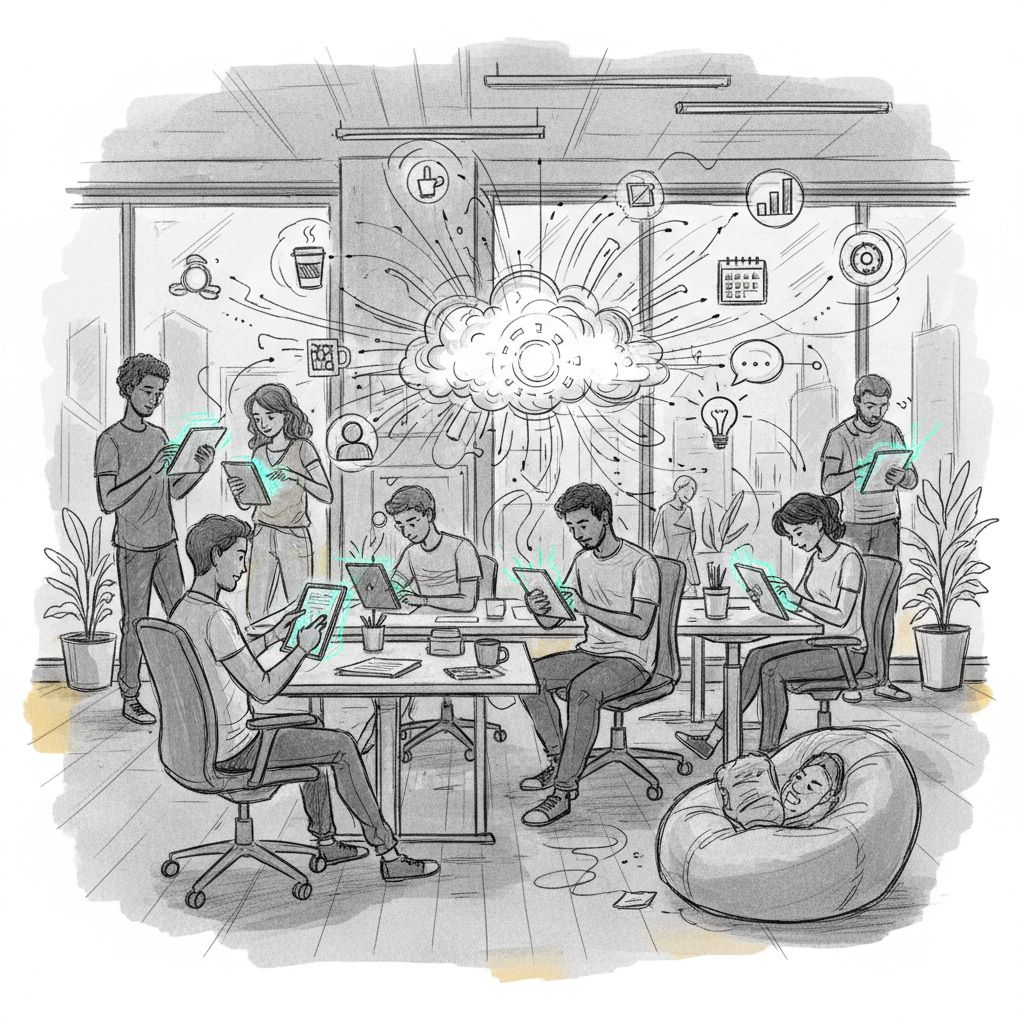
Workplace flexibility refers to arrangements that give employees control over when, where, or how much they work, including remote work, flexible hours, compressed schedules, and job sharing. It benefits both sides of the employment relationship: employees report higher job satisfaction and lower burnout, while employers see measurable gains in retention and productivity. A 2023 Gallup study found that 51% of employees would switch jobs for greater workplace flexibility, making it one of the most decisive factors in talent competition today.

Workplace flexibility is a spectrum of employer-employee agreements that govern when, where, and how much work happens, not a single policy or perk.
Each dimension operates independently. A company can offer location flexibility (remote work) without offering schedule flexibility (flextime), or vice versa. Understanding the distinctions matters because the right arrangement depends on the role, the team, and the business model.
No, and conflating the two leads to real policy confusion. A compressed workweek means the same contracted hours (typically 40) packed into four days instead of five. Flextime means employees vary their daily start and end times, often within a core-hours window set by the employer.
The distinction matters for payroll, labor law compliance, and employee expectations. Offering a "4-day week" without specifying whether hours are compressed or reduced is a common source of miscommunication during hiring.
Hybrid work has become the dominant form. McKinsey reported in 2024 that 58% of U.S. knowledge workers work in hybrid arrangements, more than any other model. That share has held steady since 2022, signaling a structural shift rather than a temporary experiment.
The other types remain relevant for specific roles and industries [2]. Flextime is common in professional services; ROWE appears most often in technology and media; job sharing is more prevalent in healthcare and education, where coverage continuity matters.
Workplace flexibility measurably improves productivity, cuts turnover costs, and reduces real estate spend, the evidence spans Stanford labs to enterprise balance sheets.
Stanford economist Nicholas Bloom's research found that remote workers were 13% more productive than their office-based counterparts and took 50% fewer sick days. Those aren't marginal gains, at scale, they translate directly to output and payroll efficiency.
The critical distinction here is output-based productivity versus presence-based assumptions. Managers who equate desk occupancy with performance don't have a reliable proxy, they have a habit. Flexible work programs fail most often when leadership measures hours logged rather than work delivered.
Gallup data links flexible work arrangements to a 21% reduction in employee burnout, which matters because burnout is one of the leading drivers of voluntary resignation. Companies with strong flexibility policies report 25–40% lower voluntary turnover, according to SHRM's research on flexible work, and that directly reduces the $15,000–$25,000 average cost to replace a single mid-level employee.
Real estate is the employer benefit that often goes unmeasured until a lease renewal forces the conversation. Upflex clients average 40%+ savings on real estate spend by right-sizing their office footprint to actual attendance patterns, using AI-powered forecasting rather than assumptions about how many desks "should" be occupied.
Caregivers, employees with disabilities, and workers in high cost-of-living metros gain disproportionately from flexible arrangements [1]. A parent managing school pickups and a commuter spending $400 a month on transit face structurally different constraints than a single employee living near headquarters.
This has direct DEI implications. Organizations that build genuine schedule and location flexibility into their hiring terms expand their accessible talent pool, reaching candidates who would decline or leave a rigidly in-office role. Retention of underrepresented groups improves when flexibility is policy, not a manager-by-manager negotiation. According to the U.S. Department of Labor's guidance on workplace leave and flexibility, equitable access to flexible arrangements is increasingly recognized as a component of fair employment practice.

Workplace flexibility fails most often not from bad policy design, but from managerial bias, coordination gaps, and compliance blind spots that organizations underestimate.
Managers rate in-office employees 15% higher in performance reviews on average, according to Harvard Business Review, making proximity bias the single biggest threat to hybrid fairness. Employees who see this pattern stop trusting the model and either demand full remote or push back into the office to protect their careers.
Fixing this requires structured performance frameworks tied to output, not visibility. Without them, flexible work policies create a two-tier workforce in practice, regardless of what the policy document says.
Asynchronous teams pay a real price in decision speed. The 2023 Microsoft Work Trend Index found 68% of hybrid workers struggle to know when colleagues will be in the office, a coordination gap that lengthens approval cycles and erodes spontaneous collaboration.
Security compounds the problem. IBM's 2023 Cost of a Data Breach Report found that 45% of data breaches involved remote access credentials, meaning every distributed employee is a potential attack vector without proper endpoint controls and access policies in place.
Platforms like Upflex address the coordination side directly, its UnifyAI engine forecasts office attendance with 97% accuracy, so teams can align in-person days without relying on group chats or guesswork.
SMBs face structural constraints that enterprises don't. Without a dedicated HR function, administering flexible scheduling policies, tracking exceptions, managing coverage, documenting accommodations, falls to managers who already carry full operational loads.
Customer-facing roles create coverage gaps that remote-first models can't easily solve. And with no corporate real estate team to model space utilization, SMBs often either over-retain office space or abandon it entirely, missing the middle ground that data-driven rightsizing makes possible.
The legal baseline for flexible work requests varies sharply by geography, and getting it wrong exposes organizations to employment claims.
The EU's Work-Life Balance Directive, effective August 2022, gives employees in member states the right to formally request flexible arrangements. In the UK, the 2024 Employment Relations (Flexible Working) Act extended the statutory right to request flexibility to employees from their first day of employment, removing the previous 26-week qualifying period. U.S. employers face no equivalent federal mandate; rules vary by state, with some states like California layering additional protections through leave and accommodation law.
Organizations operating across multiple jurisdictions need a compliance map before rolling out a single global flexible work policy, what's optional in one country may be a legal entitlement in another [2].
Workplace flexibility adoption varies sharply by industry, knowledge work leads, while healthcare, manufacturing, and retail apply narrower models tied to role constraints.
Tech, finance, and consulting have moved furthest, fastest. Seventy-four percent of tech companies now offer hybrid or fully remote options, and the results are measurable. Salesforce's flex-first policy reduced its office footprint by 30% while the company continued to grow revenue, demonstrating that physical space and business performance are no longer tightly coupled.
Clinical roles are location-bound by definition. But administrative, billing, and telehealth functions are not. Kaiser Permanente moved 40% of its non-clinical staff to hybrid arrangements after 2020 and reported no productivity decline, a signal that the constraint is role type, not industry.
Shift-based roles can't go remote, but they can restructure time. A 2022 UK four-day workweek pilot that included manufacturing firms found 92% of participating companies maintained or improved output. Schedule compression, not location choice, is the flexibility lever that works here.
Dropbox's "Virtual First" transition in 2020 is the clearest before/after data point available. The company eliminated most dedicated desk space, moved to an on-demand workspace model, and reported $400M in real estate savings over three years. Employee satisfaction scores rose 11 points in the same period.
Platforms like Upflex support exactly this kind of transition, replacing fixed leases with access to an on-demand global workspace network, while using AI-powered attendance forecasting to ensure teams still coordinate effectively when in-person time matters.
The pattern across all four sectors points to one conclusion: the right flexibility model is determined by role type, not company preference. Use the matrix below to orient your own decisions.
| Role Type | Best Flexibility Model | Primary Lever |
|---|---|---|
| Knowledge / desk-based | Hybrid or fully remote | Location choice |
| Administrative / back-office | Hybrid (2–3 days in office) | Schedule + location |
| Clinical / patient-facing | Flexible scheduling | Shift design |
| Manufacturing / retail / shift | Compressed workweek | Schedule compression |
Running a workplace flexibility program that holds requires a structured cycle: audit team needs, set output-based KPIs, deploy forecasting tools, and review quarterly.
Start with a team needs audit before writing a single policy line. Survey employees on role requirements, home-office constraints, and collaboration dependencies, flexibility programs that skip this step see 2x higher policy reversal rates within 18 months.
Ask specific questions: Which tasks require synchronous collaboration? Do employees have reliable home-office setups? Which roles have client-facing SLAs that constrain schedule choices? The answers shape a policy that reflects operational reality, not assumptions.
Measure project completion rates, response time SLAs, and employee NPS, not badge swipes or login hours. Attendance metrics tell you who showed up; output metrics tell you whether the flexibility arrangement is working.
For hybrid coordination specifically, attendance forecasting tools remove the guesswork managers currently patch with rigid mandates. Upflex's UnifyAI forecasts office attendance with 97% accuracy, letting managers schedule in-person collaboration days based on who will actually be there, without imposing fixed office days on everyone.
Quarterly policy check-ins outperform annual reviews. Teams that review flexibility arrangements quarterly report 30% higher satisfaction with the program (SHRM) [2], because problems surface and get fixed before they compound.
Manager training is non-negotiable. Equip managers with async communication protocols, proximity bias awareness, and clear escalation paths for flexibility abuse. The policy only works if the management layer actively supports it, a well-designed framework collapses without that.
Remote work is one option within workplace flexibility, not a synonym for it [3]. Workplace flexibility covers a broader set of choices: when employees work (flexible hours, compressed weeks), where they work (office, home, third-party workspace), and how work is structured (job sharing, part-time arrangements). A company can offer extensive flexibility while requiring employees to be on-site, through staggered shifts or flexible start times. Remote work is a location decision; workplace flexibility is a policy framework that includes location, schedule, and work design.
Poorly managed flexibility can reduce co-attendance and fragment teams, but structured flexibility does not inherently damage collaboration [2]. The critical variable is coordination: when teams agree on shared in-office days and use attendance forecasting to align schedules, co-presence rates stay high. Upflex's UnifyAI engine, for example, achieves 88% co-attendance among teams using the platform, demonstrating that flexibility and meaningful in-person collaboration are compatible when the scheduling infrastructure supports them.
Proximity bias, the tendency to favor employees who are physically visible, is a real risk in hybrid environments, but structured processes counter it. Set performance criteria based on output, not office presence. Train managers to evaluate remote and in-office employees against the same metrics. Use data from your workplace management platform to make attendance patterns transparent, so decisions about who comes in are driven by team coordination needs rather than individual visibility or managerial preference.
Legal rights vary significantly by country and, in some cases, by state or province. In the United Kingdom, employees with 26 weeks of continuous service have a statutory right to request flexible working, and employers must consider requests reasonably. In the United States, no equivalent federal right exists, though the Americans with Disabilities Act requires employers to consider schedule adjustments as a reasonable accommodation. The European Union's Work-Life Balance Directive gives parents and carers in member states the right to request flexibility. Always verify current local law, as this area is actively evolving.
The most reliable indicators are voluntary turnover rate, employee engagement scores, and output-based performance metrics tracked before and after a flexibility policy is introduced. Avoid relying solely on office badge data or login hours, which measure presence rather than productivity. Quarterly pulse surveys that ask employees directly about their satisfaction with current arrangements provide early warning when a policy is drifting out of alignment with team needs. Combining quantitative KPIs with qualitative feedback gives the clearest picture of program effectiveness.
Workplace flexibility is not a single policy, it is a system of choices about when, where, and how work gets done, each with distinct trade-offs for real estate, culture, and performance. Three things matter most: defining which flexibility types your organization actually offers, building the coordination infrastructure to prevent flexible schedules from fragmenting teams, and measuring utilization data so real estate decisions are driven by evidence rather than assumption.
If your hybrid program is running on badge data and spreadsheets, the next concrete step is to audit your current office utilization rate against your actual lease obligations. That gap, between space you're paying for and space your teams use, is where the cost case for a structured this approach program begins.
Explore more from our content library: