Share This Article
No items found.


A hybrid work cost model is a financial framework that calculates the total cost of running a workforce split between office and remote work, factoring in real estate, IT infrastructure, productivity, and employee retention. Companies that implement it correctly cut real estate spend by 40%+ while avoiding the hidden costs that erase those gains. The model works by mapping fixed office costs against variable remote expenses, then measuring net ROI across a defined payback period.
Start by sorting every workforce expense into four buckets: real estate, technology, people, and productivity, then assign a dollar value to each.
Real estate covers lease payments, utilities, and facilities management. Technology covers hardware, software licenses, and IT support. People covers salaries, benefits, and management overhead. Productivity, the hardest to quantify, measures output per employee per dollar spent, and it belongs in the model because cost cuts that reduce output are not savings.
The fixed-vs-variable split is where the model gets its power. Office leases are fixed costs: you pay for 20,000 square feet whether 40 employees show up or 200. On-demand coworking is variable: you pay only for the days and desks your team actually uses. That distinction is the mechanism behind the 40%+ real estate savings figure, you are converting a fixed liability into a cost that scales with real attendance.
According to Global Workplace Analytics, employers can save an average of $11,000 per half-time remote worker per year when all costs and benefits are properly accounted for — a figure that underscores why a rigorous hybrid work cost model matters.
"The data is clear: organizations that right-size their real estate portfolios using actual utilization data — not assumptions — consistently outperform those that rely on headcount-based planning." — Kate Lister, President, Global Workplace Analytics
Behind the numbers, the 5 C's of hybrid work, Collaboration, Coordination, Communication, Culture, and Cost, provide the qualitative framework. They remind you that the model must account for more than rent; a cost cut that breaks team coordination or erodes culture will show up as a productivity loss in the fourth bucket.
A 200-person company moving from five days in-office to a 3-2 hybrid schedule illustrates the shift clearly. At five days, peak desk utilization typically runs around 60%, meaning roughly 120 desks occupied at any given time [2]. On a 3-2 schedule, that figure drops to approximately 35%, because not all employees come in on the same three days. The company no longer needs space for 200 people; it needs space for around 70–80 at peak. That is a direct reduction in required square footage, and in the lease, utility, and facilities costs tied to it.
Cost-per-seat-day is the single most useful metric in any hybrid work cost model. Divide your total monthly workplace spend, lease, utilities, technology, facilities, by the number of occupied seat-days in that month.
Once you have a baseline, you can model the impact of reducing square footage, shifting to on-demand workspace for overflow days, or consolidating office locations, each change produces a new cost-per-seat-day figure you can compare against the original.
A hybrid work cost model that only counts real estate savings will overstate your net benefit by 25–40%, hidden IT, management, and onboarding costs close that gap fast.
Most finance teams build their hybrid savings case around one number: reduced square footage. That number is real, but it's gross. The costs that erode it are spread across IT, HR, and operations budgets, which is exactly why they go unaccounted for until year-end reconciliation.
"Hybrid work is not simply a cost-reduction strategy — it is a talent strategy with cost implications. Organizations that treat it purely as a real estate exercise miss the larger financial picture." — Nicholas Bloom, Professor of Economics, Stanford University
Endpoint security, VPN licensing, collaboration software, Microsoft 365, Zoom, Slack, and hardware stipends average $1,200–$2,000 per remote employee per year. For a 500-person hybrid workforce with 60% working remotely at least part-time, that's $360,000–$600,000 in annual IT spend that rarely appears in the initial savings projection.
Management overhead compounds the gap. Hybrid teams require 15–20% more coordination time from managers to align schedules, run asynchronous check-ins, and maintain team cohesion across locations. At a blended manager salary of $120,000, that overhead translates to $18,000–$24,000 per manager per year in absorbed labor cost, a line item most models ignore entirely.
Remote onboarding adds further pressure. Because new hires ramp more slowly and early attrition runs higher without in-person integration, remote onboarding costs 30–40% more than its in-person equivalent. A company hiring 100 people annually at an average onboarding cost of $5,000 per head absorbs an extra $150,000–$200,000 per year.
Reduced commuting saves employees $2,000–$5,000 per year, a figure that feeds directly into retention ROI, employees who keep more of their income are measurably less likely to leave. But home-office ergonomic stipends and expanded mental health benefits add back $500–$1,500 per employee per year, partially offsetting that retention dividend on the employer's balance sheet. For more information, see Work.
When you net all of this out, the math shifts materially. A company saving $800,000 per year in real estate will typically absorb $200,000–$300,000 in new hybrid-specific costs across IT, management overhead, and benefits. The true net saving is closer to $500,000–$600,000, still significant, but 25–37% lower than the headline figure. For a detailed breakdown of these cost categories, the cost saving benefits of hybrid work analysis from Servcorp provides useful benchmarks.
Upflex's utilization data helps corporate real estate teams anchor this calculation in actual attendance patterns rather than assumptions. When your hybrid work cost model is built on 97% accurate attendance forecasts, the real estate savings figure you're netting against is defensible, not a guess that unravels at budget review.
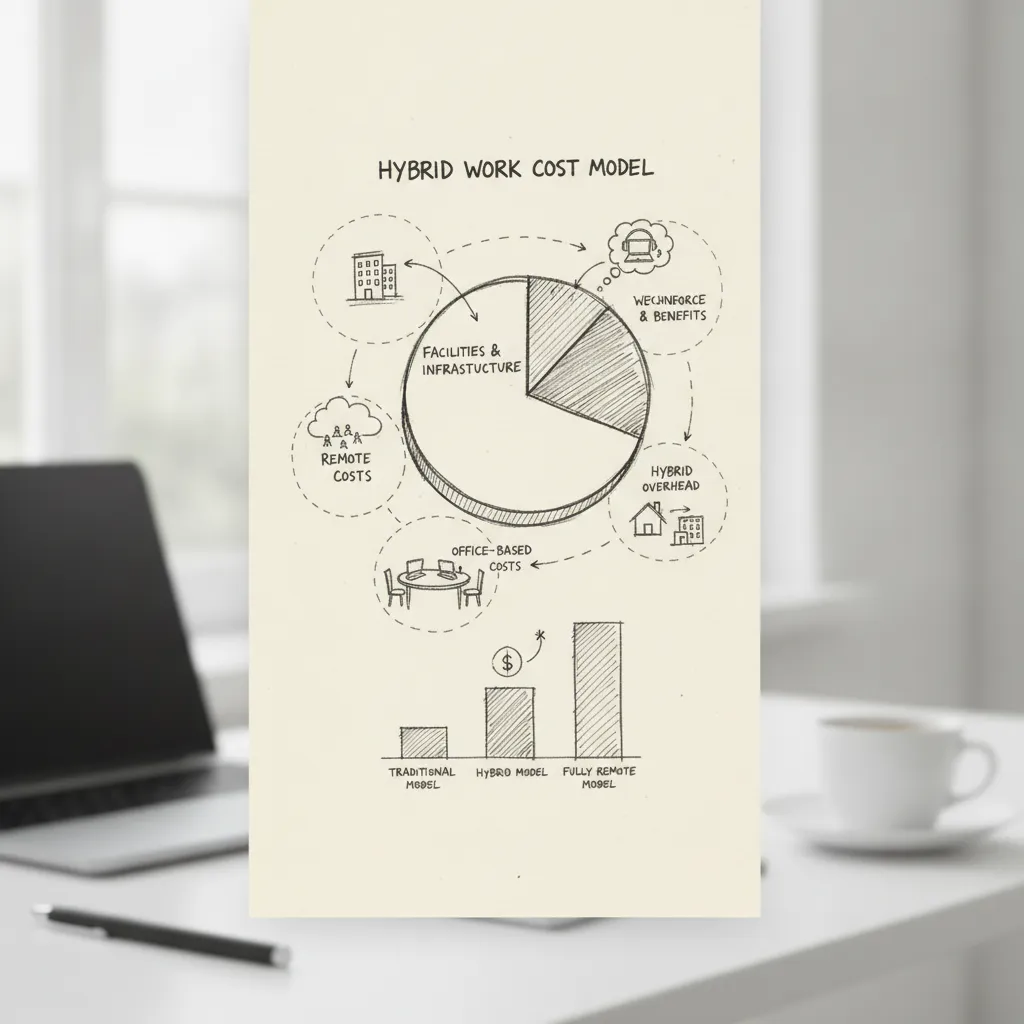
Hybrid sits between $5,000–$9,000 per employee in real estate cost annually, roughly half the in-office rate and far above the near-zero remote baseline.
The table below maps all three models against the same five metrics so you can see exactly where each one wins and where it creates cost exposure.
| Metric | Fully In-Office | Hybrid | Fully Remote |
|---|---|---|---|
| Real estate cost per employee/year | $12,000–$18,000 (major metros) | $5,000–$9,000 (right-sized) | Near zero |
| IT cost per employee/year | Low, centralized infrastructure | Moderate, split between on-site and remote tooling | $2,500–$4,000 (stipends, home office, VPN, SaaS) |
| Management overhead | Low, proximity simplifies coordination | Moderate, requires scheduling and attendance tools | High, async coordination, output tracking |
| Attrition rate | Higher, rigid mandates drive turnover | Best outcome, hybrid reduces quit rates by 35% (Stanford) | improved, isolation risk increases over time |
| Productivity index | High for collaborative roles | High, structured in-person days preserve collaboration | High for individual contributors; lower for team-dependent roles |
Fully remote eliminates real estate spend but shifts cost into IT stipends, home-office equipment, and the management overhead of coordinating distributed teams, often running $2,500–$4,000 per employee per year. A hybrid work cost model trades those stipend costs for a reduced but real estate footprint, which pays off when space is right-sized using utilization data rather than historical headcount assumptions.
Stanford research found that hybrid arrangements reduce employee quit rates by 35%, a retention gain that translates directly into lower recruiting and onboarding spend. According to Global Workplace Analytics' comprehensive costs and benefits resource, the combined savings from reduced attrition and real estate consolidation frequently exceed initial projections when organizations measure both variables together. Platforms like Upflex support that outcome by using AI-powered attendance forecasting to hit 88% co-attendance targets, keeping teams connected without forcing rigid five-day mandates that drive attrition.
Tech companies can adopt fully remote models with minimal cost penalty because their work is equipment-light and compliance requirements are manageable remotely. Manufacturing and healthcare cannot make the same move, physical equipment, regulated environments, and patient or production-floor requirements anchor a significant share of their workforce to specific locations.
For those industries, the hybrid model is constrained rather than chosen freely. Their real estate cost floor stays higher, IT complexity increases because on-site and remote infrastructure must coexist, and management overhead rises to coordinate the split. The cost calculus is fundamentally different from a software firm running the same model, which is why any honest comparison must account for sector before drawing conclusions.
Defending your hybrid work cost model to a CFO requires three numbers: upfront transition cost, monthly net savings, and break-even date.
Drop hours-logged metrics immediately. Output-based KPIs, tasks completed, revenue per employee, project cycle time, give you defensible data that correlates with business outcomes rather than desk occupancy. Stanford economist Nicholas Bloom's research found hybrid workers are 4–5% more productive than their fully in-office peers, a figure that translates directly into revenue-per-employee comparisons your finance team can model.
Upfront transition costs typically run $1,500–$3,000 per employee, covering IT infrastructure, furniture reconfiguration, and training. At a net savings of $500–$800 per employee per month, from reduced real estate, utilities, and overhead, a 200-person team reaches break-even in 2–6 months. That timeline is short enough to clear most internal hurdle rates.
Consider a 500-person financial services firm that consolidated from three floors to one and a half. The firm invested $750,000 in transition costs, technology, fit-out, and change management, and recovered that investment in 14 months through lease savings and measurably lower attrition. The break-even was accelerated because leadership tracked output KPIs from day one, giving them audit-ready proof of productivity gains.
"The most successful hybrid cost models we have studied share one trait: they measure retention ROI with the same rigor as real estate savings. Organizations that do both consistently report net savings 20–30% higher than those focused on real estate alone." — Tsedal Neeley, Professor, Harvard Business School, author of Remote Work Revolution
Retention ROI is the most underweighted variable in most hybrid cost models, and it often exceeds real estate savings in total dollar impact. Replacing an employee costs 50–200% of their annual salary in recruiting, onboarding, and lost productivity. A 200-person company that reduces attrition by 5 percentage points, 10 fewer departures per year, at an average salary of $80,000 saves $400,000 to $1.6 million annually.
That range dwarfs the lease savings many finance teams focus on. Build retention ROI into your model from the start: track voluntary turnover quarterly, segment it by work arrangement, and assign a dollar value using your actual cost-to-hire data. The result is a business case that holds up under scrutiny.
Most hybrid work cost models fail not from bad intent but from five specific, repeatable errors that erode CFO credibility before the model ever gets approved.
Mistake 1: Reporting gross real estate savings instead of net savings. Subtracting only rent from the equation ignores IT infrastructure upgrades, remote work stipends, and the management overhead required to run a hybrid program. Always present a line-item breakdown that shows gross savings, then deducts each cost category to arrive at a net figure. A model that skips this step will get picked apart in the first finance review.
Mistake 2: Sizing office space to peak headcount. Real attendance on any given day typically runs between 35% and 55% of total headcount [2]. Companies that right-size based on observed utilization data, not theoretical maximums, avoid locking into square footage they will never fill.
Mistake 3: Omitting the transition cost payback period. Presenting year-one savings without accounting for upfront investment, fit-out costs, technology deployment, lease break penalties, makes the model look better than it is. CFOs will find the gap; show the payback timeline first.
Mistake 4: Applying one model across all departments. Engineering teams need dedicated equipment bays and low-distraction zones; sales teams need huddle rooms and client-facing space. Department-level cost modeling catches these differences before they become budget surprises.
Mistake 5: Building a model with no measurement cadence. Headcount shifts and attendance patterns change faster than most finance teams expect. A hybrid work cost model without quarterly review checkpoints drifts out of accuracy within six months, at which point the decisions it supports are based on stale data. Platforms like Upflex address this directly: UnifyAI tracks real utilization continuously, so your model reflects what is actually happening in your offices rather than what you assumed at launch.

Most organizations break even on hybrid work transition costs within 12 to 18 months of full implementation. The timeline depends heavily on your lease structure, companies that consolidate office space at renewal see the fastest payback, since real estate savings typically represent 60–70% of total cost reduction. Technology investments in desk booking and attendance forecasting generally pay back within 6 months when they prevent over-provisioning. Firms that delay portfolio decisions while running hybrid programs extend their payback period significantly.
The 5 C's of hybrid work are Collaboration, Coordination, Culture, Communication, and Cost, and each one carries a direct financial implication. Poor coordination drives wasted desk capacity; weak collaboration tools increase travel spend; culture gaps raise attrition costs. Addressing all five systematically, rather than treating cost as a separate workstream, produces the most durable savings. Organizations that optimize only for cost without managing the other four typically see employee experience decline and turnover costs offset their real estate gains.
Divide your total annual occupancy cost, rent, utilities, facilities management, and technology, by the number of seats, then divide again by the number of working days in the year. For example, a $2M annual occupancy cost across 200 seats and 250 working days yields $40 per seat-day. Track actual attendance against that figure weekly. When your cost-per-seat-day exceeds $60–$80 in a major metro market, you have a clear signal to reduce your footprint or shift overflow demand to on-demand workspaces.
The primary upfront costs are workplace technology, physical office reconfiguration, and change management. Technology, covering desk booking software, attendance forecasting, and collaboration tools, typically runs $50–$150 per employee annually for enterprise deployments. Physical reconfiguration to convert assigned desks into shared or activity-based zones averages $500–$1,500 per seat depending on fit-out complexity. Change management and manager training are often underbudgeted; plan for at least one full quarter of structured communication and policy rollout before expecting stable attendance patterns.
A traditional office budget is built around fixed headcount and static square footage, assuming all employees occupy assigned desks five days a week. A hybrid work cost model replaces those static assumptions with dynamic variables: actual attendance rates, variable coworking spend, per-employee IT stipends, and retention ROI. This shift requires new data inputs — badge records, desk booking logs, and attrition tracking — but produces a far more accurate picture of true workforce costs and enables better real estate portfolio decisions over time.
A well-built hybrid work cost model does three things: it quantifies what you are actually spending per occupied seat, it identifies where fixed real estate commitments exceed real demand, and it gives finance and corporate real estate leaders a defensible number to bring to the CFO. The data consistently shows that organizations achieving 30–40%+ real estate reductions do so by combining accurate attendance forecasting with deliberate portfolio decisions, not by cutting arbitrarily.
Start with your utilization baseline. Pull 90 days of badge or booking data, calculate your cost-per-seat-day, and map it against actual attendance by floor or building. That single exercise will surface your highest-cost, lowest-utilization assets, and give you the evidence to act. If your current tools cannot produce that report, request an Upflex demo to see how UnifyAI generates it automatically.
Explore more from our content library: