Share This Article
No items found.


Understanding hybrid work infrastructure is essential. Collaboration stalls when the physical office and the digital systems that manage it don't share real-time data, not because teams lack tools, but because scheduling, space, and access systems operate in isolation. The most common gaps are disconnected booking and attendance data, access systems that don't sync with who's actually expected on-site, and real estate decisions made without usage evidence. Closing these gaps means connecting workspace access, scheduling, and occupancy data into one feedback loop rather than buying another standalone app.
Scheduling tools capture what employees plan to do; booking systems capture what they've actually reserved, and when the two don't share data, neither one reflects what's happening in the office.
The mechanism is simple to describe and hard to fix after the fact. An employee marks "in-office" in a scheduling tool for Tuesday, but never books a desk, while a teammate books a desk for Wednesday without updating their calendar status. No system reconciles the two, so planned attendance and booked attendance drift apart.
The collaboration cost shows up fast. Teammates who assumed they'd overlap discover, usually too late, that they're in the building on different days, because nothing forced the scheduling intent and the booking record to match.
This problem compounds for multi-team companies trying to coordinate in-office overlap days across departments, where even a small sync gap between tools multiplies across dozens of teams. The fix isn't a side-by-side dashboard showing both data sets, it's a system where scheduling preferences feed directly into the booking engine, so a stated intent to come in automatically becomes a reservation, not a separate data point someone has to reconcile manually.
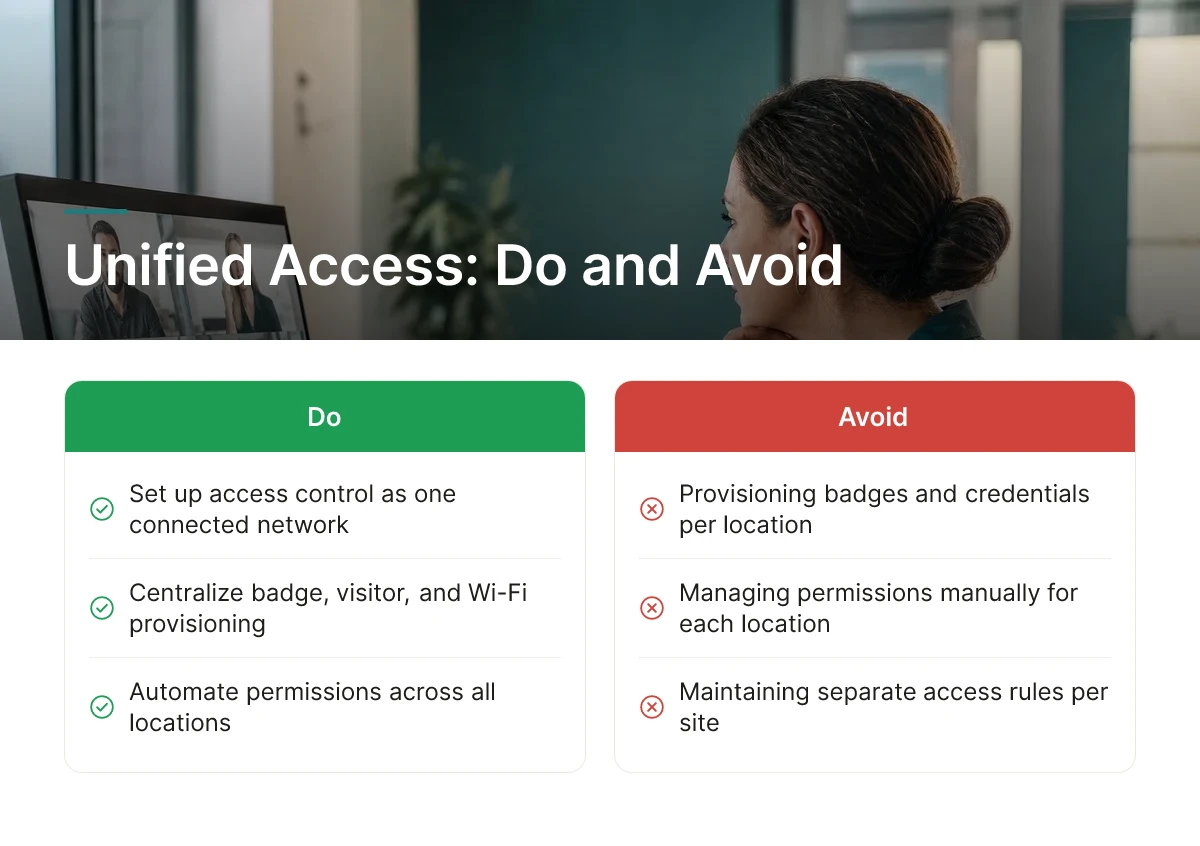
Access control set up building by building, rather than as one connected network, is one of the most overlooked gaps in hybrid work infrastructure today.
Most enterprises provision badges, visitor systems, and Wi-Fi credentials per location, which works fine when employees stay put. It breaks down the moment someone splits their week between a home office, a regional hub, and a satellite location, each with its own access rules, its own provisioning queue, and its own IT ticket.
Without a unified access layer, IT and facilities teams end up managing permissions manually for every location an employee touches. That manual process delays onboarding, creates inconsistent security postures across buildings, and leaves gaps where an employee's access was revoked at one site but never updated at another.
This gap hits hardest at organizations with employees who regularly split time across more than one city or building, consultancies, regional sales teams, and companies running hub-and-spoke office models. The differentiator most vendors miss: treat access as a network problem, not a building upgrade. One credential that works across every location in the portfolio removes the manual provisioning step entirely and closes the security blind spots that come with it.
Space optimization and scheduling are two halves of the same decision: you can't right-size a portfolio without knowing when people actually show up, and you can't coordinate attendance without knowing what space is available. Platforms like Upflex connect the two directly, UnifyAI forecasts attendance with 97% accuracy, and that forecast feeds straight into desk booking and space planning, so real estate decisions are based on predicted behavior rather than static headcount.
Sensor and badge-in data often sits isolated in a facilities dashboard while lease and consolidation decisions get made from outdated headcount assumptions instead.
The mechanism is a reporting gap, not a data gap. Most buildings already generate daily occupancy numbers through badge readers or sensors, but that data rarely travels past the facilities team. Real estate decisions, renew, downsize, consolidate, get made in a separate process, often once a year, based on static assumptions about headcount rather than actual attendance.
The result: a floor running at 35% occupancy for two straight quarters can go unnoticed simply because nobody connected the daily badge-in counts to the lease renewal calendar sitting in a different department's files.
This gap matters most for finance and real estate teams evaluating whether their portfolio size still matches how people actually work. The fix isn't a better annual audit, it's a feedback loop where occupancy trends below a set threshold automatically trigger a space-utilization review, so underused floors surface in weeks, not fiscal years.
Collaboration stalls when each team sets its own in-office days without visibility into what other teams are doing, producing empty offices on some days and overcrowded ones on others.
The mechanism is a predictable side effect of team-level autonomy. Give every department head the freedom to pick their own in-office schedule, and you get marketing in on Tuesdays, engineering in on Thursdays, and almost nobody overlapping with the teams they actually need to collaborate with.
No, a fixed calendar mandate is a policy, not infrastructure. Hybrid work infrastructure is the set of systems that let that policy actually function: scheduling tools, booking engines, and visibility layers that coordinate who shows up when. A company can mandate four office days a week and still have teams colliding for desks on Tuesday while the building sits half-empty on Thursday, because the calendar alone does nothing to balance demand.
This problem is most visible at companies with multiple departments or business units setting hybrid rules independently, with no shared layer forcing coordination between them. The differentiator worth prioritizing: a shared visibility system that shows cross-team in-office patterns before a policy is finalized, so leaders can see the overlap gaps on paper instead of discovering them through employee complaints six months later.
Spontaneous in-person collaboration disappears when colleagues have no easy way to see where teammates are actually working on a given day.
The mechanism is straightforward: without a shared location view, overlap days happen by accident instead of by design. Two people might both intend to collaborate in person that week, but with no visibility into each other's plans, the overlap either happens by luck or doesn't happen at all.
Consider a product manager and a designer who need a whiteboard session to finalize a feature before a sprint review. Each assumes the other will be in the office that week. By Wednesday, they discover the product manager is in the New York hub while the designer is working from a satellite office in another city, and the deadline forces a video call instead of the in-person session that would have moved faster.
This gap matters most for cross-functional teams that depend on periodic in-person collaboration rather than daily co-location, product, design, and sales teams working across offices. The fix isn't another status indicator bolted onto a messaging app. It's a lightweight shared calendar layer tied directly to booking data, so planned locations are visible before the week starts, not discovered mid-week when it's too late to adjust.
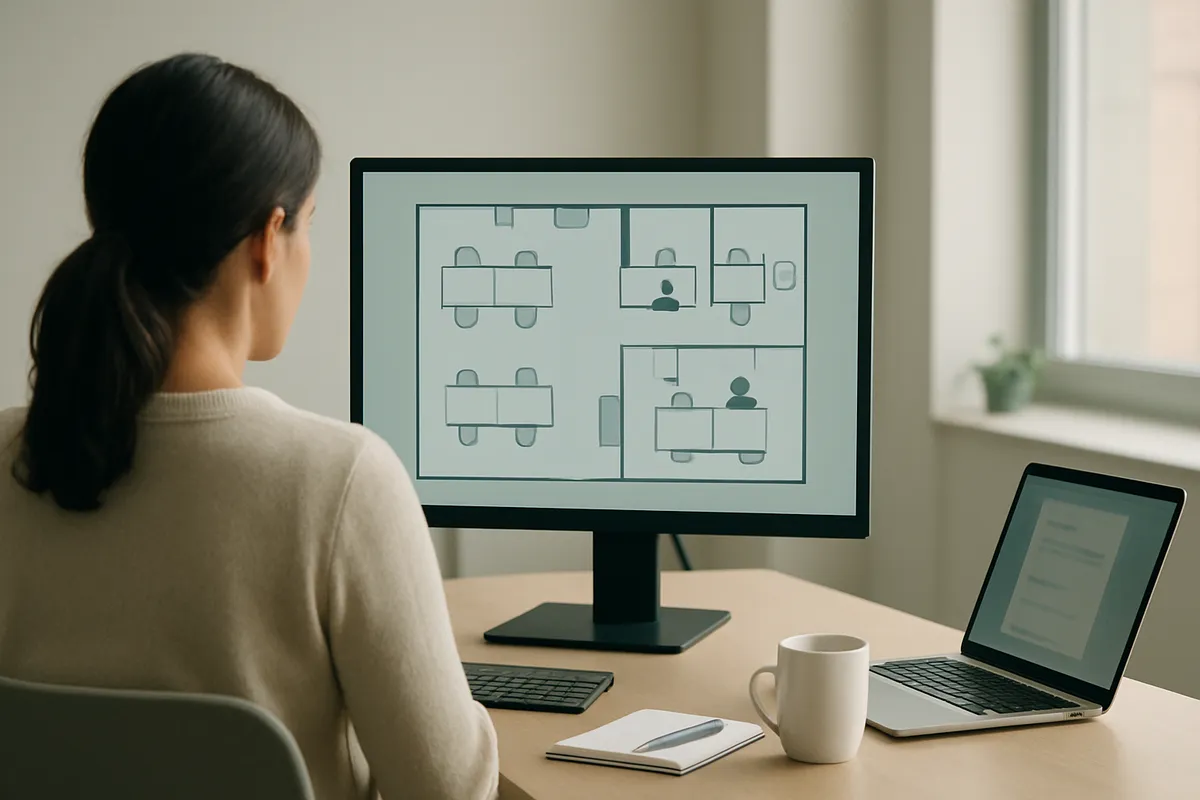
Fragmented access and visitor systems across office locations create gaps that regulators flag and auditors can't reconcile after the fact.
Three patterns show up repeatedly in multi-location hybrid setups. Orphaned access credentials linger when an employee transfers between offices or leaves the company, but the badge or app permission from their old location never gets revoked. Visitor logging is inconsistent, one site uses a paper sign-in sheet, another uses a digital kiosk, and neither syncs with the other. And audit trails have gaps because no single system captures who accessed which space, on which day, across the full portfolio.
Regulators and auditors in finance, healthcare, and legal don't accept "it's in three different systems" as an answer. They expect one consistent record of space access that can be pulled on demand [4]. Per-location systems, built independently over time, generally can't produce that without manual reconciliation.
The fix is not another point security tool. It's centralizing access logs and credential management across every location first, then layering additional monitoring on top of a system that already produces one clean audit trail.
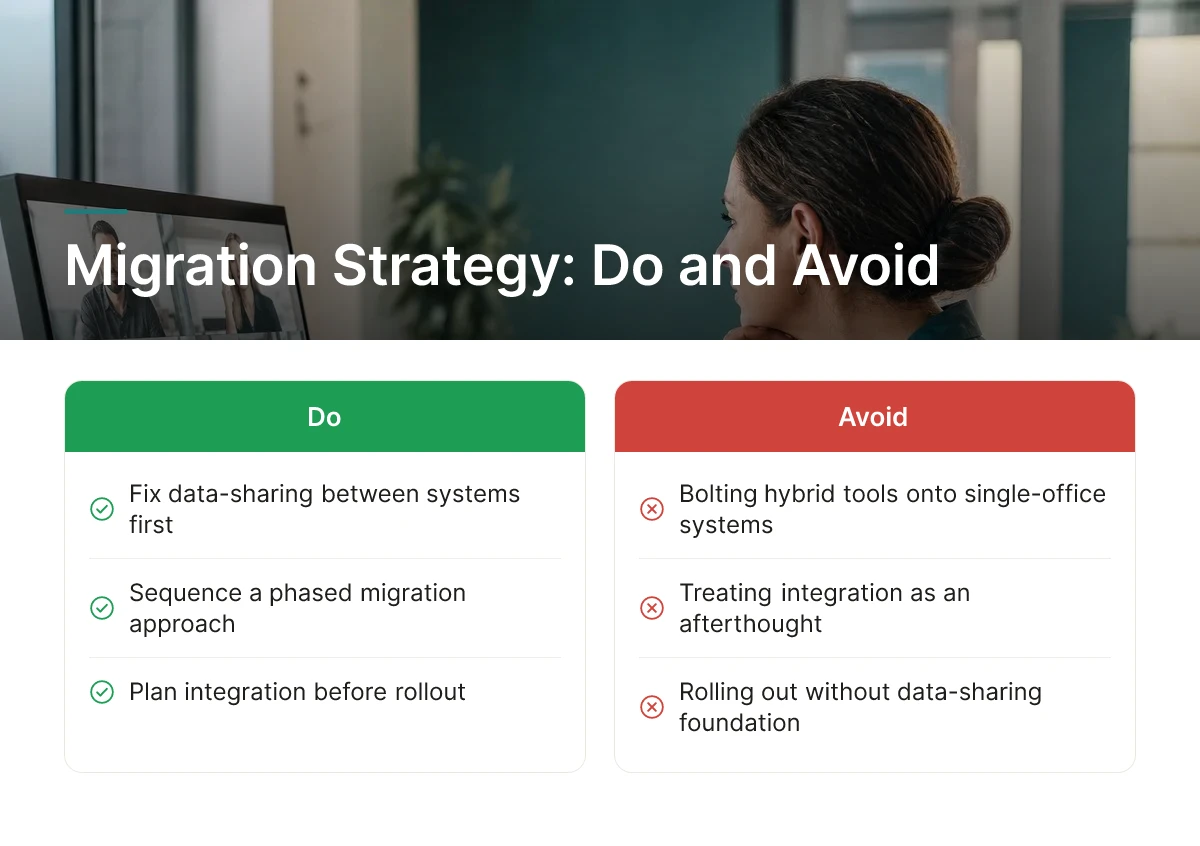
Companies stall when they bolt hybrid tools onto single-office infrastructure instead of sequencing a phased migration with data-sharing fixed first.
Legacy badge systems, booking calendars, and scheduling spreadsheets were built for one building and one way of working. They were never designed to share data with each other, let alone with a second or third location. When companies try to add hybrid capability on top, integration becomes an afterthought handled by IT after the rollout, instead of a planning input decided before it.
A phased approach avoids that trap. Start by auditing every existing badge, booking, and scheduling system to map what data each one holds and where it's siloed. Pilot the integration in a single location to confirm data flows correctly between systems. Only then expand to additional offices, once the pilot proves the connections hold.
This sequence matters most for companies moving off a traditional single-office setup for the first time. The differentiator is order of operations: fix data-sharing between existing systems before adding new locations, not after expansion has already multiplied the number of disconnected systems you're managing.
Many companies deploy hybrid systems and never measure whether forecasts, space use, or costs actually improved after rollout.
Three metrics matter here. Forecast accuracy compares expected attendance against who actually showed up, exposing whether scheduling tools are producing reliable numbers or just guesses. Space utilization rate tracks how much of each floor or location gets used on a given day. Real estate cost per occupied seat ties square footage spend directly to actual usage, rather than to headcount or lease terms alone.
The savings don't come from buying the technology. They come from using what it measures to match your real estate footprint to how teams actually use space, shrinking a floor, consolidating a lease, or reallocating desks only once the data confirms it's safe to do so.
This matters most for operations and finance leaders who need to justify continued investment in hybrid work infrastructure to a CFO or board. The differentiator: review these three metrics on a recurring cycle tied to lease renewal and budget planning dates, not as a one-time report filed away after launch.
Historical occupancy dashboards show what already happened, while predictive analytics can forecast next week's attendance and flag conflicts before they cost money.
A monthly occupancy report tells a real estate leader that a floor ran at low capacity last quarter. By the time that report lands, the lease decision window may already be closing. Predictive tools work differently: they take scheduling inputs and current occupancy signals and forecast attendance for the days ahead, surfacing under-booked space or scheduling conflicts while there's still time to act.
A concrete version of this: IoT sensors feeding a forecasting model that flags a floor running consistently under capacity months before a lease renewal decision gets made, giving real estate leaders time to consolidate rather than renew by default.
This approach fits larger portfolios where manually reviewing space data across a dozen or more locations is no longer realistic. Platforms like Upflex apply this through UnifyAI, forecasting attendance with 97% accuracy and feeding that forecast directly into desk booking and space decisions, AI's role here is closing the loop between scheduling, access, and real estate data, not running a standalone chatbot.
Fix data-sharing gaps between scheduling, booking, and access systems first, analytics and AI layers only pay off once that foundation works.
Prioritize based on four factors: number of locations, regulatory exposure, how much autonomy teams have over their own schedules, and how fragmented your current systems already are. A single-location company with low regulatory exposure can likely wait on centralized access logs. A five-office financial services firm cannot.
Hybrid work infrastructure becomes a management headache for one recurring reason: companies treat it as a one-time IT project instead of an ongoing operational practice. A rollout gets deployed, declared finished, and then nobody revisits it as headcount shifts, leases expire, or teams change how they work, so the gaps this article covers quietly reopen.
Start with whichever gap is causing the most measurable collaboration friction right now, whether that's missed co-attendance, security exposure, or stalled migration. Budget-friendly fixes address one gap at a time; mid-range and enterprise options, like consolidating forecasting, booking, and network access into one platform, address several at once. Match the investment tier to the number of gaps actually costing you money today.

Most overlooked cost: disconnected systems that create new manual work instead of removing it. When booking tools, badge data, and calendars don't talk to each other, facilities teams end up reconciling spreadsheets by hand [3]. Leaders also underestimate change management, employees resist new scheduling tools if they don't see a clear personal benefit, like guaranteed desk availability on their in-office days.
Base the decision on collaboration intensity and forecasted attendance patterns, not blanket mandates. Teams with frequent cross-functional work or client-facing responsibilities benefit most from coordinated in-office days, while individually-focused roles often perform fine remote. Attendance forecasting tools like Upflex's UnifyAI engine help by predicting who's actually coming in, letting leaders set realistic co-attendance targets instead of guessing [5].
Access control systems typically sync with booking platforms through shared calendar and identity data, so a desk reservation automatically grants building or floor access. Microsoft Places, for example, pulls scheduling signals from Outlook and Teams to show who's planning to be in the office and when [1]. Upflex extends this by layering desk booking with on-demand workspace access across external locations.
Track attendance forecast accuracy, co-attendance rates against team targets, space utilization by floor or building, and real estate cost per occupied seat. Upflex customers use these metrics to benchmark against 97% forecast accuracy and 88% co-attendance achievement, and to justify portfolio consolidation decisions with utilization data rather than anecdote.
Rollouts rarely mature in one phase, organizations typically connect tools incrementally, starting with the highest-friction gap before tackling others [3]. Research on hybrid work also shows unresolved tension between individual flexibility and organizational coordination needs, meaning infrastructure must keep adapting rather than being treated as a one-time deployment [4].
Hybrid work infrastructure succeeds when scheduling, booking, and real estate data operate as one connected system rather than three disconnected tools. Start by auditing where your current setup forces manual reconciliation, that gap is usually where cost and employee frustration both concentrate. Then prioritize attendance forecasting before space redesign, since knowing who's coming in and when is the input every other decision depends on.
Next step: pull your last quarter's badge-swipe or booking data and compare it against your leased square footage. If utilization sits below 50%, you have a quantified case for testing a platform like Upflex to forecast attendance and evaluate portfolio consolidation.
Explore more from our content library: