Share This Article
No items found.

Understanding workspace management software is essential. Pricing model choice can swing total cost of ownership by a wide margin for hybrid enterprises, because per-seat, per-space, and usage-based structures each attach cost to a different variable, headcount, square footage, or actual utilization. When attendance is unpredictable, per-seat fees often charge for capacity nobody uses, while usage-based pricing scales cost with real occupancy but can spike during high-attendance periods. The right model depends on how volatile your hybrid attendance patterns are, how much real estate you're trying to shed, and whether you value budget predictability over cost-to-usage accuracy.
Total cost of ownership for workspace management software extends well past the license fee into training time, admin overhead, integration upkeep, and capacity nobody uses. A contract that looks cheap on the quote can still be the more expensive option once finance adds up what it costs to run.
License cost is the visible line item. The hidden costs are what erode the budget quietly: the hours an admin team spends reconciling booking data with badge swipes, the integration maintenance when the tool doesn't talk cleanly to your calendar or HR system, and the training cycles needed every time a new building or policy rolls out. For global enterprises running the same platform across a dozen offices, that overhead multiplies by location, not by headcount, which is a variable most pricing proposals never model.
Per-seat pricing punishes unpredictable attendance because you pay the same fee whether a seat gets used five days a week or one.
Picture a 2,000-person company paying for 2,000 seats while average weekly attendance sits closer to half that. The unused capacity doesn't disappear from the invoice, it just quietly inflates the effective cost-per-use. Consumption-tied pricing avoids this trap by attaching cost to actual occupancy rather than headcount, but it introduces its own risk: a surge week, an all-hands event, or a seasonal return-to-office push can spike the bill right when leadership is watching spend most closely. Hybrid attendance volatility, which recent industry pricing research links to the broader shift from counting logins to counting actual usage [5], means flat per-seat commitments are harder to defend to a CFO than cost structures that flex with real occupancy.
Cloud subscription pricing moves cost from a large upfront capital expense to a smaller recurring operating expense, which changes how finance evaluates the purchase entirely.
On-premise licensing typically front-loads cost into one approval cycle, then minimizes new spend until the next major upgrade. Subscription-based workspace management software spreads the expense across budget periods, which is easier to approve but harder to forecast five years out, especially as vendors increasingly blend subscription tiers with usage-based components, a pattern now standard across roughly six in ten enterprise software contracts according to industry tracking [1]. Contract length matters just as much as the pricing structure itself. A multi-year commitment can lock in favorable rates but reduces flexibility if attendance patterns shift; rolling or annual terms preserve negotiating use but expose the organization to repricing at renewal. For hybrid enterprises still stabilizing attendance norms, shorter commitments tied to usage tend to carry less long-term cost exposure than flat multi-year deals signed before the pattern was known.
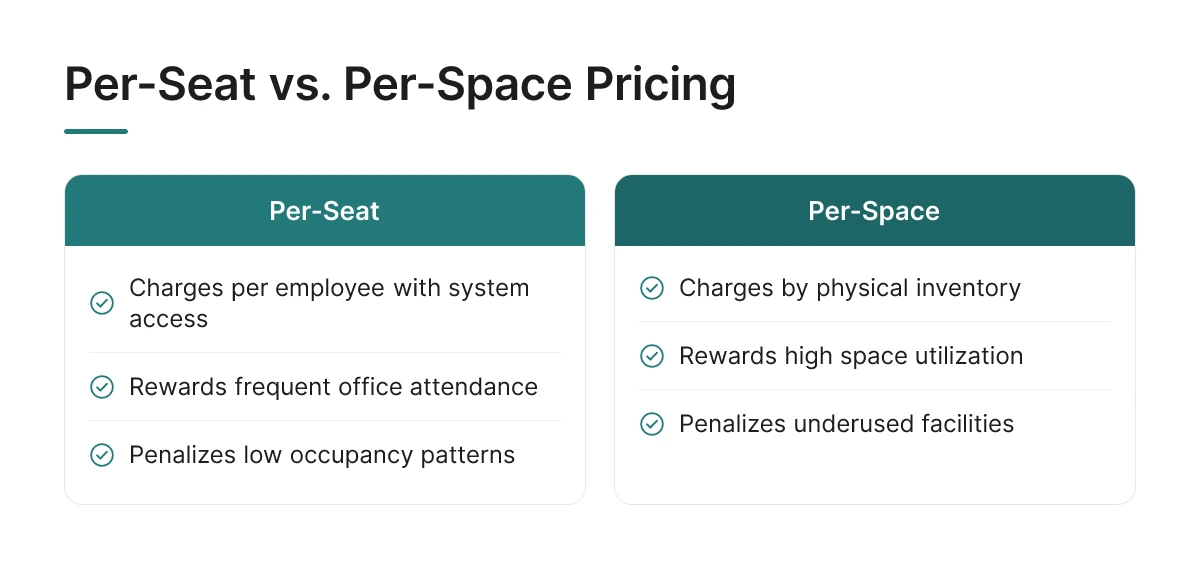
Per-seat bills by headcount, per-space bills by physical inventory, and usage-based pricing bills by actual bookings, each one rewards a different occupancy pattern and penalizes the rest. Mapping your attendance pattern to the right billing unit is the single biggest lever in controlling total cost of ownership for workspace management software.
Per-seat pricing charges a license fee for every employee with system access, whether that person badges into the office five days a week or once a month. This model mirrors the per-seat structure that dominated SaaS for two decades, where cost scaled directly with headcount regardless of actual product use [5]. It favors teams with consistent, high in-office attendance, if your workforce shows up reliably, you're paying for capacity you actually consume. If attendance is sporadic, you're funding empty licenses.
Per-space pricing charges against the physical footprint, desks, rooms, or floors under management, rather than the number of employees assigned to them. This structure suits organizations optimizing a fixed footprint: you know your square footage and want a cost model that scales with the portfolio you're managing down, not with headcount swings. It's a natural fit for real estate teams running consolidation projects, where the goal is shrinking inventory, not tracking individual badge-ins.
Per-seat works when attendance is stable and near-full; per-space works when the footprint itself is the variable you're managing; usage-based works when attendance is unpredictable or distributed. Enterprises with hybrid teams splitting time across home, HQ, and client sites rarely fit neatly into one bucket, which is why decision-makers increasingly evaluate all three against their own utilization data before signing a multi-year contract.
Usage-based, or consumption, pricing bills against bookings, check-ins, or active sessions, so cost tracks what actually happens, not what's provisioned. Adoption of consumption and hybrid models has grown sharply, with one analysis citing 85% of SaaS leaders now embracing usage-aligned pricing and 61% of companies running hybrid models as of 2025 [1]. This rewards genuine utilization but complicates budgeting, since monthly costs fluctuate with attendance swings, seasonal travel, or project-based office surges [4].
Blended models, a base platform fee plus metered overage, are emerging precisely to balance that unpredictability with the accuracy enterprises now expect [3]. Upflex's own approach reflects this logic: UnifyAI forecasts attendance with 97% accuracy, giving finance teams the visibility to budget confidently even when the underlying usage pattern shifts week to week. For more information, see Ai Seo Software Complete Guide To Tools Platforms 2026.
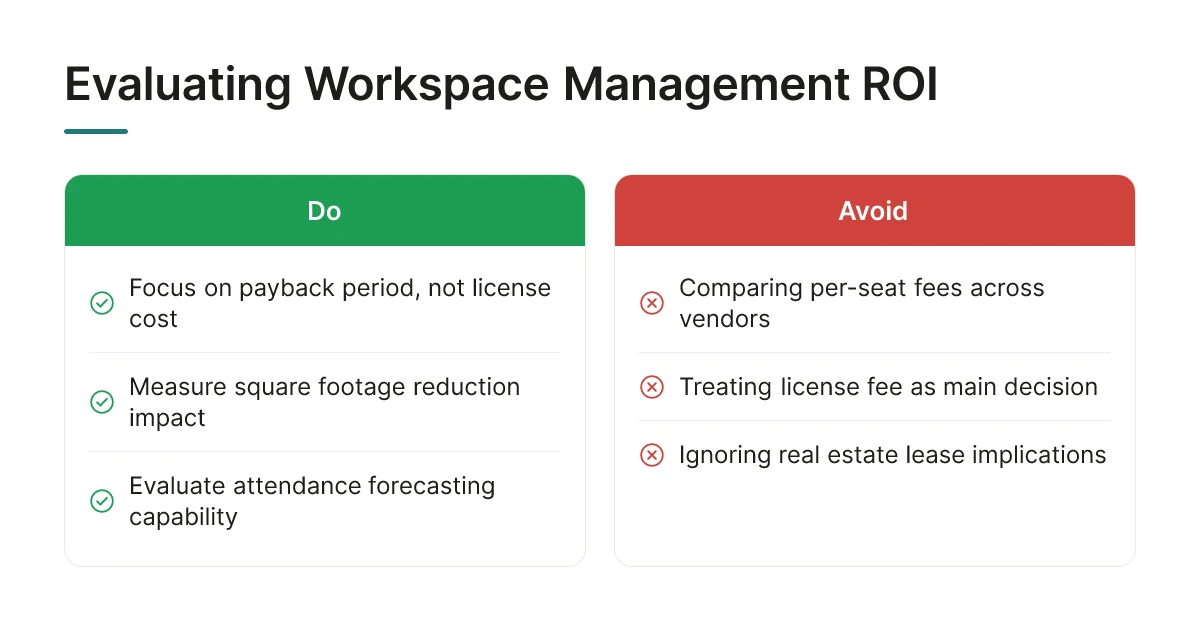
ROI on workspace management software depends on payback period, not license cost, the real question is how fast square footage reduction and avoided leasing recoup what you paid.
Most procurement teams default to comparing per-seat fees across vendors, the same instinct that drove two decades of SaaS buying generally [5]. That comparison misses the point for a corporate real estate team. A platform priced lower per seat but weak on attendance forecasting can cost you a full floor of unnecessary lease renewal. The license fee is a rounding error next to the real estate decision it informs.
Five metrics separate a credible ROI case from a guess. Track real estate cost per employee, space utilization rate, total square footage reduced, forecast accuracy for daily attendance, and admin hours saved on manual scheduling and badge-data reconciliation. Each ties directly to a line the CFO already watches.
Build your baseline before you touch pricing models. Pull at least one full quarter of current occupancy data, badge swipes, booking logs, or manual sign-ins, and calculate utilization rate and cost per employee under your existing setup. Without that before/after baseline, any vendor's savings claim is unverifiable, and you can't tell whether improvement came from the software or from a seasonal dip in travel.
The mechanism connecting forecasting accuracy to savings is straightforward. When you can predict which days teams will show up, you stop holding speculative square footage "just in case." Upflex's UnifyAI engine forecasts attendance with 97% accuracy, which lets real estate teams commit to smaller footprints with confidence instead of padding capacity against uncertainty. Lower forecast error translates directly into less vacant space carried on the books month over month.
Payback period, the time needed to recoup license cost through square footage reduction, is more decision-useful than a headline savings percentage. A 40% savings figure means little if it takes three years to materialize; a shorter payback period means the platform is already paying for itself while the lease decision is still being negotiated.
Don't evaluate license cost in isolation. Change management, employee adoption, and the weeks it takes admin teams to trust a new forecasting model all carry real cost, and skipping that factor inflates apparent ROI on paper while delaying it in practice.
The sticker price on a vendor quote rarely reflects what workspace management software actually costs to run, integration complexity, rollout sequencing, and company size can double effective total cost of ownership before year one ends.
Integration work expands cost because workspace platforms rarely sit in isolation, they need to pull live headcount data from an HRIS, cost-center data from an ERP, and floor plan geometry from CAD or BIM files. When those source systems use incompatible data models, engineering teams spend weeks mapping fields instead of days.
A company running Workday alongside a decade-old CAD archive will face a different integration load than one running a single modern HRIS. Mismatched employee ID schemas, outdated floor plans, or ERP cost-center hierarchies that don't match the real estate team's building codes all require custom mapping logic before attendance forecasting or desk booking data means anything. None of this shows up on a per-seat or per-space price list, but it drives the engineering hours behind the quote.
Company size is the single biggest variable in deployment timeline because it determines how many systems and regional variants need reconciling. A single-site company with one HRIS instance might connect its workspace platform in a matter of weeks. A multi-entity enterprise running regional HRIS variants across different countries, each with its own data governance rules and badge-access systems, faces a materially longer integration path.
Phased rollouts reduce that risk. Starting with a pilot floor or a single regional office lets a corporate real estate team validate data mapping, test employee adoption, and fix integration gaps before the mistakes get replicated across every site. A single big-bang deployment across all locations simultaneously multiplies the cost of any integration error, a mismapped HRIS field on one floor is a bug fix; the same error pushed enterprise-wide is a remediation project.
Several cost categories rarely appear in vendor quotes: data migration from legacy booking tools or spreadsheets, custom API development for non-standard ERP or CAD connections, change management training to get employees actually using the new booking workflows, and the ongoing admin headcount needed to maintain space data and resolve exceptions. Deployment choice matters too, cloud-hosted platforms shift maintenance burden to the vendor, while on-premise deployments require internal IT resourcing for upgrades and security patching over the life of the contract, a recurring cost that compounds across multi-year terms.
On-demand workspace access turns fixed square footage into a variable cost, so you stop paying for empty desks and start paying only for the attendance you actually get.
A ten-year lease is a fixed bet on headcount and attendance that rarely holds for the full term. Hybrid attendance patterns shift by quarter, by team, by season, and a lease doesn't adjust with them. On-demand access to a global network of third-party workspaces converts part of that bet into a pay-for-use arrangement, which is the same logic driving consumption-based pricing across enterprise software more broadly [4].
Yes, a flexible workspace network lets you shrink owned or leased footprint in markets where daily attendance doesn't justify a full floor, while still guaranteeing access where demand is real. Instead of carrying a lease in a secondary city to cover 15 employees who come in twice a week, you give those employees access to a nearby on-demand location and release the fixed obligation entirely. This is the mechanism behind Upflex's documented outcomes of 40%+ reduction in real estate spend for organizations that pair owned-space optimization with on-demand network access. The core footprint gets reserved for high-density hubs, the offices where co-attendance actually matters, while everywhere else becomes elastic.
The trade-off is real: variable, usage-linked cost is more efficient but less predictable, which means finance teams need better forecasting, not less of it. A fixed lease is easy to budget and hard to optimize. On-demand spend is easy to optimize and harder to budget, unless attendance forecasting is accurate enough to turn variable cost into a plannable range rather than a surprise. That's the gap workspace management software is built to close, by pairing day-by-day attendance prediction with the booking and network data needed to model next quarter's spend instead of just reporting last quarter's.
A workable framework treats owned space as anchor locations for daily-core teams, the people and functions that need a permanent desk five days a week, and on-demand access as the release valve for overflow, business travel, and satellite presence in markets too thin to justify a lease. Upflex's UnifyAI engine forecasts attendance with 97% accuracy specifically to make that split reliable: knowing who's coming in, where, and when lets you size the anchor correctly and route the rest to the network. Usage-based software pricing pairs naturally with this model, because both the real estate and the platform cost scale with actual attendance rather than headcount on paper.
Enterprises that pair attendance forecasting with flexible workspace access have documented real estate reductions of 40%+ alongside 88% co-attendance achievement, according to Upflex platform data. These outcomes come from matching actual office footprint to forecasted occupancy rather than guessing at headcount, then redirecting the freed budget toward the on-demand spaces employees actually use. The pattern holds across portfolios with multiple underused locations, not just single-office setups.
No, a longer term only lowers total cost of ownership if usage stays predictable across the contract period. Enterprises locking into multi-year per-seat deals risk paying for licenses tied to headcount that shrinks or shifts, especially as hybrid attendance patterns change [5]. Shorter terms or hybrid pricing structures protect against that mismatch, even if the sticker price per year looks higher.
Hidden admin costs, license reconciliation, usage audits, and manual reporting, can quietly inflate the real price well above the contract rate. Flexera's research on SaaS sprawl notes that enterprises face visibility gaps SMBs rarely encounter, making true cost tracking harder at scale [1]. Budgeting only for the subscription line item understates what finance teams actually spend managing the tool.
Usage-based pricing carries more short-term budget variability but often tracks real value better than flat per-seat fees. Consumption models tie cost to actual activity, which helps when usage dips, but they introduce unpredictability that requires tighter forecasting and procurement discipline [4]. Enterprises with volatile attendance patterns need stronger internal visibility before adopting this model.
Pricing structure determines whether workspace management software pays for itself or quietly adds cost on top of underused square footage. Per-seat models punish headcount volatility, pure usage-based pricing complicates budgeting, and hybrid structures increasingly split the difference [1]. The real lever isn't the pricing model alone, it's pairing that model with accurate attendance forecasting, since you can't right-size spend on space you can't predict. Upflex combines 97% accurate attendance forecasting with on-demand workspace access to tie cost directly to real usage. Start by auditing your current attendance data against your existing contract terms before your next renewal decision.
Explore more from our content library: