Share This Article
No items found.

Understanding how to reduce real estate costs is essential. You reduce real estate costs most effectively by combining lease renegotiation with flexible workspace solutions, renegotiation lowers your fixed contractual spend on existing space, while on-demand workspace access cuts the cost of maintaining underused square footage altogether. Enterprise organizations typically start by auditing utilization data to see which locations are overbuilt, then renegotiate or exit leases on the weakest performers while shifting displaced demand to flexible space. Used together, these two levers address both the cost you're locked into and the cost you're wasting on space nobody uses.
Before any initiative on how to reduce real estate costs can move forward, you need three inputs in hand: current lease documents, utilization data, and headcount forecasts. Skipping any one of these leads to decisions you'll have to reverse later.
Acquisition, holding, and disposition costs behave differently, and cutting one without understanding the other two often just shifts spend around instead of reducing it. Acquisition costs, deposits, build-outs, broker fees, are front-loaded and hard to recover once committed. Holding costs, rent, utilities, maintenance, insurance, accrue continuously and scale with how much space you keep, regardless of how much of it gets used. Disposition costs, early termination penalties, restoration obligations, subleasing friction, only show up when you try to exit. A location with low holding costs but a punishing exit clause can cost more to leave than to keep for another year. You need visibility into all three before you cut anything, because a decision that looks like savings on the holding-cost line can trigger a disposition cost that erases the gain.
Leased and owned property are treated differently for tax purposes, and that difference can change which costs are worth targeting first. Depending on your structure, lease payments and ownership-related expenses follow different treatment, which affects the real after-tax cost of keeping, exiting, or converting a given location. This isn't a reason to delay action, but it is a reason to loop in your tax and accounting team before finalizing which properties move first, a location that looks like the obvious cut on a pre-tax basis isn't always the one that saves the most money.
None of this works without alignment between finance, corporate real estate, and workplace or HR leadership. Finance owns the savings target, corporate real estate owns the portfolio data, and HR owns the people impact of any consolidation. Matterport's guidance on corporate real estate strategy makes the same point: teams that move beyond reactive cost-cutting rely on data to understand demand and plan with confidence, rather than cutting first and assessing the damage after [2].
Before picking a cost-cutting tactic, find out exactly where money leaks across the portfolio, most enterprises are paying full price for space nobody uses. That audit is the real starting point for how to reduce real estate costs, because lease renegotiation or consolidation decisions made without utilization data tend to guess wrong.
Underused square footage is usually the largest hidden cost once you overlay actual hybrid attendance on top of leased capacity. A floor sized for 500 employees working five days a week makes no financial sense when average attendance runs at a fraction of that, yet the lease, utilities, and maintenance costs stay fixed regardless of who shows up. CRE teams that keep planning around headcount instead of attendance patterns end up carrying square footage nobody is using, which is exactly the reactive cost-cutting pattern that data-driven planning is meant to replace [2].
Segment the portfolio by property type before applying any fix, because the cost levers differ by category:
Next, pull every lease expiration and break-clause date into one timeline. Leases approaching renewal or a break window are the first real targets for renegotiation, since landlords have the most incentive to deal before a space sits vacant [3]. Waiting until weeks before expiration gives up use; tenants who start the conversation early and arrive with utilization data in hand are negotiating from a position of strength, not need [4].
For hybrid organizations, portfolio optimization means sizing space to how often people actually come in, not how many people are on the headcount report. A team of 200 with 40% average in-office attendance does not need desks for 200, it needs enough desks, meeting rooms, and amenities to comfortably fit its real peak days. Matching footprint to attendance rather than headcount is the single biggest lever CRE leaders have to shrink the balance sheet without a blunt return-to-office mandate.
Running this audit manually across dozens or hundreds of locations is slow and usually stale by the time it's done. Upflex's UnifyAI engine forecasts attendance with 97% accuracy, which lets real estate teams predict which buildings and floors will be underused next quarter instead of relying on last year's badge data. That forecast, paired with desk booking and utilization tracking across the portfolio, gives finance and workplace leaders a single, current view of where square footage is earning its cost and where it isn't, the foundation for every consolidation or renegotiation decision that follows. For more information, see Five Ways To Reduce Labor Costs In Retail For 2023.

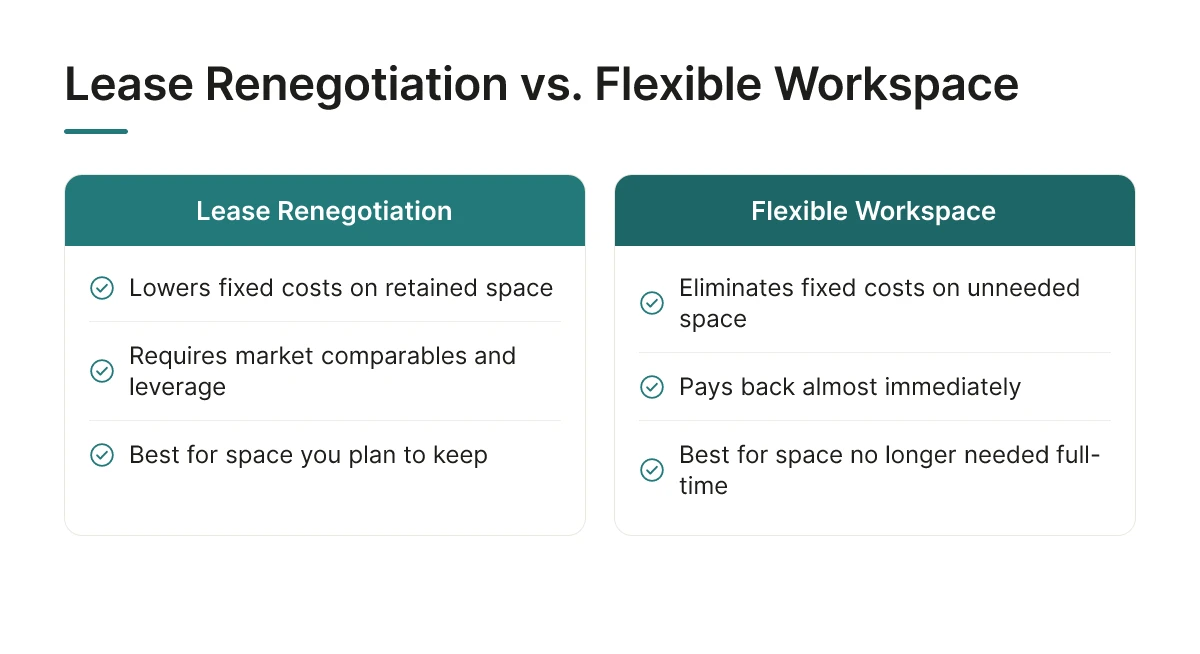
Lease renegotiation lowers fixed costs on space you plan to keep; flexible workspace eliminates fixed costs on space you no longer need full-time. Most strategies for how to reduce real estate costs come down to deciding which lever applies to which part of the portfolio, and when to pull both at once.
Lease renegotiation works by building use before you sit down with a landlord. Pull market comparables showing what nearby tenants pay for similar space, flag an approaching break clause or renewal date, and make clear that vacancy is rising in the submarket [3]. Landlords facing a real chance of losing a tenant, especially in a softening market, often prefer a reduced rent to a vacant floor [4]. Timing matters: tenants who wait until months before expiration give up most of their negotiating power [5].
Flexible workspace works differently. Instead of lowering the price of a fixed obligation, it replaces that obligation with usage-based access, you pay for desks and rooms as teams actually need them, not for square footage sitting empty five days a week. This is the structural fix for the 30-50% office utilization rates many hybrid enterprises now carry [2].
Renegotiate when a location has a long remaining term and stable, predictable demand; shift to on-demand access when demand is volatile or the lease is near expiry. A headquarters with five years left on the term and consistent attendance is a renegotiation candidate. A satellite office with unpredictable team size, or a lease expiring within a year, is better served by converting that obligation into flexible capacity.
A single corporate headquarters usually favors renegotiation first, since consolidating floors and extending the term in exchange for lower rent protects a location the business depends on long-term. Multi-location satellite portfolios behave differently, demand varies city to city, and flexible access lets a company shed fixed leases in lower-utilization markets while keeping presence where teams need it. Investment holdings sit closer to pure real estate strategy, where repositioning or divestment decisions outweigh either tactic [1].
Used together, the two tactics outperform either one alone: renegotiate the core footprint down to what stable demand actually requires, then route overflow and distributed teams to on-demand space. Upflex supports exactly this split, its UnifyAI forecasting shows which locations have genuinely stable demand worth renegotiating, while its on-demand workspace network absorbs the overflow without a new lease, a combination tied to 40%+ reductions in real estate spend among enterprises that have applied it.
The fastest way to learn how to reduce real estate costs is to sequence tactics by payback speed, not by how dramatic they look in a board deck. Flexible workspace adoption pays back almost immediately. Lease renegotiation takes longer. Consolidation or disposition takes longest of all. Building your plan around that order, rather than attempting everything at once, gives leadership visible proof the strategy works before the riskiest moves are even underway.
Rank every tactic by how quickly it converts into a lower cost-per-occupied-seat, and flexible space adoption wins that race because it needs no contract renegotiation or landlord approval.
Treating these as one undifferentiated "cost-cutting initiative" is a common planning mistake. Each tactic carries a different risk profile and a different proof point, and conflating them makes it harder to show incremental progress to the CFO.
Workplace orchestration software, scheduling, attendance forecasting, and space allocation tools, supplies the utilization data that turns renegotiation and flex-space decisions from guesswork into evidence. Without it, a real estate team negotiating a lease renewal is arguing from instinct about how much space the organization actually needs. With it, that same team walks into the negotiation with occupancy data covering weeks of actual attendance patterns.
Upflex's UnifyAI engine forecasts attendance with 97% accuracy, which gives real estate and finance leaders a defensible number to anchor both the flex-space decision and the lease negotiation in the same dataset. That consistency matters: a portfolio plan built on one source of truth is far easier to defend to a CFO than three disconnected spreadsheets.
Sequence the rollout in three phases, each tied to a metric leadership can track. Phase one: activate flexible workspace for overflow teams and measure cost-per-seat against owned office space. Phase two: renegotiate leases nearing expiration, measuring square footage reduced against actual occupancy data. Phase three: consolidate or dispose of underperforming buildings, measuring total occupancy cost against headcount served. Organizations using this approach alongside platforms like Upflex have documented reductions in real estate spend exceeding 40%, with each phase providing the data proof point for the next.
Most plans for how to reduce real estate costs fail not at launch but months later, when uncoordinated decisions quietly rebuild the inefficiency the plan was supposed to remove.
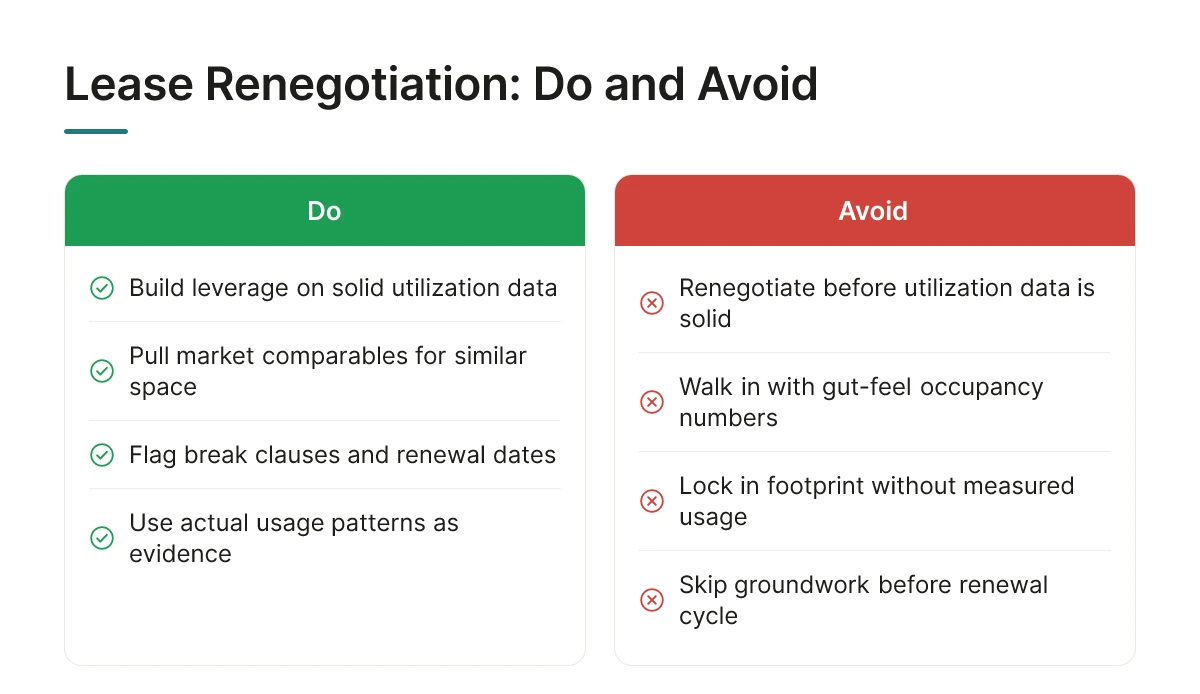
Most companies see measurable savings within one to two lease cycles, though initial concessions can appear within months of signing an amendment. Timing matters: starting renegotiation well before expiration gives you more use and more time to model alternatives, including subleasing part of your footprint or shifting staff to flexible workspace [3].
Yes, the core tactics, lease renegotiation, right-sizing, and flexible workspace access, scale down as well as up. Smaller companies often have less use in negotiations, but workspace costs still rank among the top business expenses regardless of company size [4], making utilization data and renegotiation timing just as valuable.
Not if the reduction is paired with better coordination, not just fewer desks. The risk comes from cutting space without visibility into when teams actually need to be in-office, that's what causes crowding, desk shortages, and complaints. Platforms like Upflex address this by forecasting attendance and giving employees access to on-demand workspace when the primary office runs tight, so consolidation doesn't translate into a worse day-to-day experience.
Start by instrumenting badge swipes, desk bookings, or Wi-Fi logs for 60 to 90 days before making any portfolio decision. Real estate teams that move from reactive cost-cutting to data-backed planning get more precision in forecasting demand and more confidence in right-sizing decisions [2]. Without that baseline, consolidation or lease changes are guesswork, not strategy.
Cutting real estate costs comes down to three moves: know your real utilization before you negotiate anything, renegotiate leases from a position of data and timing rather than desperation, and build flexibility into the portfolio instead of locking into another rigid long-term footprint [3][5]. Companies that skip the data step tend to cut space and lose employee trust in the same move.
Start smaller than a full portfolio overhaul: pull 90 days of badge or booking data from your highest-cost office and map it against your next lease expiration date before you schedule a single negotiation call.
Explore more from our content library: