Share This Article
No items found.


Understanding hub and spoke office is essential. A hub-and-spoke office model combines a smaller number of flagship "hub" locations with a wider network of satellite "spoke" workspaces, coworking spots, on-demand offices, or regional micro-offices closer to where employees actually live. Companies adopt it to cut real estate spend by consolidating underused headquarters space while still giving hybrid employees a professional place to work near home. It replaces the all-or-nothing choice between a single large office and fully remote work with a distributed, right-sized footprint.
A hub and spoke office model splits a company's real estate into one flagship location and a wider network of smaller, flexible workspaces positioned near where employees live. The hub anchors leadership and culture; the spokes handle everyday focused work. Together they form a single, coordinated portfolio rather than two unrelated real estate decisions.
The hub is the company's primary office, typically in a major city center, reserved for leadership presence, cross-team collaboration, client meetings, and onboarding [3]. It's deliberately smaller than a traditional headquarters built to seat the whole company at once, but it still has to earn the commute: the kind of work that happens there justifies people traveling in.
The spoke is everything else: a satellite office, a coworking membership, a dedicated desk, or even a home office arrangement, usually located closer to employee neighborhoods [4]. Spokes exist for day-to-day individual work or small-team collaboration that doesn't require the full company to be in one room. A spoke might be a single desk in a regional coworking space one week and a short-term project office the next, the format flexes to the need.
In practice, employees are assigned or choose a spoke near home for routine work, then travel to the hub only for specific, higher-value purposes, a quarterly planning session, a client pitch, a new-hire's first week. The hub isn't where work happens by default; it's where work happens by design. That distinction is what separates hub and spoke from simply scattering employees across random remote locations with no shared gathering point.
Remote work normalized distributed teams, but it also exposed how much employees and leaders still value occasional in-person connection, just not at the cost of a daily commute to a half-empty building [2]. Surveys during the shift to remote work found a majority of businesses believed the loss of social contact during work hours had hurt employee wellness [2], which pushed companies to look for a middle ground between a packed headquarters and total dispersion [2]. The hub and spoke model answers that directly: structured togetherness on fewer days, paired with convenience the rest of the week.
It's worth being precise about what this model is and isn't. Hub and spoke isn't a euphemism for downsizing, it's a portfolio strategy that matches space type to work type, so collaboration-heavy work gets a hub and routine work gets a spoke, instead of forcing every task into the same four walls.
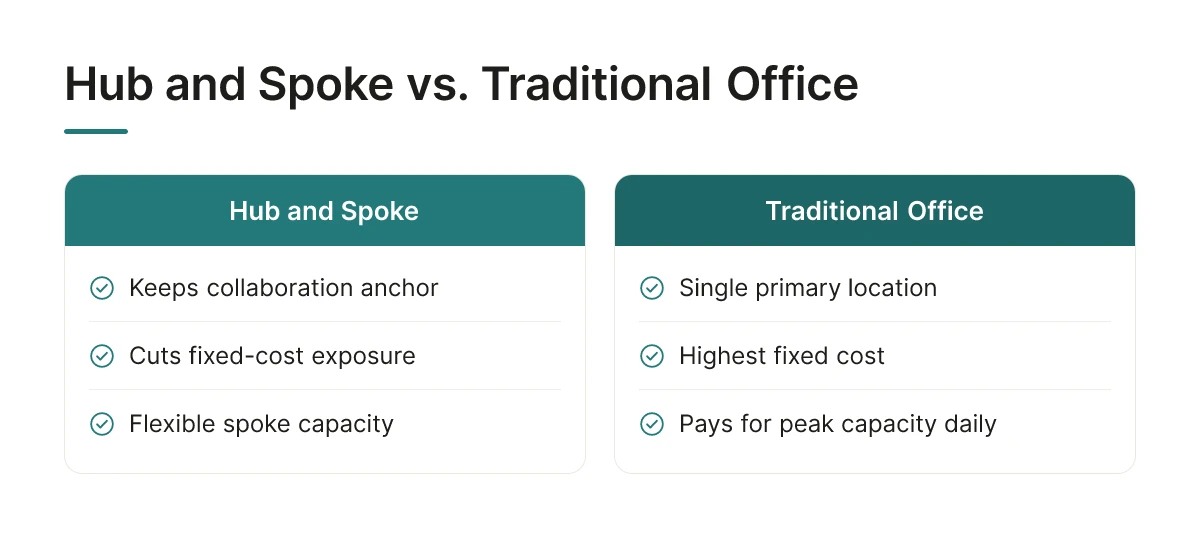
Hub and spoke sits between two extremes: it keeps a collaboration anchor like a traditional headquarters while cutting the fixed-cost exposure of fully remote work. The three models trade off differently on cost, culture, and coordination, and the right answer depends on how your workforce is actually distributed.
A traditional single-office model carries the highest fixed cost because the company leases for peak capacity, enough desks for every employee on the busiest day, even though most days fall short of that [2]. That gap between what you pay for and what gets used is the core sunk cost problem: square footage sits empty most of the week while the lease, utilities, and maintenance costs stay flat. Traditional offices do build strong culture and spontaneous mentorship, but they also force long commutes on employees who don't live near the single location, which shows up as attrition and lower satisfaction over time.
Fully remote work removes that fixed cost almost entirely, which is why many companies adopted it during the pandemic [2]. But it weakens the informal moments that drive mentorship and cross-team problem-solving, the hallway conversation that resolves a blocked project, or the new hire who learns by watching a senior colleague work through a decision in real time. A hub and spoke office is built to recover that collaboration without reinstating the full fixed-cost burden of a single headquarters [3].
That coordination overhead is real. Teams need to agree on which days matter for hub visits, and someone has to track whether those visits are actually happening. Upflex's UnifyAI engine addresses this directly by forecasting attendance with 97% accuracy, so workplace leaders can coordinate hub days around actual predicted turnout rather than guesswork, and track whether co-attendance targets are being met.
Choose hub and spoke when your talent is spread across multiple metro areas, your work depends on regular cross-team collaboration, and your current lease exposure is large enough that a lease renewal decision is already on the table. Smaller, single-city companies with low collaboration needs may do fine fully remote. Large enterprises with highly interdependent teams and multi-location leases are the clearest fit for a hub and spoke office strategy.
A hub and spoke office runs on four technology layers working together: booking and availability, attendance forecasting, security and access control, and a consolidated data view, without them, the model collapses into scattered leases with no coordination.
Companies that attempt this shift with spreadsheets and one-off booking links usually discover the gaps within a quarter. Employees can't tell which spoke has open desks, finance can't see utilization across sites, and IT ends up managing a different login process for every location.
Employees need a single place to check availability and reserve space, whether that's a desk at the hub or a seat in a third-party coworking location near home. Without this, teams default to guessing or showing up unannounced, which defeats the purpose of planning hub days for collaboration in the first place.
Forecasting tools solve a related problem: predicting who's actually coming in, and where, before the week starts. Upflex's UnifyAI engine, for example, forecasts attendance with 97% accuracy, which gives real estate leaders a defensible basis for right-sizing each hub and spoke location instead of relying on headcount assumptions or gut instinct. That accuracy matters directly for lease decisions, a hub sized for guesswork tends to stay oversized indefinitely.
Security has to work the same way everywhere, not just at the owned hub. Single sign-on, visitor management, and access controls need to extend into third-party spoke locations so an employee badges in, or checks in through an app, with the same credential and audit trail regardless of which building they're in. Gable's guide to the model notes that implementation tends to break down exactly at these seams, when companies stitch together separate tools for each site instead of one consistent layer [1]. Data consolidation closes the loop: one dashboard pulling utilization numbers from every hub and spoke location, rather than a folder of disconnected site reports that nobody reconciles. That single view is what lets finance and HR agree on what's actually underused.
None of this works in isolation from what's already running. Booking, forecasting, and access systems need to connect with existing HR records, IT identity systems, badge infrastructure, and calendar tools, so attendance data reflects reality rather than a parallel system employees ignore.
Savings come from converting fixed, long-term leases on underused square footage into flexible, pay-for-use spoke capacity, you stop paying full rent on space that sits empty three or four days a week.
The mechanism is straightforward. A conventional headquarters lease charges you for 100% of the floor plate every day, regardless of whether 30% or 90% of desks are occupied. A hub and spoke office model replaces most of that fixed cost with a smaller owned hub sized to actual peak attendance, plus variable spending on spoke locations, coworking seats, on-demand day offices, satellite sites, that scales with real usage. You pay less when fewer people show up, instead of paying the same no matter what.
Savings scale with how much underused space you currently carry, so results fall into rough tiers rather than one universal number.
A company already running a tight footprint with high utilization sees modest gains, the fixed-to-flexible conversion has less to work with. A company holding onto pre-pandemic square footage sized for daily full attendance sees meaningful to substantial savings, because the gap between leased capacity and actual occupancy is where the cost reduction lives. Cutting hub footprint while keeping headcount flat lowers cost per employee without reducing staff, you're not eliminating people, you're eliminating the square footage nobody was using. Upflex customers pursuing portfolio consolidation through this model have documented real estate spend reductions of 40%+ by right-sizing the owned hub and shifting overflow demand to its on-demand workspace network.
Calculate ROI by comparing your current fully-loaded real estate cost against the combined cost of a right-sized hub plus variable spoke usage, then adjust for productivity and retention effects.
Start with the baseline: rent, utilities, maintenance, and services across your existing footprint. Model the hub and spoke alternative, a smaller hub lease plus projected spoke spend based on forecasted attendance patterns, not guesswork. Upflex's UnifyAI engine forecasts attendance at 97% accuracy, which turns this from an estimate into a number you can defend to a CFO. Beyond direct cost, factor in two indirect drivers that rarely make the spreadsheet: reduced attrition risk from employees who no longer face long commutes, and faster time-to-fill when location flexibility widens your hiring radius beyond commuting distance to a single hub.
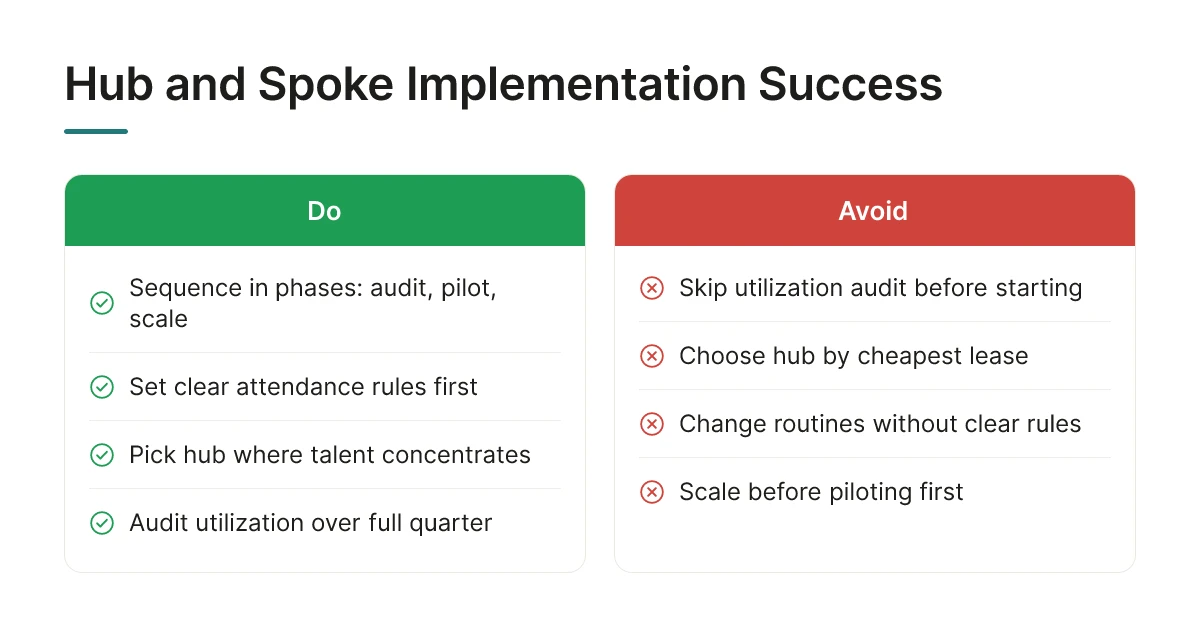
Implementation succeeds when you sequence it in phases, audit first, pilot second, scale third, and set clear attendance rules before you ask anyone to change their routine.
Start with a utilization audit of your current footprint: badge data, desk booking logs, and meeting room usage over at least a full quarter. This tells you which locations are overbuilt and which teams already cluster geographically, the raw input for deciding where your hub goes.
Pick the hub based on where talent actually concentrates, not where the lease happens to be cheapest or where leadership historically sat. Then pilot spoke locations in the zip codes with the highest employee density outside the hub radius, rather than guessing at regional coverage. Expand to full scale only after the pilot group reports reliable space quality and consistent booking availability.
Three problems surface repeatedly during rollout. Spoke space quality varies widely between providers, so an employee's third visit to a mediocre spoke location can undo weeks of goodwill. Employees default back to old habits, skipping the spoke and working from home, unless the hub and spoke office model gives them a reason to show up. And managers resist the shift because a hub and spoke office model takes away the visible headcount of everyone sitting in one room, which can slow buy-in from the middle of the org chart even when leadership is aligned.
Anchor days solve the ambiguity problem. Tell teams explicitly which days matter for hub attendance, the days reserved for collaboration, reviews, or cross-team work, so spoke flexibility doesn't drift into total unpredictability. Without an anchor framework, "flexible" quietly becomes "absent."
Track three numbers before and after rollout: commute time reduction, the gap between space utilization and booking rate, and sentiment survey trends. A shrinking gap between bookings and actual usage signals the spoke locations are trusted, not just reserved out of habit.
Platforms like Upflex support this by combining attendance forecasting with a global on-demand workspace network, so real estate and HR leaders get one utilization view across owned hubs and third-party spokes instead of stitching together separate reports.
Frame the change as an upgrade in choice, more locations, shorter commutes, control over where work happens, not as a cost-cutting move. Morale holds up far better when employees see the transition as something added to their options rather than something taken from the office they knew.
No, they solve different problems: hybrid work governs when employees come in, while hub and spoke governs where offices exist. A company can run a hybrid schedule from a single office or from a hub-and-spoke portfolio. Most distributed enterprises combine both, hybrid scheduling policies layered on top of a hub-and-spoke real estate footprint, to match attendance patterns with the right locations.
Most enterprises need one to three hubs, placed near the largest concentrations of employees or clients, not one per region. Adding hubs increases fixed costs, so the goal is the minimum number that still lets teams gather for collaboration-heavy work without long travel. Spoke locations or on-demand workspace fill the rest of the map.
Mid-sized companies can adopt hub and spoke, often more easily than large enterprises because they carry fewer legacy leases. A smaller company might keep one lean hub office and use on-demand coworking access instead of signing multiple spoke leases, which avoids the fixed overhead that made the original hub-and-spoke model expensive before flexible workspace networks existed [3].
Professional services, technology, and financial firms with geographically dispersed talent benefit most, since their work mixes solo output with periodic intensive collaboration. Any company with employees scattered across multiple cities or countries, and a real estate budget sensitive to utilization rates, gains from trading one large headquarters for a hub-and-spoke footprint.
A hub-and-spoke model only works if you can see, in real time, which offices people actually use. That means pairing the real estate decision, fewer, smaller hubs plus flexible spoke access, with attendance data accurate enough to act on. Upflex's UnifyAI engine forecasts attendance at 97% accuracy and tracks co-attendance against your collaboration goals, which is what turns a hub-and-spoke redesign into a documented 40%+ real estate savings rather than a guess. Before signing or renewing any lease, pull 90 days of badge or booking data for every location and map it against your proposed hub-and-spoke footprint, the gaps will tell you where to cut first.
Explore more from our content library: