Share This Article
No items found.


Understanding what is hub and spoke model is essential. A hub and spoke model for hybrid workplace strategy concentrates most of your office footprint in one central hub location while reducing or eliminating smaller satellite offices, the opposite of running multiple full-scale distributed headquarters. The hub carries fixed costs like long-term leases, dedicated floors, and on-site amenities, while spokes are served through flexible, on-demand workspace near where employees actually live. Compared to maintaining several distributed HQs, this approach typically lowers fixed real estate overhead and administrative duplication, while trading some of the always-on-site cohesion that a full local office provides. The right choice depends on team distribution, collaboration needs, and how predictable attendance is across locations.
The hub and spoke model is a corporate real estate strategy that pairs one anchor office with a network of flexible, on-demand workspaces instead of multiple full offices. Understanding what is hub and spoke model in this context matters because the same phrase gets used for a completely different concept in logistics, and confusing the two leads companies to the wrong playbook.
In workplace strategy, the "hub" is the primary anchor office, usually a headquarters or major market location where leadership, core teams, and client-facing functions sit. The "spokes" are smaller, flexible workspaces positioned near wherever employees actually live, rather than permanent branch offices the company owns or leases long-term.
The mechanism is straightforward: consolidate fixed real estate costs, leases, build-outs, dedicated floors, into one well-utilized hub, then cover geographically scattered employees through an on-demand workspace network instead of signing a lease in every city with a cluster of remote hires. This is a different idea from a distributed-HQ model, where a company maintains several full offices, each carrying its own fixed overhead, IT setup, and facilities staff regardless of how many desks get used on a given day [3].
Picture a company headquartered in Chicago with pockets of remote employees in Austin, Denver, and Raleigh. Rather than opening a branch office in each of those three metro areas, the company gives employees access to on-demand desks or day offices near where they live, reserving the Chicago hub for leadership, core teams, and the in-person collaboration that benefits from a permanent setting [4]. Employees in Austin might book a day office twice a week; those in Denver might use flex space mainly for client meetings or team collocation events. This maps directly onto how hybrid work actually happens, in-office days clustered a few times per week, periodic regional meetups, and all-hands gatherings at the hub, rather than everyone commuting to a fixed desk five days a week [2].
This workplace meaning is distinct from the hub-and-spoke concept in logistics and transportation, where a central distribution hub routes shipments out to regional spoke terminals for final delivery. Both uses share the same geometry, one center, several satellite points, but a real estate leader researching office strategy and a supply chain manager researching freight routing are solving entirely different problems, even though search results often blend the two.
For corporate real estate and HR leaders managing a distributed workforce, the real estate hub and spoke model is the one that determines lease costs, headcount planning, and how employees experience hybrid work day to day, the focus for the rest of this article.
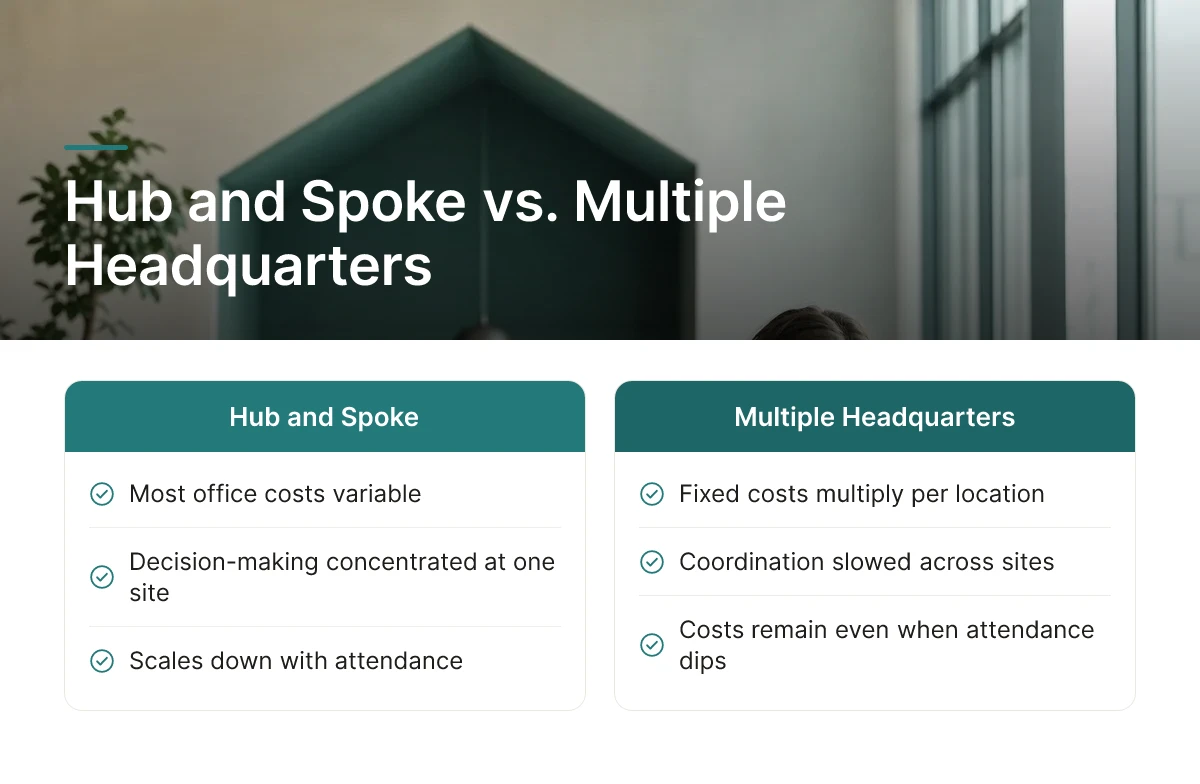
A hub and spoke setup turns most office costs variable and concentrates decision-making at one site, while multiple full headquarters multiply fixed costs and slow down coordination. Understanding what is hub and spoke model comes down to understanding this one structural trade-off: where costs live and who controls space utilization decisions.
Every additional full headquarters means another lease, another facilities team, another IT stack, and another security setup. None of this scales down when attendance dips. A regional HQ built for 500 people still carries rent, cleaning contracts, reception staff, and network infrastructure sized for 500, even on a Monday or Friday when actual occupancy might run far lower [2].
That capacity is sized for peak demand, not typical demand. Finance leaders end up paying for square footage that sits empty most of the week, a structural mismatch that shows up directly on the real estate line of the P&L.
A hub and spoke model keeps one anchor office, the hub, and replaces the rest with flexible, on-demand spoke locations that employees use only when they need them [5]. Instead of reserving fixed capacity everywhere, the organization pays roughly in line with actual attendance at each spoke.
This is where attendance forecasting changes the economics. Upflex's UnifyAI engine predicts office attendance with 97% accuracy, letting corporate real estate teams size the hub correctly and book spoke access only where and when teams actually show up, rather than guessing and overbuilding.
A single hub concentrates leadership, decision-making, and culture-building in one place, which tends to speed up alignment compared to running parallel headquarters that each develop their own norms and reporting lines [1]. Multiple full HQs mean duplicated management layers and more effort spent synchronizing policy across sites rather than executing it.
Hub and spoke works less well when several teams in different regions need daily, deep in-person collaboration, a single hub can't serve two geographies at once [3]. It also falls short when regulatory or data-residency requirements mandate a fully staffed local office rather than flexible space, a common constraint in financial services and government-adjacent industries.
A centralized hub concentrates culture-building and facilities management in one location, but it creates commute burdens, cultural splits, and single-point-of-failure risk that spoke-heavy models avoid. Understanding what is hub and spoke model trade-offs mean in practice requires weighing both sides against how a company actually operates day to day.
Concentrating headquarters functions in one place makes mentorship and culture easier to sustain, junior employees absorb norms by proximity to senior staff, and leadership can run all-hands events without coordinating across time zones. Facilities management also simplifies: one landlord, one security system, one IT closet instead of a dozen. Space forecasting gets more predictable too, since the bulk of in-person activity routes through a single address rather than scattering unevenly across regional offices.
The same concentration that strengthens culture at the hub can weaken it everywhere else. Employees who don't live near the hub absorb a real commute cost, and over time that can produce a two-tier culture, hub-based staff get face time and visibility, remote-first staff get neither. A hub also becomes a single point of disruption: a weather closure, a lease dispute, or a building system failure takes the whole operation offline at once, something a distributed footprint spreads across several sites instead.
Attendance rarely matches the policy on paper. Teams show up on different days for different reasons, which makes space planning difficult when a facilities team is sizing the hub for an average that no single week actually looks like [4]. Employees accustomed to a local office often resist losing it, and adoption tends to be uneven, sales and client-facing teams gravitate toward the hub for meetings while engineering or support functions stay remote by default [2]. None of this is a failure of the model itself; it's what happens when a hub is sized on assumption rather than data.
Attendance forecasting and space-utilization data are replacing guesswork with evidence. Instead of leasing a hub sized for a worst-case headcount, companies can use forecasting tools to see which days teams actually converge and right-size the hub accordingly, shifting the freed-up budget toward spoke access where employees actually live. Upflex applies this directly: its UnifyAI engine forecasts attendance with 97% accuracy, letting real estate leaders consolidate the hub with confidence while giving distributed employees on-demand access to a global workspace network instead of a long-term lease they may never fill. That data-driven allocation is what turns the commute-burden and two-tier-culture limitations from the prior section into solvable planning problems rather than permanent trade-offs.
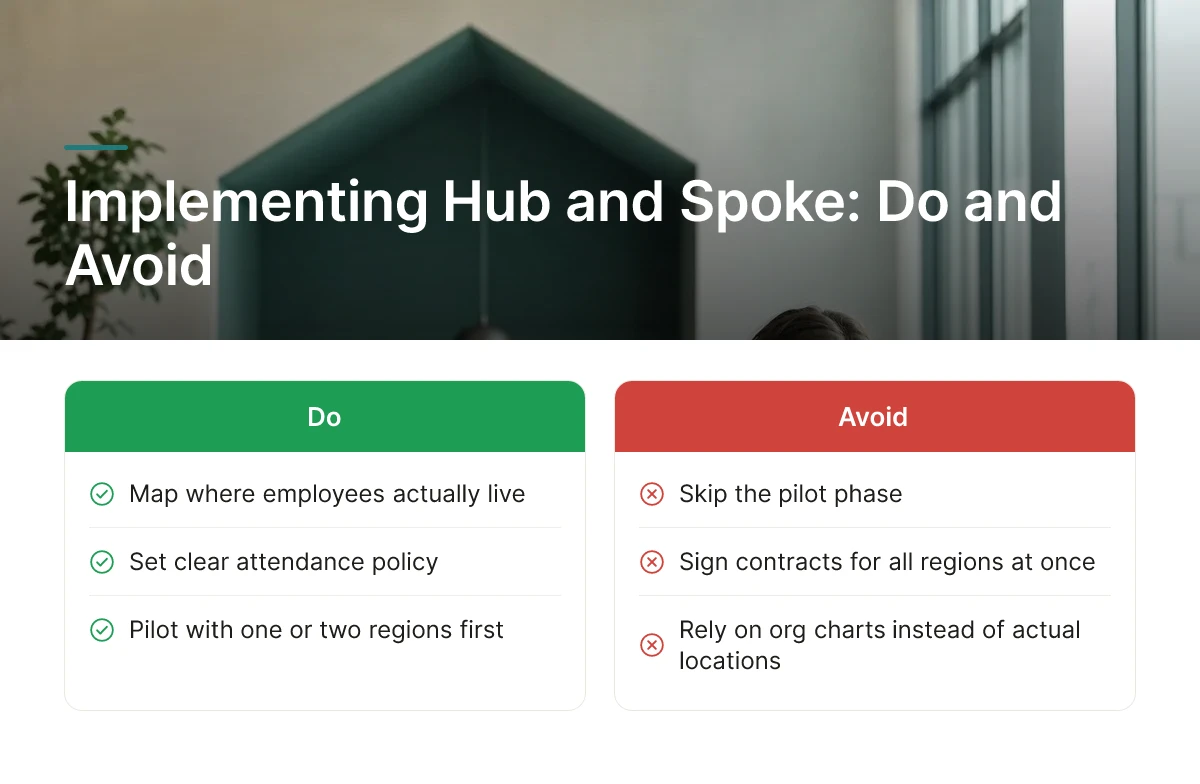
Implementation follows three phases: map where employees actually are, set clear attendance policy, then pilot with one or two regions before scaling company-wide. Skipping the pilot is the most common reason a hub and spoke rollout stalls, teams discover mismatched spoke locations or unclear booking rules only after they've signed contracts for every region at once.
Start by pulling together where employees actually live, not where org charts say they sit. Compare that against stated attendance intent, how often people want to come in, and for what reason, to decide which city anchors the hub and which secondary markets need spoke coverage [5]. This is also where attendance forecasting tools earn their keep: Upflex's UnifyAI engine processes scheduling and utilization data to predict attendance with 97% accuracy, which turns a guess about spoke demand into a data-backed decision.
Attendance policy needs a business reason behind it, not an arbitrary day count. Tie hub visits to onboarding, project kickoffs, and team syncs that genuinely benefit from in-person time, and let routine focus work happen from spokes or home [4]. This is the core of what is hub and spoke model planning gets wrong most often: treating the hub as a mandate instead of a tool for specific collaboration moments.
Run the model in one or two spoke regions first. Use real feedback, did people use the space, was the workspace type right, was frequency too high or too low, to adjust before signing agreements across every market [1].
Budget the two sides differently. The hub carries fixed, premium costs since it's a long-term anchor location. Spokes should stay flexible and budget-friendly to mid-range, scaled to actual usage rather than locked into multi-year leases, which is the entire point of pairing a core office with on-demand access instead of a second permanent headquarters.
Running a hub and spoke model well requires a booking and access platform, attendance forecasting, co-attendance coordination, and integrations that tie real estate, HR, and calendar data into one view. Without this layer, a hub and spoke model collapses into disconnected spreadsheets and guesswork, exactly the patchwork most corporate real estate teams are trying to escape.
Employees need one system to reserve a desk at headquarters or book a seat at a spoke location, whether that spoke is a company-leased satellite office or a third-party coworking space. Separate tools for the hub and for flexible spoke access force employees to check multiple apps before they know where they're even allowed to work that day. A single booking layer removes that friction and gives facilities teams one source of truth for who is using what space, where.
Forecasting uses historical check-ins and planned bookings to predict how many people will show up at each location on a given day, which is what separates a well-run hub and spoke model from one that wastes money. Without forecasting, companies either overbuild spoke capacity "just in case" or underbuild it and frustrate employees who can't find a desk. Upflex's UnifyAI engine processes scheduling and utilization data to forecast attendance with 97% accuracy, giving real estate teams the confidence to size spoke capacity against actual demand rather than assumption.
Co-attendance tools let teammates see when colleagues plan to be at the hub or at a shared spoke, so in-office days actually produce in-person collaboration instead of half-empty rooms. This matters because the entire argument for maintaining a hub depends on people showing up together, not just showing up. Coordination features that surface team schedules in advance are what turn a hub and spoke model from a real estate decision into a working team rhythm.
Office orchestration connects booking, forecasting, and network access into one managed system instead of a collection of disconnected vendors. Upflex combines its forecasting engine with access to a global on-demand workspace network, so the hub and the spoke locations are managed as a single portfolio rather than separate line items tracked in different tools [5]. Platforms built this way report achieving 88% co-attendance against stated in-office goals, and organizations using integrated orchestration have cut real estate spend by more than 40%.
The orchestration layer only works if it pulls from calendar systems, HR data for employee location mapping, and real estate or expense reporting feeds. Calendar integration shows planned meetings and travel; HR data maps which employees are assigned to which hub or region; expense and lease data close the loop on cost per square foot. Together, these integrations answer the practical question behind what is hub and spoke model in operational terms: one dashboard showing who's working where, what it costs, and whether the space is being used.

No, the underlying structure is similar, but the goals differ. Logistics and airline hub and spoke networks move goods or passengers through a central point for efficiency. In workplace strategy, the hub is a flagship office for collaboration and culture, and spokes are smaller regional offices or on-demand workspaces that reduce commute times and real estate costs for distributed employees.
There's no fixed ratio, it depends on where employees actually live and how often teams need to meet in person. Companies typically map home addresses and attendance patterns first, then add spoke offices or on-demand workspace access in clusters where enough employees justify a dedicated space, rather than guessing at a number upfront.
Not in the traditional sense, but a modified version works well. Fully remote companies often replace the physical hub with occasional on-demand meeting spaces for off-sites, while using a global workspace network as "spokes" for employees who need a desk closer to home.
Mid-size to large enterprises with distributed hybrid teams across multiple cities or countries see the biggest gains. Companies in the 500 to 10,000+ employee range, where real estate is a top-three operating cost, have the most to gain from consolidating a single headquarters while giving distributed teams flexible access to spoke workspaces instead of signing new long-term leases.
A hub and spoke model works when the hub is sized for genuine collaboration needs, not legacy headcount, and spokes are chosen based on where employees actually live and work. The real payoff comes from pairing that structure with accurate attendance data, guessing at utilization is what leads companies to overpay for empty square footage in the first place.
Before signing or renewing any lease, pull your actual badge-swipe or booking data for the last two quarters. If you don't have reliable attendance data yet, that's the first gap to close, platforms like Upflex forecast attendance with 97% accuracy, which is the kind of evidence a CFO needs before approving a hub and spoke restructuring.
Explore more from our content library: