Share This Article
No items found.


Understanding why office utilization matters is essential. Optimizing office space utilization delivers better business outcomes than headcount growth because it ties real estate cost directly to actual demand instead of theoretical capacity. Adding headcount increases payroll, benefits, and often real estate costs in lockstep, even when a large share of desks and meeting rooms sit empty most days. Companies that manage utilization instead can absorb growth into underused space, cut unnecessary leases, and reallocate real estate budget toward hiring or product investment. The result: lower fixed overhead per employee and a workplace that scales with how people actually work, not with a static seat-per-head ratio.
Headcount growth and real estate cost rise together by default, unless a company actively manages how existing space gets used. That default link is why office utilization matters: it determines whether every new hire adds to the lease bill or simply fills a seat that was already being paid for.
Most real estate planning still runs on a seat-per-head ratio inherited from a fully in-office era. Add 50 employees, lease space for 50 desks. But hybrid attendance patterns broke that formula, offices built for daily, full-capacity attendance now sit at a fraction of that most days, which means new headcount can often be absorbed into space that's already under contract [3]. Utilization management is the discipline that makes that absorption possible instead of accidental.
An empty desk costs almost the same as an occupied one, the lease, utilities, cleaning contract, and depreciation on furniture and fit-out don't scale down because attendance is low. Office vacancy and underuse have become structural problems rather than temporary ones: nearly 20% of office space across major U.S. cities sat unleased as of late 2023, the highest rate recorded since at least 1979 [1]. For a company still leasing on a per-head basis, every unused desk is a fixed cost with no offsetting output, and that gap compounds across every location in a multi-office portfolio. This is precisely why office utilization matters at the financial planning level, not just the facilities level.
The clearest proof points are comparative, not theoretical. Track cost-per-used-seat before and after an optimization effort, real estate spend divided by seats actually occupied, not seats available. Log every lease renewal that gets deferred, downsized, or avoided entirely because utilization data showed the space wasn't needed. And watch square footage per employee over several quarters: a downward trend while headcount holds steady or grows is the signal that space is being managed as a flexible resource instead of a fixed allocation.
A clear way to see ROI emerge is to compare two companies hiring 200 people in the same year:
Upflex's UnifyAI engine supports the second path directly, forecasting attendance with 97% accuracy so real estate and workplace teams know, well before a renewal date, how much space actual demand requires rather than how much headcount theoretically implies.
That shift changes what real estate is on the balance sheet. Instead of a fixed cost indexed to headcount, it becomes a lever tied to demand, one that corporate real estate and finance leaders can adjust as attendance patterns change, rather than one that only moves in one direction as the company grows.
Three metrics tell the real story: utilization rate (seats or space actually used against total capacity, over a defined period), the gap between peak and average occupancy, and utilization broken down by room type or neighborhood. Together they answer why office utilization matters more than a simple headcount ever could, they show not just who has a desk assigned to them, but who actually sits down at one.
Utilization rate is calculated by dividing occupied seats or square footage by total available capacity over a given stretch of time [4]. Peak versus average matters because a floor that hits 90% capacity on Tuesday and sits at 20% the rest of the week has a very different real estate problem than one running a steady 55% all five days [4]. Utilization by room type matters because a building can show healthy overall numbers while every desk sits empty and every conference room stays double-booked, a mismatch no single aggregate figure will catch [4].
A one-day headcount, or a badge swipe at the lobby door, understates reality because attendance swings by day of week, by team, and by season. A Monday count tells you about Monday. It says nothing about whether Thursday is overflowing or whether the whole floor empties out every other Friday. Measuring utilization across a full week or month turns a snapshot into a pattern leaders can actually act on.
Review utilization weekly to catch short-term shifts and monthly to confirm real trends before acting on them. Daily snapshots are noisy, a holiday, a weather event, or a single canceled all-hands can skew one day's numbers without meaning anything for the quarter. A rolling weekly view smooths out that noise, while a monthly roll-up is what should actually inform decisions like lease renewals or floor consolidations, since it filters out one-off anomalies and shows the sustained pattern underneath.
Occupancy sensors and workplace management platforms solve different halves of the measurement problem, and most organizations need both working together. Sensors passively capture raw presence, who's actually at a desk or in a room, independent of what anyone booked or reported [4]. Platforms layer booking behavior, badge data, and reporting dashboards on top of that raw signal, turning presence counts into decisions about floor plans, team schedules, and lease size.
Manual audits are a budget-friendly starting point for smaller footprints, but they're labor-intensive and only as good as the day they were taken. Continuous sensor networks cost more to deploy but remove the guesswork entirely, which is why Upflex pairs its UnifyAI forecasting engine, built to predict attendance with 97% accuracy, with desk booking and real-time utilization data, giving real estate and HR leaders one dashboard instead of a patchwork of spreadsheets and badge logs.

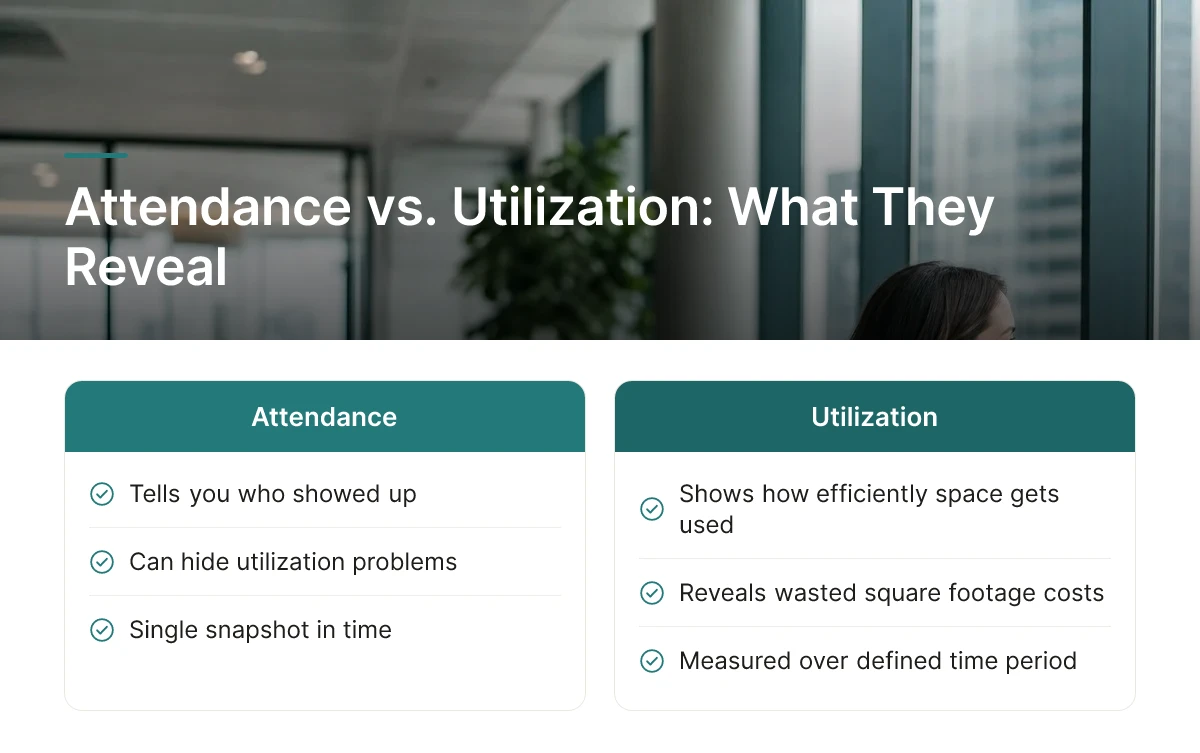
Attendance tells you who showed up, occupancy tells you how many people are in the building right now, and utilization tells you how efficiently your space gets used relative to its full capacity over time. These three numbers answer different questions, and mixing them up is a primary reason why office utilization matters so much to hybrid work strategy, a strong attendance figure can hide a utilization problem that's quietly costing a company millions in wasted square footage.
Consider a company where 80% of employees badge in on a given week. That sounds like a healthy return-to-office result. But if everyone converges on Tuesday through Thursday and skips Monday and Friday entirely, utilization on those slow days can sit near zero while Tuesday's floors are overcrowded and desks run short [5]. High attendance and low utilization can coexist in the same building, on the same week, because attendance measures people and utilization measures space over time.
The label "hybrid" matters less than whether those four days are spread out enough to avoid both overcrowding and waste. A four-day mandate that concentrates everyone on the same four days functions more like a full-time policy with one day off, it creates the same peak-day crunch and the same empty-day waste as a rigid five-day schedule, just slightly smaller.
A real hybrid strategy staggers attendance across teams and days so the building carries a steady, predictable load. That requires visibility into which teams are coming in when, not just how many days a policy allows. This is where forecasting tools earn their keep: Upflex's UnifyAI engine predicts attendance with 97% accuracy, which lets workplace leaders coordinate in-office days across teams before the mismatch between policy and reality shows up as wasted space [3].
What counts as acceptable utilization shifts by function, not just by company. Client-facing finance teams often need consistent, predictable in-person coverage because client meetings and deal work don't tolerate empty desks on short notice. Engineering-heavy tech teams, by contrast, can usually tolerate more day-to-day variability since collaboration needs cluster around specific sprints or launches rather than a daily schedule. Neither pattern is wrong, but applying one team's benchmark to another's workflow will misread the data every time.
This is also why conflating the three metrics leads to bad decisions. A company that sees low utilization and assumes it needs less space may actually have a scheduling problem, teams aren't coordinated, not that the office is oversized. Conversely, a company that sees overcrowding on peak days and leases more square footage may be solving a clustering problem with real estate when better day-distribution would have fixed it at no added cost [2].
There is no universal utilization target, a fully in-office company, a hybrid team, and a remote-first business with occasional meetups each need a different baseline entirely. Copying a number from a benchmark report without accounting for your own work model is part of why office utilization matters so much: the target only has meaning in context.
Yes, a rate considered healthy for one company can signal overcrowding or waste for another, depending on team size, function, and how people actually work day to day. A 500-person sales organization with heavy client-facing travel will naturally show lower daily occupancy than a 50-person engineering team that collocates for sprints. Neither number is wrong; they just reflect different operating models.
Company size matters too. Larger portfolios with multiple buildings can absorb more variance between floors or sites, while a single-office company has less room to average out swings in attendance. Work arrangement, fully remote with quarterly offsites, hybrid with anchor days, or mostly in-office, sets a different ceiling on what "good" even looks like before you measure anything.
Several factors shape productivity, but the ones tied directly to utilization are team size, function mix, meeting load versus focus work, and how flexible your current layout is. A floor built for fixed desks and few meeting rooms will strain under a meeting-heavy hybrid team even at moderate occupancy, while the same headcount in an open, reconfigurable layout might handle higher density without friction.
The mechanism is straightforward: when space is well-matched to how people actually use it, employees spend less time hunting for a desk or a free room, and the office stops feeling like a gamble on in-office days [4]. Too little space creates scarcity and frustration; too much creates empty floors that undercut the case for keeping the lease at all [5].
The practical approach starts with measuring your current baseline before setting any target. Upflex's UnifyAI engine forecasts attendance patterns with 97% accuracy, giving corporate real estate and workplace leaders a working baseline instead of a guess, then supports incremental improvement targets tied to actual co-attendance goals rather than an imported industry average. Revisit the target quarterly, since hybrid patterns shift with policy changes, seasonality, and team composition [5]. Borrowing another company's "good" rate without checking whether your work model matches theirs is a fast route to premature downsizing, or overcrowding the space you kept [3].
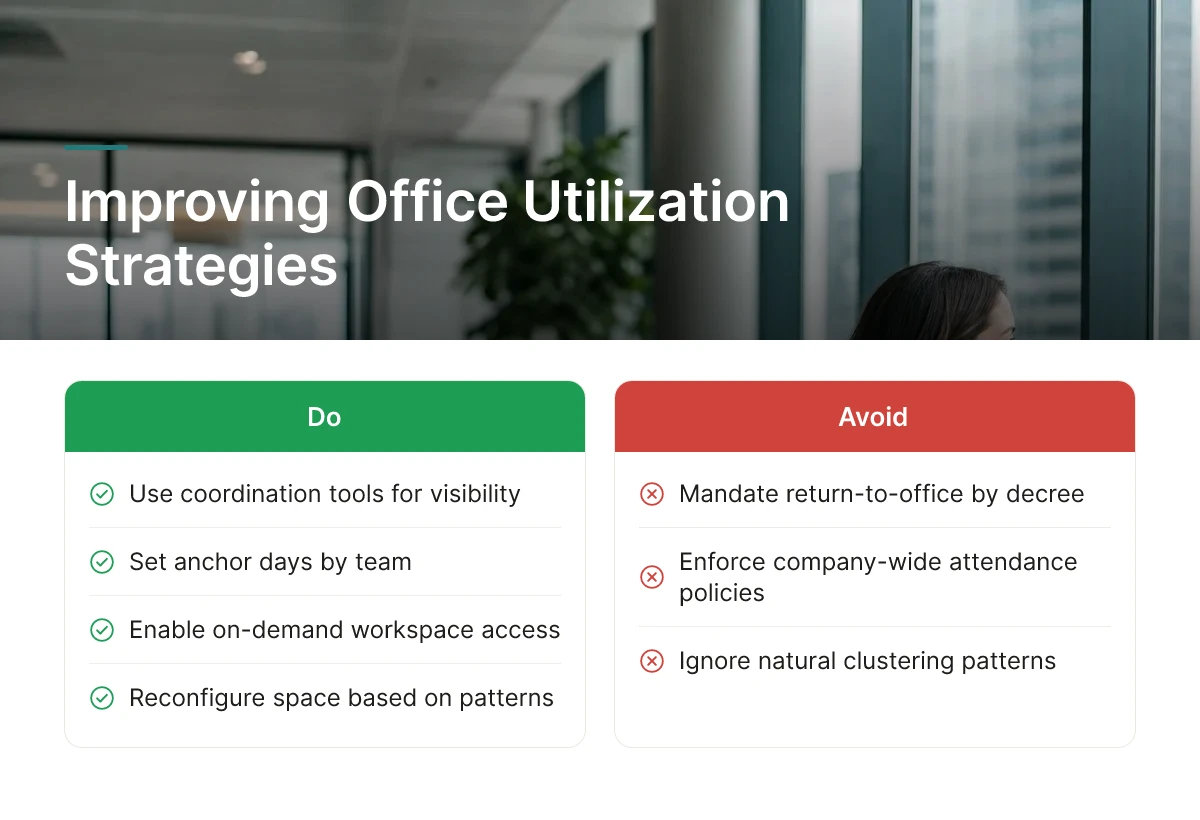
Coordination tools, space reconfiguration, and on-demand workspace access raise utilization without a single mandate, which is exactly why office utilization matters more than attendance policing.
The simplest lever is visibility. When employees can see which colleagues are already planning to come in before they commit to a commute, attendance clusters naturally around the days that matter. Anchor days set by team, not by company-wide decree, let a product team settle on Tuesday and Thursday while finance picks Monday and Wednesday, based on when each group actually needs to collaborate in person.
Neighborhood-based seating reinforces this. Instead of open, unassigned desks scattered across a floor, teams get a home base that moves with their anchor-day rhythm. This is where booking and forecasting tools do real work: a platform like Upflex uses attendance forecasting to predict who's coming in and when, so coordination happens automatically instead of through a flurry of Slack messages each week.
On the real estate side, the lever is consolidation. Companies combine underused floors, hand back excess square footage, and convert what remains into flexible space that adapts to meeting patterns rather than legacy desk-to-headcount ratios built for a five-day office [4]. Room types matter here too, fewer large conference rooms, more small huddle spaces, because hybrid collaboration tends to happen in smaller, more frequent bursts.
An on-demand workspace network solves a different problem: the employee who lives an hour from headquarters but needs a desk two days a week. Rather than maintaining excess capacity in one central building to cover people who rarely use it, companies give employees access to workspace near their homes. Upflex's global on-demand network, for instance, lets a company shrink its core footprint while still giving distributed employees somewhere to work, directly addressing the fixed-cost-per-headcount problem that headcount-based planning creates.
Taken together, the most effective utilization strategies tend to share a few common traits:
Size space to peak simultaneous attendance, not total headcount, hybrid schedules mean far fewer people show up on any given day than are employed in total [3]. A company with 1,000 employees on a three-day hybrid schedule rarely needs seating for 1,000; it needs seating for its busiest overlapping day, which forecasting tools can predict with precision.
The honest answer: it varies by starting point, and credible results come from measuring a utilization trend line before and after a change, not from a single snapshot. Companies that get this right run phased rollouts, adjust seating ratios or booking rules, then check utilization data at defined intervals, so decisions about further consolidation rest on trend evidence rather than a one-time reading [5].
Attendance counts people walking in the door; utilization tells you whether the space they occupy matches what you're paying for. A floor can feel busy at the entrance while meeting rooms sit empty and half the desks go unbooked. Without utilization data, you're guessing at lease decisions worth millions based on anecdote rather than evidence [5].
No, low utilization is a real estate signal, not a staffing signal. Headcount and space needs have decoupled under hybrid work, since how often people come in and why has become more important than how many people you employ [3]. The fix is usually right-sizing or consolidating space, not reducing the team.
Smaller companies benefit too, though the stakes scale with square footage and lease size. A 50-person team overpaying for a half-empty floor faces the same bad math as an enterprise, just with fewer zeros. Tracking utilization early also prevents bad habits, like leasing by headcount instead of actual need, from calcifying as the company grows.
Most organizations see measurable shifts in attendance patterns within one to two quarters of changing hybrid policy or space allocation. Real estate decisions, subleasing, consolidating floors, exiting a lease, take longer, often tied to renewal timelines. Forecasting tools shorten the gap by showing which changes are working before a full quarter closes.
Put simply, utilization shows whether space is being paid for twice: once in rent and once in the opportunity cost of not using that budget elsewhere. Framing it this way helps HR, finance, and operations leaders understand why office utilization matters even if they never touch a lease document directly, since the underlying issue is resource allocation, not facilities management.
Office utilization matters because it replaces guesswork with evidence at the exact moment leadership is deciding whether to renew, downsize, or consolidate a lease. Headcount no longer predicts space need [3]; only measured attendance patterns do. Three actions follow directly: track utilization before your next renewal date, use forecasting rather than historical badge data to plan seat counts, and treat consolidation as a data-driven move you can defend to both your CFO and your workforce.
Start by pulling your last two quarters of badge or booking data and comparing it against your current square footage, that single exercise usually reveals whether your next move should be a renewal, a downsize, or a platform like Upflex to forecast what comes next.
Explore more from our content library: