Share This Article
No items found.


The fastest corporate real estate optimization wins come from actions that don't require a lease renegotiation or a capital project: right-sizing underused floors with flexible workspace, automating occupancy tracking, and consolidating redundant locations into on-demand hubs. These moves target the gap between how much space hybrid teams are paying for and how much they actually use, a gap that widens every quarter without active management. Organizations that act on utilization data first, before touching leases, typically see cost and space-efficiency gains within one to two quarters.
Start corporate real estate optimization with a utilization audit, it costs nothing in lease changes and shows exactly where space is wasted.
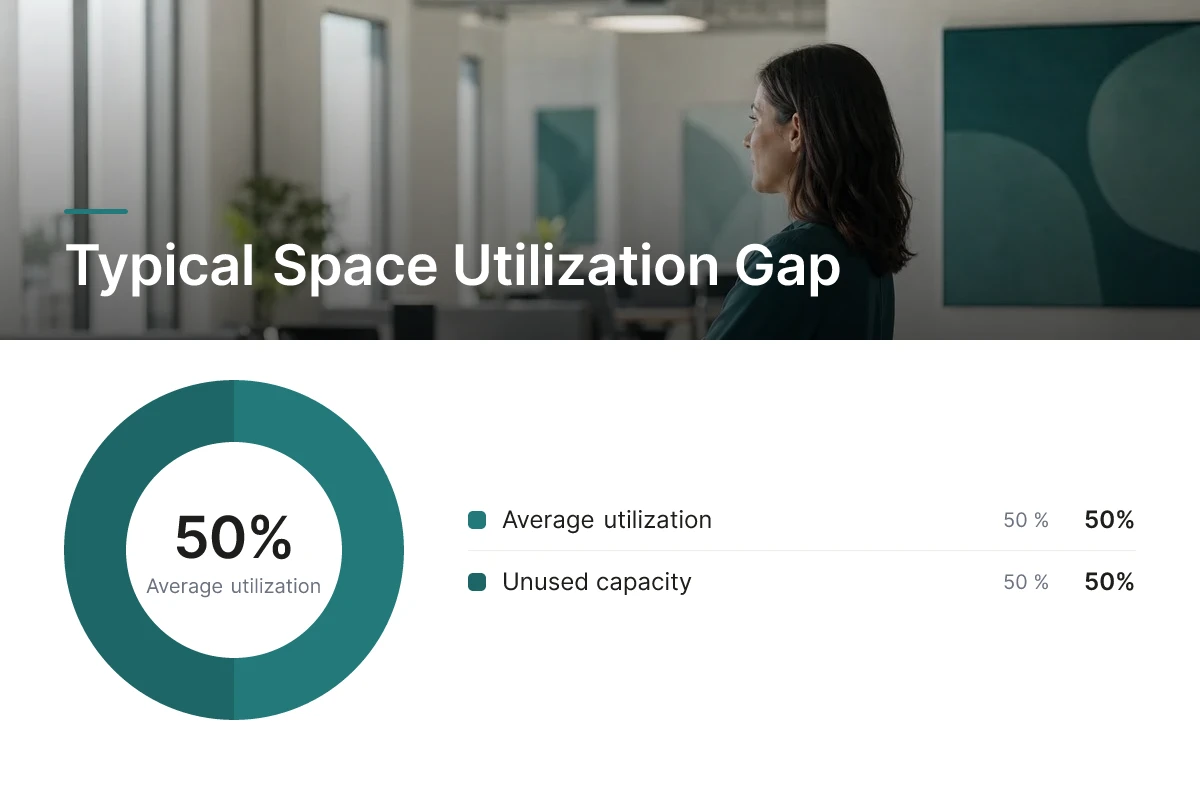
Badge swipes, occupancy sensors, or desk booking logs all reveal the same gap: how many seats a floor was built for versus how many people actually sit in it on a given day. The most common finding is a floor provisioned for full headcount that runs at a fraction of capacity even on the busiest day of the week [4]. Global utilization rates hover around 50% on average, meaning half the portfolio companies pay for sits empty most of the time [4].
This step suits organizations that haven't touched their lease portfolio yet and need a data baseline before negotiating anything with landlords or finance.
The differentiator is pairing raw occupancy data with actual attendance patterns, not just sensor counts. A floor can read "empty" because of a bad layout, desks nobody wants to sit at, or because hybrid schedules keep half the team home on Mondays and Fridays. Those two problems have completely different fixes, and conflating them wastes the audit.
Close or shrink low-utilization offices and shift that headcount to on-demand workspace, turning fixed lease cost into variable, usage-based spend.
A signed lease charges the same rent whether a floor is full or empty. On-demand workspace flips that: you pay for seats used, not seats held [5]. Candidates for consolidation are usually easy to spot, locations with consistently low average attendance, often small regional teams scattered across several cities instead of concentrated in one hub.
This move fits companies carrying multiple satellite offices or a regional footprint where no single location is anywhere near full capacity. Rather than renewing five half-empty leases, they fold that footprint into a smaller core plus flexible access.
The differentiator here is coverage continuity. Closing a dedicated office doesn't have to mean losing a city, employees still need somewhere to work in that metro area. Upflex addresses this directly by giving employees access to its on-demand workspace network, the largest global network of third-party workspaces, so a team can lose its dedicated office without losing its city.
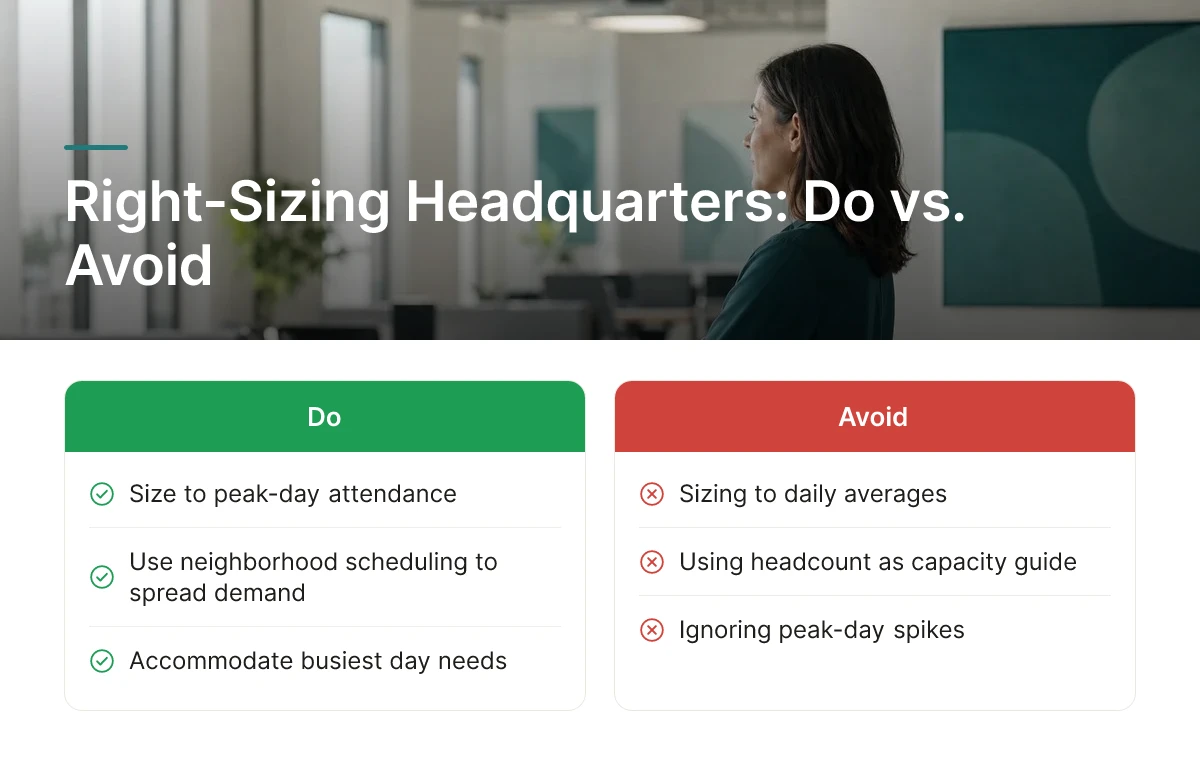
Size headquarters to peak-day attendance, not headcount or daily averages, since peak days, not typical days, set real capacity needs.
Average daily attendance understates what a building actually needs on its busiest day. If Tuesday brings in 80% of the workforce while Thursday brings in 30%, the lease has to accommodate Tuesday regardless of what the average says. Neighborhood or team-based scheduling, assigning departments to specific in-office days, smooths that peak, spreading demand across the week so the building needs less total square footage to cover everyone comfortably [3].
This approach works best for organizations anchored around one dominant headquarters with fragmented, team-by-team in-office schedules rather than a company-wide mandate.
The differentiator is forecasting attendance ahead of time instead of reacting to badge data after the fact. Upflex's UnifyAI engine predicts attendance with 97% accuracy, letting real estate teams set space requirements proactively rather than discovering the peak-day crunch after desks run out.
Automated booking removes manual seat coordination entirely, freeing facilities staff for planning work instead of spreadsheet maintenance.
Manually tracking who sits where across multiple floors or buildings turns into a full-time job once headcount passes a few hundred people. Automated booking systems eliminate that coordination layer, and the byproduct is more valuable than the time saved: every reservation becomes a data point. Instead of running a one-time audit, facilities teams get a live, continuous feed of actual utilization [2].
This fits mid-size and large teams spread across multiple floors or buildings where manual space allocation has stopped scaling.
The differentiator is using booking patterns to catch quiet space hoarding, teams that reserve rooms or desks out of habit but never show up. Reservation counts alone hide this; cross-referencing bookings against actual check-ins exposes it, which matters for any corporate real estate optimization effort trying to separate real demand from reserved-but-unused space. For more information, see Changelog.

Bring documented occupancy and attendance data into lease talks, landlords and finance teams act on evidence, not estimates.
A downsizing request backed by months of badge data and booking history moves faster than one backed by a hunch. Finance teams approve subleasing or footprint reduction when the occupancy trend is documented, not projected [1]. Shorter, more flexible lease terms also reduce exposure if attendance patterns shift again, a five-year fixed commitment locks in a guess, while shorter terms let the portfolio adjust as hybrid norms evolve [1].
This step is best timed for organizations approaching a lease renewal or break clause within the next year, when there's an actual decision point to bring evidence to.
The differentiator is sequencing: this works best after utilization audits and booking automation have already produced months of real data. Walking into a renegotiation with that evidence, rather than gut-feel estimates, is what separates a defensible corporate real estate optimization plan from a reactive cost-cutting exercise.
On-demand workspace access lets remote employees book external offices by the day, replacing the cost of a dedicated lease in every city where staff live.
Instead of signing a lease anywhere a cluster of employees shows up, companies pay only when someone actually needs a desk. The mechanism is simple: a global network of third-party offices and coworking spaces stands in for permanent square footage, priced per use rather than per year.
This matters for recruiting as much as for cost control. Remote employees who want occasional in-person workspace, without relocating or commuting to a distant headquarters, get one, which removes a common friction point in hybrid hiring and retention conversations.
This approach fits distributed or remote-first companies with employees clustered in secondary cities that don't justify a company-owned office. Upflex's differentiator here is consolidation: booking and reporting on external workspace use run through the same platform used to manage internal offices, so facilities teams get one usage record instead of a separate, disconnected tool for flex space.
AI forecasting predicts who is coming into which office on which day, so facilities teams provision space, staff, and services before demand hits, not after.
Forecasting models pull from historical badge and booking data, calendar entries, and team-level attendance patterns to project occupancy days or weeks out. Upflex's UnifyAI engine, for example, is built to forecast attendance with 97% accuracy, giving real estate and workplace teams a reliable basis for decisions that used to rely on guesswork or quarterly surveys.
Accurate forecasts extend past desk counts. When a facilities team knows Tuesday will bring 40% more people than Thursday, it can adjust cleaning schedules, front-desk staffing, and catering orders alongside space allocation, turning forecasting into an operating cost lever, not just a space-planning input.
This step suits organizations that have already completed a utilization audit and are ready to move from reactive adjustments to proactive planning. The differentiator worth noting: forecasting should predict co-attendance, which teams are physically together, rather than raw headcount, since collaboration days, not total bodies, drive how much space an office actually needs. Platforms that track co-attendance report outcomes like 88% achievement of in-person collaboration targets, a sign the forecast is solving the right problem.
Sequence these moves by lease timeline, company structure, and data maturity, running them all at once usually backfires.
Lease timeline should set the order of operations. If no renewal or break clause is near, start with the utilization audit and booking automation to build a data foundation. If a break clause is imminent, prioritize lease restructuring conversations first, using whatever utilization data already exists, even if incomplete.
Company structure changes which wins matter most. A single-headquarters organization gets the most value from right-sizing its owned footprint. A distributed company with employees spread across secondary cities gets more value from on-demand workspace networks than from renegotiating a lease it barely uses.
Data maturity is a gating factor, not a nice-to-have. Negotiating with a landlord or consolidating floors before utilization data exists means decisions get made on guesswork, which tends to get revisited, expensively, within a year [1].
Three failure points show up repeatedly: skipping the audit step and jumping straight to cuts, underestimating the change management employees need when desks or locations shift, and selecting tools that don't integrate with existing calendar or badge systems, which recreates the fragmented, non-talking-to-each-other tool problem many teams are trying to escape [4].
On cost, qualitative tiers exist, budget-friendly point tools, mid-range platforms, and enterprise-grade systems like Upflex that combine forecasting, booking, and network access. The right tier depends on portfolio size and integration needs, not feature count alone.

Persistent underutilization, rising cost per employee, and lease renewals decided without usage data are the three clearest warning signs.
Other red flags include departments hoarding space "just in case," badge or sensor data that never informs budget decisions, and employees complaining they can't find desks on the days offices are actually busiest [1].
Most organizations see measurable utilization data within 60-90 days, with lease or footprint decisions following over two to four quarters.
Early wins come from attendance forecasting and space reallocation, which require no construction or lease changes. Larger savings, consolidating floors or exiting leases, depend on renewal timing, so the full financial impact often plays out over 12-24 months.
Track square footage per employee, average daily utilization rate, cost per seat, and co-attendance against team targets, both before and after changes.
Lease expiration timelines and vacancy-adjusted occupancy cost round out the picture for CFOs. Comparing these figures pre- and post-optimization is what proves the business case, since global utilization rates hover around 50% at many companies [4] and the gap between paid-for and actually-used space is the number finance leaders want closed.
Hybrid work has made real estate optimization the top priority for CRE leaders, ahead of even cost reduction in some surveys [4].
Static floor plans and fixed assignments no longer match attendance patterns that vary by team and day. Strategies now center on dynamic space allocation, attendance forecasting, and blending owned offices with on-demand workspace to absorb demand swings without signing new long-term leases.
Peak-day utilization rate, average daily occupancy versus capacity, and desk-to-employee ratio are the core efficiency metrics.
Comparing these against co-attendance goals shows whether space is matched to how teams actually work, not just how many badges exist on paper.
Corporate real estate optimization comes down to three moves: get utilization data you trust, match space to actual attendance patterns instead of headcount, and treat flexibility as a cost lever rather than a perk. Portfolios that track these metrics consistently are the ones that walk into lease renewals with use instead of guesswork.
Platforms like Upflex make this concrete by forecasting attendance at 97% accuracy and pairing it with on-demand workspace access, which is how some organizations have cut real estate spend by more than 40%. The next step: pull your current utilization numbers for one building and compare them against actual badge or booking data from the last quarter before your next lease decision.
Explore more from our content library: