Share This Article
No items found.


Understanding why flexible workspace matters is essential. Flexible workspace matters for fast-growing startups because it decouples headcount growth from fixed real estate commitments, teams pay for space as they actually need it instead of locking into a multi-year lease sized for a headcount guess. This keeps cash available for hiring and product instead of tied up in square footage, lets distributed or hybrid teams get verified desks and meeting rooms across multiple cities without opening new offices, and gives founders room to contract footprint if growth slows. The core relationship: workspace flexibility converts a fixed cost into a variable one that tracks actual usage.
Startups cut real estate costs with flexible workspace by converting fixed lease payments into usage-based spend that scales up or down as headcount actually changes. This is particularly relevant for why flexible workspace matters.
A multi-year lease is a bet on a headcount number that a founder wrote into a board deck twelve months before move-in. Hiring plans rarely hold that long. A product pivot, a slower funding round, or a hiring freeze can leave a startup paying for a floor built for 80 people when the team tops out at 35, and the lease doesn't care which scenario played out. This is the core reason why flexible workspace matters for companies whose growth curve isn't a straight line: it removes the penalty for guessing wrong.
Three numbers tell a real estate leader whether their footprint matches reality: cost per occupied desk, utilization rate against leased capacity, and vacancy cost on space nobody is using. Cost per occupied desk shows the true price of a workstation once empty seats are factored in, not just the headline rate per square foot. Utilization rate against leased capacity exposes the gap between what a company pays for and what it actually fills on a given day. Vacancy cost quantifies that gap in dollars, rent, utilities, and services paid against desks that sit empty.
Platforms built for hybrid coordination make these metrics visible rather than theoretical. Upflex, for example, pairs attendance forecasting with desk booking data so a real estate team can see utilization trends before a lease renewal decision rather than after signing another multi-year commitment.
On-demand workspace networks give employees verified desks and meeting rooms in a new market without a local lease, broker negotiation, or buildout. A startup opening a sales presence in a second city can route those hires into a network of third-party workspaces instead of spending months and capital standing up an office for a handful of people. Upflex's on-demand network extends this further by giving distributed teams access across a large number of global locations, so expansion doesn't require a real estate decision at every stop.
Consolidating a scattered footprint into one managed network also cuts procurement overhead. Instead of separate landlord contracts, facilities vendors, and service agreements in each city, a company manages one relationship and one set of invoices, fewer line items for finance to administer, and fewer contracts for real estate to renew or renegotiate. Cost tiers across these networks run from budget-friendly day passes to premium private suites, letting teams match spend to actual need rather than committing to one fixed-cost option for every market.
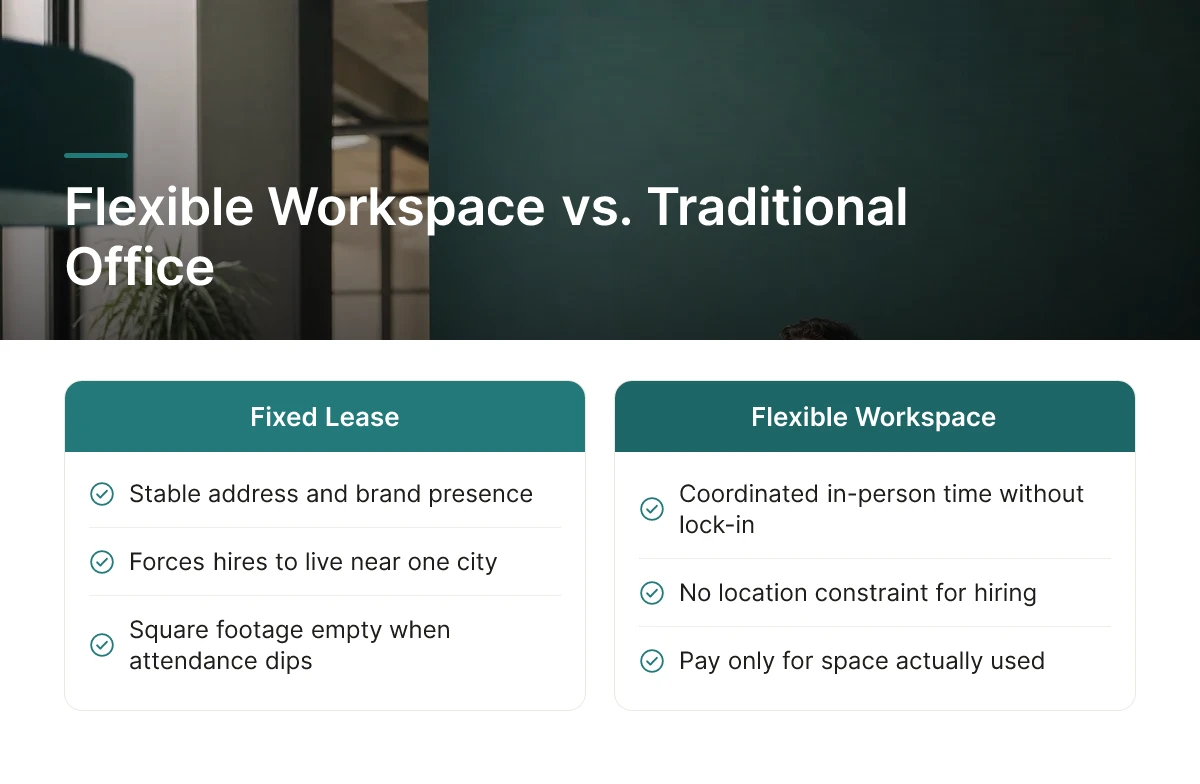
A fixed lease optimizes for permanence, fully remote optimizes for cost and location freedom, and flexible workspace optimizes for coordinated in-person time without locking a company into either extreme, this trade-off is why flexible workspace matters for growing hybrid teams.
Each model solves a different problem and sacrifices something to get there. A single-office lease gives a team a stable address and brand presence, but it forces every hire to live near that one city and leaves square footage empty whenever attendance dips below capacity. Fully remote setups eliminate real estate risk entirely, but they also eliminate the shared physical space teams need for onboarding, workshops, or client meetings. On-demand flexible workspace sits between the two: it gives distributed employees access to professional space when they need it, for a sprint, a client pitch, a team offsite, without the long-term liability of a lease signed for headcount that may not exist in a year [1].
The mechanism is proximity on demand rather than proximity by default. Instead of requiring every employee to relocate near a single headquarters, a flexible network lets a manager book space in whichever city a team happens to cluster for a given week, then release it when the need passes [4]. This matters specifically for coordination: a quarterly planning session or a cross-functional sprint needs people in the same room, not people within commuting distance of the same building year-round. When considering why flexible workspace matters, this point stands out.
Platforms built for this, Upflex is one example, pair attendance forecasting with access to a global network of third-party workspaces, so a workplace leader can see where teams are converging and book space accordingly rather than guessing. That forecasting layer is what separates coordinated hybrid collaboration from the ad hoc scramble of booking a coworking desk the night before a meeting.
Early-stage distributed teams need density on demand, a handful of people scattered across cities who occasionally need a room together, without justifying a lease [3]. Scale-ups running multiple hubs need something different: a consistent network across the cities where their offices already exist, so a traveling employee in Austin gets the same booking experience as one in Chicago [5].
Industry shapes the requirement further. A sales-heavy team needs client-facing space with conference rooms and a polished reception; an engineering team needs quiet, heads-down space with reliable Wi-Fi and fewer interruptions [1]. Neither is served well by a one-size-fits-all lease, and neither is served at all by fully remote.
Calculate ROI by comparing your fixed real estate baseline against variable flex spend at realistic utilization, then layer in the hidden costs and benefits both sides tend to omit.
Start with the number most finance teams already track: total fixed cost of your current footprint. That includes lease payments, utilities, insurance, facilities staff, and maintenance contracts. This is your baseline, the cost of square footage whether or not anyone sits in it.
Against that baseline, model variable flexible spend at a projected utilization rate rather than at full headcount. If your offices run at 30-50% utilization on a given week, a lease-vs-flex comparison built on 100% occupancy will understate flex savings and overstate how much value you're getting from owned space. This is a core reason why flexible workspace matters for any company recalculating its real estate footprint after a hybrid policy shift.
A simple square-footage comparison misses the costs that actually move the number. On the fixed-lease side, the biggest hidden cost is unused capacity, the desks, conference rooms, and floors paid for but empty most days. Relocation and build-out expenses when a lease ends or a team outgrows a space add another layer rarely included in the first pass. Add the administrative time spent coordinating multiple landlords, vendors, and facilities contracts across locations, and the true cost of "fixed" space is usually higher than the lease line item suggests. Flexible workspace has its own hidden benefits that deserve the same scrutiny. Faster time-to-desk when entering a new city avoids months of lease negotiation and permitting delays. Avoided build-out capital, the cost of furnishing and fitting out a new office, stays off the balance sheet entirely. And when plans change, as they often do for growing or distributed teams, flexible agreements avoid the early-termination penalties that make traditional leases expensive to exit. For those exploring why flexible workspace matters, this matters.
Aggregate cost comparisons break down the moment headcount changes, so frame the ROI calculation as cost-per-employee-per-month across a few headcount scenarios instead. A platform like Upflex supports this kind of modeling directly: UnifyAI forecasts attendance with 97% accuracy, which lets real estate and finance leaders project utilization-adjusted costs per employee rather than guessing at aggregate occupancy. Run the comparison at current headcount, projected headcount in twelve months, and a downside scenario, that's what shows whether flexible workspace scales with the business or just shifts cost around.
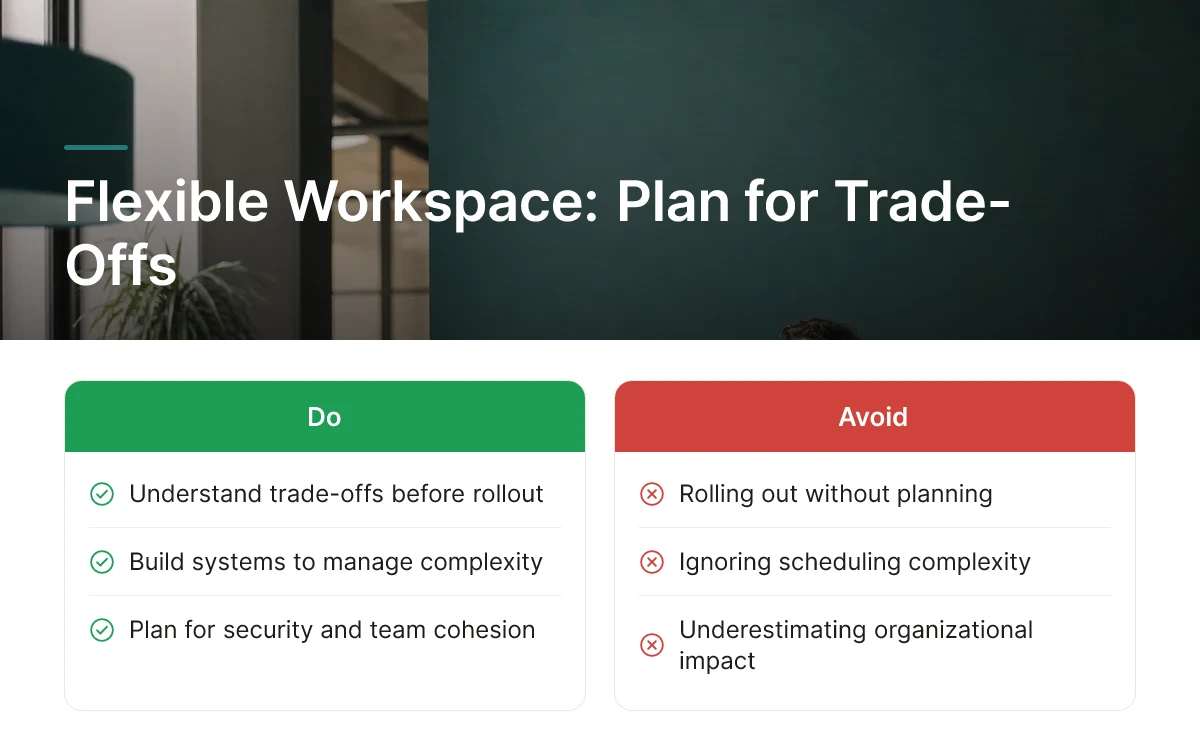
Flexible workspace reduces fixed costs and adds scheduling complexity, security exposure, and real risk to team cohesion if a company rolls it out without planning. Startups that understand these trade-offs going in build better systems than those that discover them after a failed rollout. This is part of why flexible workspace matters as a leadership decision, not just a real estate one, the trade-offs are organizational, not just financial.
Rotating through different locations weakens the informal bonding that happens when the same people sit near each other every day. Hallway conversations, spontaneous whiteboard sessions, and the social trust built over repeated small interactions don't happen as naturally when a team scatters across coworking sites or works from home most days. Startups that manage this well tend to keep a core hub location and set recurring anchor days, a fixed day or two each week when the whole team, or a specific function, is expected in the same room.
Security is the other underdiscussed risk. Working from shared or third-party spaces means screens are visible to strangers, devices connect to open or unmanaged networks, and confidential conversations can happen within earshot of other tenants. Sensitive meetings, board discussions, HR matters, product roadmaps, need access-controlled rooms, not open lounges. Finance and legal leaders evaluating flexible workspace should ask any provider about network security standards and private meeting room availability before signing on, the same way they would vet a traditional landlord's building access controls.
The most frequent operational pitfall is coordination: without visibility into who's working where on a given day, managers can't plan in-person collaboration, and employees show up to an empty office or miss a colleague they needed face time with. This is where a scheduling and booking layer stops being optional. Platforms like Upflex address this directly, its UnifyAI engine forecasts attendance patterns so teams can see who's likely to be in before the day arrives, rather than guessing.
Two transition mistakes show up repeatedly. First, moving too fast and dropping a fixed office entirely without a core anchor space, leaving the company with no consistent gathering point at all. Second, underestimating onboarding friction, new hires who join a fully flexible setup often struggle without a stable home base to learn culture, meet teammates, and build the muscle memory that comes from a known environment. Neither problem is a reason to avoid flexible workspace. Both are reasons to design the transition deliberately rather than treat it as a simple real estate swap.
Build it in stages: anchor a small core hub for culture, add on-demand access as you hire remotely or open new markets, then reassess the mix at every funding or headcount milestone. This directly impacts why flexible workspace matters outcomes.
This is why flexible workspace matters most at the moments founders and real estate leaders underestimate: the three-month stretch after a Series B, the quarter a company opens its first satellite market, the year a once-local team goes fully distributed. A startup at 20 people typically needs one well-chosen headquarters that reflects who the company is and gives new hires a place to absorb the culture in person [1]. At 80 people with a second city office and a handful of remote sales hires, that same headquarters becomes a liability if it's the only option on the table. The fix is not choosing between a lease and flexibility, it's sequencing them.
A workplace orchestration platform predicts who is coming into which location on which day, then coordinates desk bookings and external workspace access around that forecast instead of reacting to it. Upflex runs this through its UnifyAI engine, which forecasts attendance with 97% accuracy and feeds that forecast into desk booking workflows across both a company's own offices and a global network of on-demand workspaces. For a facilities or real estate leader managing a headquarters plus a growing list of satellite hires, that forecast is the difference between guessing at square footage and knowing it. The same visibility that helps a 500-person company hit 88% co-attendance on collaboration days helps a 30-person startup avoid signing for desks it won't fill for another two quarters.
Keep the headquarters for identity, onboarding, and leadership presence; route satellite teams, new-market hires, and overflow through on-demand capacity. Traditional leases lock a company into fixed square footage for years regardless of how the team changes shape, which is exactly the risk-mismatch that sinks early-stage real estate decisions [1]. On-demand access reverses that: capacity flexes with headcount instead of headcount being constrained by capacity [4].
A short recurring checklist keeps the strategy from calcifying:
Cost control and collaboration quality are not competing goals here, they're the same decision viewed from two sides. A staged, orchestration-backed strategy keeps real estate spend tied to actual presence while still giving distributed teams a professional place to work and gather when it counts.

Companies that pair flexible workspace with better utilization data typically cut real estate spend by replacing underused square footage with on-demand access. Upflex customers who combine attendance forecasting with portfolio consolidation have documented reductions of 40%+ in real estate costs, driven by right-sizing owned offices rather than renewing leases sized for pre-hybrid headcount.
Flexible workspace works at nearly any headcount, including a 10-person team, because the model scales with you rather than locking in fixed square footage [3]. A small startup can add desks or private offices as it grows without renegotiating a lease or absorbing renovation costs [3]. This is particularly relevant for why flexible workspace matters.
Alignment comes from forecasting who's coming in and coordinating schedules around that, not from mandating fixed days. Upflex's UnifyAI engine predicts attendance with 97% accuracy and tracks co-attendance against team targets, helping distributed employees and in-office staff overlap on the days that matter for collaboration.
A traditional lease still makes sense when headcount and space needs have stabilized and long-term cost per square foot beats flexible pricing. Startups with specialized infrastructure needs, like labs or manufacturing floors, or those past hypergrowth and settled into a predictable footprint, often gain more from lease certainty than from flexibility.
Flexible workspace matters because rigid leases and rigid headcount rarely move at the same speed. Startups that treat office space as a variable cost rather than a fixed liability protect runway, avoid paying for empty desks, and still give hybrid teams a reason to come in. The leaders who get the most out of this shift pair flexibility with real data, forecasting attendance instead of guessing at it. Start by pulling your current utilization numbers for the next lease renewal date on your calendar, then model what a 30% smaller footprint paired with on-demand access would actually cost.
Explore more from our content library: