Share This Article
No items found.


Workplace experience management (WEM) is how HR and real estate leaders coordinate the physical office, digital tools, and space data to support hybrid work productivity while controlling real estate costs. Unlike employee experience management, which covers the full employee lifecycle, hiring, engagement, culture, career growth, WEM focuses specifically on where and how people work day to day: desk and room availability, office utilization patterns, and the technology that connects hybrid teams to the right space at the right time. It sits at the intersection of HR, IT, and corporate real estate rather than inside HR alone.
Workplace experience management covers a narrow, concrete set of problems: how much office space gets used, who's booking desks and rooms, and whether the technology connecting hybrid teams actually works.
It does not cover hiring, onboarding, performance reviews, or career pathing. Those belong to employee experience management, a broader HR-owned function that spans the entire employee lifecycle, recruiting, culture building, engagement surveys, and development programs [5]. Employee experience management asks whether someone feels supported across years at a company. Workplace experience management asks a narrower question: did the right desk, room, or workspace exist when someone needed it today.
The distinction matters because the two disciplines are measured differently. Employee experience management tracks retention, engagement scores, and satisfaction trends over quarters or years. Workplace experience management tracks space utilization rates, booking patterns, and hybrid coordination data, metrics that update daily, sometimes hourly, as attendance shifts.
That's also why workplace experience management can't live inside HR alone. Facilities teams control the square footage and vendor contracts. IT manages the badge systems, room sensors, and booking software. HR cares about whether employees have a good reason to come in. Corporate real estate owns the lease decisions that determine how much space exists in the first place. A workplace experience strategy that ignores any one of these groups produces gaps, IT ships a booking tool HR never promoted, or real estate signs a lease nobody validated against actual usage [4].
A workplace experience manager spends most of the day watching space usage data and fixing whatever it reveals. That means monitoring which floors, desks, or rooms sit empty on which days, coordinating cleaning and catering vendors around actual attendance rather than guesswork, and troubleshooting the hybrid tech stack when video conferencing or desk-booking systems fail mid-meeting. The role also means serving as the liaison between facilities and HR, translating a return-to-office policy into a real floor plan, or flagging to HR when a team's in-office days consistently don't match their booking data.
Hybrid attendance is inherently unpredictable, and fixed real estate footprints punish that unpredictability with wasted spend. As of mid-2024, 58% of organizations run a hybrid or flexible attendance policy, and 28% have gone fully "employee choice," offering office space with no requirement to use it [1]. That flexibility is good for employees but brutal for space planning, a floor built for 300 people might see 120 on a Monday and 280 on a Wednesday. Upflex addresses this gap with UnifyAI, which forecasts attendance with 97% accuracy so real estate and workplace teams can plan space, staffing, and vendor coordination around actual demand rather than lease-driven assumptions.
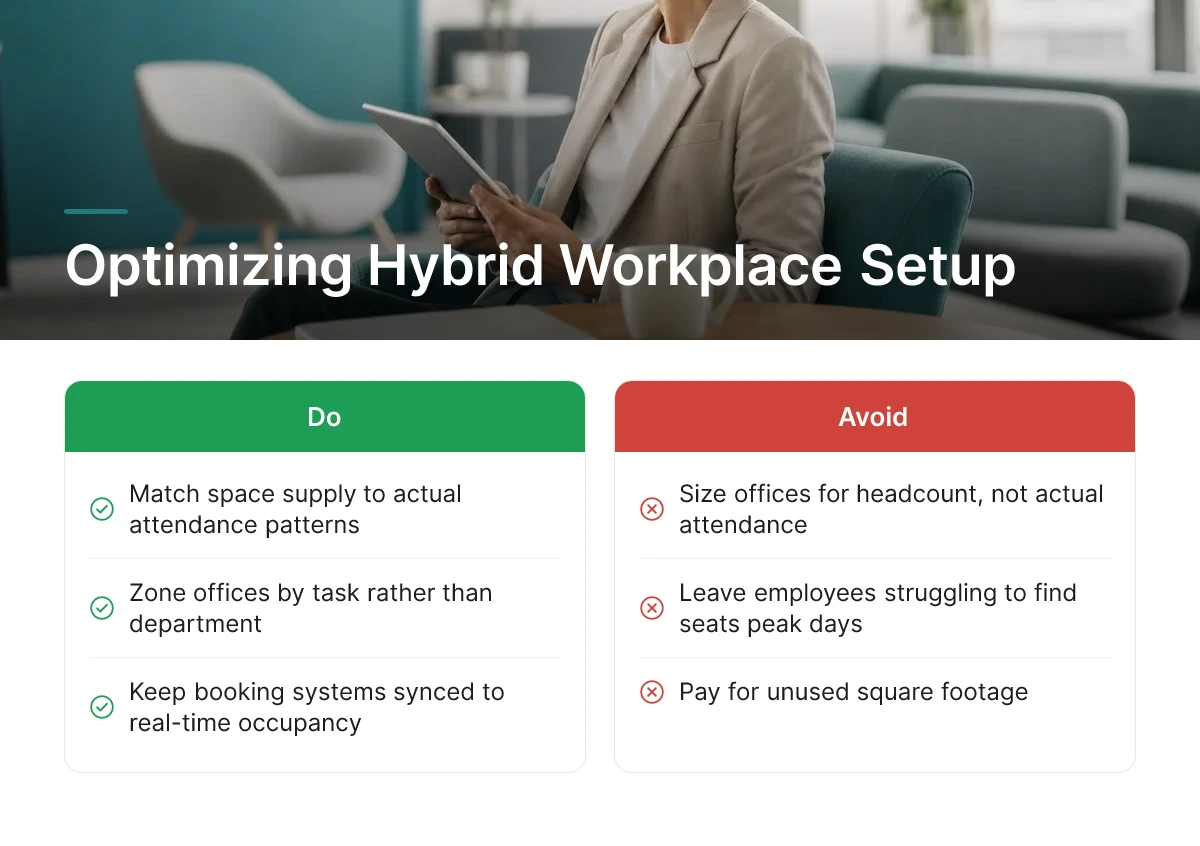
Match space supply to actual attendance patterns, zone offices by task rather than department, and keep booking systems synced to real-time occupancy so coordination doesn't break down.
Workplace experience management starts with a simple correction: most offices are still sized for headcount, not for the people who actually show up. With hybrid schedules, occupancy on any given day often runs well below desk capacity, and fixed, headcount-based planning leaves real estate leaders paying for square footage no one uses while employees still struggle to find a seat on peak days.
The fix is sizing space to attendance patterns instead of org charts. That means tracking which days, teams, and floors see the heaviest use and adjusting desk counts, meeting room inventory, and even floor closures around that reality rather than around a theoretical maximum.
Hybrid policies have become the default, CBRE's tracking of more than 340 U.S. companies found that as of mid-2024, 58% had a hybrid or flexible attendance policy, and 28% gave employees full choice over office use with no in-office requirement [1]. That variability is exactly why static space planning fails. A floor built for five-day attendance is wasted on a Tuesday-Thursday pattern, and a floor built for Tuesday-Thursday peak collapses if leadership later pushes a four-day mandate.
Zone the office around how teams actually spend their in-person time, not around fixed departmental seating charts. Three zone types tend to cover most hybrid use cases: collaboration areas for team syncs and project work, quiet zones for focused individual work, and flexible neighborhoods that shift function depending on the day's attendance mix. Facilities teams also need to anticipate peak days in advance to staff building services, cleaning, and catering accordingly [2]. Zoning only works if the digital layer matches the physical one. Booking systems, calendars, and in-office signage all need to reflect the same real-time availability, so a remote employee scheduling a hybrid meeting can see which desks and rooms are actually free before anyone walks in [4]. Without that parity, employees stop trusting the booking tool and fall back on guesswork or showing up early to claim space, the exact friction hybrid tools exist to remove.
Attendance forecasting closes the gap between planning and reality. By analyzing historical check-in data, calendar signals, and team scheduling habits, forecasting models predict who's coming in on a given day and let facilities teams adjust space allocation, staffing, and amenities before the week starts rather than reacting to it. Upflex's UnifyAI engine applies this approach directly, forecasting attendance with 97% accuracy so real estate and workplace teams can right-size space and services instead of guessing.
The common failure mode is over-provisioning based on assumptions rather than usage data, stocking a wellness room or expanding a cafe because leadership assumed demand, only to find it empty while desk space runs short elsewhere. Usage data, not intuition, should drive every amenity and layout decision.
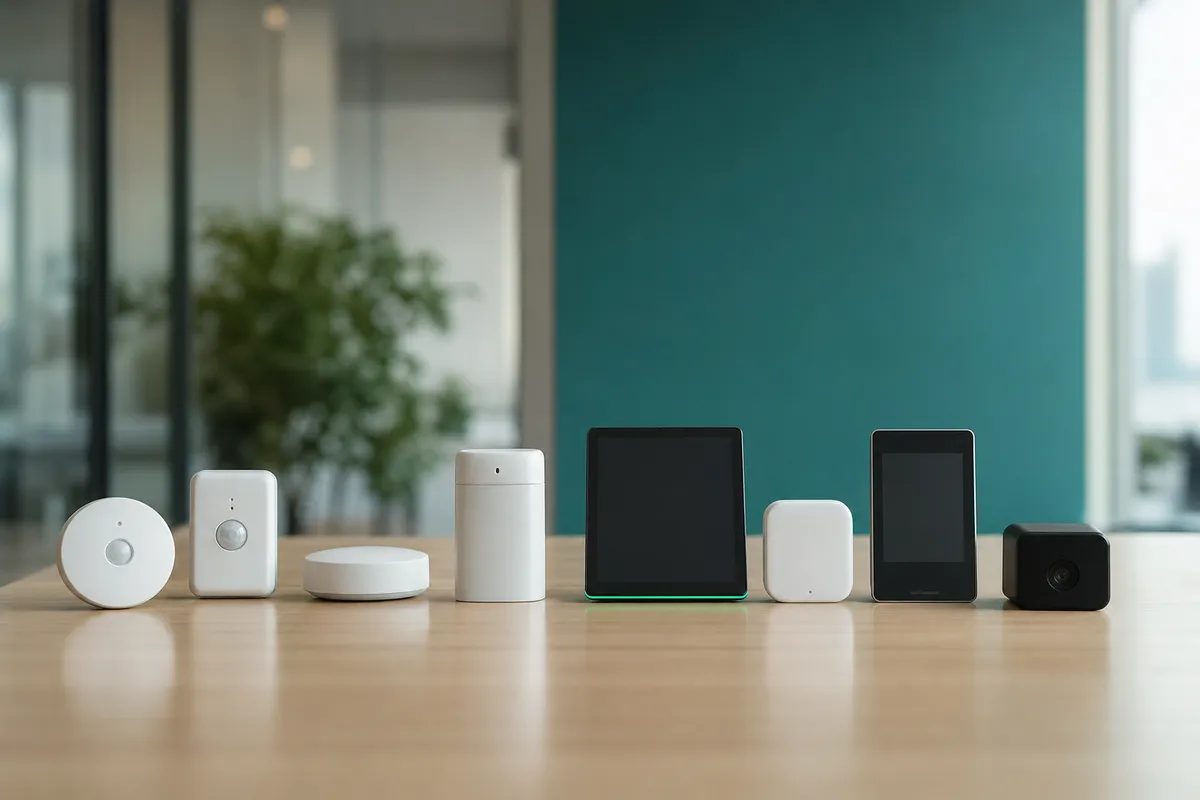
A working workplace experience management stack combines four system types, booking, sensing, scheduling, and analytics, connected to the calendar and HR tools your company already runs on.
None of these categories work in isolation. A desk booking app that doesn't know who's on vacation or which team has a scheduled in-office day is just a digital sign-up sheet. The value comes from integration, not from any single tool.
Four categories form the core of a workplace experience management stack, and each solves a distinct piece of the hybrid puzzle.
These tools need to integrate with calendar systems (Outlook, Google Calendar) and HR platforms rather than run as standalone apps. Without that connection, employees end up managing two separate calendars, one for meetings, one for desk bookings, and the data never reconciles with who's actually employed, on leave, or relocated. Hybrid work technology built to plug into existing calendar and HR infrastructure removes that duplication entirely [4].
AI-powered office orchestration ingests attendance signals and booking history, then forecasts occupancy and automatically adjusts space allocation before crowding or waste happens.
Mechanically, it works by pulling in multiple data streams, past booking patterns, calendar invites, team schedules, badge data, and running them through a forecasting model that predicts who's coming in on a given day, not just who said they would. Upflex's UnifyAI engine, for example, processes these inputs to forecast attendance at 97% accuracy and feeds that forecast directly into desk booking workflows, so space allocation adjusts automatically instead of relying on someone manually re-checking a spreadsheet.
Manual, spreadsheet-based planning leaves a structural gap: without forecasting, facilities teams either over-reserve space "just in case", wasting square footage most days, or under-plan and create crowding and desk shortages on peak collaboration days. Neither outcome serves the real goal, which is matching supply to actual demand.
Orchestration also extends past the walls of owned office space. Connecting internal booking data to an on-demand workspace network lets distributed or traveling employees get a desk near them without the company signing another lease. That's the mechanism behind Upflex's access to on-demand workspaces: overflow capacity on demand, not permanent square footage carried year-round for occasional use.
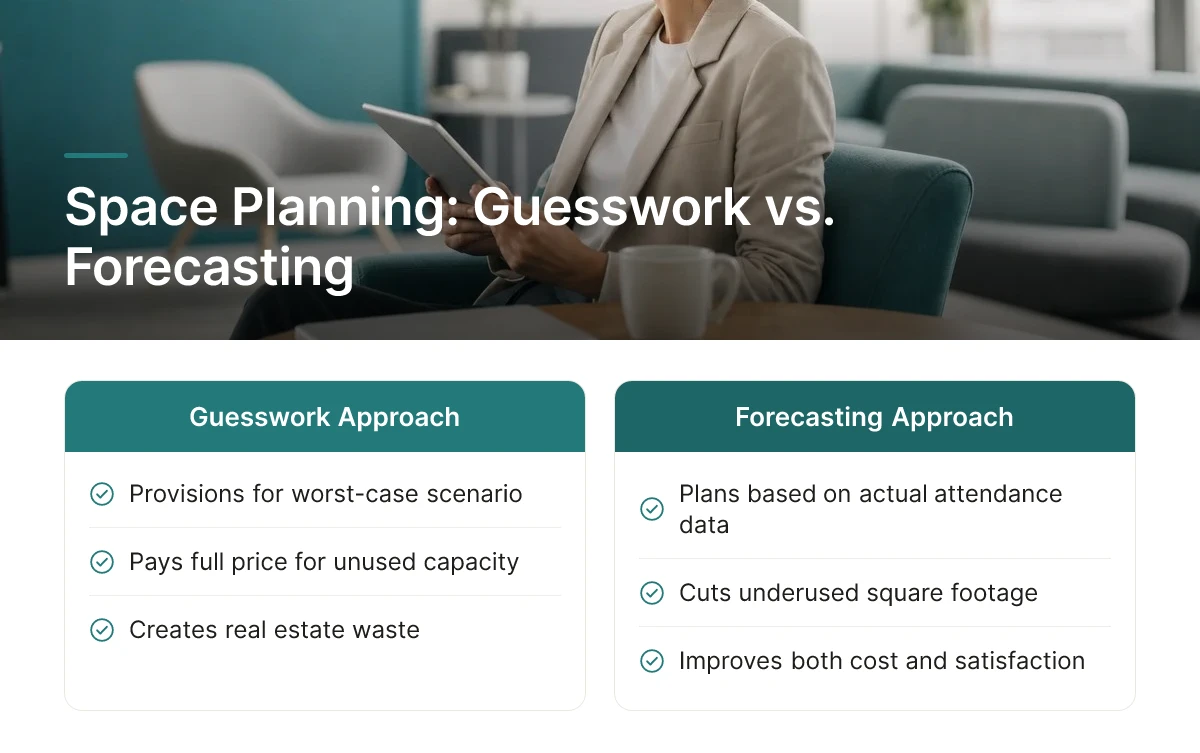
Cost and satisfaction move together when attendance forecasting replaces guesswork, letting leaders cut underused square footage without shrinking capacity on the days employees actually show up. That's the mechanism that makes workplace experience management a cost lever and an experience lever at the same time, not a trade-off between the two.
Most real estate waste comes from provisioning for a worst-case scenario that rarely happens. A company that leases enough desks for every employee, every day, is paying full price for an office that office utilization data typically shows running far below capacity on most weekdays [2]. Upflex's UnifyAI engine forecasts attendance with 97% accuracy, which lets corporate real estate leaders size their footprint to actual peak demand rather than theoretical headcount, then route any overflow to on-demand workspace instead of carrying permanent square footage for it.
That precision has a second-order effect: it stops the slow bleed of wasted spend on underutilized leases, facilities services, and amenities tied to space nobody uses. Cleaning, security, utilities, and vendor contracts all scale with floor area, cut the area intelligently and those costs fall with it, rather than getting trimmed in ways employees notice and resent.
Weigh the tooling cost tier against two return streams: direct real estate savings and harder-to-quantify productivity gains from less friction in daily work. A mid-range or enterprise-tier platform investment is easy to justify when the alternative is carrying a lease renewal at full size by default. The real estate savings alone, Upflex customers have documented reductions of 40%+ in real estate spend, tend to outweigh subscription cost within the first budget cycle, before even counting the time facilities teams save by not manually reconciling badge data and spreadsheets.
Productivity gains are softer to measure but still real: fewer canceled meetings from room conflicts, less time hunting for desks, fewer failed return-to-office pushes that erode trust before they're abandoned.
Satisfaction rises alongside savings because predictable desk and room availability removes the daily friction that makes office days feel like a gamble. An employee who knows a desk and a quiet room will be there when they arrive is more willing to come in, and more likely to see the office as worth the commute, rather than a mandate to resent.
Skip the one-off survey and track behavior instead: repeat booking rates, desk utilization trends, and whether co-attendance targets are being hit consistently, Upflex customers track an 88% co-attendance achievement benchmark as one such signal. Rising retention and steady voluntary office usage, tracked over quarters rather than a single pulse survey, tell you whether workplace experience management is actually working.
A workplace experience management program should show results in four KPI categories: space utilization rate, attendance forecast accuracy, cost per occupied desk, and tool adoption. Together these numbers tell you whether the office is being used efficiently, whether you can predict and plan around that usage, and whether your real estate dollars are following actual demand rather than guesswork.
Space utilization rate measures how much of your available desk and room inventory gets used on a given day, broken out by floor or location so you can spot underused areas before a lease renewal decision gets made. Attendance forecast accuracy tracks how close your predicted in-office headcount comes to what actually shows up, Upflex's UnifyAI engine targets 97% accuracy here, which is the figure that makes consolidation decisions defensible to a CFO. Cost per occupied desk divides your real estate spend by actual usage rather than seated capacity, exposing the gap between what you're paying for and what's being used. Tool adoption, booking completion rates, repeat usage, employee opt-in, tells you whether the technology is actually changing behavior or sitting unused.
Start by capturing a baseline before rollout. Measure utilization, attendance patterns, and desk costs for at least one full quarter beforehand, so later improvements can be credited to the program rather than to seasonal swings, holidays, or a one-off return-to-office push.
Roll out in a single location or floor first. Measure the pilot against the baseline, let the data show which mechanisms, forecasting, booking rules, space reallocation, actually move the numbers, and only then scale to additional sites. This phased approach limits the cost of a misstep and gives you a real evidence base for the business case you'll eventually take to finance and leadership.
After rollout, run utilization reviews quarterly and tie them directly to your lease renewal calendar and headcount planning cycles, not to an arbitrary reporting schedule. That alignment means the data is already in hand when a renewal decision or a reorg forces the question of how much space you actually need.
Resist treating hard savings and soft outcomes as separate scorecards. Real estate cost reduction, Upflex customers have documented reductions exceeding 40%, matters most when paired with retention and co-attendance signals, such as the 88% co-attendance achievement benchmark, showing that the savings didn't come at the expense of team collaboration or employee satisfaction.

A workplace experience manager coordinates desk and room availability, monitors attendance patterns, and troubleshoots the gap between forecasted and actual office usage. Daily work includes reviewing booking data, checking that space supply matches expected headcount, resolving conflicts between teams competing for the same floor, and reporting utilization trends to real estate and finance leaders who need to justify portfolio decisions.
Successful implementations share one pattern: pairing attendance forecasting with flexible space access instead of relying on fixed desk ratios. Organizations using platforms like Upflex combine AI-driven forecasting, accurate to 97%, with on-demand workspace access, reaching documented outcomes of 88% co-attendance achievement and real estate spend reductions above 40%, rather than guessing at headcount with spreadsheets or badge-swipe reports alone.
No, facilities management handles the physical building, maintenance, cleaning, security, while workplace experience management focuses on how people actually use and feel about the space. The two overlap operationally, since facilities teams often execute the day-to-day upkeep that supports a well-run workplace experience strategy, but the ownership and goals differ.
No single department should own it alone, corporate real estate, HR, and IT need shared accountability since each controls a different lever. Real estate owns the square footage and lease decisions, HR owns employee policy and culture, and IT owns the booking and scheduling systems. Companies that assign this to one siloed team tend to see slower, less coordinated results.
this approach works when forecasting, space data, and real estate decisions sit on one platform instead of scattered across spreadsheets, badge readers, and separate booking tools. Start by measuring the gap between your current attendance forecasts and what actually happens on the floor, that gap is usually where wasted real estate spend hides. Then evaluate whether your team needs owned-office optimization, on-demand workspace access, or both. A practical next step: pull your last quarter's utilization data and compare it against your lease renewal timeline before your next portfolio review.
Explore more from our content library: