Share This Article
No items found.


Understanding how to reduce office space costs is essential. You can reduce office space costs mid-lease by converting underused square footage into variable spend, without breaking your lease or relocating. The three levers are: shrinking your real footprint through subletting or desk consolidation, shifting from fixed daily capacity to on-demand workspace that flexes with actual hybrid attendance, and renegotiating terms (not necessarily the lease itself) around usage data. Most unused space costs money every day regardless of occupancy, so the fastest savings come from matching paid capacity to actual attendance patterns rather than waiting for lease expiration.
Before you can act on how to reduce office space costs, you need an honest audit of what you're paying for versus what your teams actually use. Most real estate budgets leak money through capacity nobody occupies, not through the rent rate itself.
Underutilization costs scale with square footage, not with the number of desks occupied on any given day, a 15,000-square-foot office paying for five-day capacity while running at two or three days of real attendance burns money every week it stays that way. VergeSense estimates a 100-person company wastes roughly $300,000 a year on office space that sits empty [1]. That figure holds even when national vacancy looks moderate on paper, Cushman & Wakefield puts U.S. office vacancy at 20.5% market-wide, and the gap inside individual companies between leased and used space is often worse [1].
To get your own number, compare badge-in or occupancy data against total available desks across a full week, not just your busiest Tuesday or Wednesday. Peak-day snapshots flatter utilization and hide the Monday and Friday troughs where most of the waste sits. A proper audit tracks:
Fixed leases charge for capacity, not consumption, rent, utilities, and service charges are billed against square footage regardless of whether ten desks or two hundred are filled on a given day. Long lease terms, built-in rent escalation clauses, and fixed square-footage commitments lock in that cost structure for years, while hybrid attendance patterns shift month to month. The mismatch means your biggest expense line moves on a schedule your workforce no longer follows [2].
Base rent is only the visible part of the bill. The audit needs to capture hidden cost categories too:
Occupancy data is the starting point every reduction strategy depends on. Without a clear picture of where attendance actually falls short of leased capacity, decisions about subletting, consolidating, or shifting to on-demand workspace are guesses rather than plans. Platforms like Upflex address this directly: its UnifyAI engine forecasts attendance with 97% accuracy, giving real estate and finance leaders the utilization data needed to decide which floors, desks, or buildings are genuinely worth paying for.
Hybrid policy cuts the days people sit in an office; pairing it with on-demand workspace access cuts the square footage you pay for year-round, that combination is where how to reduce office space costs stops being theoretical and starts showing up on the balance sheet.
Companies that signed leases for a five-day-a-week workforce are now paying full price for a workforce that shows up two or three days a week. Cushman & Wakefield puts national office vacancy at 20.5%, and the gap between space leased and space actually used inside individual companies is often worse than that market average [1]. A 100-person company wastes an average of $300,000 a year on office space that sits empty, according to VergeSense estimates cited by Deskpass [1]. That waste is the direct target of a hybrid-plus-flex strategy.
Instead of leasing enough desks for every employee every day, you pay for workspace by the day, booking, or seat as teams actually need it.
This is the same logic utilities and cloud computing already run on: pay for consumption, not theoretical peak capacity. Office space has lagged behind because leases lock in capacity for years at a time, regardless of how many desks go unused on a given Tuesday.
On-demand workspace networks act as overflow capacity, letting a company keep a smaller core office and tap external space only on high-attendance days.
A hybrid policy alone, asking people to come in three days instead of five, reduces congestion but not cost, since the lease and its square footage stay fixed regardless of who shows up. Real savings appear only when fewer office days are paired with a smaller committed footprint, backed by flexible capacity for the days attendance spikes. Upflex supports this directly: UnifyAI forecasts attendance with 97% accuracy so you know which days will run hot, and the on-demand workspace network gives employees a place to work when the core office is full, without adding permanent square footage.
This also avoids the two extremes most companies default to: relocating the entire office, which is expensive and disruptive, or doing nothing until the lease expires and continuing to pay for empty desks in the meantime. A hybrid-plus-flex model lets you right-size now, inside the lease you already have, while keeping the capacity to scale up when teams need it.

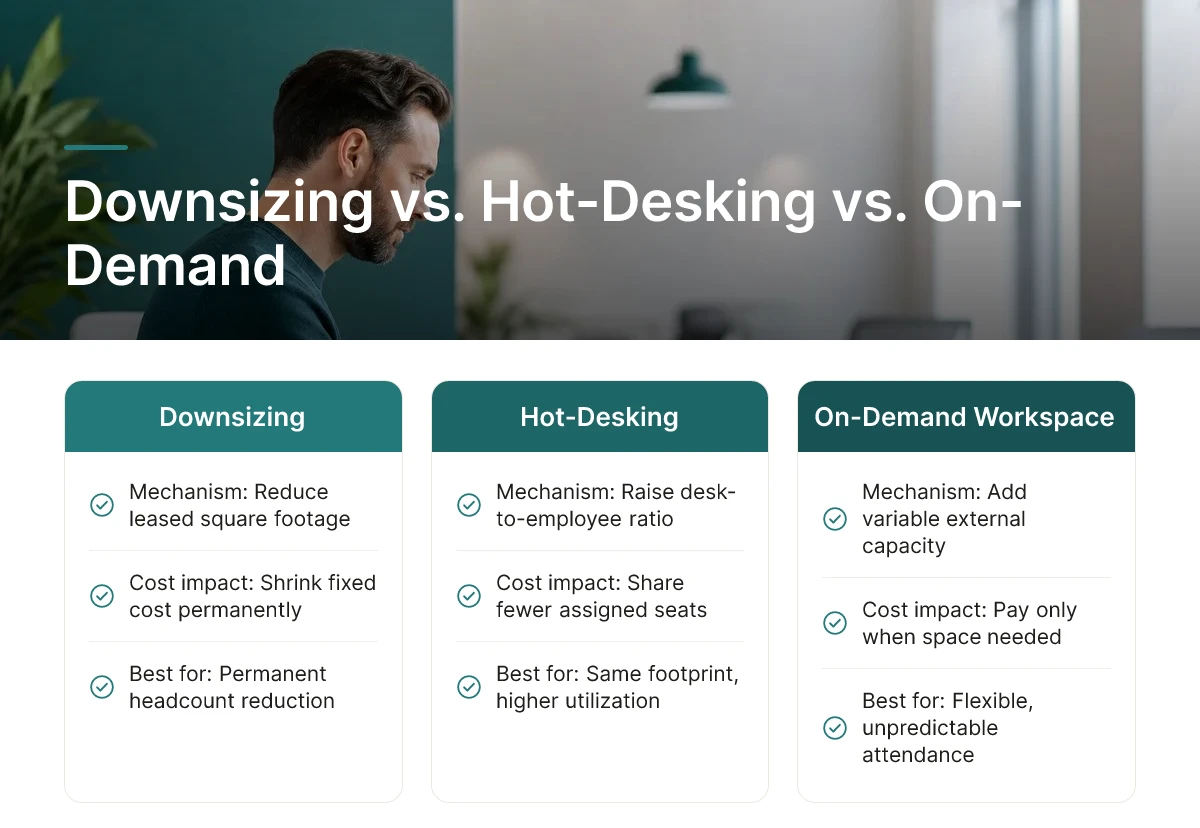
The right fit depends on growth trajectory, lease terms, and hybrid adoption, not a single best answer, since each approach reduces cost through a different mechanism.
Downsizing means physically reducing or subletting leased square footage, you give back space you no longer need and shrink the fixed cost permanently. Hot-desking keeps the same footprint but raises the desk-to-employee ratio, so more people share fewer assigned seats. On-demand workspace adds variable external capacity on top of a smaller core office, letting you pay only for space when someone actually needs it. Anyone comparing how to reduce office space costs across these three options is deciding how much flexibility to trade for how much savings.
Company trajectory and lease flexibility determine which approach pays off fastest.
Each approach carries its own friction, and none of them are instant.
These approaches are not mutually exclusive. Many companies combine hot-desking inside a smaller core office with on-demand access for overflow, a structure Upflex supports directly by pairing desk booking and attendance forecasting for the owned office with access to an external on-demand workspace network for employees who need space elsewhere. That combination handles both daily fluctuation and occasional overflow without requiring a full lease renegotiation to get started.
A credible ROI model weighs upfront transition costs against ongoing savings to produce a payback period your CFO can defend. Without that math, how to reduce office space costs becomes a guess rather than a plan.
Start with the cost side. Transition costs typically include subletting or lease-exit fees, furniture relocation or disposal, and setup for desk booking and scheduling software. Set these against recurring savings: reduced square footage, lower utility and janitorial spend, and consolidated vendor contracts for security, cleaning, and maintenance. Divide total transition cost by monthly net savings to get your payback period in months, most downsizing moves tied to sublease or lease-renegotiation strategies pay back faster than a full relocation, since relocation adds fitout and IT costs that can rival the rent savings itself [4].
Think in cost tiers rather than fixed numbers, since lease terms and markets vary too widely for one figure to apply broadly. A full floor under a long-term lease sits at a premium fixed-cost tier, you pay it whether desks are full or empty. Shrinking that footprint and routing overflow or distributed employees to on-demand workspace shifts spend toward a smaller fixed base plus a budget-friendly variable cost that scales with actual use. That shift matters because unused space carries the same fixed cost as occupied space, and industry estimates put the per-employee waste from underused offices in the hundreds of thousands of dollars annually for a 100-person company [1]. Benchmark savings per square foot by comparing your current fixed lease rate against the blended rate of a smaller core office plus variable on-demand access.
Track three metrics monthly once the new footprint is live. First, occupancy rate versus paid capacity, how much of the space you're paying for actually gets used. Second, cost per employee per month, which should trend down as footprint shrinks relative to headcount. Third, the variance between forecasted and actual attendance.
That third metric carries more weight than it first appears. A downsizing decision built on inaccurate attendance forecasts can leave teams without desks on peak collaboration days, eroding the morale gains the cost cuts were meant to protect. Upflex's UnifyAI engine forecasts attendance at 97% accuracy, which lets real estate leaders size their remaining footprint with confidence rather than padding it as a hedge against bad data. Pair that forecasting with Upflex's on-demand workspace network, and overflow demand gets absorbed without re-inflating fixed lease costs.
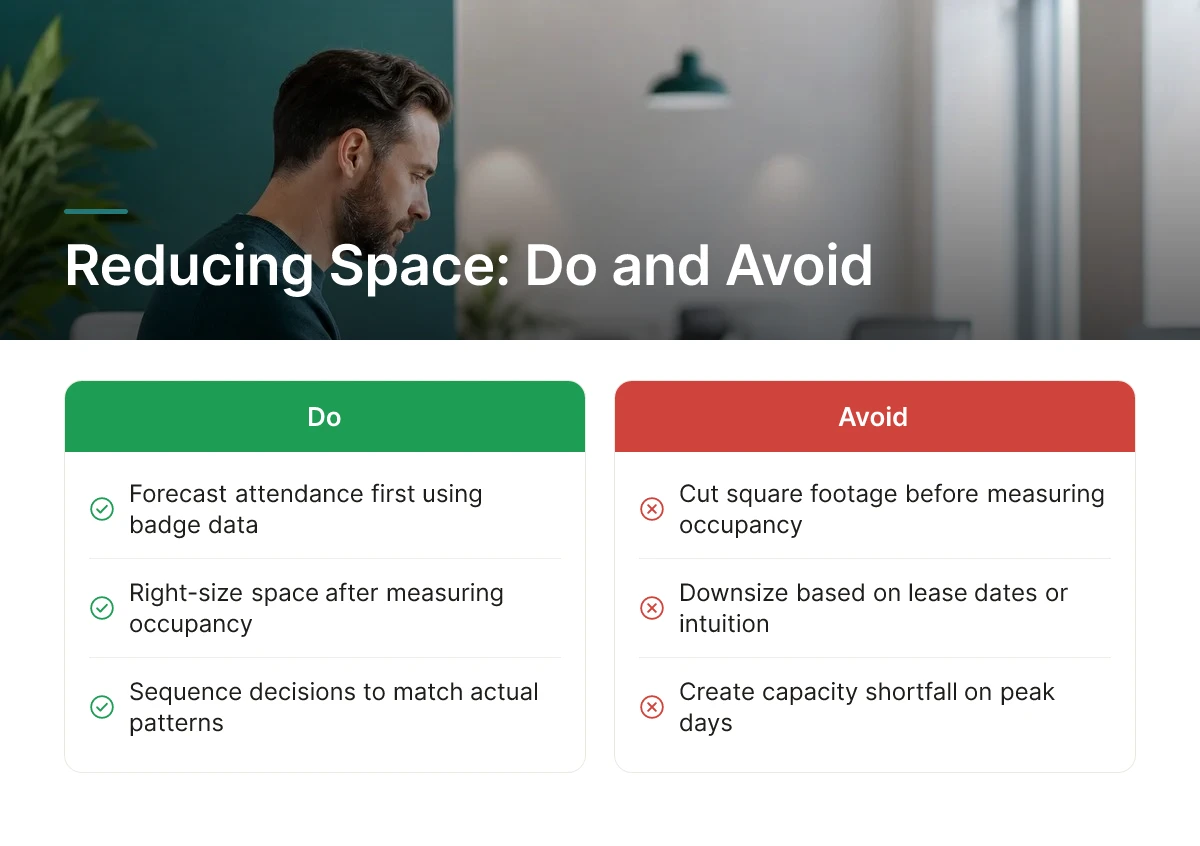
Most failures in how to reduce office space costs trace back to one error: cutting square footage before measuring actual occupancy, then forcing a shrunken office onto unpredictable attendance patterns.
When a company downsizes based on lease expiration dates or executive intuition rather than badge data, the result is a capacity shortfall on the exact days teams converge, usually Tuesday through Thursday. Employees who show up and can't find a desk stop trusting the new policy, and some stop showing up at all. The fix is sequencing: forecast attendance first, right-size second. Upflex's UnifyAI engine predicts attendance with 97% accuracy, which lets real estate teams size a reduced footprint against actual demand curves rather than guesses, and still hit co-attendance targets without overbooking the space that remains.
Track three signals continuously during any footprint change: attendance consistency, exit interview themes, and manager feedback on space availability. A drop in attendance immediately after a reduction often signals employees have concluded the office isn't worth the commute anymore, not that they've simply adapted to less space [1]. Exit interviews that mention "couldn't find a desk" or "team never in the same place" are a lagging indicator you should have caught earlier through booking data. Managers are usually the first to notice friction, ask them directly whether their teams can reliably find space together, rather than waiting for complaints to escalate to HR.
The mechanism for reducing office space costs looks different depending on what the workforce actually needs from a building. Finance and compliance-heavy teams typically need a smaller core of bookable, access-controlled desks near compliance staff and secure document handling, they can't flex into arbitrary coworking locations. Technology teams with distributed engineers tend to prioritize on-demand access across many cities over a single large headquarters, since the value is proximity to wherever the engineer happens to be. Healthcare administrative functions usually need predictable, consistent core space tied to clinical operations schedules, with less tolerance for daily desk uncertainty. None of these are solved by a blanket percentage cut, they're solved by matching space type to how each function actually works.
Two mistakes compound the risk across all three profiles. First, framing the change purely as cost-cutting invites employees to read it as a signal the company is shrinking investment in them; framing it around flexibility and choice protects retention far better. Second, under-investing in booking and access tools turns hot-desking into daily friction, wasted minutes hunting for a desk, that erodes the very savings the reduction was meant to capture.
Yes. Subleasing part of your footprint, negotiating a partial surrender clause, or shifting overflow staff to on-demand workspace all cut spend while the lease stays intact [5]. Many commercial leases already include early termination or space-surrender provisions, so the first move is reviewing your actual lease terms before assuming relocation is the only option [5].
Most companies see measurable savings within one to two billing cycles after implementing changes like subletting space or cutting unused desks. Lease renegotiations or sublease agreements take longer to finalize, often a few months, but utilization-driven changes like hot-desking or hybrid scheduling reduce real estate waste almost immediately [1].
Hot-desking saves money when it's backed by attendance data, without it, it mostly just reduces comfort. Companies that pair desk-sharing with attendance forecasting avoid both wasted square footage and the "can't find a desk" complaints that kill adoption. The savings come from right-sizing the footprint to actual usage, not from cramming more people into the same space [2].
Measure actual utilization before cutting anything. Badge data, booking logs, or occupancy sensors reveal the gap between space leased and space used, which is often far wider than leadership assumes [1]. Cutting square footage based on guesswork, rather than data, risks downsizing into a space that can't support real attendance patterns.
Cutting office space costs doesn't require breaking a lease or forcing a relocation. The companies that get this right start with utilization data, explore sublease or lease-amendment options before signing anything new, and replace rigid full-time seating with hybrid models backed by attendance forecasting. Upflex customers use this approach to combine UnifyAI's 97% accurate forecasting with on-demand workspace access, supporting real estate cuts of 40%+ without sacrificing co-attendance goals. Your next step: pull three months of badge or booking data and calculate your actual utilization rate before your next lease conversation, that number will shape every decision after it.
Explore more from our content library: