Share This Article
No items found.


Understanding flexible office space solutions is essential. Seasonal teams optimize real estate costs and workforce flexibility by combining on-demand workspace access with a smaller fixed footprint, scaling desks up during peak hiring months and down during slow periods instead of carrying year-round lease capacity. The right mix typically blends a core owned or anchor office with coworking access, satellite locations, and day-pass networks that flex with headcount. This guide covers nine specific flexible office space solutions suited to seasonal staffing patterns and how to choose between them based on team size, location spread, and budget tier.
Before diving into each option, it helps to see them side by side:
On-demand workspace networks let companies book desks or rooms by the day or visit instead of leasing them by the year, so cost tracks actual usage rather than fixed square footage.
This is the mechanism that makes most other flexible office space solutions possible at scale: a single contract grants access to desks and meeting rooms across a provider's network, and the organization pays only for occupied seats. For a corporate real estate team watching utilization sit at 30-50% in owned offices, that pay-per-use structure removes the gap between what's leased and what's actually occupied.
This model fits distributed teams with seasonal spikes spread across multiple cities, not a single location that simply grows and shrinks. A retailer staffing up for Q4 in five metro markets does not need five separate leases or five separate vendor relationships, it needs one network that covers all five.
The differentiator competitors in this category often miss: an aggregated network covers many workspace brands and locations under one agreement, instead of forcing procurement to negotiate separately with each building operator. Upflex applies this directly, combining access to the largest on-demand workspace network with UnifyAI attendance forecasting at 97% accuracy, so the owned portfolio shrinks to a year-round baseline while peak demand gets absorbed through the network rather than a new lease.
Coworking memberships give a small seasonal team one consistent home base on a monthly or rolling commitment instead of a multi-year lease.
The structure trades long-term obligation for month-to-month flexibility: a team signs up, scales seats up or down with notice, and exits when the season ends. That makes memberships well suited to small seasonal teams, generally under 15-20 people, who need a predictable single location rather than access spread across many cities.
The differentiator here is community access, not just desks. A coworking membership in a new market often comes with built-in networking events and a resident community that helps a company recruit seasonal talent locally, something a bare lease or an on-demand day pass doesn't offer.
On cost, memberships sit in a mid-range tier, typically pricier per seat than pay-per-use network access for occasional use, but considerably cheaper than standing up a dedicated satellite office for a few months of peak demand.
Satellite offices give a company a smaller, dedicated footprint in a secondary market with some lease commitment but far less scale than headquarters.
They sit between coworking and a full regional headquarters: a defined space, a signed agreement, but sized for a specific purpose rather than long-term enterprise growth. That makes them a fit for companies entering a new region for a defined season, retail peak, tax season, or a tourism cycle tied to a particular metro area [3].
The differentiator against coworking is control. A satellite office can be built out with brand identity, dedicated infrastructure, and security standards that shared coworking floors can't replicate, which matters for companies that need the space to look and feel like company property during a high-visibility season.
The trade-off is flexibility: satellite offices lock in more commitment than an on-demand network, so they work best when the season or region is predictable enough to justify a lease, even a short one, rather than pay-per-use access.
Managed flex offices hand furniture, IT setup, and day-to-day operations to a provider, so a team gets turnkey space under an agreement shorter than a standard lease.
In this model, the provider owns the operational burden, cleaning, connectivity, desks, reception, while the tenant simply occupies the space [2]. That removes the need for an internal facilities team to coordinate vendors before move-in, which matters for mid-size seasonal teams that need dedicated space but don't have staff to spin it up on short notice.
The differentiator is setup speed. Because fit-out and operations are pre-handled by the provider, a managed flex office can go from signed agreement to occupied desks far faster than a satellite office build-out, where furniture, IT, and vendor contracts are usually negotiated separately [2].
That bundling also cuts procurement fragmentation: one provider contract replaces what would otherwise be separate agreements for furniture rental, cleaning, and connectivity, reducing the number of vendors a real estate or facilities team has to manage for a single seasonal location.
A hub-and-spoke model pairs one permanent anchor office with several smaller flexible locations activated only when seasonal staffing peaks.
The hub holds core functions and the permanent team year-round, while spoke locations, coworking seats, managed offices, or on-demand network access, switch on near wherever seasonal hires actually live [5]. This fits companies with a stable core team plus a seasonal workforce spread across several metro areas, rather than concentrated in one city.
The differentiator is commute distance. Placing spokes near where seasonal staff live, instead of requiring everyone to travel to one central office, improves attendance reliability during the exact weeks a company most needs people to show up [3].
It also limits unused square footage. Leasing a single building sized for peak headcount means paying for empty desks most of the year; a hub-and-spoke structure keeps the hub sized to year-round need and lets the spokes carry the overflow, one more way flexible office space solutions convert fixed cost into variable cost tied to actual occupancy.

Day passes let you pay for a single desk on a single day, with zero membership fee and no lease signature required.
The mechanism is straightforward: you book a seat through a provider's app or an aggregator network, use it for the day, and the relationship ends there unless you book again. There's no onboarding period, no furniture, no IT setup, just a seat and a Wi-Fi password.
This tier fits short seasonal projects, onboarding weeks for new hires, or mostly-remote teams that need an occasional in-person day for a client visit or team sync. It's also the lowest-commitment way to test whether a new city or neighborhood can support a bigger footprint before signing anything longer, such as a satellite office or a monthly membership [2].
The tradeoff is cost efficiency at scale. Day passes stay budget-friendly for occasional, unpredictable use, but once a team is booking the same desks four or five days a week, the per-day rate adds up faster than a dedicated desk or suite would [3].
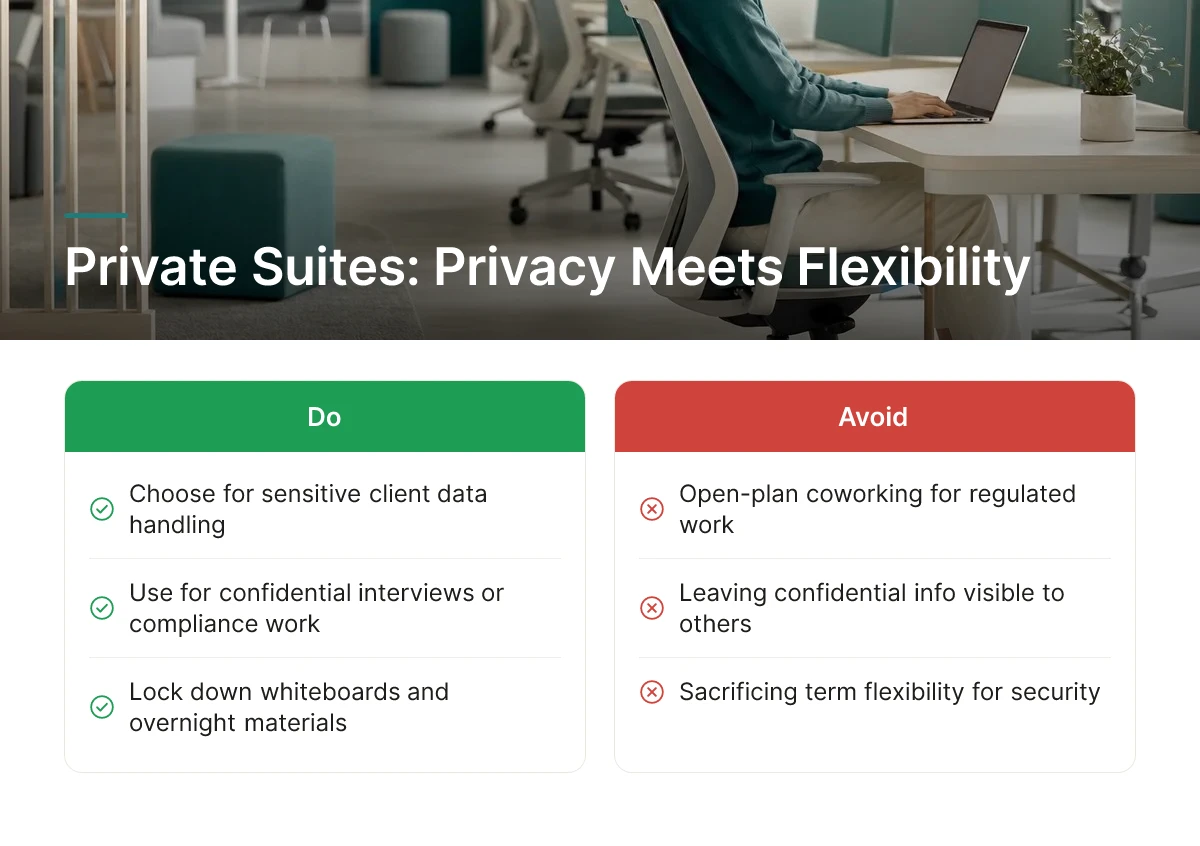
Private suites give a seasonal team a lockable, dedicated room on a month-to-month or short-term contract instead of a multi-year lease.
Unlike open coworking floors, a private suite is walled off, your team controls who enters, what's visible on whiteboards, and what's left out overnight. That matters for seasonal teams handling sensitive client data, running confidential interviews, or operating under compliance rules that open-plan coworking simply can't satisfy.
The differentiator here is one most comparisons skip entirely: private suites combine the privacy and security of a traditional leased office with the term flexibility of coworking membership. You get a door that locks and a dedicated desk count, without the five-to-ten-year lease obligation [4].
When negotiating, the number that matters most isn't the monthly rate, it's scalability within the building. Ask whether you can add an adjacent suite during a hiring surge or drop one when the project winds down, without breaking the underlying agreement. A provider that can shuffle suite sizes inside the same building beats a cheaper option that locks you into a fixed footprint.
A virtual office pairs a registered business address and mail handling with meeting rooms you book only when you actually need them.
There's no daily desk attached to this model. Instead, you get a local mailing and legal address, useful for registering a new market entity or satisfying a client's expectation of a physical presence, plus the ability to reserve a conference room for the occasional pitch, interview, or quarterly planning session.
This fits seasonal or remote-first teams that need local legitimacy or compliance standing in a region but don't have enough in-office days to justify desks at all. A consulting firm staffing up analysts for a single client engagement, for example, might need a local address and two meeting days a month, nothing more.
The differentiator is cost: because there's no daily desk commitment, this is the lowest fixed-cost option among all the flexible office space solutions on this list. The limitation is equally clear, it does nothing for teams that need people physically together every day. Treat it as a complement to desk-based options, not a substitute for them.
AI orchestration platforms forecast attendance across every location in your portfolio and automatically assign desks before employees even ask.
The mechanism works by feeding scheduling data, historical utilization, and team calendars into a forecasting model that predicts who is coming in, on which day, and at which location. The system then allocates desks across your own offices and a network of on-demand external spaces, instead of leaving coordination to individual managers juggling spreadsheets and separate booking tools.
It replaces a patchwork of manual bookings, one tool for the headquarters, another for flex space, a third for meeting rooms, with a single forecast-driven system that treats every available desk, in any city, as part of one inventory. Upflex's UnifyAI engine, for instance, forecasts attendance with 97% accuracy and combines that forecasting with access to a global on-demand workspace network, so a real estate team managing seasonal surges in three regions at once sees one coordinated allocation plan instead of three disconnected ones.
This tier is built for larger organizations running multiple seasonal peaks simultaneously, a retailer staffing up regional hubs for Q4, or a professional services firm onboarding project teams across several countries. The differentiator competitors in the point-solution and legacy real estate software categories don't address: orchestration collapses the coordination overhead of managing many vendors and bookings into one forecast, turning what used to be reactive scrambling for peak-season space into a planned, data-driven allocation process.
Match the solution to three variables in sequence: the size of your seasonal headcount swing, how spread out your team is geographically, and how much privacy or compliance protection the work requires.
Start with swing size. A 10-person seasonal bump might be fully solved with day passes or a single short-term suite. A 200-person surge across four cities needs a portfolio approach, likely a hub-and-spoke model anchoring a core office with on-demand access for overflow, since no single flexible office space solution scales cleanly across that range alone. Geographic spread is the next filter: concentrated teams can rely on one or two providers, while distributed teams need network access rather than single-building contracts. Privacy and compliance needs then determine whether open coworking is viable or whether you need private suites.
Combining models usually beats picking one. A hub-and-spoke office paired with day-pass access for travelers, or a private suite backed by virtual-office meeting rooms, covers more scenarios than any single format.
As a quick decision checklist, consider:
Terms vary by provider, but the negotiation priorities are consistent: a short cancellation notice window, a minimum commitment measured in months rather than years, and contractual language guaranteeing you can scale desk counts up or down mid-term without renegotiating the whole agreement.
Pilot one location or one season before converting the full portfolio. Measure actual utilization against your qualitative cost tier assumptions, comparing cost against occupancy variability, not a fixed budget number, then expand the model that performed best to the rest of the organization.

On-demand workspaces cut costs by replacing fixed square footage with pay-as-needed access that scales to actual headcount. Instead of leasing for peak capacity year-round, you cover overflow and seasonal spikes through a flexible network. Paired with attendance forecasting, this approach supports real estate portfolio reductions of 40%+, since you stop paying for desks nobody uses.
Track utilization rate, co-attendance achievement, and cost per occupied desk across every location. Forecast accuracy matters too, knowing attendance within a day or two in advance, ideally near 97%, lets you size space with confidence instead of guesswork. Without these numbers, consolidation decisions default to intuition rather than data.
Flexible terms reduce financial risk and let you adjust footprint as headcount shifts, but traditional long leases still offer lower per-square-foot rates and more control over buildout [1]. Seasonal or project-based teams generally come out ahead with short-term or on-demand space [2], while stable, high-density teams in one city may still benefit from a conventional lease.
On-demand workspace networks let you add or release capacity within days, compared to the months a traditional lease negotiation requires. Seasonal hiring for retail, agency, or consulting work is a common trigger [3]. A traditional lease locks in square footage regardless of whether your team is at five people or fifteen [3].
Match preferences to availability by combining attendance forecasting with real-time visibility into both owned offices and the on-demand network. When you know who's coming in and where, desk booking and space assignment stop being manual guesswork. Upflex's UnifyAI engine forecasts attendance at 97% accuracy, so coordination happens automatically instead of through spreadsheets and email chains.
Flexible office space solutions work best when they combine three things: accurate attendance forecasting, a real estate footprint sized to actual demand, and on-demand access for overflow or seasonal spikes. Track utilization and co-attendance, not just lease-end dates, to catch consolidation opportunities before renewal deadlines force the decision. Treat every lease renewal as a chance to test whether a smaller core footprint plus flexible capacity beats the status quo. Start by pulling your last two quarters of badge or booking data and comparing it against your current square footage, the gap usually tells you exactly where to cut first.
Explore more from our content library: