Share This Article
No items found.

Proximity bias is the tendency for managers to rate, reward, and promote employees they physically see in the office more favorably than equally productive remote or hybrid workers. It undermines hybrid work because it replaces output-based evaluation with visibility-based evaluation, face time becomes a proxy for commitment, even when it has no bearing on actual performance. Left unmanaged, this dynamic skews raises, promotions, and stretch assignments toward whoever sits closest to the manager, eroding trust in hybrid policies and pushing remote employees to quietly disengage or quit.
Proximity bias is an unconscious mental shortcut that leads managers to favor employees they see in person over equally capable colleagues working remotely. It is a distinct concept from simple favoritism, nobody sits down and decides to reward the person at the next desk over the one on video calls. It happens without deliberate intent, rooted in the brain's preference for the familiar and the physically near, a tendency documented well beyond the workplace [1]. Harvard Business Review describes it as a byproduct of the outdated assumption that people working outside the office are less productive than those inside it, an assumption that generates lingering "visibility" anxiety among remote staff [2].
The pattern shows up in small, repeated moments rather than one big decision. A director walks the floor and pulls two in-office engineers into a hallway conversation that changes a product decision, while the remote lead on that same project finds out after the fact. A client emergency lands at 4 p.m. and the meeting defaults to whoever happens to be on-site, not whoever has the most context. Over weeks, remote employees miss the informal knowledge-sharing, the lunch conversation, the post-standup chat by the coffee machine, that in-office staff absorb without trying.
The mechanism is straightforward: effort and output are hard to observe directly, so managers substitute something easier to see, presence. SHRM notes that proximity bias is the tendency for people in authority to give preferential treatment to whoever is physically closest to them [3], and a Future Forum survey of 10,000 white-collar workers found that more than four in ten executives flagged the risk of inequity between remote and in-office employees as a real concern [3]. TalentHR frames this as leaders unconsciously reading visibility as engagement, reliability, or commitment, simply because they see certain employees more often [5].
That substitution defeats the premise hybrid work is built on: that output, not location, should determine who gets the stretch assignment, the raise, or the promotion. Once presence becomes a proxy for contribution, teams split into an in-crowd that gets face time and informal advocacy, and a remote or hybrid tier that gets neither, regardless of who is actually delivering results.
This dynamic skews promotion and pay decisions because managers mistake visibility for merit, rewarding employees they see most rather than those who produce the most [2]. The mechanism is subtle, which is what makes it hard to self-correct without deliberate process changes.
Employees who sit near a manager pick up informal coaching, hear about stretch assignments first, and get pulled into hallway conversations that never make it into a meeting invite. Harvard Business Review notes that this favoritism stems from the assumption that in-office presence signals higher commitment and productivity, even though the underlying work quality may be identical to a remote peer's [2]. Over time, that extra access compounds: the in-person employee gets more reps on visible projects, which then reads as "stronger performance" in the next review cycle, not because the work was better, but because the opportunities were unevenly distributed from the start.
Most performance management still runs on what a manager remembers, not on logged output. When reviews depend on recall rather than documented deliverables, whoever the manager interacted with most recently or most often has an built-in advantage. SHRM reports that this gap between authority and physical distance is precisely where the problem shows up, managers default to judging what's in front of them because it's easier than reconstructing a remote employee's full contribution history [3].
Proximity bias rarely operates alone. Recency bias means the last few in-person interactions dominate a written review, crowding out months of remote contributions. The halo effect then lets visible employees get the benefit of the doubt on traits that have nothing to do with the interaction that prompted it, competence, reliability, even judgment. TalentHR's research on the topic describes how repeated in-person visibility leads managers to perceive employees as more engaged or committed simply because they're seen often, a shortcut rooted in unconscious bias rather than measured output [5].
The fairness risk is concrete: two employees with identical deliverables can land different ratings, raises, or promotion recommendations based purely on how often a manager happened to see them that quarter. Without structured, evidence-based review criteria, hybrid teams built around co-attendance tracking or informal office schedules can inadvertently formalize an advantage that has nothing to do with contribution.
This pattern comes from two unconscious mental shortcuts: repeated in-person contact builds unearned trust, and busy managers default to whatever's easiest to recall. Neither has anything to do with actual output.
Psychologists call the first mechanism the mere exposure effect: repeated, casual contact with a person increases liking and trust independent of that person's actual performance [1]. A manager who passes an employee's desk five times a day, or catches them in the hallway before a meeting, builds a sense of familiarity that has nothing to do with the quality of that employee's work. Over months, that familiarity gets mistaken for reliability.
The second mechanism is cognitive load. Managers juggling packed calendars and constant context-switching default to the information that's easiest to retrieve, not the information that's most accurate. An in-person conversation, a visible presence in a meeting, or a face seen at the coffee machine is simply more memorable than a Slack update or a status report filed at 9 p.m. [2] reports this dynamic directly: the effect describes how people in positions of power tend to treat physically closer workers more favorably, rooted in the outdated assumption that remote employees are less productive. Under deadline pressure, visibility gets misread as commitment.
This effect is often confused with affinity bias, the tendency to favor people who resemble us in background or outlook, and availability bias, the tendency to overweight whatever information comes to mind most easily. The distinction matters, as detailed in this overview of the concept, it is triggered specifically by physical presence, not by shared identity or general memorability [1]. An employee doesn't need to share a manager's background to benefit from it, they just need to be seen.
Hybrid arrangements make this worse than either fully remote or fully in-office models. When everyone works the same way, there's no comparison group and no visibility gap to notice. Hybrid schedules put remote and in-office employees side by side on the same team, making relative visibility constantly salient [3] and giving managers a live, daily basis for comparison they never had before, a tension explored further in this analysis of the hybrid work dilemma from Density.
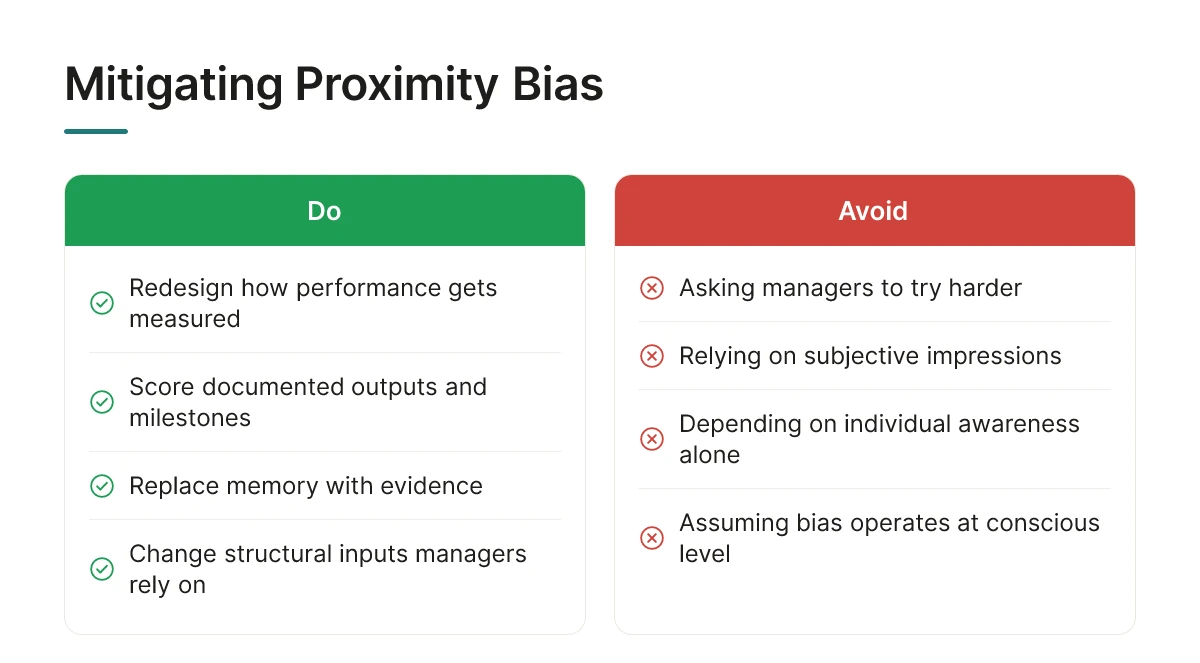
Fixing this problem requires redesigning how performance gets measured and reviewed, not asking managers to try harder to be fair.
Individual awareness helps, but bias operates below conscious thought [5]. The more durable fix is structural: change the inputs a manager relies on when scoring performance, and the bias has less material to work with.
The first step is scoring documented outputs and milestones instead of subjective impressions. When a review form asks "how did this person perform this quarter," a manager's brain defaults to whoever they saw most often. When the form asks "did this person hit these three specific deliverables, yes or no," visibility stops mattering as much. SHRM's guidance on hybrid workplaces points to this same shift, building evaluation processes around evidence rather than impressions [3].
Structured calibration adds a second layer of protection. Rather than letting one manager finalize a score alone, multiple reviewers compare ratings against a shared evidence log, project logs, client feedback, ticket closures, before numbers are locked in. This catches the case where a remote employee's strong output gets rated lower simply because their manager can't recall specific moments of it. Cross-checking forces that recall gap into the open.
Published, specific promotion criteria, named skills, measurable outcomes, defined scope of ownership, remove the ambiguity that informal judgment currently fills. HBR's research on this topic notes that vague, subjective advancement standards are exactly where physical visibility tends to substitute for merit [2]. Publishing the bar in advance gives every employee, regardless of location, the same target to work toward and gives reviewers a document to point to instead of a gut feeling.
Software that tracks attendance and contribution data gives leaders an evidence base beyond who they happen to notice in the hallway. Upflex's UnifyAI engine forecasts office attendance with 97% accuracy and tracks co-attendance against team targets, giving workplace and HR leaders an objective record of who is actually in the office, when, and with whom, replacing gut-feel presence tracking with logged data that calibration committees can reference directly.
Manager training still matters as a complement: rotating meeting times so no single time zone is favored, and actively documenting contributions from remote and in-office staff alike, builds habits that reinforce the new process rather than undermine it.
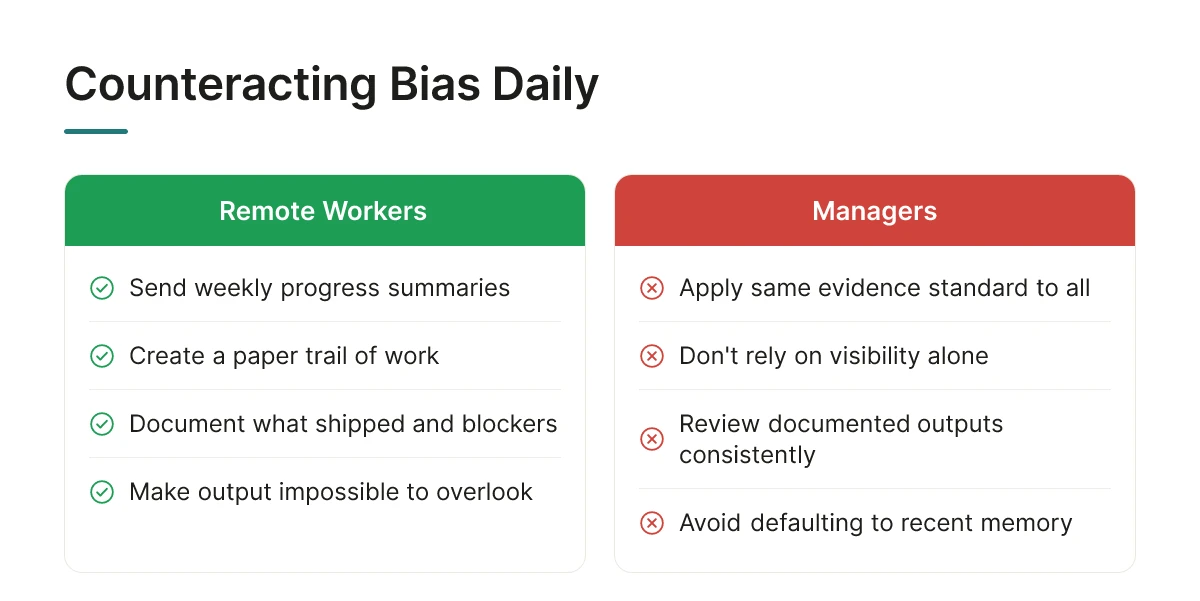
Individuals can counteract this dynamic without waiting for a policy rewrite: remote employees make their work visible in writing, and managers apply the same evidence standard to every team member regardless of location.
Visibility does not require walking the halls, it requires a paper trail. Employees working from home report worrying about being perceived as less productive than in-office peers [2], and the fix starts with making output impossible to overlook.
Documentation matters as much as the update itself. Log contributions in a shared project tracker or ticketing system so the achievement exists independent of whether a manager happened to witness it in person. When promotion or review season arrives, a written record beats a manager's memory of who they saw most often at their desk.
Managers drive this pattern mostly through habit, not intent, unconscious mental shortcuts lead them to read visibility as engagement [5]. Structure removes the shortcut.
None of this requires new software or a policy overhaul, it requires managers to treat documentation, not proximity, as the basis for judgment. Platforms like Upflex support this shift by pairing attendance forecasting with a real utilization record, giving managers data on who is actually contributing rather than who happened to be visible that day.
This tendency predates remote work entirely, it's a general cognitive tendency to favor whatever is physically or temporally closest [1]. It shapes seating-chart politics in fully in-office teams, promotion decisions across multiple office floors, and even which branch office gets executive attention. Hybrid work just made its effects more visible and measurable.
Yes, the same preference for physical closeness applies to accounts, vendors, and partners, not only coworkers. Sales and account teams may unconsciously prioritize clients they meet in person over equally valuable remote accounts. Procurement teams can favor local vendors out of familiarity rather than performance, which is worth auditing alongside internal hiring and review data.
No, favoritism is usually a conscious preference, while this effect is typically unconscious and driven by visibility, not personal liking [2]. A manager showing this tendency may genuinely believe they're being objective; they simply see in-office employees more often and mistake visibility for engagement or commitment [5].
Look for a pattern: are high-visibility assignments, praise, and promotions going disproportionately to in-office colleagues with comparable output? Signs include feeling left out of informal decisions, receiving vaguer feedback than in-office peers, or noticing performance ratings that don't match measurable results [5]. Comparing review language and outcomes across remote and in-office team members, ideally with HR data, helps confirm whether the pattern is real or coincidental.
Not entirely, this dynamic can persist in different forms, favoring employees closer to leadership's time zone, tenure, or communication style. Fully distributed teams reduce the in-office-versus-remote split, but managers can still unconsciously favor whoever is most responsive, most senior, or most similar to themselves. Structured, visibility-independent evaluation criteria still matter.
Proximity bias isn't solved by mandating more office days, it's solved by replacing visibility with data. Track who gets face time, feedback, and high-impact assignments, then compare that against actual output regardless of location [3]. Pair that discipline with tools that make hybrid coordination deliberate rather than accidental: Upflex's UnifyAI forecasts attendance with 97% accuracy so teams can plan intentional in-person collaboration instead of rewarding whoever happens to show up. Start by pulling your last two performance review cycles and cross-referencing ratings against work location, the pattern, if one exists, will be hard to ignore.
Explore more from our content library: